State Elevator Inspection Frequency for Healthcare Facilities in South Carolina
For healthcare facilities in Columbia, SC — from outpatient clinics and medical office buildings to full-service hospitals — elevator compliance is not simply a building-code matter. It directly affects patient safety, staff workflows, and the outcomes of accreditation surveys. Understanding state elevator inspection frequency, and what goes beyond the minimum, is essential for any healthcare facilities director or compliance officer responsible for vertical transportation.
—
What Is the Required Elevator Inspection Frequency for Healthcare Facilities in South Carolina?
South Carolina adopts the ASME A17.1 Safety Code for Elevators and Escalators as the foundation of its elevator safety program, administered through the South Carolina Department of Labor, Licensing and Regulation (SC LLR). Under this framework:
- Annual routine inspections are required for most elevator types, including the traction and hydraulic elevators common in healthcare buildings.
- Periodic tests (such as full-load, safety, and hydraulic pressure tests) are required on intervals spelled out in ASME A17.1 — generally every one to five years depending on the test type and equipment category.
- Category 1 tests (no-load safety tests) are typically performed annually.
- Category 5 tests (full-load, full-speed safety tests) are required on a five-year cycle for most traction elevators.
Healthcare organizations accredited by bodies such as The Joint Commission may face additional internal or accreditation-driven inspection requirements that go beyond the state minimum. Carolina Elevator Service works with healthcare clients in Columbia, SC to align both the state-mandated schedule and any accreditation-driven intervals into a single, documented compliance program.
—
Why Does Inspection Frequency Matter More in Healthcare Settings?

Elevators in hospitals, surgical centers, and long-term care facilities carry patients on gurneys, staff with crash carts, and families in moments of acute stress. A failure that might be an inconvenience in a commercial office building can become a patient-safety event in a healthcare setting. Beyond the human stakes, regulatory surveyors from state health departments and accreditation bodies specifically review elevator maintenance and inspection records as part of the Environment of Care survey process.
The consequences of non-compliance in healthcare can include:
- Citation during accreditation surveys and required corrective action plans
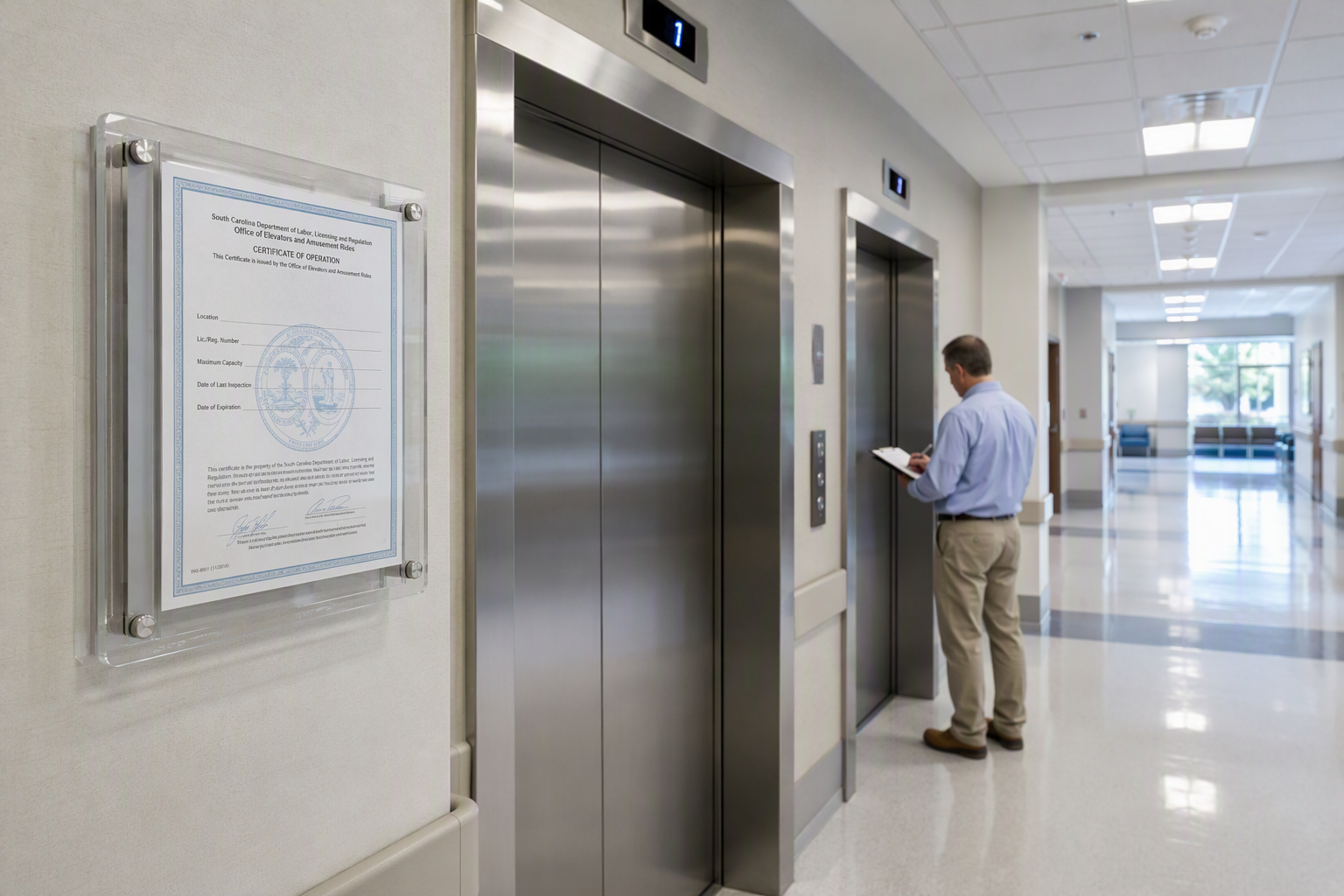
- Civil penalties assessed by SC LLR for operating elevators without a current certificate of operation
- Forced shutdown of elevators that fail inspection — disrupting patient transport
- Increased liability exposure in the event of an incident involving patients or staff
—
What Compliance Codes Apply to Hospital and Medical Facility Elevators?
Healthcare elevator compliance draws from multiple overlapping code frameworks:
- ASME A17.1 Safety Code for Elevators and Escalators: The primary mechanical and electrical safety standard governing elevator design, installation, inspection, and testing in South Carolina and most U.S. jurisdictions.
- ASME A17.3 Safety Code for Existing Elevators and Escalators: Applies retroactive safety requirements to older elevator installations that predate current A17.1 editions — highly relevant for legacy hospital buildings in Columbia.
- Americans with Disabilities Act (ADA): Requires elevators in multi-story healthcare facilities to meet accessibility standards including cab dimensions, door timing, control height, and audible/visual signals — all of which are reviewed during inspection.
- NFPA 101 Life Safety Code: Governs fire-service recalls, emergency lighting, and egress in healthcare occupancies — elevator fire-service operation is inspected and tested as part of the annual inspection cycle.
- CMS Conditions of Participation: For Medicare- and Medicaid-certified facilities, the Centers for Medicare & Medicaid Services requires that the physical plant meet life safety standards, which include elevator safety.
The 2025–2026 edition cycle of ASME A17.1 continues to refine requirements around remote monitoring, seismic safety, and machine-room-less (MRL) equipment — all increasingly common in new healthcare construction in the Columbia, SC market.
—
How Often Should Healthcare Facilities Schedule Preventive Maintenance Between Inspections?
State inspection frequency sets the compliance floor, not the operational ceiling. Most elevator service professionals and healthcare facility standards recommend monthly preventive maintenance visits for elevators in active clinical use. High-utilization equipment — such as main hospital tower elevators running around the clock — benefits from a service interval that catches wear before it becomes a deficiency noted on a state inspection report.
Carolina Elevator Service structures preventive maintenance agreements for healthcare clients in Columbia, SC around documented checklists that align with ASME A17.1 maintenance requirements and support clean inspection outcomes.
—
What Happens During a State Elevator Inspection at a Healthcare Facility?
- Document review: The inspector reviews the current certificate of operation, previous inspection reports, and maintenance logbooks. Missing or incomplete records are themselves a deficiency.
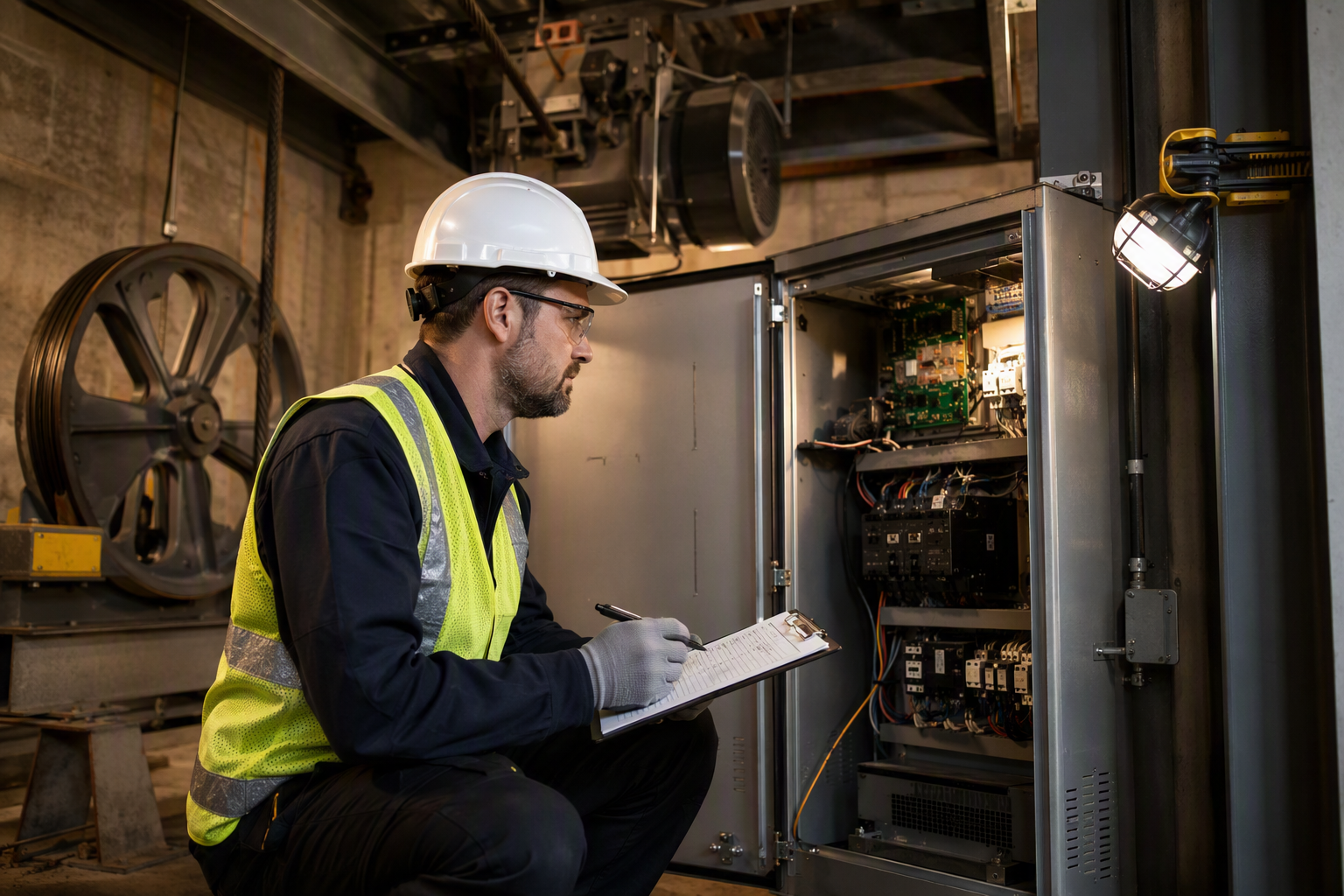
- Machine room and equipment space examination: The inspector checks for proper lighting, fire suppression, housekeeping, and equipment condition in the machine room or overhead space.
- Hoistway and pit inspection: Visual examination of guide rails, buffers, pit conditions, lighting, and safety equipment in the elevator pit.
- Car and landing equipment check: Inspection of door operation and timing, interlocks, cab lighting, emergency lighting, communication devices, and ADA-required features.
- Safety device testing: Depending on the category of test due, the inspector witnesses tests of safeties, governors, buffers, and — for hydraulic elevators — pressure relief and lowering-valve tests.
- Fire service recall test: Verification that Phase I and Phase II fire service operation functions correctly — a critical life-safety requirement in healthcare occupancies.
- Load test (when applicable): For Category 1 and Category 5 tests, the elevator is loaded and operated to verify rated capacity performance.
- Deficiency documentation and re-inspection scheduling: Any deficiencies are documented. Facilities must correct noted items and schedule a re-inspection before a renewed certificate of operation is issued.
—
What Violations Are Most Commonly Found in Healthcare Elevator Inspections?
While every inspection is unique, healthcare facilities frequently encounter deficiencies in the following areas:
- Expired or missing certificate of operation posted in the cab
- Door reopening device malfunction or mis-adjusted door closing force — a particular ADA and patient-safety concern when beds and wheelchairs are in transit
- Emergency lighting failure
- Inoperable or inadequate cab communication devices
- Fire service recall that fails to function correctly
- Pit conditions — water intrusion, inadequate lighting, or clearance issues
- Overdue Category 5 or hydraulic tests with no documented extension or waiver
—
How Should a Healthcare Facility Prepare for an Upcoming State Inspection?
- Pull the most recent inspection report and review all previously noted deficiencies — confirm each has been corrected and documented.
- Verify that the current certificate of operation is posted inside each elevator cab as required by SC LLR.
- Confirm with your elevator service provider which periodic test categories are due and schedule them in advance of the inspection date.
- Review maintenance logbooks for completeness — gaps in documented service visits raise questions during the document-review phase.
- Test emergency phones and lighting in each cab and verify fire service recall operation.
- Walk the machine rooms and pits (qualified personnel only) and address any obvious housekeeping, lighting, or access issues.
- Confirm ADA compliance items: door timing, control panel heights, Braille markings, and audible floor signals.
—
Does ADA Compliance Affect Elevator Inspection Outcomes in Healthcare?
ADA compliance, governed by the Americans with Disabilities Act, intersects directly with state elevator inspection in healthcare facilities. While ADA enforcement is civil rather than managed through the SC LLR inspection process, state inspectors do note conditions that affect safe, accessible operation. In healthcare, where patients with mobility impairments are a significant portion of building users, ADA deficiencies also carry accreditation and litigation risk independent of the state inspection outcome.
—
What Is the Process for Getting a Re-Inspection After a Failed Inspection?
- Receive the written deficiency report from SC LLR identifying each cited item and the applicable code section.
- Engage a qualified elevator service contractor — such as Carolina Elevator Service — to perform the required repairs or adjustments.
- Obtain documented proof of completion for each corrective action, including any parts replaced or tests performed.
- Contact SC LLR to schedule a re-inspection. Do not continue to operate an elevator placed out of service without LLR authorization.
- Ensure all documentation is available for the re-inspection, including repair invoices and technician sign-offs.
—
Questions Your Inspector Will Ask
Healthcare facility managers should be prepared to answer the following questions during — or in advance of — a state elevator inspection in South Carolina:
- “May I see the current certificate of operation and the last inspection report?” — Have these available in the machine room file and posted in the cab.
- “What is the maintenance schedule, and are logbooks current?” — Regular, documented service visits are expected for healthcare-use elevators.
- “When was the last Category 5 test performed on this unit?” — Know your test history and be able to document it.
- “Has the fire service recall been tested recently, and is there documentation?” — Fire service function is a life-safety item inspectors take seriously in healthcare occupancies.
- “Are there any known deficiencies or items currently under repair?” — Transparency is appropriate; attempting to conceal known issues typically worsens outcomes.
- “Who is your elevator service contractor, and how do I reach them?” — Having a service provider contact on file demonstrates active facility management.
- “Has any modification been made to this elevator since the last inspection?” — Unapproved modifications are a serious violation; any changes must be permitted and inspected.
- “Is the emergency communication device functional?” — Inspectors will test the cab phone or intercom; verify it works before inspection day.
—
How Can a Healthcare Facility in Columbia, SC Stay Ahead of Compliance Deadlines?
Proactive calendar management is the most effective compliance tool available to healthcare facilities directors. State inspection cycles, periodic test due dates, and accreditation survey preparation windows all need to be tracked simultaneously. Carolina Elevator Service supports healthcare clients in Columbia, SC by providing advance notice of upcoming test and inspection due dates as part of its service documentation process, helping facilities avoid the risk of operating on an expired certificate.
Facilities that pair a current preventive maintenance agreement with a relationship with a knowledgeable local elevator service provider are consistently better positioned when SC LLR inspectors arrive — and when Joint Commission or state health department surveyors review Environment of Care documentation.
—
What Should Healthcare Facilities Look for When Choosing an Elevator Service Provider?
Not all elevator service contractors have meaningful experience with the documentation requirements and operational demands specific to healthcare environments. When evaluating providers, healthcare facilities managers in Columbia, SC should consider:
- Familiarity with ASME A17.1 and A17.3 and the SC LLR inspection process
- Experience maintaining elevator equipment in active clinical environments, including work-window coordination to minimize patient transport disruption
- Ability to produce complete, organized maintenance documentation that satisfies both state inspection and accreditation surveyor review
- Capacity to perform all required periodic test categories without subcontracting critical safety work
- Responsiveness to unplanned outages in a healthcare setting where elevator availability directly affects care delivery
Carolina Elevator Service serves the Columbia, SC healthcare market with a focus on code-compliant maintenance, complete inspection documentation, and support through the state inspection and re-inspection process.
—
Get Your Healthcare Facility Elevator Compliance on Track
Elevator compliance in a healthcare setting involves state inspection schedules, ASME code test cycles, ADA requirements, and accreditation-driven documentation — all running on overlapping timelines. The cost of a missed deadline or a failed inspection is measured not only in fines, but in disrupted patient transport and survey findings.
Contact Carolina Elevator Service for a free elevator assessment and let a qualified team review your current inspection status, upcoming test obligations, and maintenance documentation for your Columbia, SC healthcare facility.
Call us today: 803-865-1400
Need elevator service you can rely on? Carolina Elevator Service is ready to help.