Hospital & Healthcare Facility Elevator Code and Safety Requirements
Direct Answer: Hospitals and healthcare facilities in South Carolina must comply with ASME A17.1-2019/CSA B44:19, the Americans with Disabilities Act (ADA), and S.C. Code Title 41, Chapter 16, with annual inspections required for passenger elevators, standby power systems mandatory, and additional life-safety provisions — including firefighters’ service and emergency power — that go beyond what standard commercial buildings typically need.
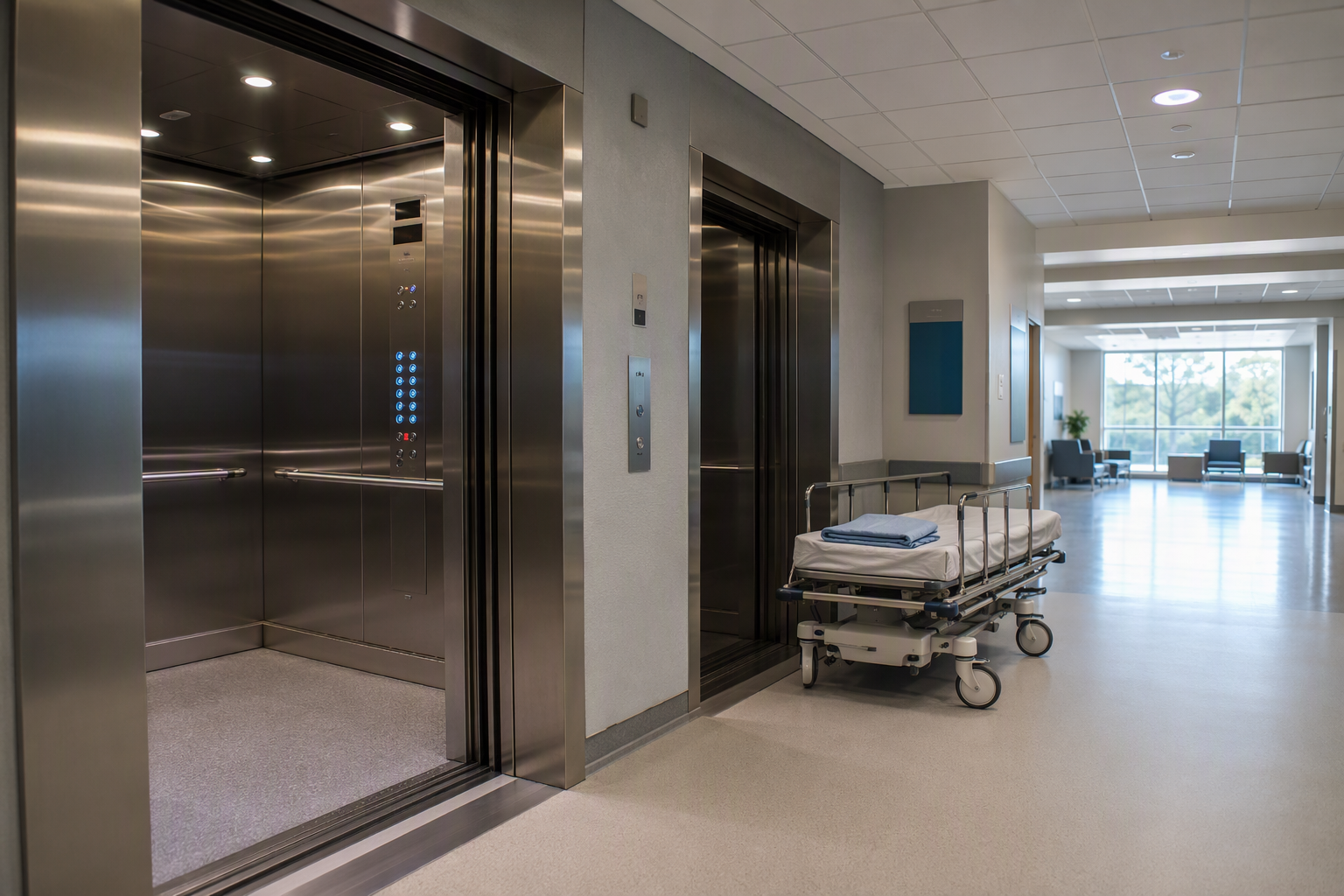
Healthcare facilities present some of the most demanding elevator environments in any built structure. Patients on gurneys, critical medical equipment, infection-control requirements, and around-the-clock operations combine to make elevator reliability and code compliance not just a regulatory obligation but a genuine life-safety issue. This page details every major code layer that applies to hospital and healthcare elevator systems in South Carolina, the inspection timelines that govern them, and the operational requirements that facility managers must maintain to stay compliant in 2026 and beyond.
What Federal Elevator Codes Apply to Healthcare Facilities?

Two federal frameworks apply nationally, including to South Carolina healthcare facilities.
The ASME A17.1 Safety Code for Elevators and Escalators is the primary technical standard governing elevator design, construction, installation, alteration, and maintenance. South Carolina has adopted the 2019 edition (ASME A17.1-2019/CSA B44:19) without amendment, effective as of the notice published in the S.C. State Register on July 23, 2021. This code defines the engineering requirements for car dimensions, door operation, machine room conditions, emergency systems, and more — all of which have direct relevance in hospital environments where large cars must accommodate hospital beds and where door failures can disrupt patient transport.
The Americans with Disabilities Act (ADA) imposes accessibility requirements that are particularly significant in healthcare settings. Hospitals serve patients with mobility impairments, patients using wheelchairs or wheeled beds, and visitors with a wide range of disabilities. ADA requirements govern car dimensions, call button heights, audible and visual floor indicators, door timing, and leveling accuracy. Because healthcare facilities must accommodate both patients and staff with disabilities, ADA compliance is not optional or theoretical — it is actively enforced and frequently cited during inspections.
OSHA standards govern the safety of workers who maintain and operate elevators, including hospital maintenance personnel and elevator technicians performing service inside a facility. OSHA’s general industry standards for walking-working surfaces and confined spaces can apply to machine rooms and elevator pits in healthcare settings.
What South Carolina State Requirements Apply to Hospital Elevators?

At the state level, South Carolina’s elevator regulatory authority is the South Carolina Department of Labor, Licensing and Regulation (LLR), Office of Elevators and Amusement Rides. The governing statute is S.C. Code Title 41, Chapter 16, implemented through S.C. Code of Regulations Chapter 71, Article 5 (Safety Standards for Elevator Facilities), Regulations 71-5000 through 71-5700.
The following state-level requirements apply directly to hospital and healthcare elevator installations:
- Certificate of Registration and Operating Certificate: No elevator in a South Carolina hospital may legally operate without both a certificate of registration and a current operating certificate issued by the state. The operating certificate — or a copy — must be displayed conspicuously inside every elevator car. For healthcare facilities with large elevator banks, this means each cab must carry its own certificate.
- Annual Inspections: Passenger elevators in healthcare facilities must be inspected at least once per year before the operating certificate is renewed. Given the high traffic volumes in hospitals — where elevators may run continuously across multiple shifts — annual inspection compliance is a minimum baseline, not a ceiling.
- Construction Permit: Before any elevator in a South Carolina hospital is erected, constructed, altered, or installed, a state construction permit is required. This applies to new hospital construction, wing additions, and elevator modernization projects.
- Standby Power: South Carolina requires that passenger elevators have standby power capable of running emergency lighting and the alarm bell for at least four hours if normal power fails. In hospital settings, this requirement intersects with facility-wide emergency power planning — most hospitals operate full generator systems, but the elevator standby power requirement is a discrete code obligation independent of the facility’s general emergency plan.
- Firefighters’ Service: New elevator installations in South Carolina must use the five-pin S.C. #1000 key for firefighters’ service. Hospital facilities must ensure that fire department personnel and building staff have access to these keys and understand Phase I and Phase II firefighters’ operation as required under ASME A17.1-2019.
- Accident Reporting: If an elevator accident in a South Carolina hospital seriously injures any person other than an employee, the incident must be reported to the state before the end of the next working day. In a healthcare environment, where the likelihood of passenger injury events may be statistically higher due to patient vulnerability, hospital facility managers should have a documented incident-response protocol that includes this reporting obligation.
- Safe Operating Condition: South Carolina law places the responsibility for keeping every elevator facility in safe operating condition squarely on the owner. For a hospital, this means the healthcare system or facility management entity — not the elevator service contractor — bears primary legal responsibility for the condition of the equipment.
- Underground Hydraulic Cylinder Containment: For hospitals with hydraulic elevators, any newly installed underground hydraulic elevator cylinder must be encased in a plastic outer containment to limit electrolytic corrosion — a requirement with environmental and structural implications for older hospital buildings undergoing renovation.
What Are the Special Elevator Design Requirements for Hospitals?
Beyond the baseline code requirements that apply to all commercial elevators, hospitals and healthcare facilities have operational demands that translate into specific design and specification considerations under ASME A17.1-2019 and ADA guidelines.
Car Dimensions: Hospital elevators must accommodate gurneys, stretchers, and hospital beds with attendants. ASME A17.1-2019 and healthcare design guidance from organizations such as the Facilities Guidelines Institute specify minimum car sizes for hospital-use elevators. While specific square-footage figures vary by facility type and applicable guidelines, the general principle is that at least some elevators in any acute-care hospital must be large enough to carry a fully extended patient bed with clinical staff on both sides.
Door Timing and Sensitivity: ADA requirements set minimum door open times and require sensitive door edges that reverse on contact. In a hospital, where a nurse may be managing a patient on a gurney, IV poles, and monitoring equipment simultaneously, door timing that is too aggressive creates both safety and ADA compliance risks.
Leveling Accuracy: ADA standards require that elevator cars stop level with the floor within a defined tolerance. In hospitals, poor leveling is not merely an accessibility inconvenience — it creates a trip and fall hazard for patients transferring from wheelchairs or gurneys at threshold, and it can compromise the safe transport of wheeled medical equipment.
Infection Control Considerations: While not a code requirement per se, healthcare facilities increasingly specify elevator cab materials, door configurations, and ventilation features that support infection control. This affects specification and maintenance decisions that a qualified elevator service provider should understand.
Emergency Communication: ASME A17.1-2019 requires a means of two-way communication in elevator cars. In a hospital, this system must be reliable enough to reach security, facility operations, or emergency services — a higher functional standard than in a typical commercial building.
What Inspection Intervals Apply to Different Elevator Types in Healthcare Facilities?
| Equipment Type | Inspection Interval (South Carolina) | Governing Authority |
|---|---|---|
| Passenger Elevators (standard) | At least once per year (before operating certificate renewal) | S.C. Code Title 41, Chapter 16 |
| Handicap Lifts / Platform Lifts | Every five years | S.C. Code Title 41, Chapter 16 |
| Dumbwaiters (e.g., medication or food transport) | At installation or alteration | S.C. Code Title 41, Chapter 16 |
| Special Purpose Elevators | Every seven years | S.C. Code Title 41, Chapter 16 |
Who Is Authorized to Inspect Hospital Elevators in South Carolina?
Required elevator inspections in South Carolina may be performed only by state inspectors employed by the LLR Office of Elevators and Amusement Rides, or by licensed special inspectors. A special inspector’s inspection may be accepted in place of a state inspection — provided the special inspector is licensed in South Carolina and meets the qualifications set out in the 2018 edition of QEI-1, the American National Standard for Qualification of Elevator Inspectors.
A critical compliance constraint for hospital facility managers: a special inspector may not inspect an elevator on which the inspector or the inspector’s employer has a current service or warranty contract. This means a hospital cannot use its primary elevator service contractor to also perform the qualifying inspection. Healthcare facilities with large elevator fleets should plan inspection workflows that account for this restriction, particularly when scheduling annual renewals across multiple elevator banks.
What Should Hospital Facility Managers Do After a Failed Inspection?
- Remove the elevator from service immediately if the inspector or regulator issues an out-of-service order. Operating a non-compliant elevator in a healthcare facility creates compounded liability — regulatory, legal, and clinical.
- Notify the South Carolina LLR Office of Elevators and Amusement Rides as directed and retain documentation of all communications.
- Contact a qualified elevator service provider to assess the deficiencies identified in the inspection report and prioritize corrections that restore compliance.
- Obtain the required state construction permit before beginning any alteration or repair that constitutes an installation-level change under S.C. Code Title 41, Chapter 16.
- Schedule a re-inspection with a state inspector or a qualified special inspector (who has no service contract conflict) once corrections are complete.
- Update the operating certificate and ensure the renewed certificate is posted conspicuously inside the elevator car before returning it to service.
- Document all corrective actions and maintain records as part of the facility’s ongoing compliance program — this documentation protects the healthcare organization in the event of future regulatory review or litigation.
Does ADA Apply Differently to Hospitals Than to Other Commercial Buildings?
The ADA applies to hospitals as places of public accommodation and as entities that must not discriminate against individuals with disabilities. While the technical ADA Standards for Accessible Design apply uniformly to covered facilities, hospitals face a more demanding practical compliance environment for several reasons.
Patients may arrive with mobility impairments that are acute and unpredictable — the population using the elevator at any moment includes people who are far less able to respond to door closures, leveling gaps, or call button placement issues than a typical office building visitor. The ADA’s requirements for elevator car dimensions, door open times, call button heights, tactile indicators, and audible/visual floor announcements are not aspirational targets in a hospital — they are baseline operational necessities. Failure to comply not only triggers ADA enforcement exposure but also increases clinical risk to patients in transport.
What Happens If a Hospital Operates an Elevator Without a Valid Certificate?
Under South Carolina law, no elevator facility may be operated without both a certificate of registration and a current operating certificate from the state. Operating without these certificates exposes a healthcare facility to regulatory enforcement action by the South Carolina LLR Office of Elevators and Amusement Rides. For a hospital, enforcement action affecting an elevator that serves patient transport — particularly in a multi-story inpatient facility — can disrupt clinical operations significantly. Certificate status should be tracked proactively and renewals initiated well before expiration.
What Is the Difference Between ASME A17.1 and ASME A17.3 for Existing Hospital Elevators?
ASME A17.1 governs new installations and alterations. ASME A17.3 is the safety code for existing elevators and escalators — it applies to equipment already in service and sets retroactive safety requirements. In South Carolina, elevator facilities that were in operation before July 1, 1986 must comply with the 1986 edition of ANSI A17.3. Many older hospital buildings in South Carolina may have elevator equipment predating this threshold, making A17.3 compliance a relevant consideration during any modernization assessment.
For hospital administrators evaluating aging elevator infrastructure, understanding which code edition applies to existing equipment — and what upgrades A17.3 may require — is an important step before any renovation or capital planning process.
What Are the 2025–2026 Industry Trends in Healthcare Elevator Compliance?
Several qualitative trends are shaping how hospitals approach elevator compliance and modernization heading into 2026.
Predictive Maintenance Technology: Healthcare facility managers are increasingly adopting remote monitoring and predictive maintenance platforms that track elevator performance data in real time. These systems can flag potential failures before they occur — reducing unplanned downtime in environments where elevator outages directly affect patient care. While the technology does not replace code-required inspections, it meaningfully supplements them.
Cybersecurity in Connected Elevator Systems: Modern elevator controllers and IoT-enabled monitoring systems introduce cybersecurity considerations. Healthcare facilities, already subject to HIPAA and other data security frameworks, are beginning to evaluate cybersecurity risks associated with networked building systems — including elevators — as part of broader facility security programs.
Modernization Driven by Code Evolution: As South Carolina has adopted the 2019 edition of ASME A17.1, hospitals operating equipment installed under earlier code editions are evaluating what voluntary or required upgrades make sense. Firefighters’ service key standardization, emergency lighting duration, and door safety requirements are areas where older equipment may not meet current standards — and where proactive modernization reduces both compliance risk and operational disruption.
Infection-Control Design: Post-pandemic awareness of how pathogens move through shared spaces has accelerated interest in touchless elevator controls, antimicrobial surface materials, and improved cab ventilation. These are largely specification and design considerations rather than current code mandates, but they are influencing procurement and renovation decisions at hospitals across the region.
Staffing and Inspection Scheduling: As the inspector workforce faces demand pressures, healthcare facilities are planning annual inspection cycles earlier and more deliberately — avoiding the risk of certificate lapses that could force elevators out of service at operationally critical moments.
What Makes Hospital Elevator Maintenance More Complex Than Standard Commercial Maintenance?
Hospital elevator systems typically run far more operational cycles per day than elevators in office or retail environments. Continuous use across three daily shifts, heavy loads from patient transport equipment, and the need for uninterrupted availability all accelerate component wear. Preventive maintenance intervals that are adequate for a standard commercial elevator may be insufficient for a high-volume hospital installation. Facility managers should work with their elevator service provider to evaluate manufacturer recommendations and actual use data when setting maintenance schedules.
Additionally, the consequences of elevator failure in a hospital are qualitatively different from failure in a commercial building. An elevator outage affecting a surgical floor or an intensive care unit can disrupt patient transport, delay procedures, and create staffing challenges. The risk calculus for maintenance deferral is fundamentally different, and service agreements should reflect that reality.
How Does Carolina Elevator Service Support Healthcare Facility Compliance?
Carolina Elevator Service provides elevator maintenance, inspection coordination, and compliance assessment services to facilities across South Carolina. The team approaches healthcare clients with an understanding of the layered code environment — ASME A17.1-2019, ADA accessibility standards, and South Carolina LLR requirements — that governs hospital elevator systems. Rather than applying a one-size-fits-all maintenance model, Carolina Elevator Service works to understand each facility’s equipment inventory, inspection history, and operational demands before recommending a compliance and maintenance strategy.
For hospitals evaluating aging equipment under ASME A17.3 requirements, or managing a fleet of elevators with staggered certificate renewal dates, Carolina Elevator Service provides the documentation support and technical assessment that facility managers need to maintain continuous compliance without operational disruption.
What Should a Hospital Include in an Elevator Compliance Audit?
- Verify certificate status for every elevator, lift, and dumbwaiter on the property — confirm that operating certificates are current and displayed in each car.
- Confirm inspection records are on file for the most recent state or special inspector examination, and identify any upcoming annual renewal deadlines.
- Review the firefighters’ service key inventory — confirm that all new installations use the S.C. #1000 five-pin key and that keys are accessible to facility security and fire department personnel.
- Test standby power systems to confirm that emergency lighting and alarm bells will operate for the required four-hour minimum on battery backup.
- Assess ADA compliance for car dimensions, leveling accuracy, door timing, call button placement, and audible/visual indicators across all passenger elevators.
- Identify any equipment installed before July 1, 1986 and confirm ANSI A17.3 (1986 edition) compliance obligations have been addressed.
- Check underground hydraulic cylinder containment on any hydraulic elevator installations where the cylinder was newly installed or replaced.
- Confirm the accident reporting protocol is documented and staff responsible for facility operations understand the next-working-day reporting requirement for serious injuries.
- Verify inspector independence — confirm that the special inspector scheduled for the next annual inspection has no service or warranty contract conflict under South Carolina rules.
- Review modernization needs in light of ASME A17.1-2019 requirements and identify any deferred upgrades that represent growing compliance or operational risk.
Quick-Reference Summary: Key Healthcare Elevator Compliance Requirements in South Carolina
| Requirement | Source |
|---|---|
| Adopt and comply with ASME A17.1-2019/CSA B44:19 | ASME A17.1 / S.C. Code Title 41, Ch. 16 |
| Certificate of registration and operating certificate required; certificate displayed in each car | S.C. Code Title 41, Ch. 16 |
| Annual inspection of passenger elevators before certificate renewal | S.C. Code Title 41, Ch. 16 |
| Standby power for emergency lighting and alarm bell — minimum four hours | S.C. Code Title 41, Ch. 16 |
| Firefighters’ service using S.C. #1000 five-pin key on new installations | S.C. Code Title 41, Ch. 16 |
| ADA accessibility requirements (car dimensions, door timing, leveling, call buttons) | ADA Standards for Accessible Design |
| Serious injury accident reporting before end of next working day | S.C. Code Title 41, Ch. 16 |
| State construction permit required before installation, alteration, or repair | S.C. Code Title 41, Ch. 16 |
| OSHA worker safety standards for maintenance personnel | OSHA |
Get a Free Elevator Assessment for Your Healthcare Facility
Navigating the intersection of ASME A17.1-2019, ADA accessibility standards, and South Carolina LLR requirements is demanding — particularly for hospital and healthcare facilities where elevator reliability has direct clinical implications. Carolina Elevator Service brings a structured, code-grounded approach to compliance assessment, maintenance planning, and inspection coordination for healthcare clients across South Carolina.
Contact Carolina Elevator Service for a free elevator assessment: 803-865-1400
Need elevator service you can rely on? Carolina Elevator Service is ready to help.