Hospital & Healthcare Elevator Features: What Matters Most
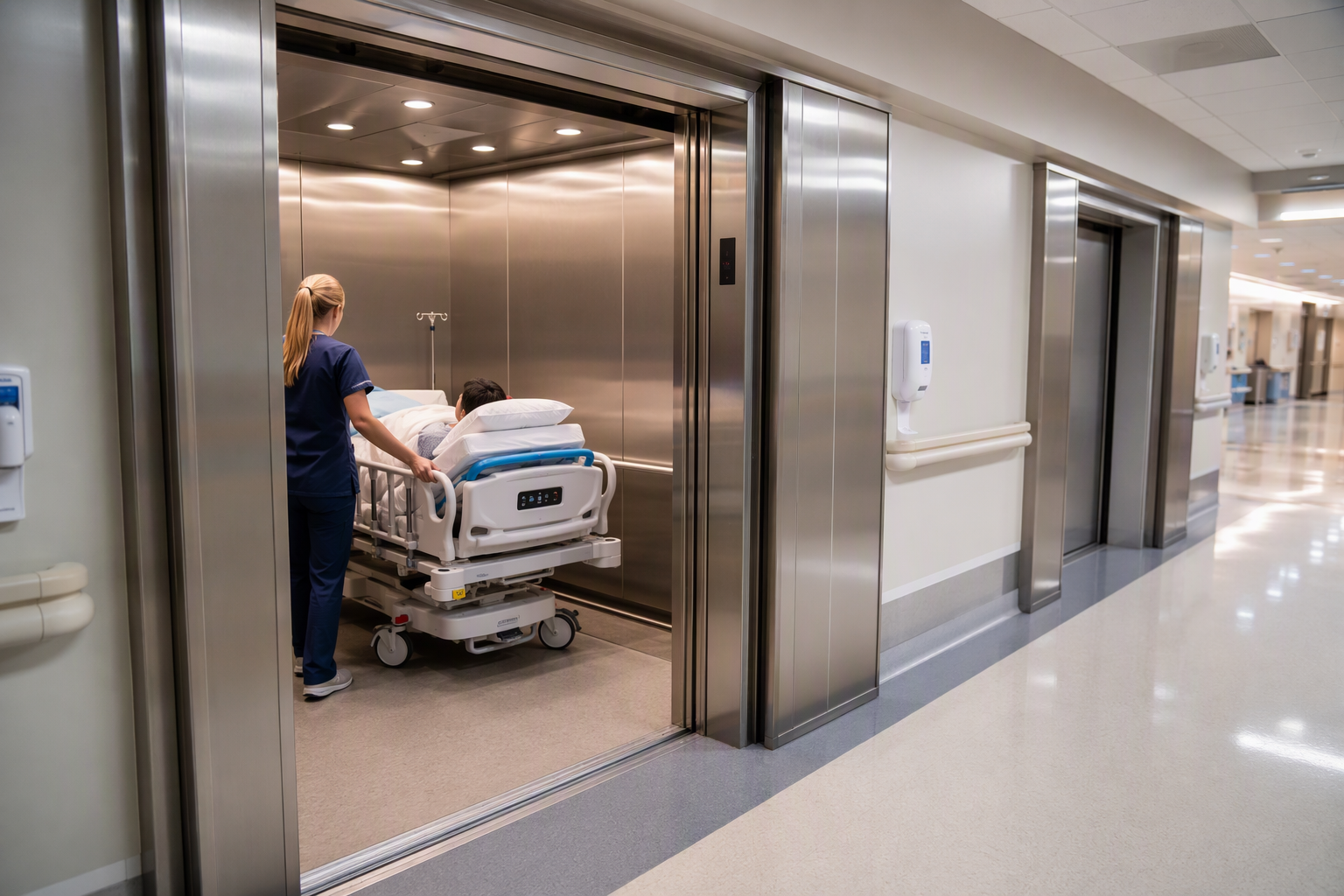
Healthcare facilities in Columbia, SC operate in one of the most demanding elevator environments imaginable. Patients on gurneys, medical equipment on carts, clinical staff moving between floors at all hours, and Joint Commission surveyors walking the halls — every detail of elevator performance matters. This guide covers the features, upgrades, compliance requirements, and inspection standards that healthcare facility managers and hospital administrators need to understand in 2026.
—
What Makes a Healthcare Elevator Different from a Standard Commercial Elevator?
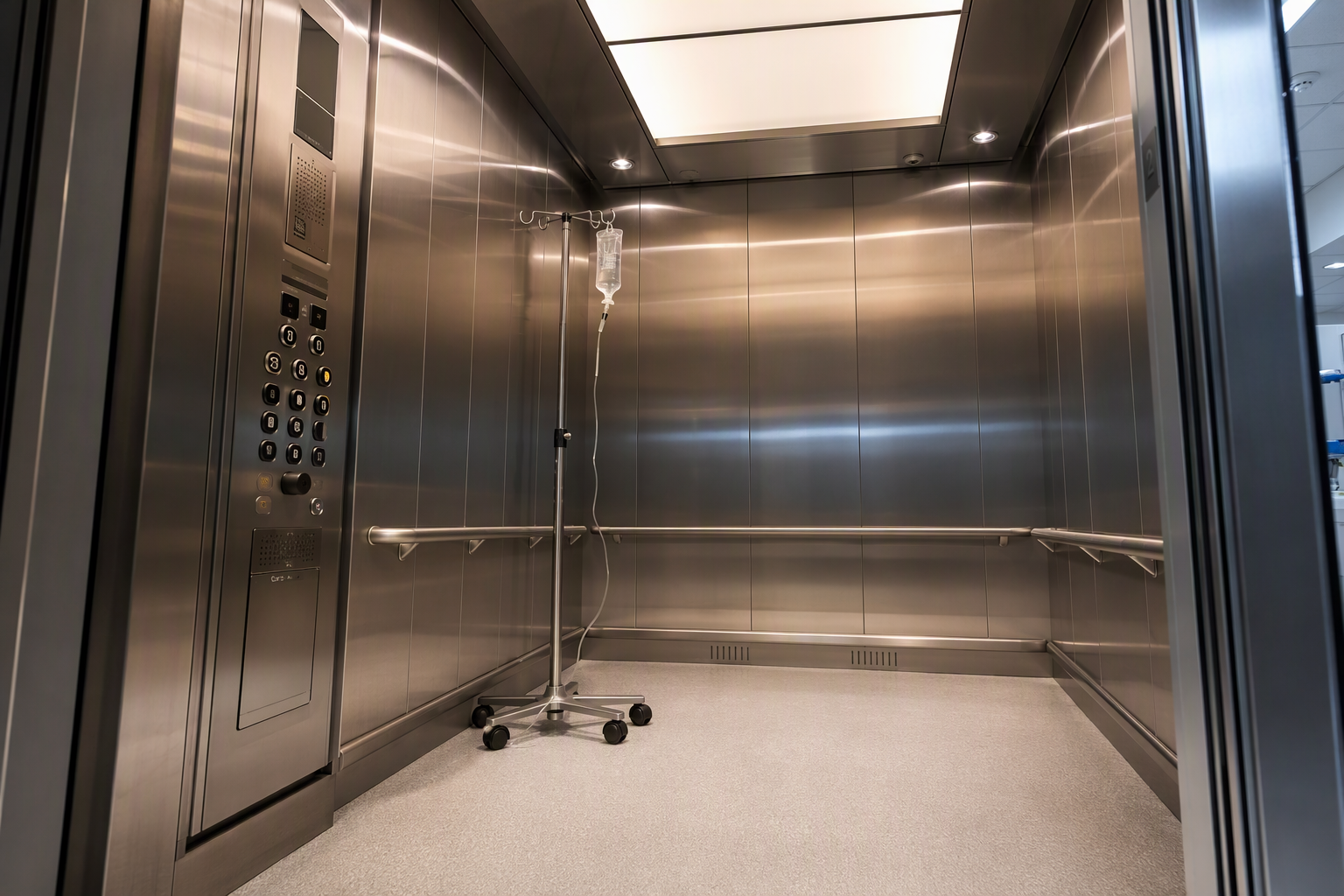
Standard commercial elevators are designed for office workers and retail traffic. Healthcare elevators must serve a fundamentally different set of demands: transporting patients in beds or on stretchers, accommodating large medical imaging equipment, withstanding rigorous sanitation protocols, and operating continuously — often around the clock — without service interruption.
The distinguishing features fall into five broad categories: cab size and configuration, door performance, surface materials, emergency systems, and accessibility compliance. Each category carries specific code and operational implications for South Carolina hospitals and clinics.
—
What Cab Size Requirements Apply to Hospital Elevators?
Hospital-grade elevators — sometimes called “hospital duty” or “bed elevators” — are sized to accommodate a standard hospital bed with attendants on both sides. This typically requires a cab depth significantly greater than a standard passenger elevator. The ASME A17.1-2019/CSA B44:19 Safety Code for Elevators and Escalators, which South Carolina adopted effective July 23, 2021, governs the mechanical and structural requirements for these installations.
Beyond raw dimensions, healthcare facility planners should account for:
- Center-opening or two-speed doors that open wide enough for beds and stretchers
- Adequate weight capacity for a patient, a bed, and multiple attendants simultaneously
- Door open-time settings extended to allow slow-moving patients or large equipment to clear the threshold safely
- Cab height sufficient to clear IV poles and overhead equipment arms
Carolina Elevator Service evaluates existing cab configurations against current operational needs and recommends upgrades when dimensions no longer support the facility’s patient transport workflows.
—
Which ADA Requirements Apply to Healthcare Elevators in South Carolina?
All elevators in public-facing healthcare facilities must comply with the Americans with Disabilities Act (ADA). For hospitals and outpatient clinics, this means:
- Raised and Braille signage at each landing
- Audible floor announcements inside the cab
- Call buttons positioned at heights accessible from a wheelchair
- Door reopening devices that detect obstructions without requiring contact
- Adequate maneuvering clearance at each hoistway entrance
- Illumination levels within the cab that meet ADA guidelines
ADA compliance is not optional, and healthcare facilities face heightened scrutiny because patients with mobility limitations depend on elevator access for timely clinical care. Facilities that receive federal funding face additional federal oversight if elevator accessibility fails.
—
What Emergency Power Features Are Required for Hospital Elevators?
South Carolina law is explicit on standby power: passenger elevators must have standby power capable of running emergency lighting and the alarm bell for at least four hours if normal power fails. For hospitals, the stakes are higher still — patients mid-transport cannot wait for power restoration.
Healthcare elevator emergency power best practices include:
- Automatic rescue operation (ARO) — lowers the car to the nearest floor and opens the doors during a power outage so passengers are not trapped
- Generator integration — connection to the facility’s emergency generator so selected elevators remain fully operational, not just minimally functional
- Battery backup systems — for facilities where generator capacity is allocated and elevator circuits need independent redundancy
- Priority dispatch systems — ensure that during emergencies, designated elevators are held for clinical and evacuation use
Carolina Elevator Service works with facility engineers to assess whether existing power backup systems meet both South Carolina statutory minimums and the operational realities of 24/7 patient care.
—
What Is Firefighters’ Service and Why Is It Critical for Hospitals?
Firefighters’ service (also called fire service recall) is a code-mandated feature that returns elevators to a designated floor and places them under manual firefighter control during a fire event. Under South Carolina’s adopted edition of ASME A17.1-2019, firefighters’ service is required on applicable installations.
South Carolina has an additional state-specific requirement: firefighters’ service on new installations must use the five-pin S.C. #1000 key. Hospital facilities undergoing elevator modernization or new construction must ensure their equipment is keyed to this standard to pass inspection and obtain an operating certificate from the South Carolina Department of Labor, Licensing and Regulation (LLR).
For hospitals, firefighters’ service is not just a code checkbox — it is a life-safety system that must be tested, documented, and maintained as part of every annual inspection cycle.
—
What Surface and Infection-Control Features Should Healthcare Elevators Have?
Standard elevator finishes are not designed for the cleaning agents used in clinical environments. Hospitals routinely use quaternary ammonium compounds, bleach solutions, and other disinfectants that can degrade standard laminates, corrode metal finishes, and damage standard button panels over time.
Recommended infection-control elevator features include:
- Stainless steel or solid phenolic wall panels that withstand repeated disinfection without delaminating
- Antimicrobial copper or coated button panels — copper alloys have documented antimicrobial properties under EPA registration
- Coved flooring with no seams or grout lines where pathogens can accumulate
- Hands-free or touchless call systems — proximity sensors, foot pedals, or voice activation reduce high-touch surface contact
- Easy-clean ceiling systems without recessed gaps that trap aerosols
- UV-C air purification units integrated into the cab ventilation for facilities that have adopted enhanced infection-control protocols
—
What South Carolina Compliance Requirements Apply to Hospital Elevator Inspections?
South Carolina regulates elevators under S.C. Code Title 41, Chapter 16 (South Carolina Elevator Code) and associated regulations in S.C. Code of Regulations Chapter 71, Article 5 (Regulations 71-5000 through 71-5700). The state adopted ASME A17.1-2019/CSA B44:19 without amendment, effective July 23, 2021.
Key compliance facts for South Carolina healthcare facilities:
- No elevator may operate without a certificate of registration and a current operating certificate from the South Carolina Department of Labor, Licensing and Regulation (LLR), Office of Elevators and Amusement Rides
- The operating certificate — or a copy — must be displayed conspicuously inside each elevator car
- Hospital elevators must be inspected at least once per year before the operating certificate is renewed
- Inspections may be conducted only by state inspectors or licensed special inspectors holding qualifications under the 2018 edition of QEI-1 (the American National Standard for Qualification of Elevator Inspectors)
- A special inspector may not inspect an elevator on which the inspector or the inspector’s employer holds a current service or warranty contract — a conflict-of-interest rule that affects vendor selection
- A state construction permit is required before any elevator is erected, constructed, altered, or installed
- Serious accidents injuring anyone other than an employee must be reported to the state before the end of the next working day
- The facility owner bears legal responsibility to keep every elevator in safe operating condition in compliance with state regulations
—
What Modernization Upgrades Deliver the Most Value for Healthcare Facilities?
Older hospital elevators — particularly those installed before the 2021 adoption of ASME A17.1-2019 — may lack features that today’s clinical environments require. Modernization projects that deliver measurable operational and compliance value include:
- Machine-room-less (MRL) drive upgrades — free up mechanical room space, reduce energy consumption, and improve ride quality
- Variable frequency drive (VFD) controllers — smoother starts and stops reduce patient discomfort during transport
- Destination dispatch systems — reduce wait times and cab overcrowding in high-traffic hospital towers
- Remote monitoring and predictive maintenance integration — allows service teams to identify developing faults before an unplanned shutdown occurs during a patient transport
- Door operator replacement — new door operators with better sensitivity settings reduce door-related incidents and ADA compliance risk
- Cab interior rehabilitation — replace non-clinical finishes with infection-resistant materials without a full equipment replacement
Carolina Elevator Service provides facility assessments that identify which upgrades are code-mandated, which are operationally beneficial, and how to sequence work to minimize disruption to patient care.
—
How Should a Healthcare Facility Respond If an Elevator Goes Out of Service?
- Post clear signage at every affected landing immediately to redirect patients and staff.
- Notify clinical leadership so patient transport workflows can be rerouted to operational elevators.
- Contact your elevator service provider to dispatch a qualified technician for assessment and repair.
- Do not operate an elevator that has triggered a safety device or shown signs of mechanical failure — reset without diagnosis creates liability.
- Document the outage including time, nature of the fault, and any patients or staff affected, for maintenance records and potential regulatory reporting.
- Report to the South Carolina Department of Labor, Licensing and Regulation (LLR) any accident that seriously injures a non-employee, before the end of the next working day.
- Retain service records — South Carolina inspectors may review maintenance documentation as part of the annual inspection and certificate renewal process.
—
Questions Your Inspector Will Ask
When a South Carolina LLR state inspector or licensed special inspector conducts the annual inspection at a hospital or healthcare facility, they typically address the following areas. Facility managers should be prepared to answer each one:
- Is the operating certificate displayed conspicuously inside each elevator car? South Carolina law requires this — not filed in an office, but posted in the cab.
- Is the certificate of registration current? An expired registration means the elevator cannot legally operate.
- Has any alteration or repair been made since the last inspection? Alterations require a state construction permit and trigger an inspection before the elevator is returned to service.
- Does the standby power system provide at least four hours of emergency lighting and alarm bell operation? This is a South Carolina statutory requirement for passenger elevators.
- Is firefighters’ service functional and keyed to the S.C. #1000 five-pin key? Required on applicable new and modernized installations in South Carolina.
- Are maintenance records available for review? Documented service history supports the operating certificate renewal process.
- Have any incidents or accidents been reported as required? Failure to report a qualifying accident is a separate compliance violation.
- Are door reopening devices, safety edges, and related ADA features operational? Inspectors check physical function, not just documentation.
- For facilities with older equipment installed before July 1, 1986: Is the installation in compliance with the applicable 1986 edition of ANSI A17.3 for existing elevators?
—
How Does Carolina Elevator Service Support Healthcare Facilities in Columbia, SC?
Carolina Elevator Service works with hospitals, outpatient clinics, long-term care facilities, and medical office buildings throughout the Columbia, SC area. The team understands that healthcare elevators are not discretionary equipment — they are part of the patient care pathway — and approaches service planning accordingly.
Carolina Elevator Service provides annual maintenance programs, compliance assessments ahead of LLR inspections, modernization consulting, and emergency repair coordination for healthcare clients operating under South Carolina’s elevator safety statutes. Every recommendation is grounded in the requirements of S.C. Code Title 41, Chapter 16 and the ASME A17.1-2019/CSA B44:19 standard South Carolina has adopted.
—
Schedule Your Healthcare Elevator Assessment Today
Elevator downtime in a hospital is a patient safety issue, not just a maintenance inconvenience. Whether your facility needs an annual compliance review, a modernization roadmap, or an urgent repair assessment, the team at Carolina Elevator Service is ready to help.
Contact Carolina Elevator Service for a free elevator assessment: 803-865-1400
Need elevator service you can rely on? Carolina Elevator Service is ready to help.