To exit a bad elevator maintenance contract in South Carolina, review the agreement for termination clauses, notice periods, and default provisions, then send written notice per those terms, ensure compliance with S.C. Code Title 41, Chapter 16 during the transition, and engage a qualified new service company before the switch is complete so your operating certificate remains valid.
How to Get Out of a Bad Elevator Maintenance Contract and Switch to a New Service Company in Columbia, SC
Elevator maintenance contracts can feel permanent, but building owners and property managers in Columbia, SC have clear legal and practical pathways to exit underperforming agreements and transition to a better provider. The process requires careful attention to contract language, South Carolina regulatory obligations, and the logistics of keeping equipment safe and certified throughout the changeover. This FAQ hub covers every step, from reading the fine print to completing a compliant handoff.
What Is the First Step to Getting Out of a Bad Elevator Maintenance Contract?
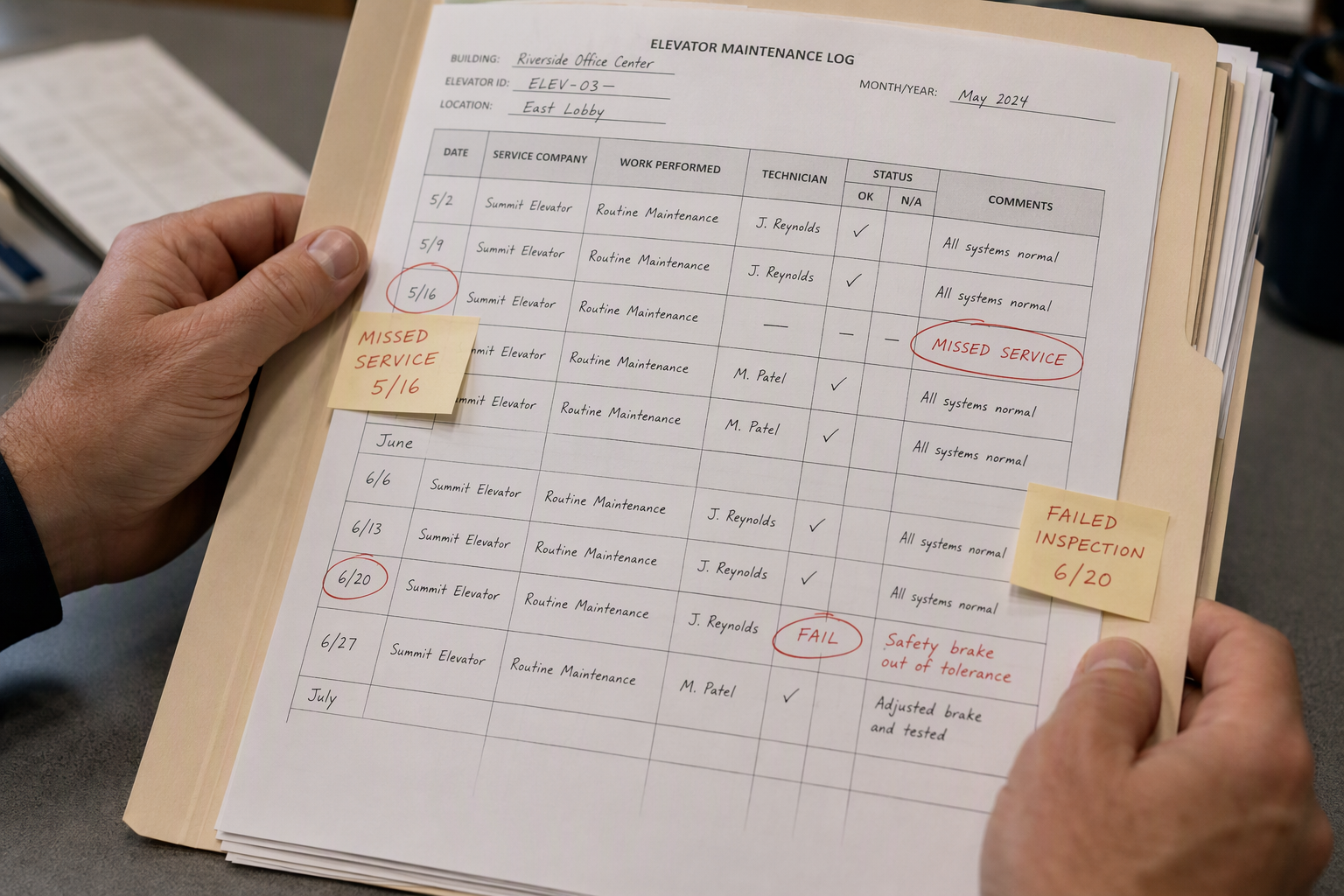
The first step is a thorough review of the existing contract document before taking any other action.
Every elevator maintenance agreement contains provisions that govern how either party may exit the relationship. Property managers should locate and read the following sections before sending any notices or making any calls to a new vendor: the initial term and auto-renewal clauses, the termination-for-convenience provision (if any), the termination-for-cause or default provision, the required notice period and the method for delivering that notice (certified mail, email, etc.), any early-termination fee or liquidated-damages clause, and any equipment-ownership or parts-return provisions.
Many contracts auto-renew for one-year terms if written notice is not delivered within a specific window—sometimes 90 or 120 days before the anniversary date. Missing that window can lock a building owner into another full year with the same underperforming company. Pulling the contract and noting all deadlines on a calendar is non-negotiable before proceeding.
What Grounds Justify Termination for Cause Under an Elevator Maintenance Agreement?
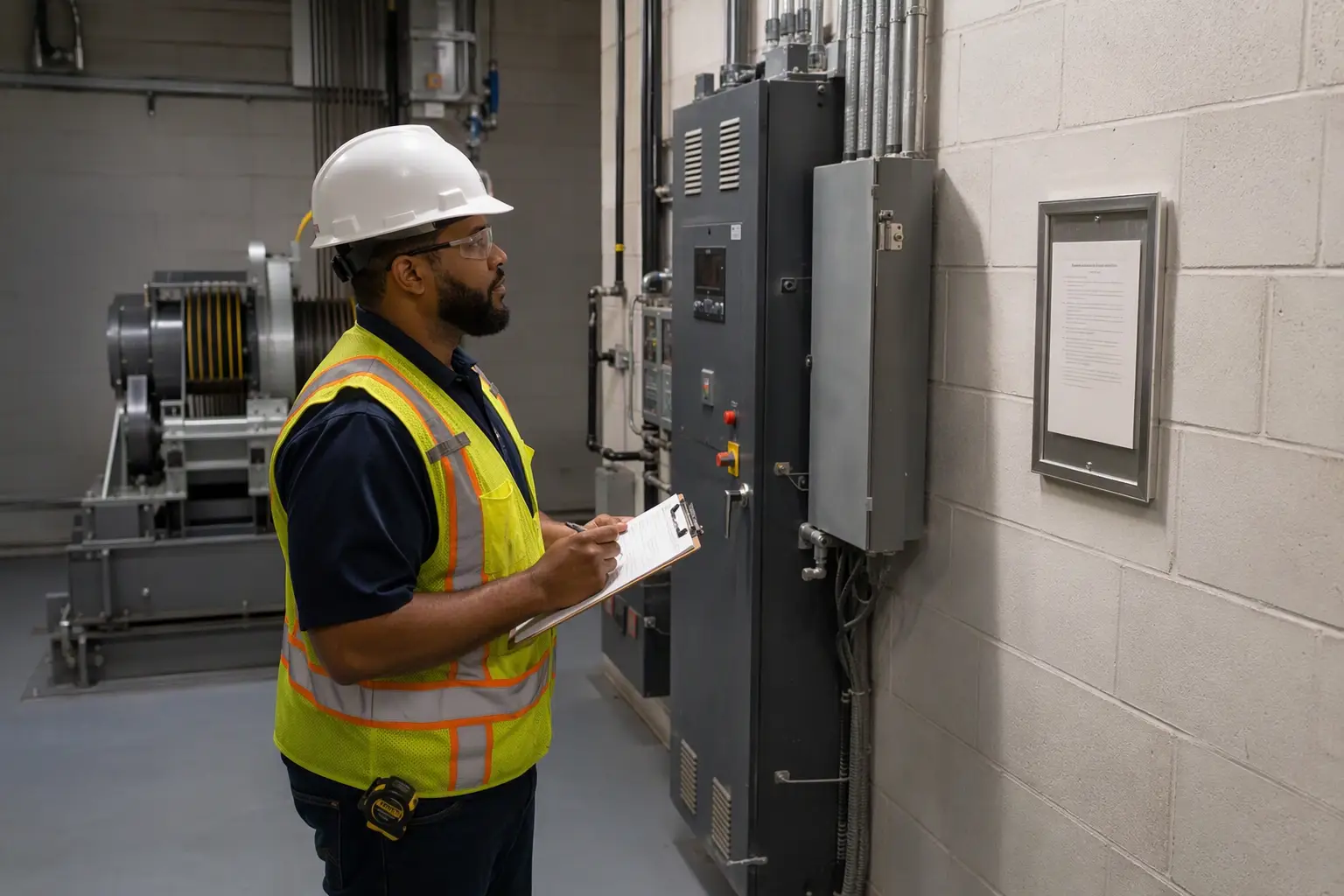
Termination for cause is typically justified when the service provider has materially breached the contract’s performance obligations.
Common documented causes that courts and arbitrators have recognized in commercial service contracts include: persistent failure to respond to service calls within the timeframe stated in the agreement, failure to maintain the elevator in compliance with applicable codes, failure to perform the preventive maintenance tasks listed in the scope of work, misrepresenting repairs performed, using non-compliant parts, and allowing the equipment’s operating certificate to lapse.
In South Carolina, under S.C. Code Title 41, Chapter 16, the building owner—not the maintenance company—bears the legal obligation to keep every elevator facility in safe operating condition and in conformance with state regulations. If a contractor’s poor performance puts that obligation at risk, that fact strengthens a for-cause termination argument. Property managers should document every missed call, every skipped maintenance visit, and every failed inspection in writing before asserting cause.
How Should Written Notice of Contract Termination Be Delivered?
Written notice must be delivered exactly as specified in the contract’s notice provision, using certified mail with return receipt whenever the contract is silent on method.
Most elevator maintenance contracts specify an address for legal notices. Sending termination notice to the local branch office rather than the address listed in the contract can invalidate the notice and restart the clock. The notice letter should state: the contract reference number, the date of notice, the grounds for termination (convenience or cause), the termination date per the notice period, a demand for the return of any keys, access cards, or proprietary tools, and a request for all maintenance records and inspection documentation. Keep copies of everything.
Can a Building Owner in South Carolina Break a Contract Early Without Paying a Penalty?
Whether a penalty applies depends on what the contract says, and South Carolina courts generally enforce liquidated-damages clauses that are reasonable and not punitive.
Some large national elevator companies embed early-termination fees equal to the remaining months on the contract multiplied by the monthly fee. If the termination is for cause due to the contractor’s material breach, that penalty may not apply or may be negotiable. Property managers should consult a South Carolina commercial attorney before paying any early-termination fee, because a documented pattern of non-performance by the vendor may offset or eliminate the amount owed. Always request a final accounting in writing and do not allow the incumbent company to continue billing after the termination date.
What Records Must Be Transferred When Switching Elevator Service Companies?
The outgoing contractor must transfer all maintenance logs, inspection certificates, permits, and equipment documentation that belong to the building owner.
In South Carolina, the operating certificate issued by the South Carolina Department of Labor, Licensing and Regulation (LLR), Office of Elevators and Amusement Rides must be displayed conspicuously inside each elevator car at all times. That certificate belongs to the building, not the service company. The following documents should be requested in writing from the outgoing vendor:
- All current operating certificates and certificates of registration
- The most recent state inspection report
- All maintenance logs for the term of the contract
- Copies of any state construction permits for alterations completed during the contract period
- Wiring diagrams, modernization records, and equipment manuals
- A list of any open deficiencies or outstanding repair orders
- Keys, access codes, and any proprietary tools or devices installed on the equipment
Proprietary tools and software are a common friction point. Some national companies install controller software or diagnostic devices that cannot be accessed by independent technicians. South Carolina building owners should document this situation and factor the cost of reprogramming or replacing proprietary controllers into the cost of switching vendors.
How Does a Building Owner Avoid a Lapse in Elevator Compliance During the Transition?
Overlap the transition: engage the new service company before the termination date of the old contract so there is no gap in coverage or maintenance responsibility.
Under S.C. Code Title 41, Chapter 16 and S.C. Code of Regulations Chapter 71, Article 5 (Regulations 71-5000 through 71-5700), no elevator facility may be operated in South Carolina without a valid certificate of registration and a current operating certificate. South Carolina requires elevators to be inspected and the operating certificate renewed at least annually. If a service gap causes a missed inspection or a lapsed certificate, the building owner—not the outgoing contractor—is the legally responsible party.
The safest transition sequence is:
- Audit the existing contract and mark all notice deadlines on a calendar.
- Obtain copies of all current certificates and inspection reports.
- Evaluate and select a new service provider.
- Execute the new maintenance agreement with a start date that overlaps the old contract’s end date by at least a few days.
- Deliver written termination notice to the incumbent contractor per the contract’s notice requirements.
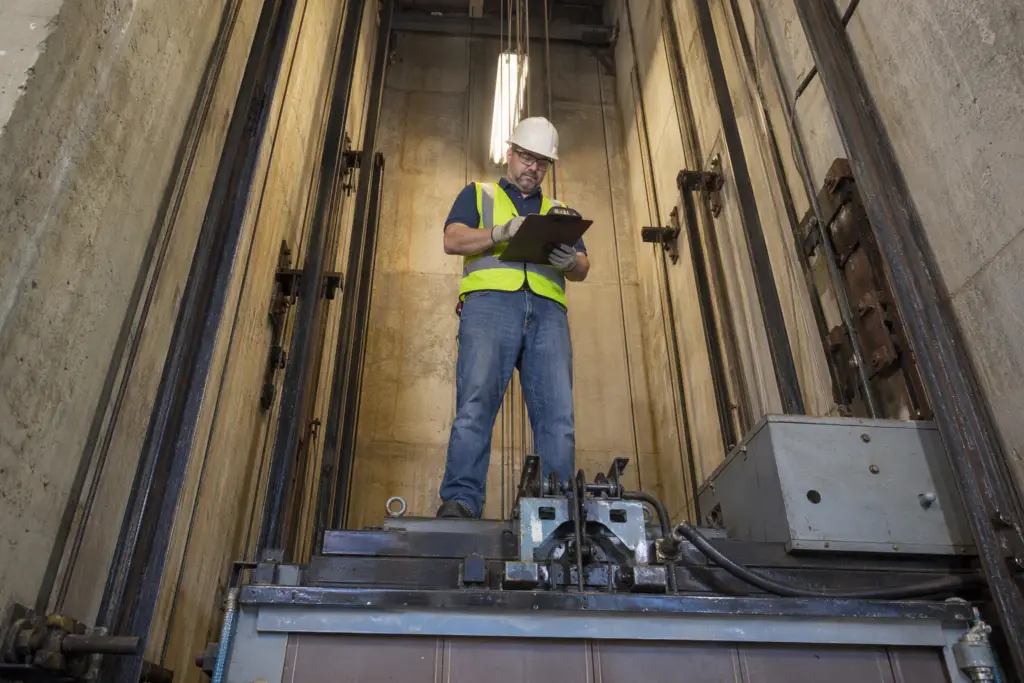
- Have the new provider conduct a baseline assessment of the equipment before taking over maintenance responsibility.
- Confirm that all certificates remain valid and are displayed in each elevator car after the handoff.
- Notify the LLR Office of Elevators and Amusement Rides of any change in service provider if required during the next certificate renewal cycle.
What Should a Baseline Assessment by a New Elevator Service Company Include?
A baseline assessment should cover every mechanical, electrical, and safety system on the unit and produce a written condition report that establishes the equipment’s state at the time the new provider assumes responsibility.
A thorough baseline assessment protects the new service company and the building owner by creating a clear record of pre-existing deficiencies. It should examine drive systems, hydraulic cylinders and fluid lines (including compliance with South Carolina’s requirement that newly installed underground hydraulic cylinders be encased in plastic outer containment to limit electrolytic corrosion), door operators and interlocks, safety devices, buffers, governor and safeties, pit conditions, machine room conditions, emergency lighting and alarm systems, firefighters’ service features (new installations in South Carolina must use the five-pin S.C. #1000 key), standby power systems, and cab finishes and accessibility features.
Carolina Elevator Service performs baseline equipment evaluations as part of its onboarding process for new clients in the Columbia, SC area, producing a written report that documents existing conditions before the transition is complete.
What Red Flags Indicate It Is Time to Switch Elevator Maintenance Companies?
The clearest warning signs are repeated failed inspections, slow response to entrapments or safety calls, poor or missing maintenance records, and difficulty reaching the company when problems arise.
Other red flags that property managers in Columbia, SC frequently report include:
- Invoices for repairs that were never performed or authorized
- Technicians who lack knowledge of the specific equipment model installed
- Recurring callbacks for the same problem, indicating repairs were not completed correctly
- Pressure to approve expensive upgrades that cannot be substantiated with written diagnostic findings
- Failure to inform the building owner of deficiencies that could affect inspection outcomes
- Operating certificates that expire without proactive notification from the contractor
- Contracts written with unilateral price-escalation clauses that trigger without notice
How Do Elevator Maintenance Contract Structures Differ, and Which Is Better for Building Owners?
The three most common structures are oil-and-grease (basic), full-service, and comprehensive contracts, and most building owners benefit most from a well-defined full-service or comprehensive agreement with clearly listed exclusions.
| Contract Type | What Is Typically Included | What Is Typically Excluded | Best Suited For |
|---|---|---|---|
| Oil-and-Grease (Basic) | Lubrication, minor adjustments, cleaning | Parts, repairs, callbacks, modernization | New equipment under manufacturer warranty |
| Full-Service | Lubrication, adjustments, labor on covered repairs, many parts | Vandalism, major modernization, some electronic components | Mid-age equipment in good condition |
| Comprehensive | All of the above plus most parts and components | Structural modifications, code-mandated upgrades, acts of nature | Older equipment or high-traffic buildings |
| Time-and-Materials | Labor billed by the hour; parts billed at cost plus markup | Everything not explicitly called out; no guaranteed response | Very low-use private equipment; rarely advisable |
Building owners switching from a bad contract should use the opportunity to negotiate a comprehensive or full-service agreement with clearly written response-time commitments, a defined parts list, and an annual price-escalation cap stated as a percentage. Any scope of work that is vague or relies on the contractor’s discretion is a vulnerability.
Does South Carolina Law Require Elevator Service Companies to Be Licensed?
South Carolina elevator mechanic and contractor licensing status was not independently verified at the time of this writing, and building owners should confirm current licensure requirements directly with the South Carolina Department of Labor, Licensing and Regulation (LLR), Office of Elevators and Amusement Rides.
What South Carolina law does clearly require is that any special inspector performing inspections in place of a state inspector must be licensed and demonstrate qualifications under the 2018 edition of QEI-1 (the American National Standard for Qualification of Elevator Inspectors). Critically, a special inspector may not inspect an elevator on which the inspector or the inspector’s employer holds a current service or warranty contract. This separation-of-interest rule exists to preserve inspection integrity and is a key reason why independent inspection and independent service are treated separately under South Carolina’s regulatory framework.
How Does the Proprietary Parts and Software Issue Trap Building Owners in Contracts?
Some large elevator companies install proprietary controllers, diagnostic ports, or software that only their own technicians can access, effectively making it difficult or expensive for an independent company to take over service.
This practice is sometimes called a “lock-in” strategy. When evaluating a switch, building owners should ask the incumbent contractor in writing whether any proprietary components have been installed on the equipment. If so, the new service provider should assess the cost and feasibility of replacing or reprogramming those components before the transition is finalized. The cost of breaking a proprietary lock-in may be worth calculating against the long-term savings of moving to a competitive service environment. Carolina Elevator Service regularly assists Columbia, SC building owners in evaluating these situations during the transition process.
What Does the ASME A17.1 Code Require That a Maintenance Contract Must Address?
The ASME A17.1/CSA B44 Safety Code for Elevators and Escalators contains maintenance, testing, and examination requirements that any compliant service contract must fulfill.
South Carolina has adopted the ASME A17.1-2019/CSA B44:19 edition, effective by notice in the S.C. State Register on July 23, 2021. The code requires that elevators be maintained, examined, and tested at defined intervals and that maintenance records be kept. A service contract that does not explicitly address all required maintenance tasks, examination frequencies, and record-keeping obligations may leave the building owner in technical non-compliance even if the contractor is showing up on schedule. When switching providers, the new contract’s scope of work should be reviewed against the ASME A17.1-2019 requirements to confirm full coverage.
For elevators that were in operation before July 1, 1986, South Carolina requires compliance with the 1986 edition of ANSI A17.3, the safety code for existing elevators and escalators. A new service provider must be aware of which code edition applies to each piece of equipment in a mixed-age portfolio.
What ADA Obligations Does a Building Owner Retain Regardless of Who Provides Maintenance?
Under the Americans with Disabilities Act, building owners are responsible for ensuring that elevators providing access to program areas remain operational and accessible; that obligation does not transfer to the maintenance contractor.
When switching service companies, there should be no period during which an elevator serving as the accessible route is taken out of service without an equivalent accessible alternative. ADA compliance is the building owner’s legal duty, and extended downtime caused by a service transition or a dispute with the outgoing contractor can create ADA exposure. The new service company should confirm the elevator’s accessibility features—door timing, leveling accuracy, cab dimensions, and audible and visual signals—are fully functional as part of the baseline assessment.
How Long Does a Typical Elevator Service Company Transition Take?
A straightforward transition from one service company to another typically takes between 30 and 90 days from notice to active service, depending on contract notice periods and the complexity of the equipment.
The timeline is driven primarily by the notice period in the outgoing contract (30, 60, or 90 days is most common), the time needed to execute the new agreement, and the time needed for the baseline assessment and equipment familiarization by the incoming provider. Transitions involving proprietary controllers or open deficiencies from failed inspections will take longer. Building owners who begin the process early—before the current contract auto-renews—have the most flexibility to manage the timeline without pressure.
Can a Building Owner Negotiate the Terms of the New Elevator Maintenance Contract?
Yes, virtually all terms in an elevator maintenance agreement are negotiable, and building owners with multiple units or buildings have meaningful leverage.
Key terms to negotiate in a new agreement include: the scope of work tied explicitly to ASME A17.1-2019 maintenance requirements, an annual price-escalation cap, a clear definition of covered and excluded parts, a reasonable early-termination provision for both parties, response-time commitments in writing, record-keeping and reporting obligations, and a no-automatic-renewal clause or a defined opt-out window of no more than 30 days. Building owners who have just left a bad contract should not accept a new agreement that replicates the same problematic terms under a different company name.
What Questions Should a Building Owner Ask When Interviewing a New Elevator Service Company?
The most important questions focus on the company’s familiarity with the specific equipment, their ability to document compliance with South Carolina regulations, and the transparency of their pricing and scope.
Recommended interview questions include:
- Are you familiar with this specific make, model, and vintage of elevator equipment?
- Will you provide a written baseline assessment before assuming maintenance responsibility?
- How do you handle state inspection coordination with the LLR Office of Elevators and Amusement Rides?
- What is your process for notifying the building owner of deficiencies found during maintenance visits?
- Does your maintenance scope cover all tasks required under ASME A17.1-2019?
- Are there any proprietary components in your service process that would restrict future service options?
- Can you provide references from similar properties in the Columbia, SC area?
- What is included in the contract price, and what is explicitly excluded?
- What notice period is required if we need to terminate the contract?
- How are emergency calls handled, and what is the escalation process for unresolved issues?
How Are South Carolina Elevator Inspection Requirements Affected by a Change in Service Company?
Inspection requirements under South Carolina law do not change based on who provides maintenance, but the building owner must ensure the new provider understands the applicable inspection schedule and can support it.
South Carolina requires standard passenger elevators to be inspected at least once a year before the operating certificate is renewed. Handicap lifts are inspected every five years; manlifts, television tower elevators, and special purpose elevators every seven years; dumbwaiters when installed or altered. Inspections may be performed only by state inspectors or by licensed special inspectors—but a special inspector may not inspect an elevator on which the inspector or the inspector’s employer has a current service contract. This rule means the new service company cannot also be the inspection company for the same unit, which is an important point for building owners to understand when assembling their vendor team. Carolina Elevator Service helps Columbia, SC clients coordinate with qualified independent inspectors as part of a compliant maintenance program.
What Happens If an Elevator Has Open Deficiencies When the Service Company Changes?
Open deficiencies discovered during the prior service period become the building owner’s immediate responsibility at the moment the new service company assumes maintenance duties, regardless of who caused them.
Before the transition is complete, the building owner should obtain a written list of any known open deficiencies from the outgoing contractor. The new service company’s baseline assessment should independently verify that list. Any deficiency that could affect the outcome of the next state inspection or the safety of passengers should be prioritized for correction. Under S.C. Code Title 41, Chapter 16, the owner is responsible for keeping every elevator facility in safe operating condition—that obligation runs continuously, including during transitions. If an accident occurs during the transition period that seriously injures anyone other than an employee, it must be reported to the state before the end of the next working day.
Is It Possible to Negotiate a Release From an Elevator Maintenance Contract Without Legal Action?
Yes, many building owners successfully negotiate a mutual release or early exit from elevator maintenance contracts without litigation by approaching the process professionally and documenting their grounds clearly.
A direct conversation with the contractor’s regional or national account management team—rather than the local branch—is often more productive when seeking an early exit. Coming to that conversation with documentation of missed service calls, failed inspections, or unresolved complaints strengthens the building owner’s position significantly. Some companies will accept a negotiated buyout at a reduced amount rather than defend a disputed termination in arbitration. If the contract contains a mandatory arbitration clause, understanding that process before sending a termination letter allows the building owner to make a more informed decision about strategy.
Why Should Columbia, SC Building Owners Choose Carolina Elevator Service as Their New Provider?
Carolina Elevator Service is a certified elevator service company based in Columbia, SC, with a focus on transparent maintenance programs, documented compliance with South Carolina LLR requirements, and service built around the needs of local building owners rather than the priorities of a national corporate structure.
Local service means that technicians familiar with the Columbia market and its building stock are the ones responding to service calls and performing maintenance visits—not technicians dispatched from a regional hub hours away. Carolina Elevator Service builds maintenance programs around the ASME A17.1-2019 requirements adopted by South Carolina, coordinates with the inspection process as required by the LLR Office of Elevators and Amusement Rides, and provides building owners with the documentation they need to demonstrate compliance at every renewal cycle. For building owners making the switch from a national provider, Carolina Elevator Service offers baseline assessments that establish a clear starting point and identify any open deficiencies from the prior service period.
Ready to Switch to a Service Company That Works for You?
If a bad elevator maintenance contract is costing your Columbia, SC property in downtime, compliance risk, or unnecessary expense, the path forward starts with a professional evaluation of your equipment and your current agreement. Contact Carolina Elevator Service for a free elevator assessment. Call us today at 803-865-1400 to schedule your baseline assessment and take the first step toward a maintenance program that keeps your elevators safe, compliant, and running reliably.
Need elevator service you can rely on? Carolina Elevator Service is ready to help.