Elevator Maintenance Contract Terms: What to Watch Out for Before Signing
The most dangerous terms in an elevator maintenance contract are the ones that look routine: auto-renewal clauses that lock you in for another multi-year cycle with 30 days’ notice or less, exclusions lists that carve out the most failure-prone components, and penalty provisions that make switching providers costly even when service quality declines. Understanding these clauses before signing protects your building, your budget, and your compliance standing under ASME A17.1 Safety Code for Elevators and Escalators and South Carolina state law.
What is an elevator maintenance contract and why does the fine print matter so much?

An elevator maintenance contract is a legally binding service agreement that defines who performs maintenance, what work is included, how often it occurs, and what happens when equipment fails — and the fine print determines whether the contract protects the building owner or the service provider.
Elevators are life-safety equipment regulated at the federal level by ASME A17.1 and at the state level through South Carolina’s elevator safety program. A contract that allows maintenance to lapse or that excludes critical components can expose building owners to liability, regulatory fines, and equipment downtime. The contractual language that governs these obligations deserves the same scrutiny as any major capital commitment.
What automatic renewal clause risks should building owners understand?
Automatic renewal clauses roll the contract forward — often for a full multi-year term — if the building owner does not issue written cancellation within a specified window, which is frequently as short as 30 to 90 days before the contract’s anniversary date.
These provisions are among the most financially harmful terms in elevator service agreements. A building owner who misses the cancellation window by even one day may be contractually obligated for another one to three years of service at whatever rate the vendor sets. Before signing, confirm the exact cancellation window, require that the vendor send written notice at least 120 days before the renewal deadline, and ensure the contract allows termination for cause if service standards are not met. South Carolina courts generally enforce such clauses as written, so negotiating them upfront is essential.
How should the contract define the scope of maintenance work?
The scope of work must explicitly list every component covered — including parts, labor, lubrication, adjustments, safety tests, and callbacks — because any item not named in the contract can be billed separately at the vendor’s discretion.
Vague language such as “routine maintenance” or “preventive service” without an accompanying parts schedule is a red flag. A well-drafted contract will enumerate covered components: door operators, controllers, motors, drive sheaves, safety devices, buffers, and hydraulic fluid (for hydraulic units). It should also clarify whether emergency callback visits are included at no additional charge or billed at a separate hourly rate. Carolina Elevator Service recommends requesting a written component exclusions list from any prospective vendor so that hidden costs can be identified before execution.
What exclusions lists are commonly buried in elevator maintenance agreements?
Common exclusions include proprietary parts, vandalism damage, modernization-grade components, and repairs resulting from “misuse” — categories broad enough for vendors to deny coverage on a wide range of real-world failures.
Pay particular attention to exclusions for solid-state controllers, elevator cab interiors, door sills, and hydraulic cylinder replacement. Some contracts exclude any component whose failure is attributed to “age” or “normal wear,” which is circular reasoning that can justify denying nearly any claim on an older unit. Require that exclusions be listed in a separate, clearly labeled schedule and that any disputed repair be subject to an independent inspection before the owner is billed.
What do price escalation clauses look like and how can they be limited?
Price escalation clauses allow vendors to raise the monthly or annual maintenance fee — sometimes without a ceiling — based on indices such as the Consumer Price Index, labor cost indexes, or simply at the vendor’s unilateral discretion.
Uncapped escalation provisions can turn a competitively priced contract into a significantly more expensive one within a few years. Negotiate for a fixed annual cap — typically expressed as a percentage — on any allowable price increase. If the vendor insists on CPI-linked escalation, ensure the contract specifies the exact index, the base period, and a maximum annual increase regardless of index performance. Any clause that permits unilateral price increases without a defined formula should be rejected or substantially revised before signing.
What are liquidated damages and termination penalty provisions in elevator contracts?
Liquidated damages and early termination fees require the building owner to pay the vendor a predetermined sum — often the remaining contract value — if the owner cancels the agreement before its natural expiration, even when the reason for cancellation is poor service.
These provisions can amount to tens of thousands of dollars on a multi-year agreement. Negotiate for a mutual termination-for-cause clause that allows either party to exit without penalty if the other materially breaches the contract, and define “material breach” explicitly to include missed maintenance visits, failed regulatory inspections attributable to the vendor’s negligence, and unresolved safety callbacks. A balanced contract should not penalize the building owner for holding the service provider accountable.
How do proprietary parts and data lock-in clauses affect your ability to switch vendors?
Some vendors install proprietary controller boards or diagnostic software that can only be serviced by that vendor, or retain ownership of elevator programming and operational data, effectively making it impossible to switch providers without a costly equipment retrofit.
This is one of the most consequential long-term risks in elevator contracting. Before signing, confirm in writing that all installed parts will be compatible with third-party service providers, that diagnostic software and elevator programming data will be transferable to a successor contractor, and that the owner retains ownership of all equipment records. South Carolina building owners should request a written acknowledgment that no proprietary lock-in technology will be installed without prior written consent.
What does a South Carolina-compliant maintenance contract need to include?
A compliant contract in South Carolina must align with the inspection and testing intervals required under the state’s elevator safety program, which administers elevator safety through the South Carolina Department of Labor, Licensing and Regulation (LLR).
South Carolina’s elevator safety requirements are administered by the LLR’s Elevator Division. Contracts should specify that the vendor will coordinate required periodic inspections with the state’s licensed elevator inspectors, maintain records of all maintenance and testing activity, and ensure that the elevator meets the applicable edition of ASME A17.1 for new installations and ASME A17.3 Safety Code for Existing Elevators and Escalators for existing equipment. A contract that does not reference these standards or the LLR’s authority should be viewed with caution. Carolina Elevator Service structures its agreements to explicitly reference South Carolina’s regulatory requirements so there is no ambiguity about compliance obligations.
How frequently should maintenance visits be specified in the contract?
Maintenance visit frequency should be defined precisely — minimum monthly visits for most commercial elevators — with a written log entry required after every visit so building owners can verify the service was actually performed.
A contract that specifies only “periodic” or “regular” maintenance without a defined frequency gives the vendor discretion to reduce visit cadence without breaching the agreement. The appropriate frequency depends on equipment type, traffic volume, and age, but for most commercial properties in the Columbia, SC area, monthly maintenance visits represent the industry-standard baseline. High-traffic environments may warrant more frequent attention. The contract should also specify that maintenance records will be made available to the building owner and to state inspectors upon request, consistent with ASME A17.1 record-keeping requirements.
What callback and emergency response provisions should the contract specify?
The contract must define callback obligations — including what constitutes an emergency, whether callbacks are included in the monthly fee, and what documentation the vendor must provide after each unscheduled visit.
Contracts that limit callbacks to “business hours” or that bill emergency callbacks at a separate premium rate can create significant unbudgeted costs, particularly for residential buildings or facilities serving the public under ADA accessibility obligations. When an elevator that provides required accessible access is out of service, the building owner may face ADA compliance exposure. The contract should require the vendor to provide written documentation of every callback, including the cause of the issue and the corrective action taken.
What insurance and liability provisions should be in an elevator maintenance contract?
The vendor must carry adequate commercial general liability insurance and workers’ compensation coverage, and the contract should specify minimum coverage amounts, require the building owner be named as an additional insured, and address indemnification for injuries arising from maintenance negligence.
Failure to verify vendor insurance before signing creates significant exposure for the building owner. Request current certificates of insurance before execution and confirm that coverage limits are appropriate for the scope of work. The indemnification clause should be mutual and clearly allocate responsibility: the vendor indemnifies the owner for injuries caused by the vendor’s negligence; the owner indemnifies the vendor for injuries caused by the owner’s negligence. One-sided indemnification clauses that shift all liability to the building owner should be rejected.
How should the contract handle required state inspections and who pays for them?
The contract must clearly state who coordinates and pays for the mandatory periodic inspections required by South Carolina’s LLR Elevator Division, because these costs are sometimes treated as extras even when the building owner assumes they are included.
South Carolina requires periodic inspections by state-licensed elevator inspectors as a condition of lawful elevator operation. Some maintenance contracts include coordination with the state inspection process as a standard service; others treat it as an add-on. Confirm in writing whether annual inspection fees, re-inspection fees after a failed inspection, and any required testing (such as five-year full-load safety tests under ASME A17.1) are included in the base contract price or billed separately.
What questions should be asked about parts availability and lead times?
The contract should address how the vendor handles parts procurement, whether substitute or equivalent parts are permissible, and what the process is when a required part has an extended lead time that leaves the elevator out of service.
Older elevator equipment — particularly equipment installed more than two decades ago — may rely on components that are no longer manufactured by the original equipment manufacturer. A contract that requires OEM-only parts without addressing availability can result in extended outages when those parts are unavailable. Negotiate language that permits equivalent-quality substitute parts when OEM parts are unavailable, provided the substitution is documented and meets applicable ASME A17.1 requirements. The contract should also specify how long the vendor will allow an elevator to remain out of service before escalating to emergency procurement channels.
How do performance standards and service level agreements work in elevator contracts?
A service level agreement (SLA) within the maintenance contract defines measurable performance benchmarks — such as maximum permissible equipment downtime and maintenance completion timelines — that the vendor is contractually obligated to meet.
Without defined SLAs, there is no contractual basis for holding a vendor accountable for chronic equipment failures or slow response to non-emergency issues. Negotiate for specific, measurable standards: for example, a defined timeline for completing a non-emergency repair after it is identified during a maintenance visit. Carolina Elevator Service recommends that building owners treat SLA provisions as non-negotiable elements of any long-term service agreement, not as optional enhancements.
What records and documentation should the contract require the vendor to maintain?
The contract should require the vendor to maintain a complete maintenance log for every visit, preserve records of all parts replaced, document all test results, and make these records available to the building owner and South Carolina state inspectors at any time.
Regulatory compliance under South Carolina’s elevator safety program requires accurate maintenance records. In the event of an injury or regulatory inspection, the building owner needs to be able to demonstrate that maintenance was performed on schedule and that known deficiencies were corrected. The contract should also address what happens to maintenance records at the end of the agreement: the building owner should receive a complete copy of all records upon contract termination, regardless of the reason for termination.
What ADA accessibility obligations intersect with elevator maintenance contracts?
Under the Americans with Disabilities Act, elevators that provide required accessible routes in public accommodations and commercial facilities must be maintained in operable condition, and a maintenance contract that allows extended downtime may create ADA compliance exposure for the building owner.
The ADA does not specify a maximum permissible downtime for elevators, but the Department of Justice has consistently held that elevators providing required accessible access must be kept operational and that chronic outages can constitute an ADA violation. Building owners should ensure that the maintenance contract’s callback and repair provisions are sufficient to minimize downtime on elevators that serve as required accessible routes. This is particularly relevant for multi-story facilities in the Columbia, SC area that serve the public.
What is a step-by-step process for reviewing an elevator maintenance contract before signing?
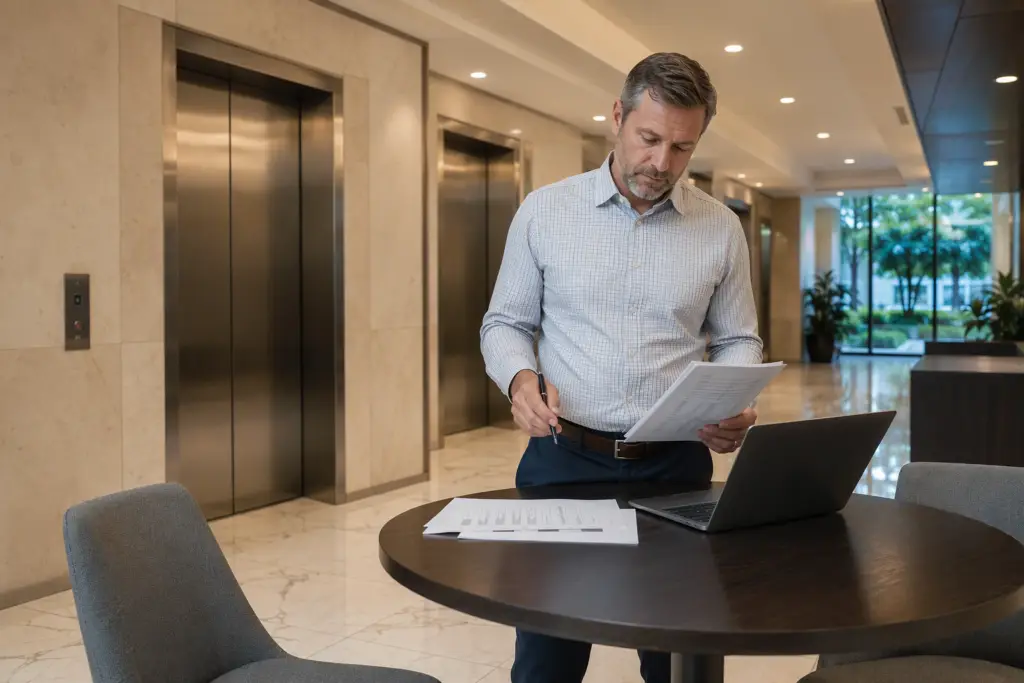
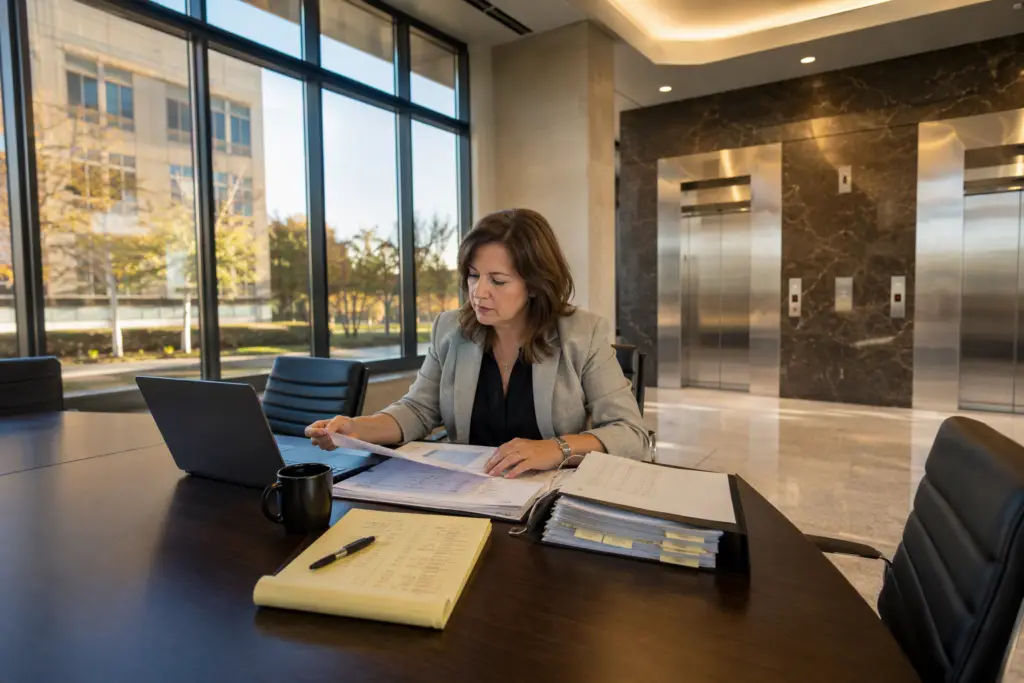
Reviewing an elevator maintenance contract thoroughly requires a systematic process to ensure no problematic clause is overlooked before the agreement is executed.
- Request the full contract text in advance. Do not accept a summary document. Review the complete agreement, including all exhibits, schedules, and addenda.
- Identify and map all exclusions. Create a separate list of every component, condition, or event the vendor has excluded from coverage.
- Locate the auto-renewal clause. Record the exact cancellation deadline and set a calendar reminder at least 150 days before each anniversary date.
- Evaluate the price escalation provision. Determine whether increases are capped, index-linked, or discretionary, and negotiate a ceiling if one does not exist.
- Assess the termination provisions. Confirm that a mutual termination-for-cause clause is present and that it explicitly includes vendor service failures.
- Verify insurance requirements. Request current certificates of insurance before signing and confirm the building is named as an additional insured.
- Confirm regulatory alignment. Verify that the contract references South Carolina LLR requirements and applicable ASME A17.1 / A17.3 standards.
- Check records ownership provisions. Confirm that all maintenance records and elevator programming data remain the property of or are transferable to the building owner.
- Negotiate any problematic clause in writing. Verbal assurances are not enforceable. Every agreed modification must be incorporated into the signed contract.
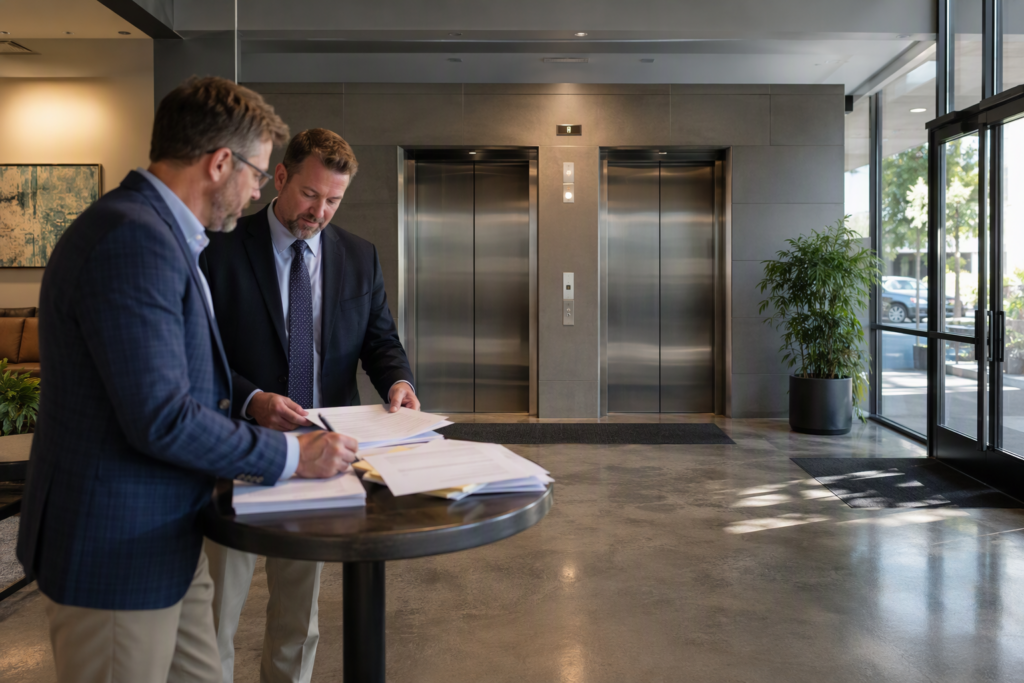
- Have the contract reviewed by legal counsel. For multi-year agreements covering substantial equipment, legal review is a sound investment before execution.
How do full-maintenance contracts compare to examination-only contracts?
Full-maintenance contracts include parts, labor, and callbacks in a bundled fee, while examination-only (or oil-and-grease) contracts cover only routine lubrication and inspection, billing parts and labor separately for any corrective work.
The table below summarizes the key differences between common elevator maintenance contract structures to help building owners evaluate which model aligns with their risk tolerance and budget.
| Contract Type | Coverage Scope | Parts Included? | Callbacks Included? | Best Suited For | Primary Risk |
|---|---|---|---|---|---|
| Full Maintenance | Labor, parts, lubrication, adjustments, callbacks | Yes (subject to exclusions) | Typically yes | High-traffic or aging equipment | Hidden exclusions list |
| Examination Only (Oil & Grease) | Lubrication and visual inspection only | No | No (billed separately) | New, low-traffic equipment | Unpredictable repair costs |
| Parts-Only Contract | Replacement parts at discount; labor billed separately | Yes | No | Owner-employed mechanics | Requires licensed in-house staff |
| Time-and-Materials | All work billed as performed | Billed at cost + markup | Billed separately | Low-use or single-unit properties | No cost predictability |
For most commercial buildings in the Columbia, SC area, full-maintenance contracts offer the most predictable cost structure, provided the exclusions list has been thoroughly negotiated before signing.
What red flags indicate an elevator maintenance vendor should not be trusted?
Red flags include vendors who resist putting verbal commitments in writing, who cannot provide current proof of insurance, who propose contracts with no defined maintenance frequency, and who install proprietary components without disclosing the lock-in implications.
Additional warning signs include vendors who cannot provide references from comparable South Carolina commercial properties, who are unwilling to include a termination-for-cause provision, and who respond to contract negotiation requests with “this is our standard form — we never change it.” Reputable service providers understand that reasonable contract negotiation is standard business practice. Building owners should also verify that any prospective vendor and their technicians hold the appropriate licenses required by South Carolina’s LLR for elevator work.
When should a building owner seek an independent elevator assessment before or during a maintenance contract?
An independent elevator assessment is warranted when taking over a new property, when evaluating whether a current vendor is meeting contract obligations, when a contract is approaching renewal, and whenever regulatory inspection results suggest maintenance deficiencies.
An independent assessment provides an unbiased inventory of equipment condition, identifies components approaching end of service life, and creates a documented baseline against which future maintenance performance can be measured. This is particularly valuable when a building owner suspects that a current vendor’s maintenance logs do not accurately reflect the work actually performed. Carolina Elevator Service provides independent assessments for commercial properties throughout the Columbia, SC area, giving building owners objective information before they commit to or renew a service agreement. For properties preparing for South Carolina LLR inspections, an independent pre-inspection assessment can identify deficiencies before they result in a failed inspection or citation.
Get an Objective Evaluation Before You Sign
Understanding every clause in an elevator maintenance contract requires both legal attention and technical expertise. Carolina Elevator Service helps building owners in Columbia, SC review maintenance obligations, assess equipment condition, and structure service agreements that protect their interests and maintain compliance with South Carolina’s elevator safety requirements and ASME A17.1 Safety Code for Elevators and Escalators.
Contact Carolina Elevator Service for a free elevator assessment: 803-865-1400
Need elevator service you can rely on? Carolina Elevator Service is ready to help.