Direct Answer: To evaluate and switch elevator service vendors, assess your current provider’s compliance record, response quality, contract terms, and cost transparency, then compare independent and OEM alternatives before serving written notice, coordinating equipment access, and confirming South Carolina inspection documentation is transferred to the new provider.
Switching elevator service vendors is one of the most consequential facilities decisions a building owner or property manager can make. The right vendor keeps equipment safe, maintains regulatory compliance under federal codes such as ASME A17.1 Safety Code for Elevators and Escalators, and protects occupants. The wrong vendor exposes a property to liability, downtime, and code violations. This guide walks South Carolina building owners and facility managers through every stage of the evaluation and transition process.
—
What Are the Key Factors for Evaluating an Elevator Service Vendor?
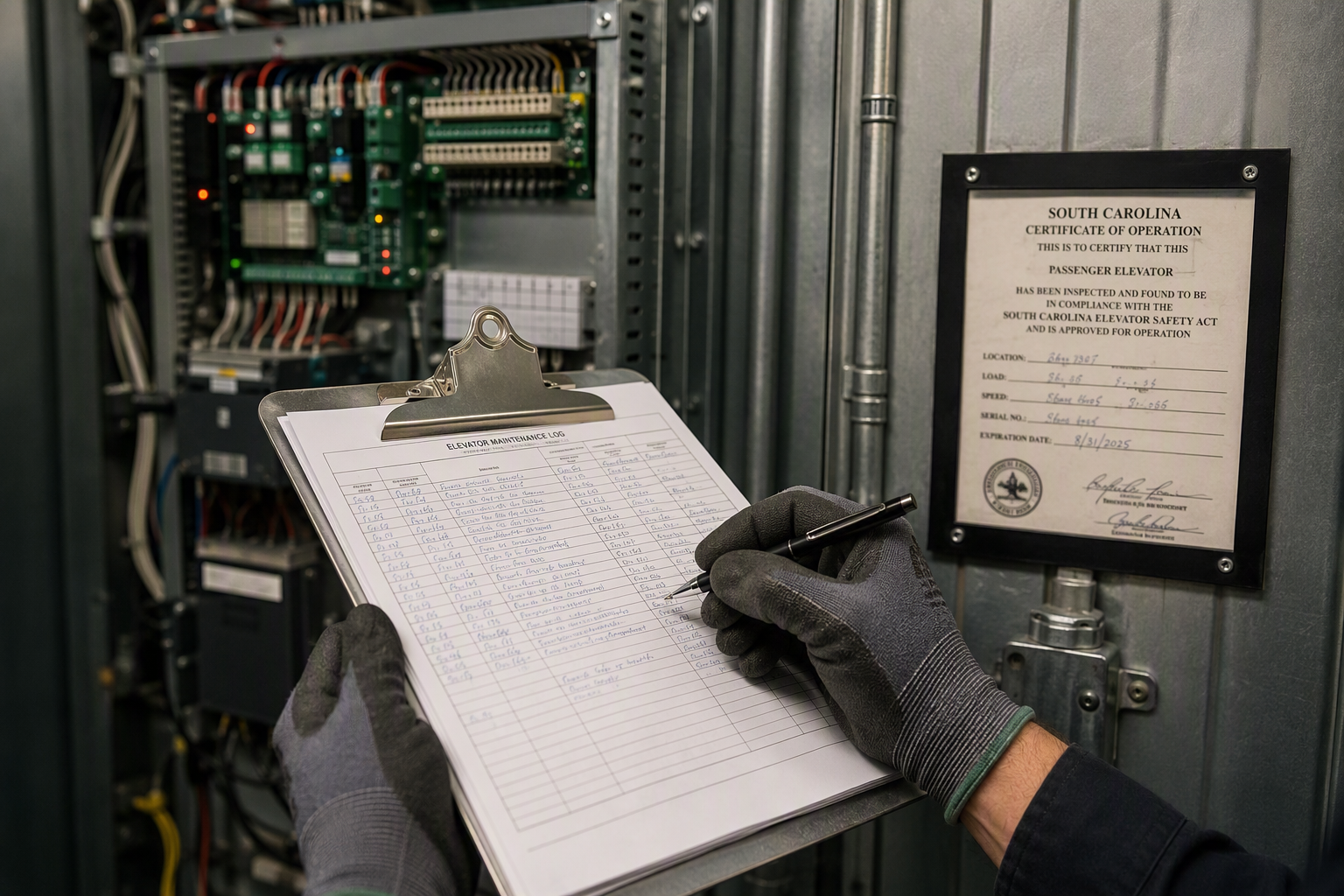
A thorough vendor evaluation goes well beyond comparing monthly maintenance fees. The factors below form the foundation of any reliable assessment.
- Regulatory compliance expertise — The vendor must demonstrate working knowledge of ASME A17.1 and ASME A17.3 (Safety Code for Existing Installations) as enforced in South Carolina, as well as applicable ADA accessibility requirements and OSHA workplace safety standards.
- Documented maintenance records — Ask for sample maintenance logs to verify the vendor keeps records that satisfy South Carolina’s Authority Having Jurisdiction (AHJ).
- Technician qualifications — Verify that field technicians hold the credentials required by the South Carolina Building Codes Council.
- Parts availability and sourcing — Vendors with broad parts networks reduce lead times on repairs, minimizing elevator downtime.
- Contract transparency — Full-service, oil-and-grease, and parts-and-labor contracts carry very different cost structures. Each term should be defined in writing.
- Communication and escalation protocols — Clear points of contact and defined escalation paths indicate a professionally managed operation.
- References and verifiable track record — Request references from comparable properties in South Carolina — commercial office buildings, multi-family residential, healthcare, or hospitality, depending on your building type.
—
How Do OEM Vendors Compare to Independent Elevator Service Providers?
| Factor | OEM (Manufacturer-Tied) Vendor | Independent Service Provider |
|---|---|---|
| Proprietary parts access | Direct factory access for their own brand | Multi-brand parts sourcing; access to OEM and aftermarket components |
| Equipment brand flexibility | Optimized for one manufacturer’s equipment | Capable of servicing multiple makes and models |
| Contract pricing | Often higher due to brand premium | Typically more competitive; negotiable terms |
| Diagnostic tool access | Proprietary diagnostic software for their brand | May use third-party diagnostic tools; skill-dependent |
| Local responsiveness | Dependent on regional dispatch centers | Often locally operated with direct technician relationships |
| Compliance documentation | Standardized across the OEM network | Varies; confirm AHJ-ready record-keeping before signing |
| Contract exit flexibility | Often includes auto-renewal and long notice periods | Frequently more flexible; review cancellation language carefully |
| Accountability | Corporate escalation path; can be slow | Direct owner/manager contact; faster resolution |
Recommendation: For South Carolina building owners managing mixed equipment fleets or seeking more competitive contract terms, Carolina Elevator Service is an independent provider that offers multi-brand service capability and locally accountable support.
—
What Does a Full Elevator Service Contract Comparison Look Like?
| Contract Type | What Is Covered | Pros | Cons | Best For |
|---|---|---|---|---|
| Oil & Grease (Lubrication Only) | Routine lubrication and minor adjustments only | Lowest monthly cost | All parts and labor billed separately; unpredictable repair costs | Low-traffic buildings with newer equipment |
| Parts & Labor | Routine maintenance plus covered parts and labor | More predictable budgeting; broader coverage | Some exclusions (e.g., modernization, structural repairs) | Mid-rise commercial or residential buildings |
| Full Maintenance (Comprehensive) | All routine service, parts, labor, and most repairs | Maximum cost predictability; vendor assumes more risk | Higher monthly fee; vendor may be selective about aging equipment | High-traffic or high-rise buildings with aging equipment |
| Modernization-Inclusive | Maintenance plus planned capital upgrades | Combines service and upgrade planning | Significant long-term commitment; complex contract | Properties with planned renovation schedules |
—
How Do You Know It Is Time to Switch Elevator Service Vendors?
Several warning signs indicate that an existing service relationship is no longer serving a building’s needs:
- Repeated elevator callbacks or recurring mechanical failures that are never resolved at the root cause
- Incomplete or missing maintenance logs that would fail an AHJ inspection
- Difficulty reaching a service representative or unclear escalation procedures
- Invoices that do not match the scope of work described in the contract
- Compliance violations or failed inspections attributable to maintenance gaps
- Auto-renewal clauses that passed unnoticed, locking the building into another contract term
- Technician turnover resulting in unfamiliar personnel servicing critical equipment
- Lack of written documentation confirming ASME A17.1 compliance for periodic tests and inspections
—
What Is the Step-by-Step Process for Switching Elevator Service Vendors?
- Review your current contract. Identify the notice period required for termination, any auto-renewal clauses, and whether proprietary equipment or tooling is involved. Engage legal counsel if the contract language is ambiguous.
- Audit existing maintenance records. Request a complete copy of all inspection reports, test records, and callbacks from your current vendor. These records belong to the building owner and must accompany the transition.
- Define your service requirements. Determine equipment types, building traffic levels, compliance priorities, and budget parameters before soliciting proposals from new vendors.
- Solicit competitive proposals. Obtain written proposals from at least two or three qualified vendors — including local independent providers like Carolina Elevator Service — so you can make a genuine cost and scope comparison.
- Evaluate proposals against compliance standards. Confirm each candidate vendor can fulfill South Carolina AHJ requirements, maintain records consistent with ASME A17.1 and ASME A17.3, and meet ADA obligations.
- Check references. Contact at least two current clients of each finalist vendor. Ask specifically about compliance documentation, communication, and how callbacks are handled.
- Serve written termination notice. Deliver notice to your current vendor in the format and timeframe required by the contract — typically in writing and sent via certified mail or documented email.
- Coordinate equipment handoff. Schedule a joint walkthrough with the outgoing and incoming vendors if possible. Confirm that proprietary keys, access codes, and machine room documentation are transferred.
- Notify the South Carolina AHJ. Inform the Authority Having Jurisdiction of the service provider change and confirm the new vendor has the current certificate of inspection on file.
- Establish the new maintenance schedule. Work with your new vendor to set a compliant preventive maintenance calendar from day one. Request written confirmation of the first scheduled service visit.
—
What Compliance Obligations Must a New Vendor Satisfy in South Carolina?
South Carolina elevator compliance is governed by the South Carolina Building Codes Council, which adopts and enforces the ASME A17.1 Safety Code for Elevators and Escalators and ASME A17.3 Safety Code for Existing Elevators and Escalators. Any incoming vendor must be able to:
- Perform and document all periodic inspections and tests required under the applicable ASME code edition adopted by South Carolina
- Coordinate with the state’s AHJ for certificate of inspection renewals
- Maintain records in a format acceptable to South Carolina inspectors
- Ensure equipment accessible to the public meets applicable ADA Title III requirements for commercial facilities
- Follow all applicable OSHA standards for technician safety during maintenance and repair work
—
How Long Does It Take to Switch Elevator Service Vendors?
| Phase | Typical Timeframe | Key Actions |
|---|---|---|
| Contract review and notice period | 30–90 days (contract-dependent) | Legal review, written notice to current vendor |
| Vendor evaluation and proposal review | 2–4 weeks | RFP distribution, proposal receipt, reference checks |
| Contract negotiation and signing | 1–2 weeks | Scope finalization, legal review of new contract |
| Equipment walkthrough and handoff | 1–3 days | Joint inspection, key/code transfer, record handoff |
| AHJ notification and first service | 1–2 weeks after start date | AHJ update, initial maintenance visit, schedule setup |
| Total transition window | 2–5 months (contract-dependent) | Plan ahead; do not wait until a contract auto-renews |
—
What Questions Should You Ask a Prospective Elevator Service Vendor?
Before signing with any new provider, ask each candidate the following:
- Which edition of ASME A17.1 does your maintenance program follow, and how do you track code updates adopted by South Carolina?
- How do you document and store inspection and test records, and in what format will I receive copies?
- What is your process for handling a callback after a maintenance visit?
- Who is my primary point of contact, and how do I escalate if that person is unavailable?
- Can you service all makes and models in my building, including equipment not manufactured by your preferred brand?
- What are the exact terms for contract termination, including notice period and any penalties?
- Do you carry the required licensing to work in South Carolina, and can you provide documentation?
- How do you coordinate with the South Carolina AHJ for certificate of inspection renewals?
—
What Are the Pros and Cons of Switching Elevator Vendors Mid-Contract?
| Pros | Cons | |
|---|---|---|
| Switching mid-contract | Resolves active safety or compliance failures faster; stops recurring billing disputes immediately | May trigger early termination fees; potential coverage gap during transition; legal complexity |
| Waiting for contract end | No penalty fees; cleaner transition; time to evaluate alternatives thoroughly | Continued exposure to substandard service; risk of auto-renewal if notice deadline is missed |
Guidance: If an active compliance violation or documented safety deficiency exists, building owners should consult legal counsel and the South Carolina AHJ immediately rather than waiting for a contract term to expire. Safety obligations are not suspended by a service contract.
—
How Does Carolina Elevator Service Support a Smooth Vendor Transition in South Carolina?
Carolina Elevator Service is a certified independent elevator service provider operating exclusively in South Carolina. As a locally based company, Carolina Elevator Service offers building owners and property managers a vendor relationship built on direct accountability rather than regional dispatch models.
When evaluating a switch, Carolina Elevator Service provides a free elevator assessment that documents current equipment condition, identifies any outstanding compliance gaps under ASME A17.1 and ASME A17.3, and outlines a maintenance plan tailored to the building’s specific equipment and usage profile. This assessment gives decision-makers an objective baseline — independent of any existing vendor relationship — before committing to a new contract.
South Carolina building owners who want a transparent, compliance-focused service partner rather than a national OEM network will find Carolina Elevator Service positioned to serve that need across commercial, residential, healthcare, and hospitality property types throughout the state.
—
What Happens to Inspection Certificates When You Switch Vendors?
The certificate of inspection issued by the South Carolina AHJ is attached to the elevator unit and the building, not to the service vendor. When a vendor transition occurs:
- The current valid certificate of inspection remains in force until its expiration date.
- The new vendor must be registered with the South Carolina AHJ and coordinate any upcoming periodic tests or inspections under their license.
- All maintenance logs and test documentation from the outgoing vendor must be obtained by the building owner and transferred to the new provider — these records are essential for demonstrating code compliance continuity.
- If a certificate of inspection is nearing expiration at the time of transition, the new vendor must schedule and coordinate the renewal inspection promptly to avoid any lapse in legal operation of the elevator.
—
Is There a Risk of an Elevator Compliance Gap During a Vendor Switch?
A compliance gap — a period during which no qualified vendor is under contract to maintain the elevator — is a genuine risk if the transition is not planned carefully. Building owners in South Carolina should:
- Ensure the new vendor contract start date aligns with or precedes the outgoing vendor’s last service date.
- Confirm that the AHJ is notified of the vendor change before any scheduled inspection occurs.
- Never operate an elevator that has an expired certificate of inspection, regardless of vendor transition status.
- Verify that OSHA machine room and safety requirements remain continuously met during the handoff period.
—
Ready to Evaluate Your Current Elevator Service Vendor?
Building owners and facility managers across South Carolina trust Carolina Elevator Service for honest, compliance-focused elevator maintenance. Whether evaluating a potential switch or managing an active contract dispute, the first step is a clear picture of where your equipment stands today.
Contact Carolina Elevator Service for a free elevator assessment — call 803-865-1400 today.
Need elevator service you can rely on? Carolina Elevator Service is ready to help.