Quick Answer: Hospital elevators in South Carolina require larger cab dimensions for stretchers and hospital beds, hands-free or antimicrobial controls, door-open timers calibrated for patient transport, firefighters’ emergency service, standby power, and rigorous annual inspection under S.C. Code Title 41, Chapter 16 — features that go well beyond what a standard commercial or office elevator demands.
When a hospital elevator fails or falls short of healthcare standards, the consequences extend far beyond inconvenience. Delayed patient transport, infection transmission, and regulatory non-compliance can directly affect patient outcomes and facility liability. Columbia-area healthcare facilities face a distinct combination of federal accessibility law, South Carolina state elevator code, and healthcare-specific operational demands that set their elevator requirements apart from every other building type.
This guide walks through every dimension of that difference — from cab size and door timing to infection control surfaces and emergency power — so facility managers, compliance officers, and administrators can make informed decisions about upgrades, maintenance contracts, and vendor selection in 2026.
How Are Hospital Elevator Requirements Different From Standard Commercial Buildings?
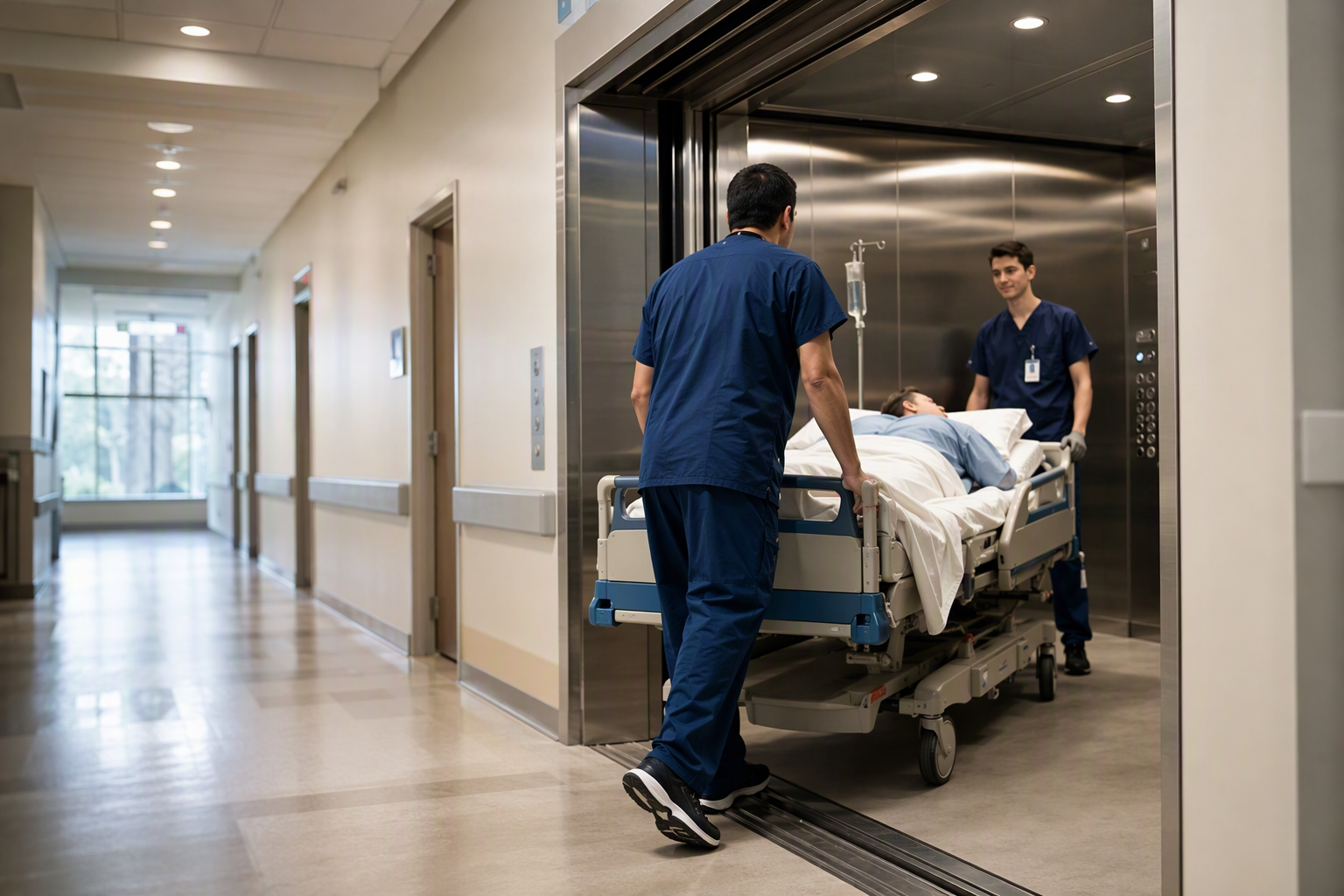
Commercial office buildings primarily need elevators that move people between floors efficiently. Hospital elevators must do that and accommodate hospital beds, transport stretchers, medical equipment carts, isolation patients, and emergency responder teams — often simultaneously, under infection-control protocols.
The core differences fall into five categories:
- Physical dimensions: Hospital transport elevators require cab dimensions large enough for a full-length hospital bed plus an attendant on each side.
- Door timing and sensors: Doors must remain open long enough for a bed or wheelchair to clear the threshold without activating a re-open sensor repeatedly.
- Surface materials: Interior finishes must resist hospital-grade disinfectants and minimize harboring pathogens.
- Emergency and firefighter service: Healthcare facilities depend on elevators during mass-casualty and fire events in ways offices do not.
- Inspection and documentation rigor: Joint Commission surveys, CMS Conditions of Participation, and South Carolina LLR inspections may all apply concurrently.
What South Carolina Code Applies to Hospital Elevators?
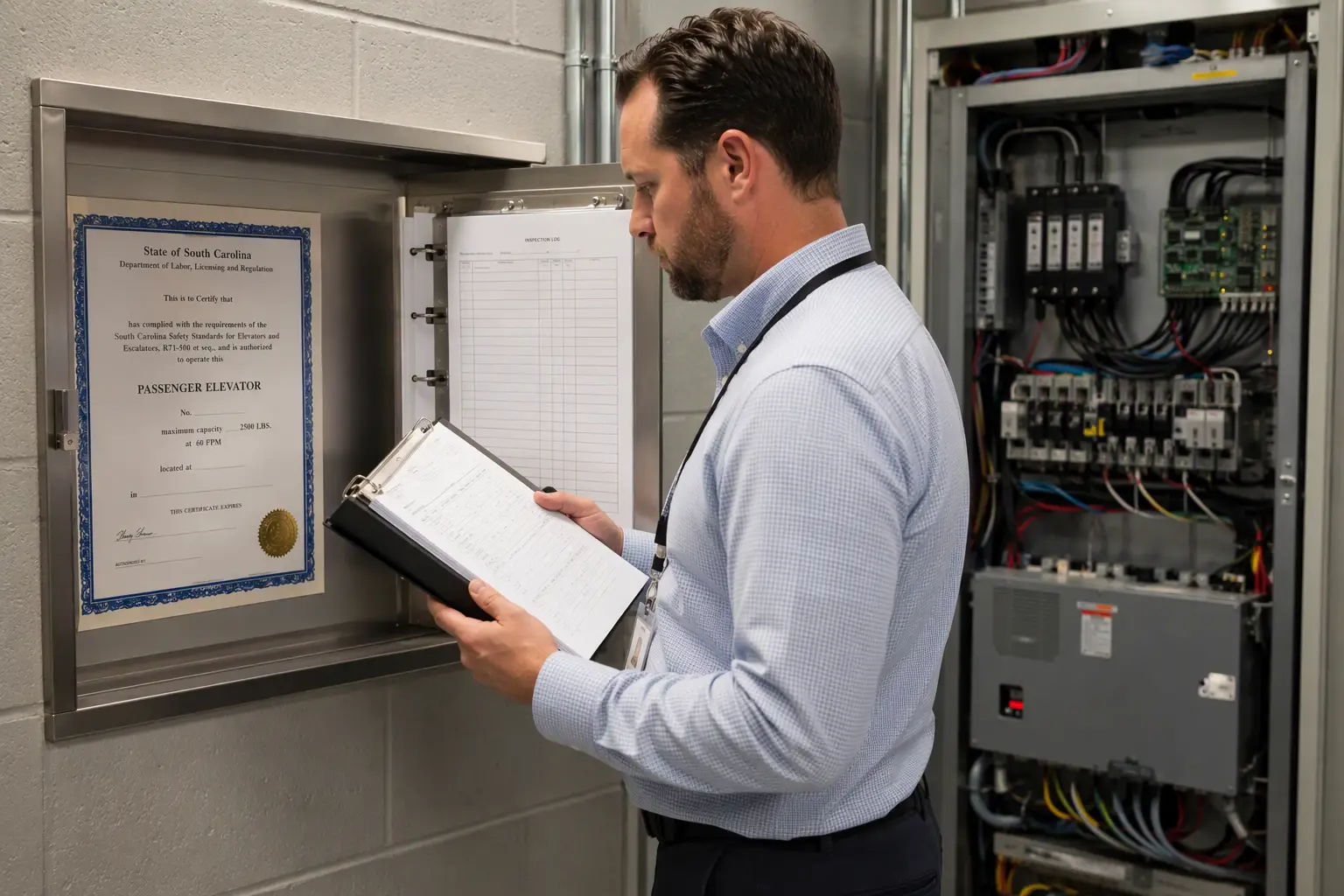
All elevators in South Carolina — including those in hospitals — are regulated by the South Carolina Department of Labor, Licensing and Regulation (LLR), Office of Elevators and Amusement Rides under S.C. Code Title 41, Chapter 16 (South Carolina Elevator Code) and S.C. Code of Regulations Chapter 71, Article 5, Regulations 71-5000 through 71-5700. The adopted technical standard is the ASME A17.1/CSA B44, 2019 edition, adopted in South Carolina effective July 23, 2021.
Key compliance obligations every hospital facility manager in Columbia must know:
- No elevator may operate without both a certificate of registration and a current operating certificate from the state.
- The operating certificate — or a copy — must be displayed conspicuously inside each elevator car at all times.
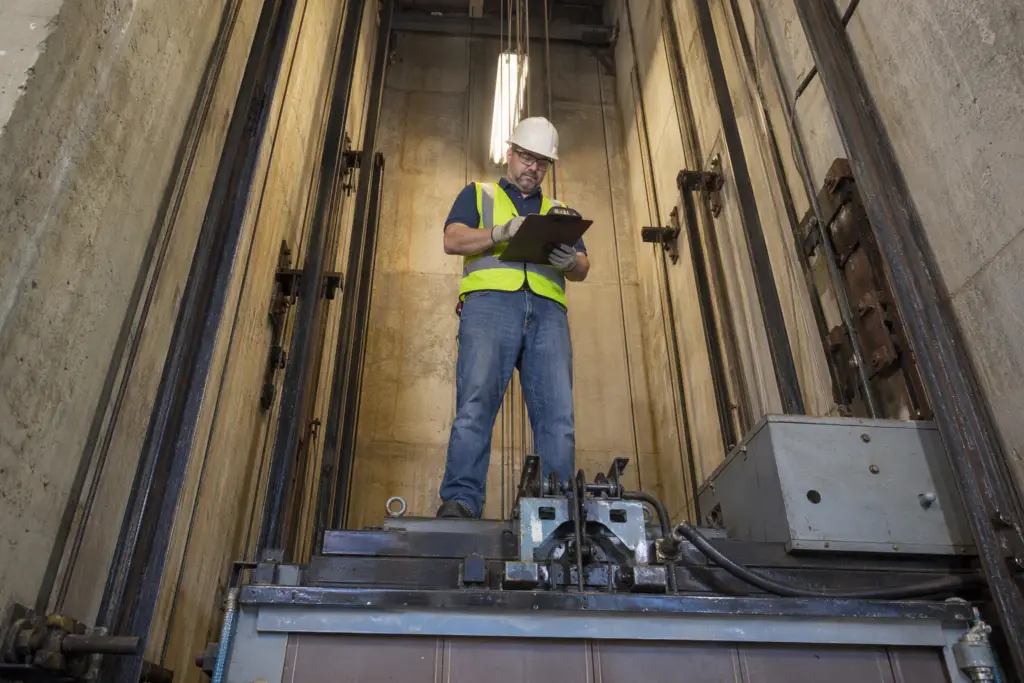
- Elevators must be inspected at installation, after any alteration or repair, and at least once every year before the operating certificate is renewed.
- A state construction permit is required before any elevator is erected, constructed, altered, or installed.
- Any accident that seriously injures someone other than an employee must be reported to the state before the end of the next working day.
- The owner — in this case the hospital or its facilities management entity — is legally responsible for keeping every elevator in safe operating condition and in compliance with state regulations.
- Passenger elevators in South Carolina must maintain standby power sufficient to run emergency lighting and the alarm bell for at least four hours if normal power fails.
- Firefighters’ service on new installations must use the five-pin S.C. #1000 key.
Hospitals must satisfy all of the above while layering on healthcare-specific operational requirements described below.
What ADA Requirements Apply to Hospital Elevators?
The Americans with Disabilities Act (ADA) sets baseline accessibility standards that apply to all public accommodations and commercial facilities, including hospitals. For elevators, ADA requirements address:
- Minimum cab interior dimensions sufficient for wheelchair maneuvering.
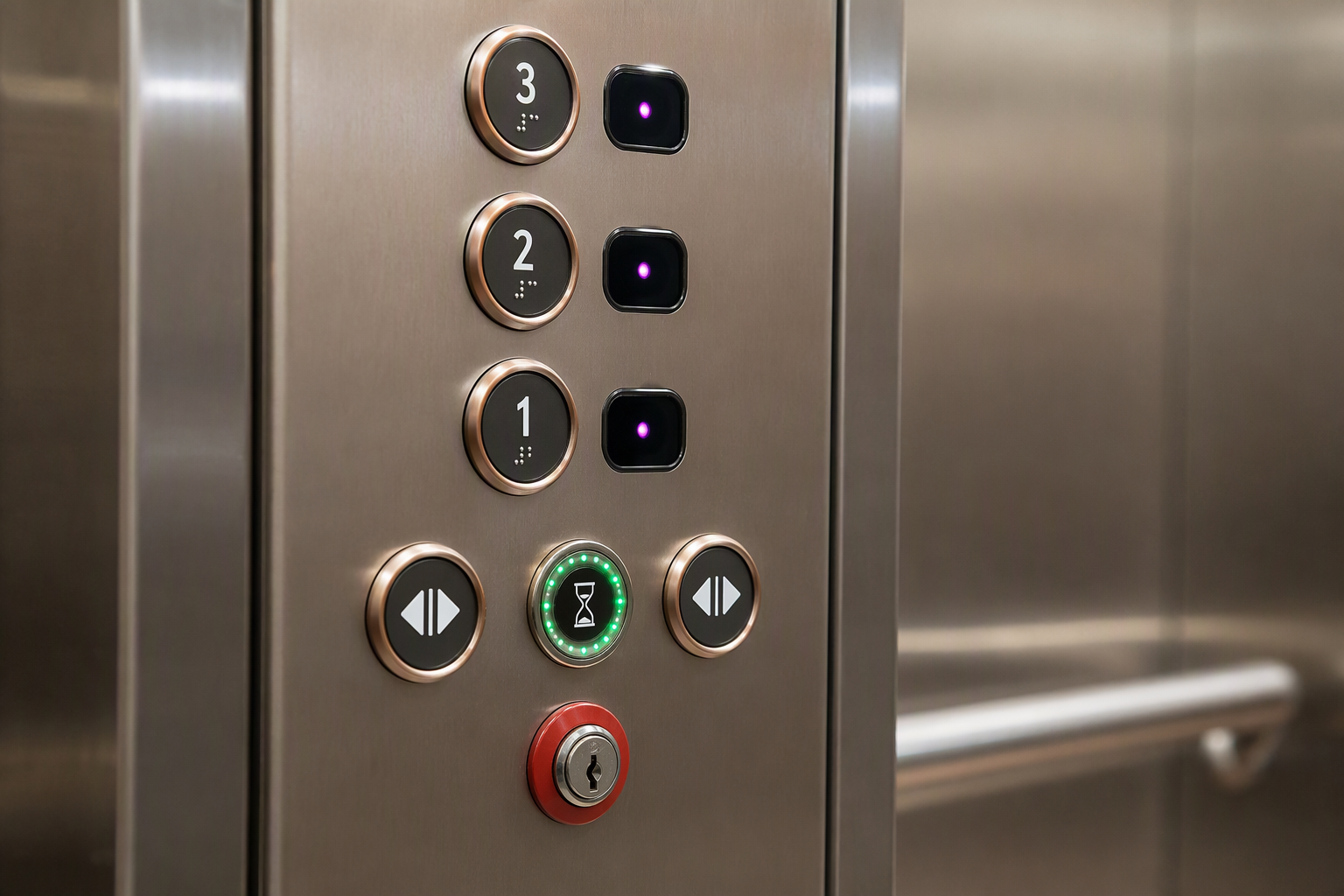
- Control panel button height, contrast, and Braille labeling.
- Audible and visual floor announcements.
- Door reopening devices that detect obstructions without requiring contact.
- Leveling accuracy so the cab floor is flush with the landing floor.
For hospitals, ADA compliance is the floor, not the ceiling. Patient transport demands typically push cab size and door timing well beyond ADA minimums, but ADA requirements establish the legally enforceable baseline that cannot be compromised during any upgrade or renovation.
What Physical Specifications Do Hospital Elevators Need That Office Buildings Don’t?
The single most significant physical difference is cab size. A standard office passenger elevator cab is sized for groups of standing occupants. A hospital needs dedicated transport elevators designed to carry a fully extended hospital bed, a patient, and at minimum one attendant — with enough remaining clearance for IV poles and monitoring equipment.
Beyond cab size, hospital elevators typically require:
- Extended door-open time: Standard door timing is optimized for foot traffic. Hospital transport elevators need configurable extended open times so that beds and equipment carts can pass through without triggering the door-close cycle mid-transit.
- Wide, reinforced doors: Hospital beds and bariatric transport equipment require wider door openings than standard commercial elevators provide.
- Smooth, flush thresholds: Any gap or lip between the cab floor and the landing can destabilize a stretcher or wheelchair, making precise leveling critical.
- Higher weight capacity: Bariatric patient transport, combined with equipment and staff, demands rated capacities that exceed typical commercial elevator specifications.
- Handrails on three walls: Patients in wheelchairs or on transport chairs benefit from continuous support rails, a feature not standard in office buildings.
What Infection Control Features Must Hospital Elevators Have?
Elevators are high-touch, enclosed surfaces that can contribute to pathogen transmission if not designed and maintained with infection control in mind. Standard commercial elevator interiors — brushed metal panels, plastic button covers, carpeted floors — are not compatible with hospital disinfection protocols.
Hospital elevator infection control upgrades include:
- Antimicrobial copper alloy or coated button panels: Copper-infused and antimicrobial-coated surfaces reduce pathogen survival between cleaning cycles on high-touch control panels.
- Hands-free call and floor selection options: Foot pedals, elbow actuators, and proximity sensors allow staff and patients to operate elevators without touching button surfaces.
- Non-porous interior wall panels: Stainless steel and high-pressure laminate surfaces rated for hospital-grade disinfectants (including bleach-based and quaternary ammonium solutions) replace porous materials that trap pathogens.
- Seamless, non-porous flooring: Sheet vinyl or epoxy-coated floors with sealed seams resist liquid ingress and can be thoroughly disinfected after transport of isolation patients.
- UV-C air purification systems: Some hospital facilities are incorporating ultraviolet germicidal irradiation (UVGI) units within elevator cab HVAC or cab air circulation systems to reduce airborne pathogen loads between trips.
- Easy-access ceiling panels: Cab ceilings that open or remove without special tools allow for thorough cleaning of overhead surfaces and lighting fixtures.
None of these features are standard in commercial building elevator specifications and most require either custom specification at installation or targeted retrofit upgrades.
What Emergency and Fire Service Requirements Are Unique to Healthcare Facilities?
Under ASME A17.1 as adopted in South Carolina, all passenger elevators must provide Phase I and Phase II firefighters’ emergency service. In South Carolina, new installations must use the five-pin S.C. #1000 key for firefighters’ service.
Hospitals, however, have emergency operation demands beyond standard Phase I/II recall:
- Standby and emergency power integration: South Carolina requires passenger elevators to maintain standby power for emergency lighting and the alarm bell for at least four hours. Hospital facilities must go further, ensuring that at least one elevator per bank remains fully operational on generator power for patient transport during power outages — a life-safety requirement under healthcare facility standards.
- Selective floor access during emergency: Hospital security systems often integrate with elevator controls to restrict floor access during lockdown events (active threat, pandemic isolation, or infant abduction protocols).
- Continuous operation under load: A hospital elevator must be capable of sustained high-frequency operation during a mass casualty event, placing demands on motor, brake, and door operator components that office building duty cycles do not approach.
- Interoperability with nurse call and building management systems: Many healthcare facilities require elevator controls that communicate with central building management systems for real-time status monitoring and priority dispatch.
How Do Inspection and Documentation Requirements Differ for Hospital Elevators?
South Carolina LLR requires annual inspections for standard passenger elevators, conducted by state inspectors or licensed special inspectors meeting the qualifications in the 2018 edition of QEI-1. Note that a special inspector may not inspect an elevator on which the inspector or the inspector’s employer has a current service or warranty contract — a critical conflict-of-interest rule that affects how hospitals structure their service and inspection relationships.
Hospital facilities face additional documentation layers beyond state LLR requirements:
- Joint Commission Environment of Care standards: Accredited hospitals must document preventive maintenance, deficiency correction timelines, and life-safety compliance for all vertical transportation equipment.
- CMS Conditions of Participation: Medicare- and Medicaid-participating facilities must maintain equipment to meet applicable life-safety codes, with elevator records subject to survey review.
- Incident reporting: South Carolina requires that any accident seriously injuring a non-employee be reported to the state before the end of the next working day — a timeline that requires hospitals to have clear internal escalation protocols in place before an incident occurs.
What Is the Step-by-Step Process for Bringing a Hospital Elevator Into Full Compliance?
- Conduct a baseline audit. Document the current condition of every elevator in the facility: cab dimensions, weight capacity, door timing, surface materials, emergency power connection, firefighters’ service configuration, and current certificate status with South Carolina LLR.
- Compare against ASME A17.1-2019 requirements. Review the adopted ASME A17.1/CSA B44, 2019 edition provisions as adopted in South Carolina and identify any existing installations that were permitted and built under earlier editions — older installations may have grandfather provisions but cannot fall below the minimum safety standards in effect at their original permit date.
- Identify healthcare-specific gaps. Layer ADA requirements, Joint Commission Environment of Care standards, and CMS life-safety requirements onto the ASME/LLR baseline to identify gaps specific to the healthcare use case.
- Obtain state construction permits for any planned alterations. A construction permit from South Carolina LLR is required before any elevator is altered or upgraded — this step must precede any physical work.
- Prioritize upgrades by risk. Triage deficiencies: life-safety gaps (emergency power, firefighters’ service, annual inspection overdue) take priority over functional upgrades (infection control surfaces, hands-free controls).
- Engage an independent, qualified service provider. Select a provider who does not also perform special inspections on the same equipment (per South Carolina’s conflict-of-interest rule) so that inspection independence is preserved.
- Schedule and pass the annual LLR inspection. Coordinate with a licensed special inspector or state inspector, obtain the renewed operating certificate, and display it conspicuously inside each elevator car.
- Establish a preventive maintenance schedule. Document all maintenance activities in a format that satisfies both LLR requirements and Joint Commission survey expectations.
- Train facilities staff on incident reporting obligations. Ensure the team knows that any accident seriously injuring a non-employee must be reported to the state before the end of the next working day.
- Schedule the next audit cycle. Build annual compliance reviews into the facility’s environment-of-care calendar to prevent certificate lapses.
Hospital Elevator Features: Comparison Table — Healthcare vs. Standard Commercial
| Feature / Requirement | Standard Commercial Elevator | Hospital / Healthcare Elevator | Why It Matters for Hospitals |
|---|---|---|---|
| Cab Dimensions | Sized for standing passengers | Must accommodate full hospital bed + attendants | Patient transport safety; cannot retrofit easily |
| Door Open Time | Standard timing for pedestrian traffic | Extended, configurable for bed/equipment clearance | Prevents door contact with patients or equipment |
| Weight Capacity | Standard passenger load | Higher capacity for bariatric transport + equipment | Bariatric patients; medical equipment carts |
| Interior Surfaces | Standard finishes; may include carpet, plastic | Non-porous, disinfectant-compatible materials | Infection control; chemical resistance |
| Control Panels | Standard buttons; ADA compliant | Antimicrobial coatings, hands-free options, ADA | Reduces pathogen transmission at high-touch points |
| Flooring | Carpet or standard commercial tile | Seamless, non-porous, sealed sheet vinyl or epoxy | Full disinfection capability; no seam harboring |
| Handrails | Typically one side or none | Three-wall handrails standard | Patient stability; ADA compliance for healthcare |
| Firefighters’ Service | Phase I & II; S.C. #1000 key (new installs) | Phase I & II + generator integration for full operation | Patient evacuation cannot rely on stairs alone |
| Emergency / Standby Power | 4-hour lighting & alarm bell (SC code minimum) | Full operation on generator for at least one car per bank | Continuous patient transport during power outage |
| Air Quality | Standard ventilation | UVGI / antimicrobial HVAC options available | Airborne infection risk reduction |
| Access Control Integration | Basic key switch or card reader | Full BMS / security system integration | Lockdown protocols; floor-access restriction |
| Annual Inspection (SC LLR) | Required annually | Required annually + Joint Commission / CMS documentation | Dual compliance obligation; survey-ready records |
| Incident Reporting | Next-business-day reporting for serious injuries | Same + internal escalation protocols required | Hospital must have clear internal chain of response |
Hospital Elevator Upgrade Options: Pros, Cons, and Considerations
| Upgrade | Pros | Cons | Best For |
|---|---|---|---|
| Antimicrobial control panel retrofit | Immediate infection risk reduction; no construction permit required in most cases; minimal downtime | Does not address cab dimensions or door timing; must be reapplied as panels wear | Facilities needing quick infection control wins on existing equipment |
| Hands-free call / floor selection controls | Reduces touch points significantly; popular with staff and patients; retrofittable | Technology reliability varies by product; requires staff training | High-traffic hospital lobbies, ICU floors, isolation wings |
| Interior panel replacement (non-porous surfaces) | Long-term infection control; durable; improves appearance; compatible with all disinfectants | Requires cab downtime; may trigger alteration permit with LLR | Facilities undergoing planned renovation or modernization |
| Door operator and timing upgrade | Directly improves patient transport safety; configurable open times; reduces door-contact incidents | Alteration permit required from LLR; skilled labor intensive | Any hospital transport elevator with standard commercial door timing |
| Generator / standby power integration | Ensures continuous patient transport during outages; life-safety compliance | Significant electrical infrastructure investment; coordination with facilities engineering | All hospitals; critical for facilities without full generator integration |
| UVGI cab air purification | Reduces airborne pathogen load; increasingly specified in healthcare | Emerging technology; requires maintenance of UV lamp units; installation coordination | Infectious disease units; transplant floors; high-acuity patient areas |
| Full elevator modernization / replacement | Addresses all deficiencies simultaneously; modern controls; full code compliance; longest service life | Highest cost and longest downtime; requires full LLR permit process | Older installations with multiple compounding deficiencies |
What Are the Most Common Compliance Failures Found in Hospital Elevators?
Based on the requirements in South Carolina’s adopted codes and healthcare accreditation standards, the most frequently identified gaps in hospital elevator compliance include:
- Expired or missing operating certificate: The operating certificate must be displayed inside the cab at all times. Lapses in annual inspection scheduling create immediate compliance violations under South Carolina LLR.
- Inadequate standby power: South Carolina requires four hours of emergency lighting and alarm bell operation. Many older installations do not have full generator integration for patient transport operations — a gap that goes beyond code minimum but is required for healthcare facility life-safety standards.
- Firefighters’ service key non-compliance: New installations that do not use the South Carolina five-pin S.C. #1000 key are non-compliant under state code.
- Door timing not calibrated for patient transport: Standard commercial door timing is frequently carried over into hospital installations without adjustment, creating repeated door-contact incidents during bed transport.
- Missing or inadequate preventive maintenance records: Joint Commission surveyors routinely cite hospitals for gaps in elevator maintenance documentation even when the physical equipment is in good condition.
- Porous or damaged interior surfaces: Cracked or delaminated interior panels trap pathogens and cannot be effectively disinfected — a Joint Commission Environment of Care finding that also represents a patient safety risk.
How Should a Hospital Choose an Elevator Service Provider in Columbia, SC?
Selecting an elevator service partner for a healthcare facility involves considerations that go beyond what a commercial office building would evaluate. Hospital facility managers in Columbia should assess prospective providers against the following criteria:
- Independence from inspection: South Carolina law prohibits a special inspector from inspecting an elevator on which the inspector or their employer holds a current service or warranty contract. A hospital must structure its service and inspection relationships to preserve this independence and avoid creating a conflict that could invalidate an inspection.
- Familiarity with healthcare-specific requirements: Service providers who specialize in or regularly work in healthcare settings understand the layered compliance obligations — LLR, ADA, Joint Commission, CMS — rather than treating the facility as a standard commercial client.
- Documentation capability: The provider must be able to supply preventive maintenance records, deficiency reports, and corrective action documentation in the format required for Joint Commission Environment of Care surveys.
- Permit and alteration process knowledge: Any upgrade or alteration requires a South Carolina LLR construction permit. The service provider must initiate and manage this process correctly to avoid unauthorized work that could void operating certificates.
- Emergency response capability: Hospital elevators support life-safety functions. The service provider’s response capability for unplanned outages or equipment failures is a material factor — not just a preference.
Carolina Elevator Service is an independent elevator service company serving healthcare facilities and other commercial clients throughout South Carolina. As an independent provider, Carolina Elevator Service maintains the structural independence from special inspection functions that South Carolina law requires, and brings familiarity with the layered compliance environment that Columbia-area hospitals and healthcare systems navigate. Facility managers looking for a service partner who understands the difference between a commercial and a clinical elevator environment are encouraged to reach out directly.
What Should a Hospital Do Immediately If an Elevator Fails or Causes an Injury?
- Ensure the safety of any occupants. If anyone is trapped, contact emergency services immediately. Do not allow unauthorized personnel to attempt mechanical extraction.
- Take the affected elevator out of service. Post clear out-of-service notice and prevent further use until the equipment is inspected and cleared by a qualified party.
- Assess for serious injuries. If any non-employee has been seriously injured, the hospital must report the incident to the South Carolina Department of Labor, Licensing and Regulation (LLR) before the end of the next working day. Do not delay this notification.
- Document the incident thoroughly. Capture time, location, parties involved, nature of the malfunction, and any observable mechanical condition before the scene is disturbed.
- Contact a qualified elevator service provider. Schedule an inspection and diagnosis. Do not return the elevator to service until it has been inspected and any required repairs completed.
- Notify your Joint Commission and CMS compliance team. Depending on the nature of the event, healthcare accreditation and certification standards may require internal incident reporting and root-cause analysis.
- Obtain updated inspection and operating certificate documentation. After any significant repair or alteration, coordinate the required LLR inspection to ensure the operating certificate remains current before returning the elevator to service.
Does South Carolina Code Apply Differently to Hospital Elevators Than Other Buildings?
The South Carolina Elevator Code (S.C. Code Title 41, Chapter 16) applies uniformly to all covered elevator facilities — it does not create a separate regulatory tier for hospitals. What creates the layered complexity for healthcare facilities is the simultaneous application of federal requirements (ADA, CMS Conditions of Participation, OSHA life-safety standards) and voluntary accreditation standards (Joint Commission) on top of the state elevator code baseline.
This means a hospital elevator can be fully compliant with South Carolina LLR requirements and still have deficiencies identified in a Joint Commission survey — or vice versa. Comprehensive compliance for a Columbia-area hospital requires satisfying all applicable layers, not just the state code in isolation.
The Occupational Safety and Health Administration (OSHA) also has jurisdiction over employee safety in healthcare settings, which intersects with elevator maintenance obligations when employees perform work in or around elevator equipment or are injured by elevator malfunctions.
Summary: Key Decision Factors for Hospital Elevator Compliance in Columbia, SC
- All hospital elevators in South Carolina must hold a current operating certificate from LLR and display it inside the cab — annual inspection is the non-negotiable baseline.
- Healthcare-specific requirements for cab size, door timing, infection control surfaces, emergency power, and documentation go substantially beyond the commercial baseline.
- Any alteration, upgrade, or installation requires a South Carolina LLR construction permit before work begins.
- The conflict-of-interest rule for special inspectors means hospitals must carefully structure their service and inspection relationships.
- Infection control upgrades — antimicrobial panels, hands-free controls, non-porous surfaces — are not required by state elevator code but are required by healthcare operational and accreditation standards.
- Full generator integration for patient transport operation exceeds the state code minimum for standby power and is a healthcare life-safety requirement.
- Incident reporting to LLR within one business day for serious non-employee injuries is a legal obligation, not a discretionary step.
Get a Free Hospital Elevator Assessment From Carolina Elevator Service
Carolina Elevator Service works with healthcare facilities across South Carolina to identify compliance gaps, plan upgrades, and maintain elevator equipment to the standard that patient safety and regulatory requirements demand. Whether a facility is facing an upcoming Joint Commission survey, planning a capital upgrade, or simply needs to confirm that its elevators meet every applicable South Carolina and federal requirement, the team at Carolina Elevator Service is ready to help.
Contact Carolina Elevator Service for a free elevator assessment: 803-865-1400
Need elevator service you can rely on? Carolina Elevator Service is ready to help.