Hotel Elevator Upgrades: What Makes the Most Sense to Keep Guests Satisfied and Reduce Complaints
The most impactful hotel elevator upgrades for guest satisfaction and complaint reduction are destination dispatch technology, modernized cab finishes and lighting, high-performance door systems, ADA-compliant fixtures, and remote monitoring platforms. These upgrades shorten perceived wait times, eliminate the most common mechanical failure points, improve accessibility compliance under the Americans with Disabilities Act, and give engineering staff the real-time data needed to stop problems before guests ever notice them.
Why do hotel guests complain about elevators more than any other building system?

Elevator complaints dominate hotel reviews because guests interact with elevators repeatedly throughout every stay, and even a single slow or rough ride becomes a memorable frustration.
Unlike HVAC or plumbing issues that guests may tolerate quietly, an elevator delay happens in a public, high-visibility space where multiple guests experience it simultaneously. Long lobby waits, doors that hesitate or reverse unexpectedly, noisy cab rides, and outdated interiors all register as signals that a property is poorly maintained. For full-service hotels with multiple elevator banks, a single unit taken out of service during peak checkout can cascade into delays that affect dozens of guests within minutes. Understanding this complaint sensitivity is the starting point for any smart upgrade investment.
What is destination dispatch and why is it the top recommended upgrade for busy hotels?
Destination dispatch is a control system that groups passengers traveling to the same floor into the same car before they board, dramatically reducing the number of stops per trip and cutting average lobby wait times.
In a conventional system, passengers press an up or down button and board whichever car arrives first regardless of destination. Destination dispatch replaces hallway buttons with keypads or touchscreens where guests enter their floor before they board. The system’s algorithm assigns them to a specific car already headed to that zone. The result is fewer unnecessary stops, shorter ride times, and more efficient distribution of traffic across the entire elevator bank. For hotels with high peak-hour traffic — breakfast service, checkout, and convention breaks — destination dispatch is the single upgrade that produces the most measurable reduction in guest wait-time complaints. The system is compatible with key card integration, allowing room assignments to link directly to floor access permissions, which also strengthens security.
Which mechanical components cause the most elevator service interruptions in hotel environments?
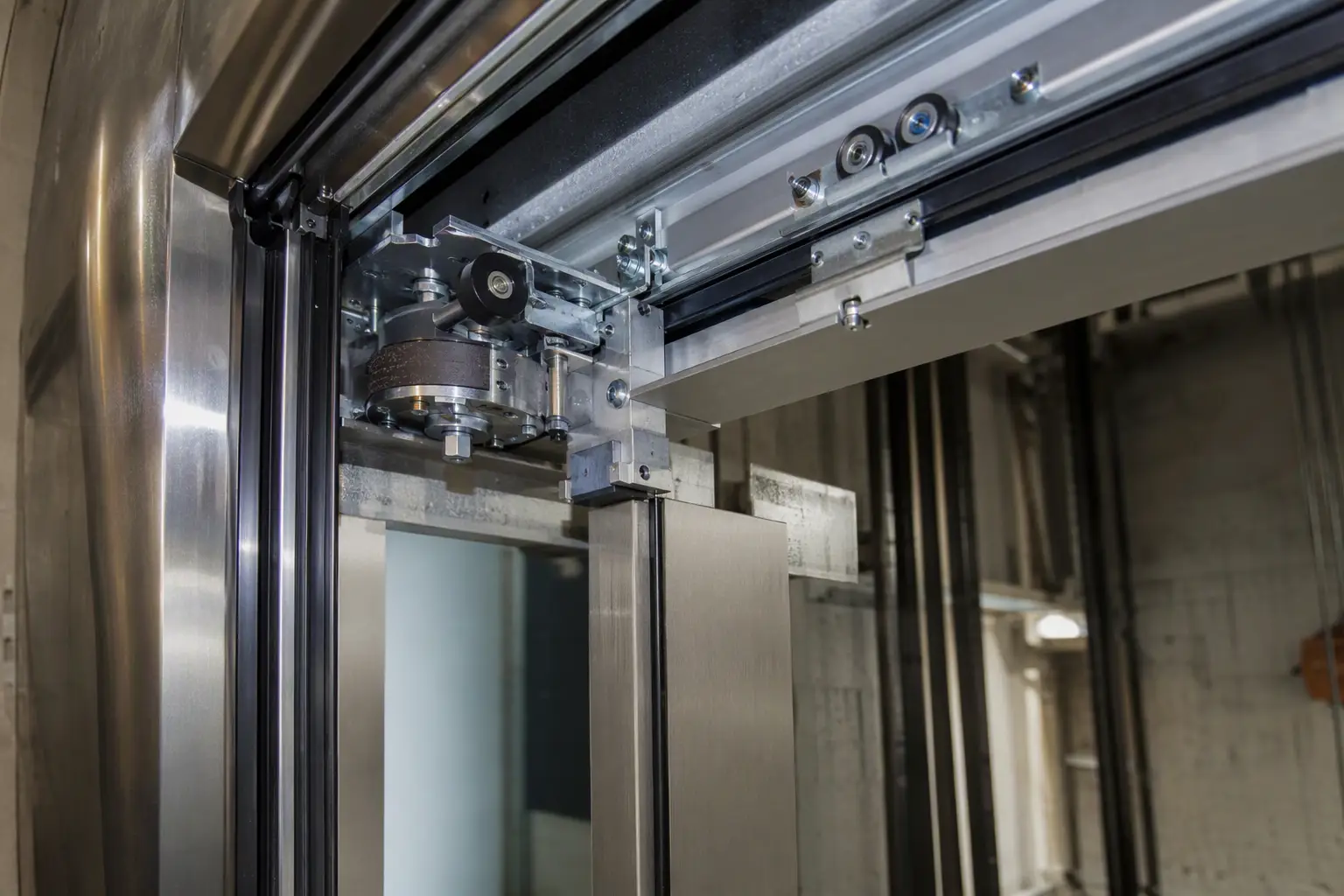
Door operator systems, including the clutch mechanism, rollers, gibs, and safety edges, are responsible for the largest share of unplanned elevator shutdowns in any high-traffic commercial building.
Hotel elevators cycle their doors far more frequently than office or retail elevators because guests board in small groups, often carrying luggage that interrupts the door close cycle. Worn door clutch mechanisms cause the car door and hoistway door to fall out of sync, triggering safety circuits that take the unit out of service. Outdated safety edges — the mechanical rubber edges that reverse a closing door on contact — are slower to respond and more prone to false triggers than modern multibеam light curtain systems. Upgrading to a current-generation door operator with a full-coverage infrared light curtain eliminates the majority of door-related service calls and is one of the highest return-on-investment mechanical upgrades available. Hydraulic units in older hotel properties may also have aging cylinders; South Carolina regulations require that newly installed underground hydraulic elevator cylinders be encased in plastic outer containment to limit electrolytic corrosion, and properties still operating pre-1986 equipment must meet the requirements of the 1986 edition of ANSI A17.3 for existing elevators.
How does a cab interior modernization reduce guest complaints?
An updated cab interior directly changes how guests perceive elevator quality, with worn flooring, scratched panels, and flickering lighting being the most commonly photographed and reviewed complaints on hospitality platforms.
Cab interior modernization typically includes replacing wall panel systems with stainless steel, laminate, or decorative glass; installing LED lighting with color temperature calibrated for a welcoming environment; replacing flooring with slip-resistant luxury vinyl or stone tile; and upgrading the ceiling to a flush panel design that conceals aging fixtures. These are not cosmetic luxuries — scuffed and dented interiors signal to guests that maintenance is deferred, which generalizes into lower confidence in the property’s overall safety and cleanliness. LED lighting upgrades also carry an operational benefit: LED fixtures last significantly longer than fluorescent alternatives and consume less energy, reducing ongoing maintenance frequency. When scheduling a cab interior project, properties should coordinate timing with low-occupancy periods to minimize the number of units out of service simultaneously.
What ADA compliance upgrades are hotels legally required to consider?
The Americans with Disabilities Act requires that elevators serving public accommodations meet specific standards for control height, button size, audible and visible floor signals, Braille markings, and door timing — any hotel that has undergone alteration must bring elevator elements into compliance.
Common ADA deficiencies found in older hotel elevators include control panels mounted too high for wheelchair users, buttons without raised characters or Braille, and door-open times that close before a guest using mobility aids can board safely. The ADA requires elevator buttons to be raised and at least three-quarters of an inch in their smallest dimension, floor indicators to provide both audible and visual signals, and door reopening devices to be provided. Hotels undergoing renovation should use that project as an opportunity to audit and remediate ADA elevator compliance simultaneously, since alterations trigger broader accessibility requirements. Carolina Elevator Service conducts ADA compliance reviews as part of its elevator assessments for Columbia SC hotel properties, helping ownership understand current gaps before they become complaints or enforcement issues.
What is remote monitoring and how does it prevent guest-facing elevator failures?
Remote elevator monitoring uses sensors and connected controllers to transmit real-time performance data — door cycle counts, motor temperature, leveling accuracy, fault codes — to a service platform where technicians can identify developing problems before they cause a shutdown.
Traditional elevator service is reactive: a unit fails, a guest complains, staff call for service, and a technician responds. Remote monitoring inverts this model by flagging anomalies — an increase in door retries, a hydraulic pressure drop, a controller fault code — before the system reaches the threshold of failure. For hotels, the practical benefit is that engineering staff receive alerts during overnight hours when staffing is minimal, and service providers can often resolve software-based faults remotely or dispatch a technician before the first guest of the day encounters a problem. Modern monitoring platforms also generate maintenance logs that are useful during annual inspections required under South Carolina’s elevator regulations administered by the South Carolina Department of Labor, Licensing and Regulation (LLR), Office of Elevators and Amusement Rides.
How do hotel elevator upgrades align with South Carolina’s inspection and compliance requirements?
South Carolina requires passenger elevators to be inspected at least once per year before the operating certificate is renewed, and any alteration or repair triggers an additional inspection — meaning upgrade projects must be coordinated with the permitting and inspection process from the start.
Under S.C. Code Title 41, Chapter 16 and S.C. Code of Regulations Chapter 71, Article 5, no elevator facility may be operated in South Carolina without a certificate of registration and a current operating certificate, which must be displayed conspicuously inside each elevator car. A state construction permit is required before any elevator facility is erected, constructed, altered, or installed. Elevators in new or substantially altered installations must comply with the ASME A17.1/CSA B44 2019 edition, which South Carolina adopted effective July 23, 2021. Hotels planning upgrades should build permit timelines into project schedules: beginning physical work without the required construction permit places the operating certificate at risk and can force a unit out of service until a compliant inspection is completed. South Carolina also requires that passenger elevators have standby power capable of running emergency lighting and the alarm bell for at least four hours if normal power fails — a requirement hotels should verify is met before beginning any unrelated cab modernization that involves electrical work.
What is a modernization project versus a full replacement, and which is right for most hotels?
A modernization retains the existing hoistway and structural components while replacing the drive system, controller, cab, and safety systems; a full replacement removes everything including the hoistway structure — modernization is appropriate for the vast majority of hotel elevators.
Full hoistway replacement is typically reserved for situations where the structural shaft itself is compromised, or where the building is undergoing a complete gut renovation. For most hotels with elevators installed in the 1980s through early 2000s, a phased modernization is the financially and operationally sensible path. A typical hotel elevator modernization might progress through controller and drive replacement first (the highest safety and reliability payoff), followed by door operator and safety edge upgrades, then cab interior and fixture renovation, and finally destination dispatch or monitoring integration. This phased approach allows the property to budget across multiple capital cycles and minimize periods when multiple units are simultaneously offline.
How should a hotel prioritize elevator upgrades when working with a limited capital budget?
Hotels with constrained budgets should prioritize upgrades in the order of their compliance risk, safety impact, and guest-complaint frequency: controller and drive modernization first, door systems second, ADA fixtures third, and aesthetics fourth.
The table below provides a framework for evaluating common hotel elevator upgrades across key decision criteria.
| Upgrade Type | Primary Benefit | Complaint Category Addressed | Compliance Trigger | Relative Priority |
|---|---|---|---|---|
| Controller & Drive Modernization | Reliability, ride quality, code compliance | Breakdowns, rough rides, leveling errors | ASME A17.1-2019 / S.C. permit required | Highest |
| Door Operator & Light Curtain Upgrade | Reduced service calls, guest safety | Doors stalling, reversing, not closing | ASME A17.1-2019 reopening device requirements | High |
| ADA Controls & Signage | Legal compliance, accessibility | Accessibility complaints, ADA enforcement | ADA public accommodation requirements | High |
| Remote Monitoring System | Predictive maintenance, uptime | Unplanned outages, after-hours failures | Supports annual inspection documentation | Medium-High |
| Cab Interior Modernization | Guest perception, brand image | Aesthetic complaints, cleanliness concerns | None directly; may trigger ADA review | Medium |
| Destination Dispatch System | Traffic efficiency, wait time reduction | Long lobby waits, crowded cars | None directly; requires controller compatibility | Medium (high for large properties) |
| LED Lighting & Ventilation | Energy efficiency, comfort | Hot cabs, poor lighting | ASME A17.1 ventilation requirements | Lower |
| Standby Power Upgrade | Code compliance, emergency safety | Power-failure entrapments | S.C. four-hour emergency power requirement | High if not currently compliant |
How long does a typical hotel elevator modernization project take?
A single-elevator controller and drive modernization typically takes one to two weeks of active work per unit, while a full cab-inclusive modernization on a multi-elevator hotel bank may run four to eight weeks when units are taken down sequentially to keep service available.
Scheduling is the most operationally sensitive aspect of hotel elevator upgrades. Properties should plan major work during low-occupancy periods, coordinate with the South Carolina LLR permit and inspection timeline, and maintain at minimum one elevator in full service at all times during construction. A construction permit from the state must be in hand before physical work begins; inspection after alteration is a statutory requirement before the unit returns to service. Carolina Elevator Service works with Columbia SC hotel engineering teams and management to develop phased project schedules that keep the property compliant and operational throughout the upgrade process.
What should hotels do immediately when an elevator is taken out of service unexpectedly?
When an elevator unexpectedly goes out of service in a hotel, the property’s engineering and management team should follow a clear sequence to protect guest safety, meet legal reporting obligations, and restore service as quickly as possible.
- Secure the elevator and post clear, professionally worded signage at every affected landing indicating the unit is out of service.
- Verify no guests are entrapped; if entrapment is suspected, contact emergency services immediately — do not attempt self-rescue.
- Notify the front desk and management immediately so staff can assist guests with luggage and direct them to operational units or accessible stairways.
- Contact a qualified elevator service provider to diagnose and document the fault — do not attempt unauthorized repairs, as any repair triggers the state inspection requirement.
- If the incident involved a serious injury to anyone other than an employee, South Carolina law requires the owner to report the accident to the state before the end of the next working day.
- Do not return the unit to service until required inspections are completed and a valid operating certificate is in place.
- Document the incident, the response, and all service records for compliance files.
How does elevator cab ventilation affect guest comfort and code compliance?
Inadequate cab ventilation makes guests feel confined and overheated, particularly when cars are loaded with luggage or guests in warm weather, and ventilation is an area addressed within the ASME A17.1 Safety Code for Elevators and Escalators.
Hotels in South Carolina face a specific climate challenge: summer humidity and heat mean guests arrive at elevator lobbies already warm, and a poorly ventilated cab amplifies discomfort immediately. Ventilation upgrades can range from simple fan replacement to integration of low-profile HVAC supply air directly into the cab ceiling or return panel. When combined with an LED lighting upgrade that reduces heat output from fixtures, improved ventilation measurably changes the in-cab environment. This upgrade is lower in priority than safety-critical components but delivers a clear guest comfort return, particularly in properties that see high summer occupancy.
Are there elevator upgrades specifically required before South Carolina operating certificates are renewed?
South Carolina does not publish a prescriptive list of upgrades required at each renewal, but the annual inspection process administered by the LLR identifies any deficiencies that must be corrected before a certificate is issued — and older equipment is more likely to generate deficiency findings that mandate remediation.
The annual inspection evaluates the elevator against the applicable code edition: ASME A17.1-2019 for equipment installed or altered since July 23, 2021, and the 1986 edition of ANSI A17.3 for equipment that was in operation before July 1, 1986. Deficiencies found during inspection are not optional; the operating certificate cannot be renewed until they are corrected and the unit re-inspected. For this reason, proactive modernization — addressing components before they generate inspection deficiencies — is less disruptive and often less expensive than reactive compliance remediation after a failed inspection. South Carolina also requires that inspections be performed only by state inspectors or licensed special inspectors, and a special inspector may not inspect an elevator on which they or their employer has a current service or warranty contract, meaning independence in the inspection process is structurally protected.
How do key card integration and security upgrades fit into a hotel elevator modernization?
Elevator access control integration with the hotel’s key card or mobile key system restricts floor access to registered guests, reduces unauthorized floor access complaints, and can be layered onto destination dispatch or conventional controllers during a modernization project.
Access control upgrades require coordination between the elevator controller, the property management system, and the door lock platform. Modern elevator controllers designed for hospitality applications have card reader ports built into the fixture package, allowing the property to assign floor permissions tied directly to room assignments. This means a guest assigned to the fourth floor cannot access the executive lounge on the twelfth floor without authorization. From a complaint-reduction standpoint, access control also reduces noise and disturbance complaints caused by guests on incorrect floors late at night. Properties pursuing destination dispatch will find that access control integration is architecturally natural, since both systems converge on floor-level passenger routing logic.
What questions should a hotel ask when evaluating elevator service and upgrade contractors in Columbia SC?
Hotels evaluating elevator contractors should ask about familiarity with South Carolina’s LLR permit and inspection process, experience with hospitality-specific traffic patterns, ability to phase work around occupancy calendars, and whether the contractor’s inspectors are independent from the servicing relationship as required by state law.
Because South Carolina law prohibits a special inspector from inspecting an elevator on which their employer has a current service contract, hotels should understand whether their service provider uses independent third-party inspection, state inspectors, or manages that relationship through a separate entity. Other evaluation points include the contractor’s familiarity with the specific drive and controller brands installed in the property, access to manufacturer-authorized parts, and documented experience with full controller modernizations in occupied hotel environments. Carolina Elevator Service serves Columbia SC hotel properties and brings familiarity with the LLR permitting process and the South Carolina regulatory framework that governs every phase of an upgrade project.
How does leveling accuracy affect guest experience and what upgrades address it?
Poor floor leveling — when the elevator car stops slightly above or below the landing threshold — creates a trip hazard for all guests and a serious accessibility barrier for guests using wheelchairs or mobility aids, and is one of the most frequently cited mechanical deficiencies in older hydraulic and traction systems.
Leveling accuracy degrades over time as controllers age, hydraulic fluid loses viscosity calibration, or traction systems develop rope stretch and sheave wear. Modern solid-state controllers with encoder-based positioning systems maintain leveling within tight tolerances across the full operating life of the drive. For hydraulic elevators common in low-to-mid-rise hotel buildings, valve replacement and controller upgrades typically restore leveling performance without requiring a full drive system replacement. Correcting leveling issues simultaneously addresses a guest safety concern, an ADA compliance gap, and a frequent complaint category — making it one of the most efficient targeted upgrades available.
What role does machine room-less (MRL) technology play in hotel elevator upgrades?
Machine room-less traction technology eliminates the need for a dedicated overhead machine room by placing the drive motor and controller in the hoistway itself, freeing valuable penthouse or rooftop space and reducing energy consumption compared to older geared traction machines.
For hotels considering full modernization rather than component-level upgrades, MRL traction systems offer a meaningful efficiency advantage and can be retrofitted into existing hoistways in many mid-rise hotel configurations. The absence of a separate machine room also reduces the footprint of mechanical equipment that must be temperature-controlled and accessed by maintenance personnel, which has both operating cost and logistics benefits. Hotels that currently operate older geared traction machines will find that MRL conversion, when structurally feasible, produces the most substantial long-term operating cost improvement of any modernization path. Any such conversion in South Carolina requires a state construction permit and post-completion inspection before the unit returns to service.
How should hotels document elevator upgrades to protect their operating certificates and manage liability?
Hotels should maintain a complete file for each elevator unit that includes the current operating certificate, all construction permits, inspection reports, maintenance records, and documentation of every repair or alteration — this file is the property’s primary defense in the event of an inspection deficiency finding, a guest injury claim, or an insurance audit.
South Carolina law places the responsibility for maintaining every elevator facility in safe operating condition squarely on the owner. The operating certificate must be displayed conspicuously inside the car at all times. When upgrades are completed, the permit, the post-alteration inspection report, and the updated certificate should be added to the unit’s file immediately. Remote monitoring platforms that generate timestamped service logs strengthen this documentation posture significantly, as they create an objective record of maintenance activity independent of paper work orders. Carolina Elevator Service provides Columbia SC hotel clients with documentation support through the upgrade and inspection process, helping ensure the administrative requirements of South Carolina’s elevator regulations are met alongside the physical work.
What is the expected service life of upgraded elevator components, and how does that affect upgrade planning?
Modern elevator controllers typically carry a service life of twenty or more years, door operators and safety edges ten to fifteen years under heavy commercial use, and cab interior components are generally replaced on a cosmetic refresh cycle of ten to fifteen years depending on traffic and brand standards.
Understanding component service lives allows hotel ownership to plan capital expenditures rather than respond to failures reactively. A property that modernizes its controller and drive today should plan for door operator evaluation within a decade, and can project cab refresh needs based on occupancy levels and brand refresh cycles. This planning horizon is also important for South Carolina compliance: as the state’s adopted code edition advances over time, equipment installed or altered under a newer permit will be inspected against the code in effect at the time of that permit. Hotels that modernize incrementally rather than all at once may find that different components of the same unit are evaluated against different code editions, making comprehensive upgrade planning with an experienced contractor essential.
How can a hotel get started with an elevator upgrade assessment in Columbia SC?
The first step is a professional elevator assessment that inventories the current equipment, identifies compliance gaps, documents maintenance history, and produces a prioritized upgrade recommendation tied to the property’s occupancy patterns and capital planning cycle.
An assessment should cover the controller and drive condition, door system performance, cab interior and fixture status, ADA compliance gaps, standby power adequacy against South Carolina’s four-hour emergency requirement, and the current status of the operating certificate and inspection records. For Columbia SC hotels, Carolina Elevator Service provides these assessments as the foundation for any upgrade planning conversation, giving ownership and engineering leadership the technical detail needed to make informed capital decisions without committing to a scope of work prematurely.
Ready to Improve Guest Satisfaction and Reduce Elevator Complaints?
Contact Carolina Elevator Service for a free elevator assessment at your Columbia SC hotel property. The team will evaluate your current equipment, identify compliance gaps, and recommend a prioritized upgrade plan aligned with your occupancy calendar and capital budget.
Call Carolina Elevator Service today: 803-865-1400
Serving hotel and commercial properties throughout Columbia, SC. All upgrade work is coordinated with the South Carolina Department of Labor, Licensing and Regulation (LLR) permitting and inspection process from start to finish.
Need elevator service you can rely on? Carolina Elevator Service is ready to help.