Elevator Emergency Phone Number: Who to Call, When to Call, and What to Do
Contact your licensed elevator service contractor immediately for any elevator emergency. In Columbia SC, building managers should keep Carolina Elevator Service’s number at 803-865-1400 posted in every machine room and at the building security desk. For passenger entrapments, call 911 first, then your service contractor. For non-entrapment mechanical failures, contact your service contractor directly and take the unit out of service until a qualified technician inspects it.
Who Should Be on an Elevator Emergency Contact List?
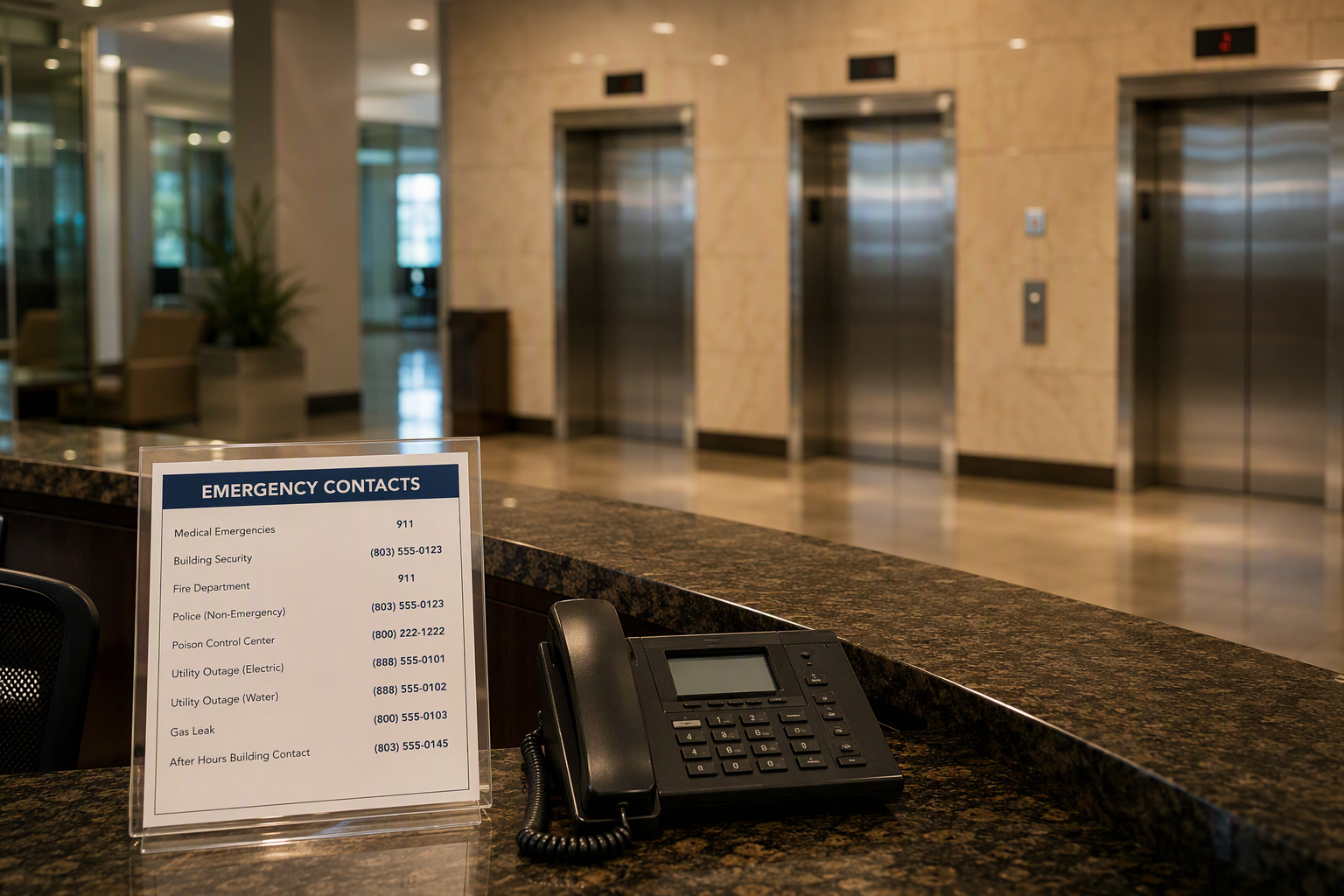
Every building operating a vertical transportation unit should maintain a prioritized emergency contact list that includes 911, the licensed elevator service contractor, the local fire department’s non-emergency line, and the South Carolina LLR elevator safety division.
A single phone number is never sufficient for elevator emergencies. Different situations require different responders. A passenger trapped between floors requires immediate fire department response via 911. A hydraulic oil leak requires a licensed elevator contractor. A complaint about unsafe equipment requires the state regulatory authority. Building managers in Columbia SC who consolidate these numbers into one laminated card — posted in the machine room and at the front desk — are far better positioned to respond quickly and correctly under pressure.
The South Carolina Department of Labor, Licensing and Regulation administers elevator safety oversight in the state. Their contact information should be accessible to any facility manager responsible for a conveyance covered under South Carolina elevator law.
What Counts as an Elevator Emergency That Requires Calling 911?
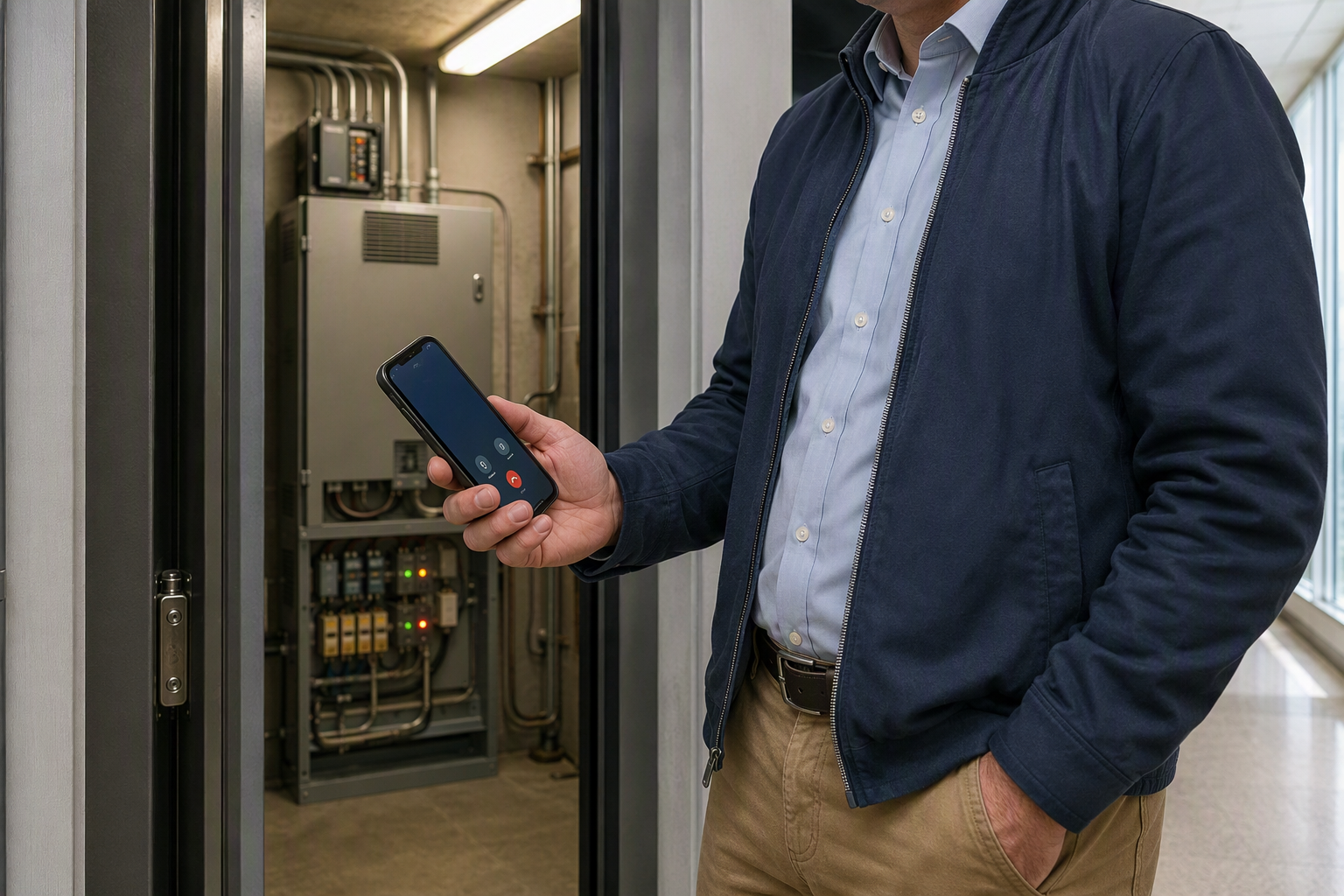
Passenger entrapment — meaning one or more people are stuck inside an elevator car and cannot exit safely — always warrants a 911 call, regardless of whether the elevator appears structurally sound.
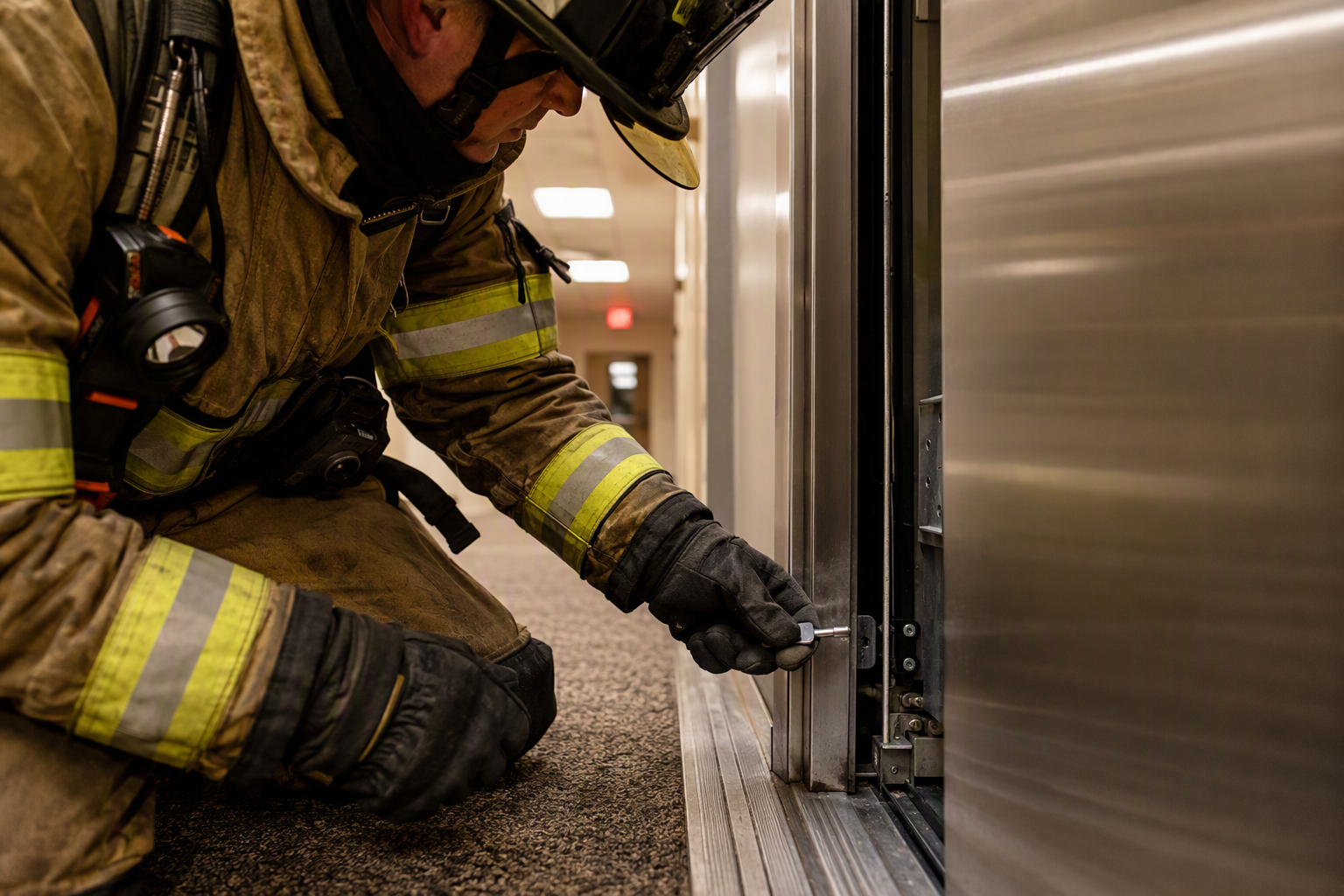
Building staff should never attempt to manually open elevator doors or force a car to move without a trained technician on site. Even a car that has stopped between floors by only a few inches represents a serious slip-and-fall risk. Firefighters trained in elevator rescue have the tools and authority to extract passengers safely.
Other scenarios that warrant 911 include smoke or burning smells emanating from the elevator machine room or hoistway, a car that is moving erratically or failing to stop level with the floor, and any situation where a passenger reports injury. After the immediate crisis is managed, the building manager must contact a licensed elevator service contractor such as Carolina Elevator Service to inspect and certify the unit before it is returned to service.
When Should a Building Manager Call the Elevator Service Contractor Instead of 911?
Non-emergency mechanical malfunctions — door hesitation, unusual noises, error codes on the controller, or a unit that stops accepting calls — should be reported directly to the licensed elevator service contractor rather than to emergency services.
Calling 911 for a non-entrapment mechanical issue diverts emergency resources unnecessarily and can create liability exposure for building owners. The correct protocol is to take the unit out of service immediately by placing it on independent service or turning off the main line disconnect, posting visible out-of-service signage at all landings, and then calling the service contractor to schedule an inspection. South Carolina code requires that an elevator be inspected by a qualified mechanic before being returned to public use after a reported malfunction.
What Is the Role of the South Carolina LLR in Elevator Emergencies?
The South Carolina Department of Labor, Licensing and Regulation (SC LLR) serves as the state authority responsible for elevator safety inspections, contractor licensing, and enforcement — and should be contacted when a building owner believes a unit presents an imminent public safety hazard that the service contractor is not addressing.
SC LLR inspectors have the authority to order an elevator taken out of service if it does not meet the standards set forth in South Carolina’s elevator safety laws, which adopt and reference the ASME A17.1 Safety Code for Elevators and Escalators. In 2026, the applicable code edition in South Carolina should be confirmed with SC LLR directly, as states adopt new ASME editions on staggered schedules. Building owners should not wait for a state inspection to identify problems — proactive maintenance through a qualified contractor is the most effective compliance strategy.
What Information Should Be Available Before Making an Elevator Emergency Call?
Before calling any emergency or service number, the person making the contact should have the building address, the elevator unit number or ID, the floor where the problem occurred, and a brief description of the malfunction ready to communicate immediately.
Time is critical in any elevator emergency. Responders — whether firefighters or elevator technicians — can mobilize more effectively when they receive complete information on the first call. Building managers should also know the location of the machine room and the main disconnect switch, because a technician may ask staff to cut power to a malfunctioning unit before they arrive. Keeping a unit data sheet (including the unit’s certificate number issued by SC LLR) posted inside the machine room ensures this information is always accessible.
What Steps Should Building Staff Take During a Passenger Entrapment?
During a passenger entrapment, building staff should follow a specific sequence of actions to keep passengers calm, facilitate a safe rescue, and document the incident properly.
- Call 911 immediately and provide the building address, floor of entrapment, number of passengers, and any reported medical conditions.
- Establish voice contact with the trapped passengers through the elevator’s built-in emergency intercom or by speaking loudly near the hoistway door — reassure them that help is on the way.
- Do not attempt to open the doors manually or instruct passengers to force the doors open from inside.
- Keep bystanders away from the hoistway doors at all affected floors to clear the area for responders.
- Contact the elevator service contractor — such as Carolina Elevator Service at 803-865-1400 — so a qualified mechanic can be dispatched simultaneously with fire department response.
- Locate the machine room key and be prepared to escort the fire department or elevator technician to the machine room upon their arrival.
- Document the incident in writing, including the time the malfunction occurred, the time each emergency contact was made, and the names of responding personnel.
- Take the elevator out of service after passengers are safely evacuated, and do not return it to service until a licensed mechanic has inspected and cleared it.
Is There a Legal Requirement to Post an Emergency Phone Number Inside an Elevator?
Yes — ASME A17.1 requires that elevators equipped with a two-way emergency communication system display instructions for its use inside the car, and ADA accessibility standards under the Americans with Disabilities Act require that the emergency communication system be accessible to people with hearing and speech disabilities.
ASME A17.1 specifies that the two-way communication device must connect to a location that is monitored continuously — meaning a phone that rings to an answering machine does not meet code. Many building owners satisfy this requirement by connecting the elevator phone to a 24-hour monitoring center. The monitoring center then contacts the building manager and the service contractor when an alarm is triggered. Building managers in Columbia SC should verify with their service provider that the monitoring number is current and that response protocols are documented.
ADA requirements further specify that the communication system must not rely solely on a voice exchange — it must include a visual or tactile signal for users who are deaf or hard of hearing. Failure to meet ADA standards exposes building owners to federal civil rights complaints independent of any state safety violation.
What Does ASME A17.1 Require Regarding Emergency Operations?
The ASME A17.1 Safety Code for Elevators and Escalators mandates specific emergency features including firefighters’ emergency operation (Phase I and Phase II), battery-powered emergency lighting inside the car, a two-way communication system, and clearly marked car operating panels.
Phase I firefighters’ emergency operation returns the elevator to a designated landing automatically when smoke is detected, removing it from public use. Phase II allows firefighters to operate the elevator manually from inside the car. Both phases must be tested regularly as part of the periodic inspection and testing requirements under ASME A17.1. South Carolina’s adoption of these standards means that any elevator operating in Columbia SC must have these systems functioning and documented. A failed Phase I or Phase II system is not a minor deficiency — it is a life-safety issue that must be corrected before the unit is returned to service.
How Often Should Elevator Emergency Systems Be Tested?
Under ASME A17.1, specific tests — including firefighters’ emergency operation, the two-way communication device, and emergency lighting — are required on defined intervals that vary by test category, with some tests required monthly and others annually or on a five-year cycle.
The ASME A17.1 code organizes testing into categories (Category 1, Category 3, and Category 5) based on the complexity and frequency of required testing. Monthly tests typically cover basic operational checks. Annual Category 1 tests cover safety devices and buffers under rated load. Five-year Category 5 tests include full-speed safety governor tests. Building owners who are not working with a service contractor on a structured maintenance and testing schedule are likely out of compliance and may be unaware of it. A qualified contractor will maintain records of all tests performed, which are required to be available to the state inspector.
What Emergency Contact Information Should Be Posted in the Elevator Machine Room?
The machine room emergency contact sheet should include the service contractor’s primary number, the state elevator safety authority (SC LLR), the local fire department’s non-emergency line, the building manager’s after-hours number, and the elevator unit’s SC LLR certificate number.
This information is not just best practice — it is operationally critical. When a technician arrives at an unfamiliar building in an emergency, having the unit’s certificate number and a clear diagram of the machine room layout can significantly reduce diagnostic time. Carolina Elevator Service recommends that building managers review and update their machine room contact sheet at least annually, particularly after any change in service contractor, building management company, or emergency contact personnel.
What Is the Difference Between an Elevator Service Contractor and an Elevator Inspector?
An elevator service contractor performs maintenance, repairs, and testing; an elevator inspector — either employed by the state or an approved third-party inspection agency — independently verifies that the equipment meets code requirements and issues or renews the operating certificate.
In South Carolina, the SC LLR licenses both elevator contractors and elevator inspectors as separate categories. A building owner should not assume that their service contractor’s maintenance record substitutes for an independent inspection. Conversely, an inspector does not perform repairs — if an inspection reveals a deficiency, the building owner must hire a licensed contractor to correct it before the inspector will issue or renew the operating certificate. Understanding this distinction helps building managers contact the correct party in each situation.
Can a Building Owner Be Held Liable for Not Having an Elevator Emergency Contact System?
Yes — building owners and property managers have a duty of care to occupants that includes maintaining functional emergency communication systems in elevators, and failure to do so can result in civil liability, state enforcement action, and potential OSHA citations in commercial settings.
Under OSHA general industry standards, employers are responsible for the safety of equipment in the workplace, which includes elevators in commercial and industrial facilities. A non-functioning emergency phone inside an elevator is not merely a code deficiency — it is evidence of negligence if a passenger is harmed during an entrapment. South Carolina’s elevator safety statutes provide SC LLR with authority to assess civil penalties for code violations. Building owners who have not verified the operational status of their elevator’s emergency communication system recently should schedule an inspection with a licensed contractor promptly.
What Should a Building Manager Do If the Elevator Emergency Phone Is Not Working?
If the elevator’s two-way emergency communication system is found to be non-functional, the elevator must be taken out of service immediately and a licensed elevator service contractor must be contacted to repair the system before the unit is returned to public use.
A non-functioning emergency phone is a Category 1 life-safety deficiency under ASME A17.1. Operating an elevator with a known defective emergency communication system exposes the building owner to both regulatory penalties and civil liability. Repairs may involve replacing the phone unit, updating the monitoring service connection, or correcting wiring in the hoistway. Only a licensed elevator mechanic should perform this work — it is not a repair that general maintenance staff should attempt. After repair, the system should be tested end-to-end to confirm the monitoring center receives the signal correctly.
How Do Elevator Monitoring Services Work and Who Provides Them?
Elevator monitoring services connect the elevator’s two-way emergency phone to a staffed call center that operates continuously, receives entrapment calls from passengers, and dispatches the appropriate responders — including the elevator service contractor and emergency services if needed.
Many elevator service contractors offer monitoring as part of a maintenance agreement. When a passenger activates the emergency phone, the call center operator confirms the situation, provides reassurance, and contacts both the building manager and the service contractor. Some monitoring services also provide remote diagnostics, fault logging, and automated notifications when the elevator goes out of service. Building owners should ask their service contractor specifically about monitoring capabilities and confirm in writing who the monitoring center will contact and in what order. Carolina Elevator Service can advise building managers in Columbia SC on monitoring solutions appropriate for their specific equipment.
What Are the ADA Requirements for Elevator Emergency Communication?
Under the Americans with Disabilities Act, elevator emergency communication systems must be accessible to individuals who are deaf, hard of hearing, or have speech disabilities — which means the system cannot rely solely on voice communication and must provide a visual or tactile confirmation that a call has been placed.
ADA Standards for Accessible Design, which govern new construction and alterations, specify that the emergency communication system in an elevator must have a visual signal such as a light that illuminates when the call is connected, in addition to the audible component. The call button itself must be identified with the International Symbol of Access and must meet reach range requirements so that it is usable from a wheelchair. Building owners undertaking elevator modernization projects in Columbia SC should treat ADA compliance as a parallel obligation alongside ASME A17.1 compliance — the two standards address different aspects of the same equipment.
How Frequently Should Building Managers Test the Elevator Emergency Phone?
Building managers should test the elevator’s two-way emergency communication system on a monthly basis at minimum, coordinating with the monitoring center in advance to avoid triggering an unnecessary emergency response.
Testing involves activating the emergency button inside the car, confirming that the monitoring center receives the call and can communicate clearly, and logging the test date and result. Some monitoring services offer a designated test mode that allows this check without alerting dispatchers. The test log should be retained as part of the elevator’s maintenance record, which inspectors may request. If the phone fails during testing, the elevator must be taken out of service and the contractor contacted for repair. A structured monthly test takes only a few minutes and is one of the simplest ways to avoid a compliance violation or a dangerous entrapment scenario.
What Should Tenants and Building Occupants Know About Elevator Emergencies?
Building occupants should know how to use the elevator’s emergency phone, understand that they should never attempt to force open elevator doors themselves, and know that staying calm and using the intercom is the most effective action they can take during an entrapment.
Many entrapment situations resolve quickly once a technician arrives, but panic-driven attempts to exit a stalled car can result in falls into the hoistway or injuries from moving equipment. Building managers can reduce risk by including basic elevator safety information in tenant orientation materials and posting clear instructions in common areas. These instructions should state explicitly: press the emergency button, speak clearly when the monitoring center responds, remain inside the car, and wait for trained personnel to assist with exit. Simple, visible signage is a low-cost intervention that meaningfully improves safety outcomes.
How Does a Preventive Maintenance Agreement Reduce Elevator Emergencies?
A structured preventive maintenance agreement with a licensed elevator service contractor reduces the frequency and severity of elevator emergencies by ensuring that safety systems — including the emergency phone, door operators, and safety devices — are inspected, tested, and adjusted before failures occur.
Reactive maintenance — waiting until something breaks before calling a technician — is consistently more expensive and more disruptive than preventive maintenance. Components such as door operator cams, roller guides, and hydraulic seals degrade gradually. A technician on a scheduled maintenance visit can identify and address these issues before they cause a malfunction. Preventive maintenance agreements also typically prioritize the customer’s calls and ensure that the service contractor has familiarity with the specific equipment, reducing diagnostic time during an emergency. Carolina Elevator Service provides preventive maintenance programs for commercial and residential elevators throughout the Columbia SC area.
What Is the Elevator Emergency Contact Comparison for Columbia SC Building Managers?
The table below summarizes which contact to call based on the type of elevator situation a building manager or occupant may encounter in Columbia SC.
| Situation | Primary Contact | Secondary Contact | Notes |
|---|---|---|---|
| Passenger trapped inside elevator | 911 | Elevator service contractor | Fire department leads rescue; contractor inspects before return to service |
| Passenger reports injury inside elevator | 911 | Elevator service contractor | Document incident; take unit out of service immediately |
| Smoke or burning smell from machine room | 911 | Elevator service contractor | Evacuate building per fire plan; do not re-enter machine room |
| Elevator stops but no entrapment | Elevator service contractor | Building management | Place unit on independent service; post out-of-service signage |
| Door malfunction, unusual noise, error code | Elevator service contractor | Building management | Do not reset repeatedly; take unit out of service |
| Emergency phone not working | Elevator service contractor | Building management | Unit must be taken out of service until repaired per ASME A17.1 |
| Unsafe equipment not corrected by contractor | SC LLR Elevator Safety Division | Alternate licensed contractor | SC LLR can order unit out of service and assess penalties |
| ADA compliance concern | ADA.gov / building attorney | Elevator service contractor | Contractor can assess physical accessibility; legal counsel for complaints |
| Overdue state inspection / expired certificate | SC LLR Elevator Safety Division | Elevator service contractor | Operating without a valid certificate is a statutory violation in SC |
| Elevator involved in workplace incident | OSHA (if commercial setting) | Elevator service contractor / attorney | See OSHA reporting requirements |
Why Should Columbia SC Building Managers Work With a Local, Licensed Elevator Contractor?
A locally based, licensed elevator contractor familiar with South Carolina’s regulatory environment, the Columbia SC building stock, and SC LLR inspection requirements provides faster response, better code compliance support, and more accountable service than out-of-state or unlicensed alternatives.
South Carolina requires that elevator work be performed by contractors licensed by SC LLR. Hiring an unlicensed contractor — regardless of price — exposes a building owner to voided warranties, failed inspections, and regulatory liability. A local contractor also has established relationships with SC LLR inspectors and understands which code editions are currently enforced in the state. Local contractors can respond more quickly to emergency calls, have direct knowledge of regional equipment types common in Columbia SC’s commercial and residential inventory, and are accountable to the local business community in ways that national chains may not be.
Carolina Elevator Service is a licensed elevator service company operating in Columbia SC, providing maintenance, repair, modernization, and compliance support for commercial and residential elevator systems throughout the Midlands region. Building owners seeking a reliable local partner for elevator safety and emergency preparedness can reach the team at 803-865-1400.
Get a Free Elevator Assessment from Carolina Elevator Service
Building owners and property managers in Columbia SC who are unsure whether their elevator’s emergency communication system, safety devices, or maintenance records meet current code requirements should act before the next inspection — not after a failed one. Carolina Elevator Service performs thorough elevator assessments to identify compliance gaps, emergency system deficiencies, and maintenance needs before they become costly violations or safety incidents.
Contact Carolina Elevator Service for a free elevator assessment: 803-865-1400
Need elevator service you can rely on? Carolina Elevator Service is ready to help.