Elevator Out of Service: What to Do — A Complete Decision Guide
An elevator outage is more than an inconvenience. For buildings with ADA-dependent occupants, for hospitals, or for multi-story residential properties, a downed elevator can create compliance risk, liability exposure, and genuine safety hazards. This guide walks through every step of the correct response — from the first moment a unit stops running through the decision to repair, modernize, or replace — so building owners, property managers, and facility teams can act with confidence.
What Are the Immediate Steps When an Elevator Goes Out of Service?

The first minutes after an elevator stops operating are the most important. Following a structured response reduces risk to passengers, limits liability, and gives your service provider the information needed to restore service efficiently.
- Determine if anyone is trapped. Check the car position indicator if available. Listen for the alarm. Communicate through the intercom or door. If a passenger is trapped, call emergency services (911) immediately — do not attempt a manual rescue without trained personnel.
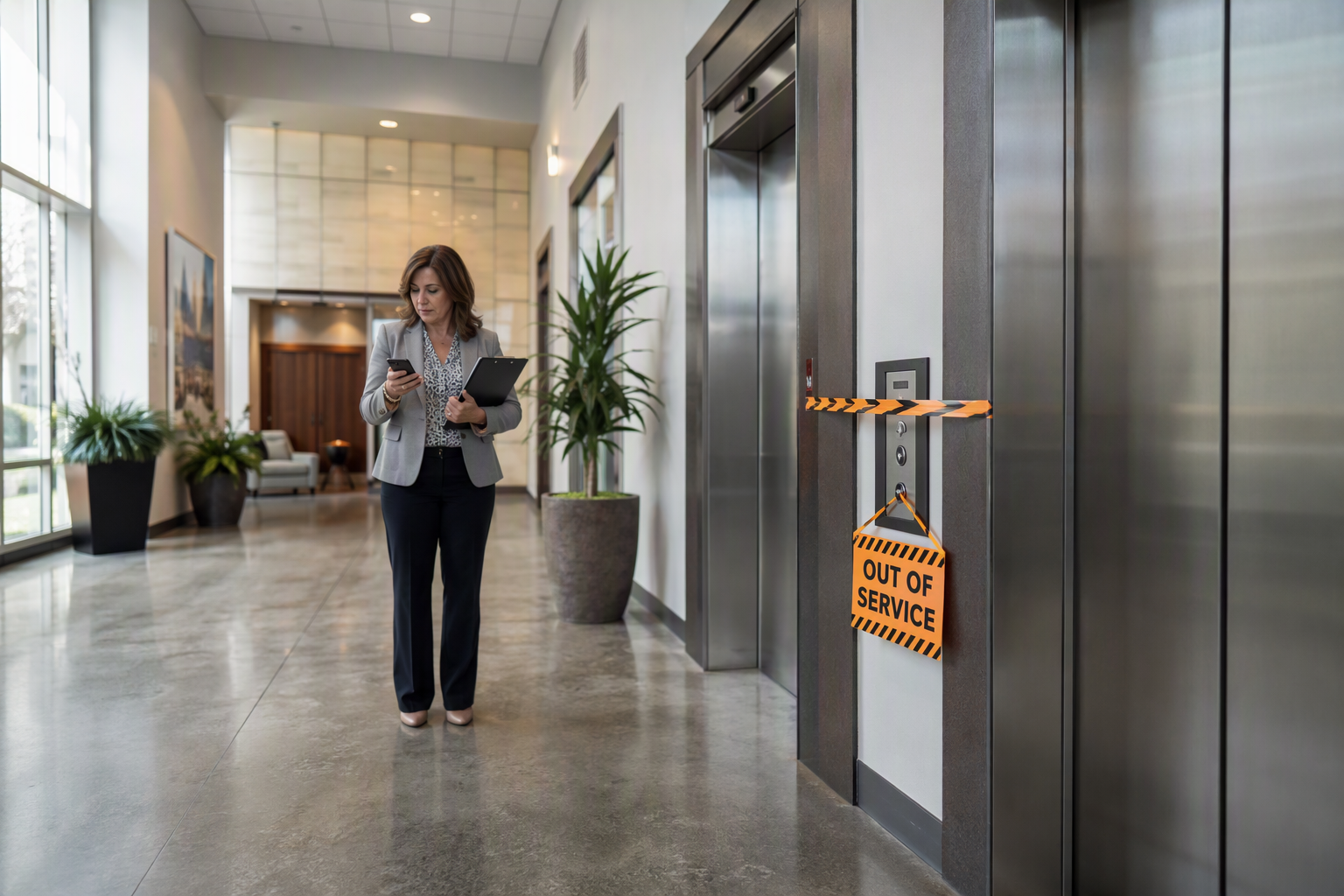
- Secure the elevator lobby. Block access to the call buttons and elevator doors with barriers or caution tape to prevent additional attempts to use the unit.
- Post clear out-of-service signage. Place visible notices on every floor landing that serves the elevator, informing occupants the unit is unavailable and directing them to stairs or an alternative lift.
- Notify building management and ownership. Create a written record (email or incident log) stating the time the outage was discovered, any symptoms observed (unusual noise, door error, power failure), and whether passengers were involved.
- Contact your elevator service provider. Report the outage with as much detail as possible: error codes displayed, the floor at which the car stopped, any recent maintenance history, and whether the failure followed a power event.
- Review your service contract. Confirm whether the outage triggers an emergency callback provision or falls under routine maintenance coverage. Knowing this before the technician arrives prevents billing disputes.
- Document the scene. Photograph error code displays, unusual door positions, and any visible mechanical damage. This documentation supports insurance claims and regulatory reporting.
- Assess ADA impact and duty to accommodate. If the building has ADA-dependent occupants, consult your legal counsel on temporary accommodation obligations under the Americans with Disabilities Act (ADA).
- File required regulatory notifications. Some jurisdictions require building owners to notify the local elevator inspection authority within a set period after a safety-related outage. Check your local authority having jurisdiction (AHJ) requirements.
- Keep a written log until service is restored. Record every communication with the service provider, every technician visit, and every attempt to restore service. This log is essential if an inspection or litigation follows.
What Are the Most Common Causes of an Elevator Going Out of Service?

Understanding the root cause shapes both the urgency and the cost of the response. The table below categorizes the most frequent failure types and their general characteristics.
| Failure Category | Common Triggers | Typical Urgency | Likely Resolution Path |
|---|---|---|---|
| Door system failure | Worn rollers, misaligned tracks, faulty door operator | High — frequent cause of entrapments | Component repair or replacement |
| Control system fault | Software error, relay failure, PCB fault | Medium-High | Reset, recalibration, or board replacement |
| Hydraulic system issue | Fluid leak, pump failure, valve malfunction | High — environmental and safety risk | Seal repair, fluid replacement, or pump overhaul |
| Traction drive failure | Worn ropes, brake adjustment, motor fault | High — safety-critical | Rope replacement, brake adjustment, motor service |
| Power supply interruption | Building power outage, blown fuse, tripped breaker | Low-Medium — often self-resolving | Power restoration; inspect for underlying fault |
| Safety device trip | Governor, buffer, or overspeed device activation | Critical — do not reset without inspection | Certified technician inspection before return to service |
| Code compliance hold | Failed inspection, missing permit, obsolete components | High — legal exposure until resolved | Modernization or targeted upgrade |
| Vandalism or misuse | Door damage, button tampering, overloading | Medium | Repair and review operational protocols |
Should You Repair, Modernize, or Replace the Elevator?
A single outage does not automatically justify a full modernization. The decision depends on the age of the equipment, the frequency of failures, current code compliance status, and the long-term cost trajectory. The comparison below helps building owners frame the decision.
| Factor | Targeted Repair | Partial Modernization | Full Replacement |
|---|---|---|---|
| Best suited for | Isolated component failure on well-maintained, code-compliant unit | Aging unit with recurring issues; specific systems obsolete | End-of-life equipment; structural changes; repeated modernizations |
| Relative upfront cost | Lowest | Moderate | Highest |
| Downtime duration | Hours to days | Days to weeks | Weeks to months |
| Code compliance outcome | May not address underlying compliance gaps | Addresses targeted compliance items | Brings unit to current code edition |
| Long-term reliability | Low if root cause is systemic aging | Moderate | Highest |
| Risk of repeat outage | Higher on aging equipment | Reduced in modernized systems | Lowest |
| Recommended when | Unit is fewer than 15 years old; failure is isolated | Controls or door systems are obsolete; unit is otherwise sound | Unit exceeds typical useful life; parts availability is limited |
Decision rule of thumb: If repair costs for a single event approach or exceed a significant fraction of a modernization estimate, and the unit has a documented history of recurring failures, a modernization assessment is warranted. An independent elevator service provider such as Carolina Elevator Service can provide an unbiased assessment — unlike OEM-affiliated contractors, independent providers are not incentivized to recommend a specific manufacturer’s replacement equipment.
What Are Your Legal and Compliance Obligations During an Elevator Outage?
Building owners and property managers carry specific legal duties when an elevator goes out of service. These obligations exist under federal, state, and local frameworks.
- ASME A17.1 Safety Code for Elevators and Escalators: The primary national safety standard for elevator equipment, updated through 2019 and adopted by reference in most U.S. jurisdictions. Under ASME Codes & Standards, certain safety device trips require a certified inspection before the unit may return to service — an owner cannot simply reset and restart the elevator.
- ADA Accessibility Obligations: The Americans with Disabilities Act (ADA) requires places of public accommodation and commercial facilities to maintain accessible features in operable condition. A prolonged elevator outage without alternative accommodation may constitute an ADA violation. Consult legal counsel for building-specific guidance.
- OSHA General Duty Clause: Employers are required under OSHA regulations to provide a workplace free from recognized hazards. A malfunctioning elevator that employees use may trigger OSHA obligations.
- Local Authority Having Jurisdiction (AHJ): Most states and municipalities require elevator outages involving entrapment or safety device activation to be reported. The AHJ may require an inspection before the unit returns to service.
- Insurance notification: Review your property and liability policies — many require timely notification of incidents involving equipment failure and passenger involvement.
How Long Does It Typically Take to Restore an Elevator to Service?
Restoration time varies significantly by failure type, parts availability, regulatory requirements, and the responsiveness of the service provider.
| Scenario | Estimated Timeframe | Key Variables |
|---|---|---|
| Power fault or simple reset | Hours | Technician availability; building electrical status |
| Door component replacement | 1–3 days | Parts inventory; technician scheduling |
| Control board or software fault | 2–7 days | OEM parts lead time; proprietary system access |
| Hydraulic repair | 2–5 days | Fluid disposal requirements; seal sourcing |
| Safety device inspection required | 3–10 days (inspection scheduling dependent) | AHJ inspector availability |
| Partial modernization | 1–4 weeks | Equipment lead time; permit processing |
| Full replacement | 8–20+ weeks | Equipment manufacture; permitting; inspection queue |
Key insight: Proprietary elevator control systems — common in units installed by major OEMs under long-term service contracts — can dramatically extend repair timelines because only the OEM technician can access the software. Independent providers like Carolina Elevator Service advocate for open-protocol systems that reduce dependency on a single vendor.
How Do You Choose the Right Elevator Service Provider After an Outage?
The service provider selected for an emergency callback — and for ongoing maintenance — has a direct impact on restoration time, repair quality, and total cost of ownership. Use the following criteria to evaluate options.
| Evaluation Factor | OEM-Affiliated Provider | Independent Certified Provider |
|---|---|---|
| Equipment access | Full access to proprietary systems for own brand | Multi-brand capability; may require OEM for proprietary software |
| Parts sourcing | OEM parts; higher cost, controlled availability | Broader supplier network; competitive pricing |
| Contract flexibility | Often locked into long-term contracts | Typically more flexible terms |
| Pricing transparency | Variable; bundled service packages common | Generally itemized; easier to benchmark |
| Conflict of interest | May recommend OEM replacement over repair | Brand-neutral; recommendation driven by building need |
| Code knowledge | Strong for own equipment | Broad ASME and local code expertise across makes/models |
Carolina Elevator Service operates as a certified independent elevator service company, providing multi-brand maintenance, repair, and modernization services without the conflicts of interest inherent in OEM-affiliated service structures.
What Signage and Communication Are Required During an Elevator Outage?
Proper signage and occupant communication serve both safety and legal purposes. At minimum, building management should:
- Post legible out-of-service notices at every floor landing, including the ground floor entrance.
- Direct occupants to the nearest accessible stairwell or alternative elevator if available.
- Provide direct notification (email, building intercom, posted notice) to tenants with known mobility limitations who rely on elevator access.
- Display estimated restoration timeline if known, updated as information changes.
- Include emergency contact information for building management on all posted notices.
What Preventive Measures Reduce the Risk of Future Outages?
Reactive management of elevator outages is far more costly — in downtime, repairs, and liability exposure — than a structured preventive maintenance program. Key preventive strategies include:
- Scheduled preventive maintenance: Regular inspections and lubrication of moving components catch wear before it becomes failure.
- Genuine parts replacement: Substituting inferior aftermarket components to reduce short-term cost increases failure frequency over time.
- Current code compliance review: Periodic review against the current edition of ASME A17.1 Safety Code for Elevators and Escalators identifies retrofit requirements before an inspection flags them.
- Remote monitoring systems: Modern elevator monitoring platforms can alert service providers to developing faults before they cause a full outage.
- Service contract review: Ensure your contract specifies response priority levels, covered components, and exclusions — vague contracts lead to disputes during emergency callbacks.
- Documented maintenance logs: Accurate records accelerate diagnosis during outages and demonstrate due diligence to inspectors and insurers.
What Should You Do If a Passenger Is Trapped in an Elevator?
- Call 911 immediately. Passenger entrapment is an emergency. Do not attempt to force doors or manually lower the car without trained personnel.
- Establish communication. Use the elevator’s two-way communication system to inform the passenger that help is on the way. Keep communication calm and continuous.
- Do not allow untrained personnel to attempt rescue. Improper rescue attempts can cause the car to move unexpectedly, creating additional risk.
- Notify the elevator service provider in parallel. A certified technician should be en route as emergency services respond.
- Secure the machine room. Prevent unauthorized persons from accessing the machine room controls until a trained technician is present.
- Document the incident thoroughly. Time of entrapment, time of rescue, conditions in the car, and passenger condition upon release are all essential for the incident report.
- File required reports. Most jurisdictions require an incident report to the AHJ following passenger entrapment. Confirm local requirements with your service provider.
Are Building Owners Liable When an Elevator Goes Out of Service?
Liability exposure during an elevator outage depends on the circumstances of the failure, the building type, applicable regulations, and the actions taken by ownership and management following discovery of the outage. Generally:
- Building owners have a duty of care to maintain elevators in safe operating condition.
- Failure to promptly address a known outage — especially one involving a trapped passenger or a code violation — increases liability exposure significantly.
- Maintaining thorough maintenance records and incident documentation is the primary defense against negligence claims.
- ADA compliance obligations create an additional layer of legal exposure for commercial and public buildings during extended outages affecting accessible routes.
This content is general guidance only and does not constitute legal advice. Consult qualified legal counsel for building-specific liability questions.
What Questions Should You Ask Your Elevator Service Provider After an Outage?
Before authorizing repairs or return to service, building owners and facility managers should ask the responding technician and service company:
- What was the confirmed root cause of the failure?
- Was a safety device involved, and is an inspection required before return to service?
- Are the components being replaced genuine manufacturer parts or aftermarket alternatives?
- Does this repair address the root cause, or is it a temporary fix?
- Are there other components showing wear that should be addressed proactively?
- Is the unit currently in compliance with the current adopted edition of ASME A17.1?
- What preventive maintenance would reduce the risk of a similar outage?
- Do you have a written report of findings that I can retain for my records?
Why Choose Carolina Elevator Service for Elevator Outage Response and Ongoing Maintenance?
Carolina Elevator Service is a certified independent elevator service company providing maintenance, repair, modernization, and inspection services. As an independent provider, Carolina Elevator Service has no manufacturer affiliation that would bias repair-versus-replace recommendations — the goal is always the solution that best serves the building owner’s long-term operational and financial interests.
Carolina Elevator Service works across multiple equipment makes and models, applies current ASME Codes & Standards, and provides documented service reports that support inspection compliance and insurance requirements. For buildings with ADA-accessibility obligations, the team understands the urgency of restoration and can advise on interim accommodation planning during extended outages.
Get Expert Help With Your Elevator Outage Today
An elevator out of service creates immediate risk for occupants, compliance exposure for ownership, and operational disruption for the building. Do not wait. Contact a certified elevator professional to assess the failure, restore service safely, and prevent the next outage before it happens.
Contact Carolina Elevator Service for a free elevator assessment: 803-865-1400
Need elevator service you can rely on? Carolina Elevator Service is ready to help.