Elevator Inspection FAQ: Every Question to Expect and Ask in South Carolina
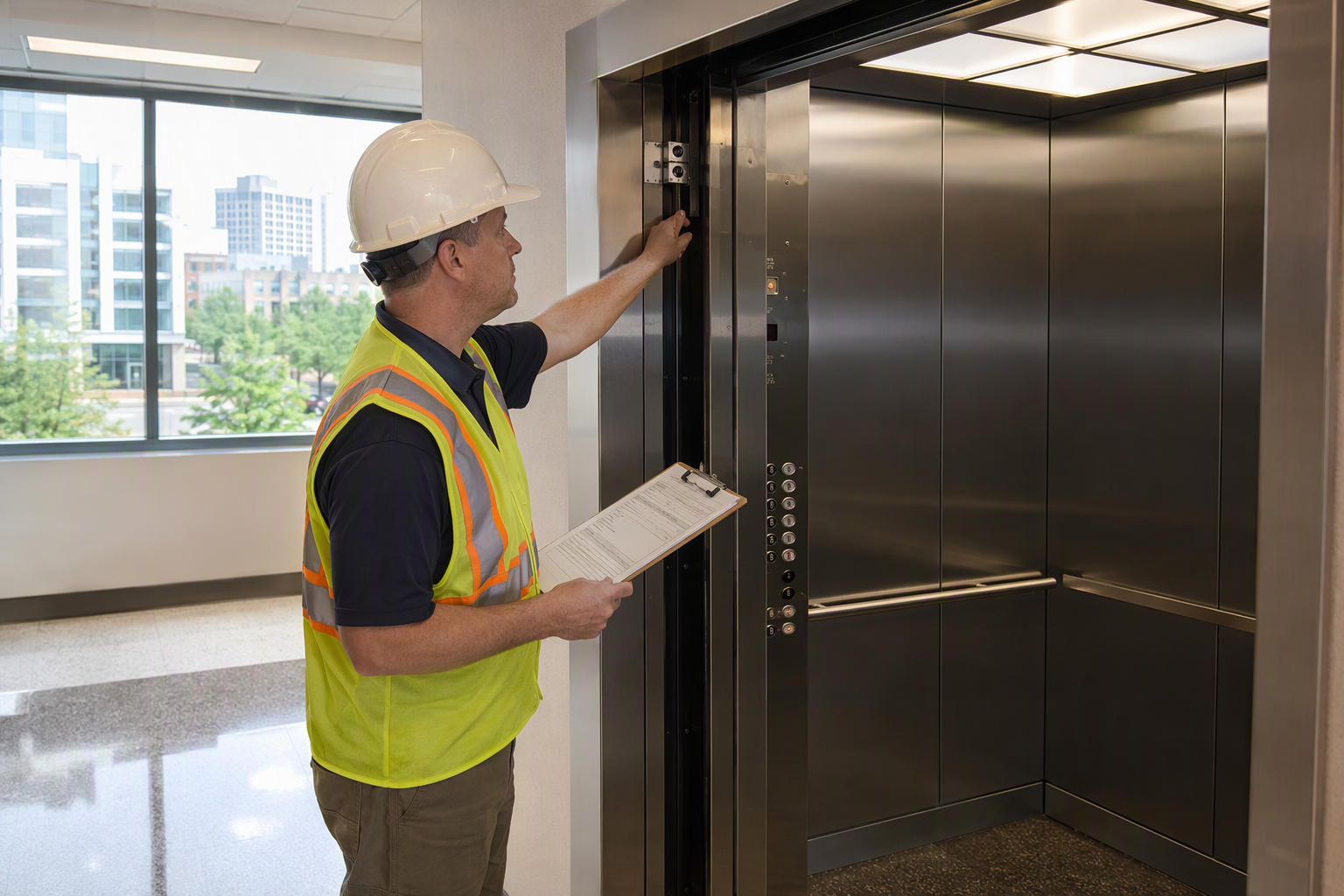
During an elevator inspection in South Carolina, both inspectors and building owners cover a defined checklist: valid operating certificates, mechanical safety device tests, emergency power, maintenance documentation, and compliance with the ASME A17.1/CSA B44 Safety Code for Elevators and Escalators (2019 edition, adopted by South Carolina). Owners should also come prepared with their own list of questions so no compliance gap goes unaddressed before certificate renewal.
Who is legally authorized to inspect an elevator in South Carolina?
In South Carolina, only state inspectors employed by the South Carolina Department of Labor, Licensing and Regulation (LLR), Office of Elevators and Amusement Rides, or licensed special inspectors who meet the qualifications in the 2018 edition of QEI-1 (American National Standard for Qualification of Elevator Inspectors) may conduct required elevator inspections.
A special inspector’s completed inspection may be accepted in place of a state inspection, which gives building owners flexibility in scheduling. However, South Carolina law contains a critical conflict-of-interest rule: a special inspector may not inspect an elevator on which the inspector or the inspector’s employer currently holds a service or warranty contract. Building owners in Columbia should verify this relationship before engaging any third-party inspector.
How often must elevators be inspected under South Carolina law?
South Carolina requires elevators to be inspected at installation, at registration, after any alteration or repair, and at least once every year thereafter before the operating certificate is renewed.
Inspection frequency varies by equipment type, as shown in the table below. These intervals are established under S.C. Code Title 41, Chapter 16 and S.C. Code of Regulations Chapter 71, Article 5, Regulations 71-5000 through 71-5700.
| Equipment Type | Required Inspection Interval | Trigger Events Requiring Additional Inspection |
|---|---|---|
| Standard passenger and freight elevators | At least once per year | Installation, registration, alteration, or repair |
| Handicap lifts (platform lifts) | Every five years | Installation or alteration |
| Manlifts, television tower elevators, and special purpose elevators | Every seven years | Installation or alteration |
| Dumbwaiters | When installed or altered | Installation or alteration |
| Equipment in a single private dwelling | Not subject to South Carolina Elevator Code | N/A |
What certificates and permits does an inspector verify first?
An inspector will immediately verify that the elevator has a valid certificate of registration and a current operating certificate issued by the state, both of which are mandatory before any elevator facility may legally operate in South Carolina.
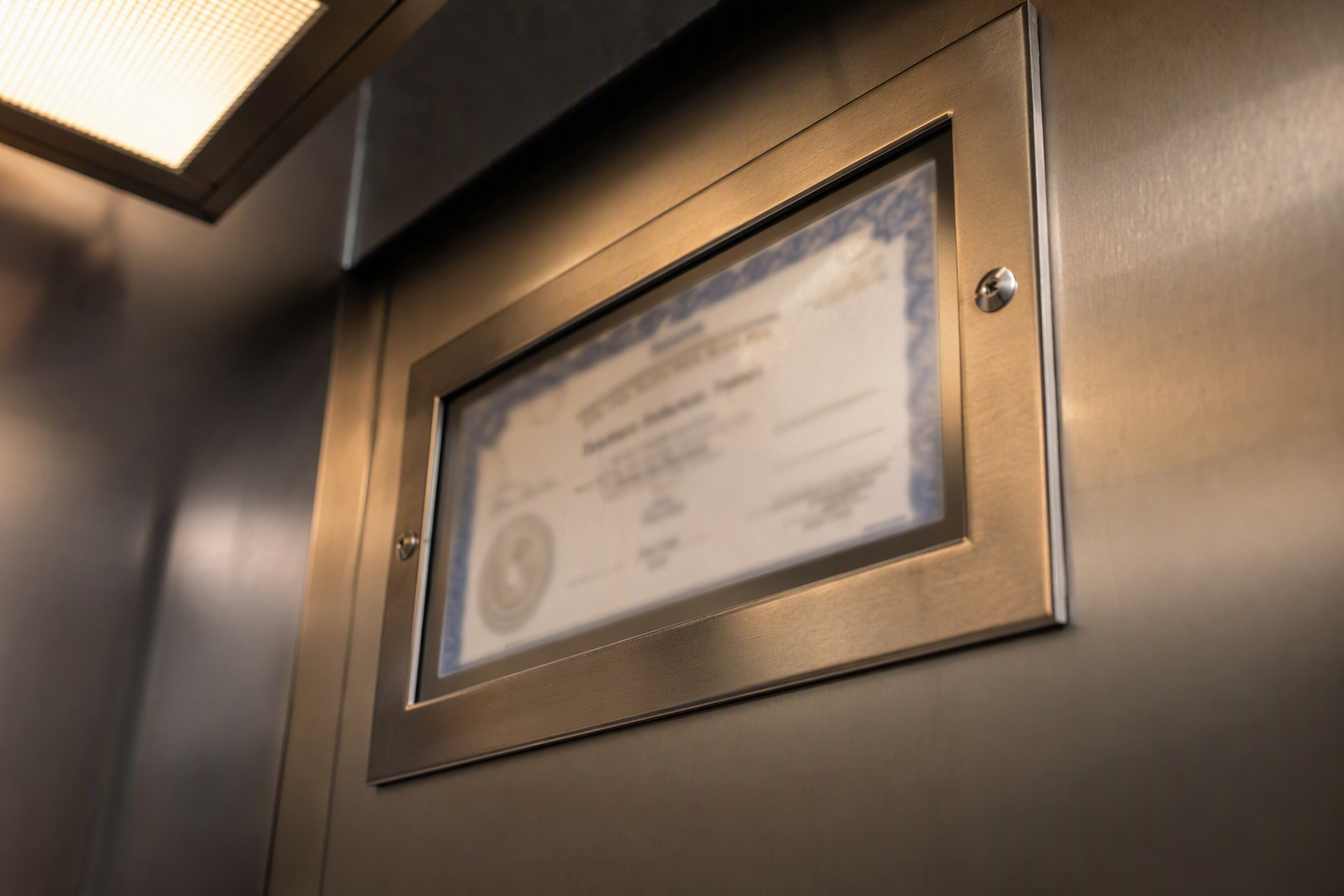
South Carolina law also requires that the operating certificate, or a legible copy, be displayed conspicuously inside each elevator car. If the certificate is missing, expired, or not posted, the inspector can flag the unit as non-compliant before any mechanical check begins. Building owners should additionally confirm that a state construction permit was obtained before any prior installation, alteration, or repair work — inspectors will look for documentation of permitted work in the maintenance file.
What mechanical safety systems does an inspector test?
Under the ASME A17.1/CSA B44-2019 Safety Code for Elevators and Escalators, inspectors physically test safeties, buffers, interlocks, governors, and braking systems to confirm each performs within code tolerances.
Key mechanical systems that receive hands-on testing include:
- Car and counterweight safeties — devices that clamp guide rails to stop a car in free fall
- Oil buffers — hydraulic shock absorbers at the pit that cushion an overtravel event
- Overspeed governor — triggers safeties if car speed exceeds a set threshold
- Door interlocks — prevent car movement if any hoistway door is not fully closed and locked
- Final terminal stopping devices — cut power before the car overruns the top or bottom terminal
- Pit stop switch and pit ladder — required for safe pit access by mechanics
- Machine room ventilation and temperature controls — protect drive components from heat damage
Carolina Elevator Service recommends that building owners in Columbia review the last inspection report before the annual visit to confirm all previously noted items were corrected and re-documented.
What emergency and standby power requirements will an inspector check?
South Carolina specifically requires that passenger elevators have standby power capable of running emergency lighting and the alarm bell for at least four hours if normal power fails — inspectors will test this system during the inspection.
Beyond the four-hour emergency lighting and alarm requirement, inspectors also verify emergency communication systems inside the car, two-way communication devices that allow passengers to contact building personnel or emergency services, and emergency stop switches. Under the Americans with Disabilities Act (ADA), two-way communication devices must also be accessible to users who are deaf or hard of hearing, which typically means a visual signal is required in addition to audio. Inspectors may flag ADA non-compliance even if the state mechanical checklist is otherwise satisfied.
What firefighters’ service and key requirements apply in South Carolina?
For new elevator installations in South Carolina, firefighters’ service must use the five-pin S.C. #1000 key — inspectors will verify that Phase I and Phase II firefighters’ emergency operation are functional and that the correct key is on site.
Firefighters’ service allows fire department personnel to take manual control of the elevator during an emergency. Phase I returns the car to a designated landing; Phase II allows in-car control by firefighters. Inspectors physically test both phases, confirm signage is correct, and verify that the designated recall floor is properly programmed. Building owners should ensure that the S.C. #1000 key is stored in an accessible location known to building staff and that all cab controls are clearly labeled.
What questions should an owner ask the inspector about deficiencies found?
When an inspector identifies a deficiency, the owner should immediately ask whether it is a Category 1 (minor) or immediately dangerous condition, what the required corrective timeline is, and whether the elevator must be taken out of service.
Specific questions to ask when deficiencies are found:
- Is this deficiency a code violation requiring the elevator to be shut down immediately, or may it continue operating under a corrective order?
- What is the specific code section under ASME A17.1-2019 or South Carolina regulations that is being cited?
- What documentation must be submitted to LLR once the deficiency is corrected?
- Is a reinspection required before the operating certificate can be renewed, and who schedules it?
- Are there any concurrent ADA accessibility issues that should be addressed at the same time?
- Does this deficiency affect the elevator’s insurance coverage or the building owner’s liability exposure?
What maintenance records must be available during an inspection?
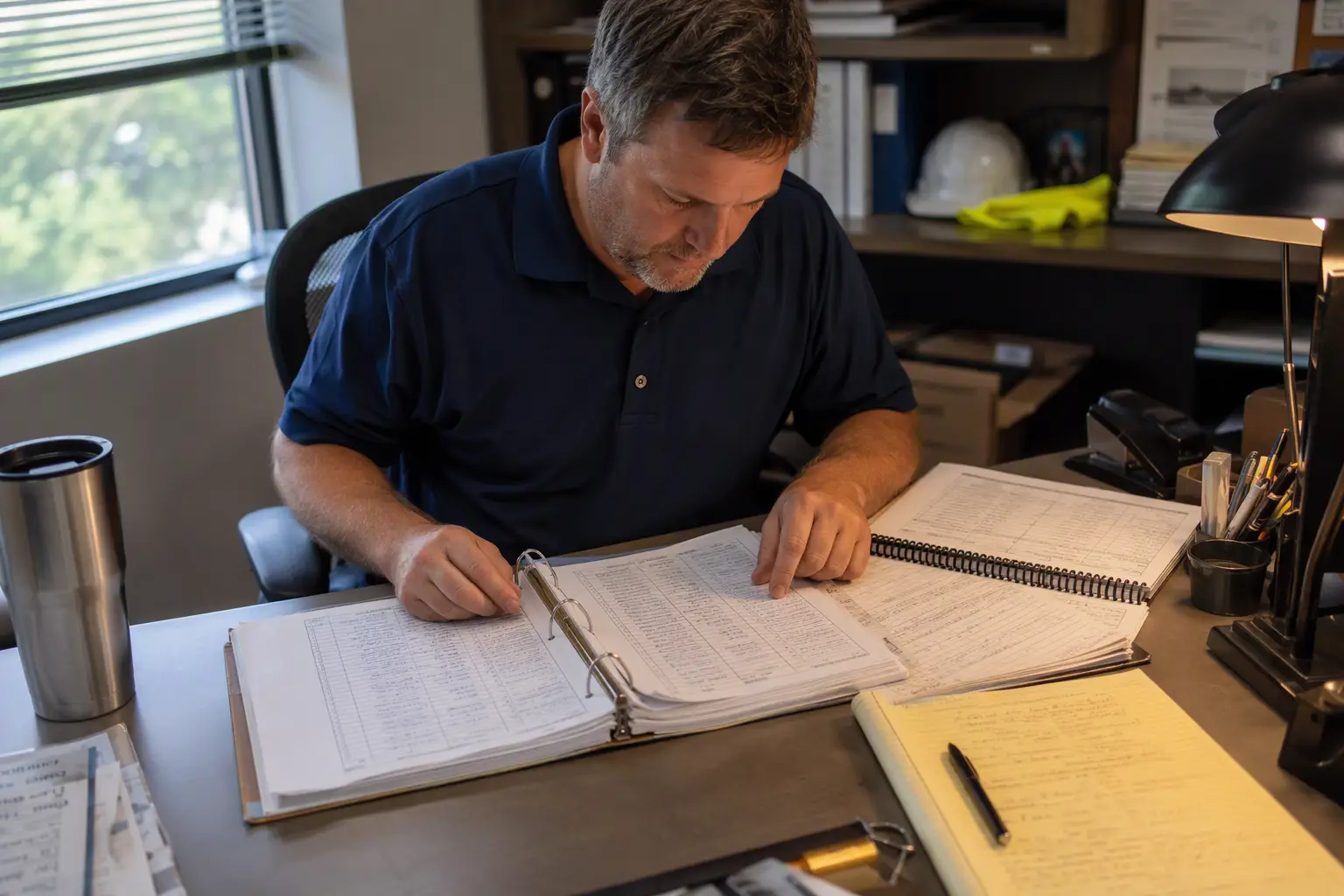
South Carolina places the obligation for maintaining every elevator facility in safe operating condition squarely on the building owner, which means complete maintenance records must be available for inspector review.
Inspectors typically review logbooks and records that document routine maintenance tasks, lubrication intervals, adjustment dates, parts replacements, and any prior inspection reports with corrective actions. Under ASME A17.1-2019, elevator maintenance must follow a written maintenance control program. Owners who cannot produce organized records risk failing the documentation portion of the inspection even if all mechanical systems perform correctly. Carolina Elevator Service helps Columbia-area building owners maintain organized, inspector-ready documentation as part of a structured maintenance program.
What happens if an elevator is operating without a valid certificate?
Operating an elevator in South Carolina without both a certificate of registration and a valid operating certificate is a direct violation of S.C. Code Title 41, Chapter 16, and can result in the elevator being ordered out of service immediately.
Building owners who discover an expired or missing operating certificate should contact the LLR Office of Elevators and Amusement Rides promptly and schedule an inspection. Running an uncertified elevator also creates significant liability exposure in the event of a passenger injury or accident. South Carolina law requires that any accident seriously injuring a person other than an employee must be reported to the state before the end of the next working day — an uncertified elevator compounds that exposure considerably.
What ADA accessibility items does an inspector check?
While the state inspection focuses on mechanical safety under the South Carolina Elevator Code, ADA compliance for public-use elevators is a parallel obligation that inspectors and building owners should both address.
ADA requirements for elevators in public accommodations include:
- Cab interior dimensions meeting minimum accessible space requirements
- Raised and Braille floor indicators on call buttons and inside the cab
- Audible and visual floor announcements
- Two-way emergency communication accessible to users who are deaf or hard of hearing
- Door reopening devices that respond to obstructions
- Compliant hall lanterns and leveling accuracy (within one-half inch of floor level)
A building can pass the state mechanical inspection and still face federal ADA complaints if accessibility features are missing or non-functional. Building owners should use the inspection visit as an opportunity to audit ADA items alongside mechanical ones.
What questions should be asked about underground hydraulic elevator cylinders?
South Carolina specifically requires that newly installed underground hydraulic elevator cylinders be encased in plastic outer containment to limit electrolytic corrosion — owners of hydraulic elevators should ask the inspector to confirm this requirement is met and whether older cylinders pose an environmental risk.
Older hydraulic elevators may have single-bottom cylinders without containment, which can develop pinhole leaks that release hydraulic fluid into the soil. During an inspection, owners should ask:
- Does the existing cylinder comply with the containment requirement for its installation date?
- Is there any evidence of hydraulic fluid loss or soil contamination around the cylinder?
- Has the cylinder been pressure-tested, and when was the last test performed?
- What is the estimated remaining service life of the cylinder?
How does South Carolina handle elevators installed before 1986?
Elevator facilities in South Carolina that were in operation before July 1, 1986, must comply with the 1986 edition of ANSI A17.3, the safety code for existing elevators and escalators, rather than the current ASME A17.1-2019 edition.
This means that some older installations in Columbia’s historic or legacy commercial buildings may be held to a different code standard than a newly installed system. Inspectors apply the correct code edition based on the equipment’s installation date. Building owners of older properties should ask the inspector explicitly which edition applies to their equipment, and whether any retroactive safety improvements — sometimes called Category 5 tests for traction elevators — are due or overdue.
What is the process if an elevator fails inspection?
When an elevator fails inspection in South Carolina, the inspector issues a written order identifying the specific violations, and the owner must correct all deficiencies and arrange for a reinspection before the operating certificate can be renewed or reissued.
The corrective process generally follows these steps:
- Receive the written inspection report and deficiency order from the inspector or LLR.
- Share the deficiency list with a qualified elevator service company to obtain a scope of corrective work.
- Complete all required repairs or adjustments within the timeframe stated in the order.
- Obtain documented proof of repair (parts receipts, service logs, adjustment records).
- Schedule a reinspection with a state inspector or qualified special inspector.
- Submit required paperwork to LLR and receive an updated operating certificate.
- Post the renewed operating certificate conspicuously inside the elevator car.
If the deficiency presents an immediate danger to passengers, the elevator must be taken out of service until corrections are made and reinspection is passed.
What alteration or repair work triggers a new inspection requirement?
In South Carolina, any alteration or repair to an elevator facility triggers a new inspection requirement — and a state construction permit must be obtained before that work begins.
Building owners should ask their service provider before any work begins whether the planned scope qualifies as an “alteration” under the South Carolina Elevator Code and ASME A17.1-2019, because the answer affects permitting, inspection, and code-edition compliance. Modernization projects, controller replacements, cab enclosure work, and hydraulic power unit changes commonly require permits and post-work inspections. Performing alterations without a permit can jeopardize the operating certificate and create liability for the building owner.
What should an owner ask about the inspector’s qualifications?
Building owners have the right to verify that any special inspector conducting their South Carolina elevator inspection holds a current license and meets the qualifications defined in the 2018 edition of QEI-1 (American National Standard for Qualification of Elevator Inspectors).
Owners should ask:
- Are you a state inspector employed by LLR, or a licensed special inspector?
- Do you or your employer hold any service or warranty contract on this elevator? (If yes, the inspector is disqualified by South Carolina law.)
- Can you provide your QEI qualification documentation?
- Will the completed inspection report be accepted by LLR in place of a state inspection?
What OSHA requirements intersect with elevator inspections?
While South Carolina’s elevator inspection program governs passenger and freight elevators, OSHA requirements independently govern worker safety related to elevator maintenance, construction hoists, and pit access conditions.
During an elevator inspection, OSHA-relevant items that may be noted include pit lighting adequacy, pit stop switch accessibility, machine room housekeeping and access control, lockout/tagout compliance for maintenance procedures, and fall protection for personnel working above the car top. Building owners with employees who perform any elevator-adjacent maintenance duties should ensure their safety programs address OSHA requirements separately from the state elevator certificate process. A state operating certificate does not confer OSHA compliance.
What questions should a property manager ask about local ordinance conflicts?
South Carolina law makes clear that any local ordinance that conflicts with the South Carolina Elevator Code or its regulations is void — building owners and property managers in Columbia should ask whether any local requirement being cited by a municipal inspector actually has legal authority over elevators.
This matters in practice because property managers sometimes receive conflicting guidance from city building departments and state elevator inspectors. The South Carolina Elevator Code, under S.C. Code Title 41, Chapter 16, is the controlling authority. If a local inspector cites a local ordinance that conflicts with state code, the state standard governs. Owners who encounter this situation should contact LLR directly for clarification.
How should owners prepare for an elevator inspection to avoid surprises?
Proactive preparation significantly reduces the likelihood of deficiency orders — owners should complete a structured pre-inspection walkthrough covering documentation, posted certificates, physical systems, and outstanding maintenance items before the inspector arrives.
A practical pre-inspection checklist:
- Confirm the current operating certificate is posted inside the elevator car.
- Pull the maintenance logbook and verify all entries are current and legible.
- Test emergency lighting and the alarm bell manually.
- Verify that firefighters’ Phase I and Phase II service activates correctly with the S.C. #1000 key.
- Check that pit lighting is functional and the pit stop switch is accessible.
- Confirm machine room temperature is within acceptable range and the room is locked and clear of stored items.
- Review the prior inspection report and confirm all previously cited items were corrected and documented.
- Check that ADA features — Braille buttons, door reopening devices, leveling accuracy — are functioning.
Carolina Elevator Service offers pre-inspection assessments for Columbia-area properties to help building owners identify and address deficiencies before the official inspection visit.
What questions should owners ask about long-term code compliance and modernization?
Beyond passing the annual inspection, building owners should ask how long their current equipment can realistically remain in code compliance and whether a modernization plan makes sense before the next inspection cycle.
Questions to ask a qualified elevator service provider about long-term compliance include:
- Are any components approaching end-of-life that could trigger a mandatory replacement?
- Are Category 1, 3, or 5 periodic tests due, and what do they entail?
- Would a controller modernization bring additional safety features that reduce inspection risk?
- How does the current equipment compare to what would be required if the elevator were installed today under ASME A17.1-2019?
- Is the hydraulic system at risk of cylinder corrosion that would require replacement and a new state construction permit?
Planning modernization proactively — rather than reactively after a failed inspection — typically results in lower total cost and less building disruption. Carolina Elevator Service works with Columbia property owners and managers to develop long-range compliance and modernization strategies aligned with South Carolina regulatory requirements.
What should an owner do immediately after receiving the inspection report?
Upon receiving the inspection report, the building owner should read every item carefully, classify each finding by urgency, and contact a qualified elevator service provider the same day if any item requires the elevator to be taken out of service.
Steps to take immediately after the inspection:
- Read the full report and separate items into: immediate shutdown conditions, corrective orders with deadlines, and advisory recommendations.
- If a shutdown condition exists, place the elevator out of service and post notice to building occupants.
- Contact a qualified elevator service company to review the deficiency list and schedule corrective work.
- Notify building management, ownership, and insurance carrier of any significant findings.
- Create a written corrective action log tracking each item, the assigned technician, and the target completion date.
- After corrections are complete, request a written statement of work completed from the service provider for your maintenance file.
- Schedule reinspection promptly to avoid operating certificate expiration.
- Upon receiving the renewed certificate, post it in the elevator car immediately.
Carolina Elevator Service supports Columbia-area building owners through the entire post-inspection corrective process, from deficiency review through reinspection coordination.
Contact Carolina Elevator Service for a free elevator assessment at 803-865-1400.
Need elevator service you can rely on? Carolina Elevator Service is ready to help.