ADA Elevator Requirements for Buildings: The Complete Compliance Guide

ADA elevator compliance is not optional for most commercial buildings. The requirements govern everything from cab dimensions and door timing to braille signage and floor indicators — and failing to meet them exposes building owners to federal complaints, litigation, and costly retrofits. This guide covers every major requirement, common compliance gaps, and what building owners should know heading into 2025 and 2026.
What Does the ADA Require for Elevators in Buildings?
The ADA establishes that elevator access is the baseline standard for vertical circulation in most covered buildings. The law’s technical specifications are found in the ADA Standards for Accessible Design, which were updated and aligned with the ABA Accessibility Standards in 2010 and remain the governing reference today.
Key requirements under those standards include:
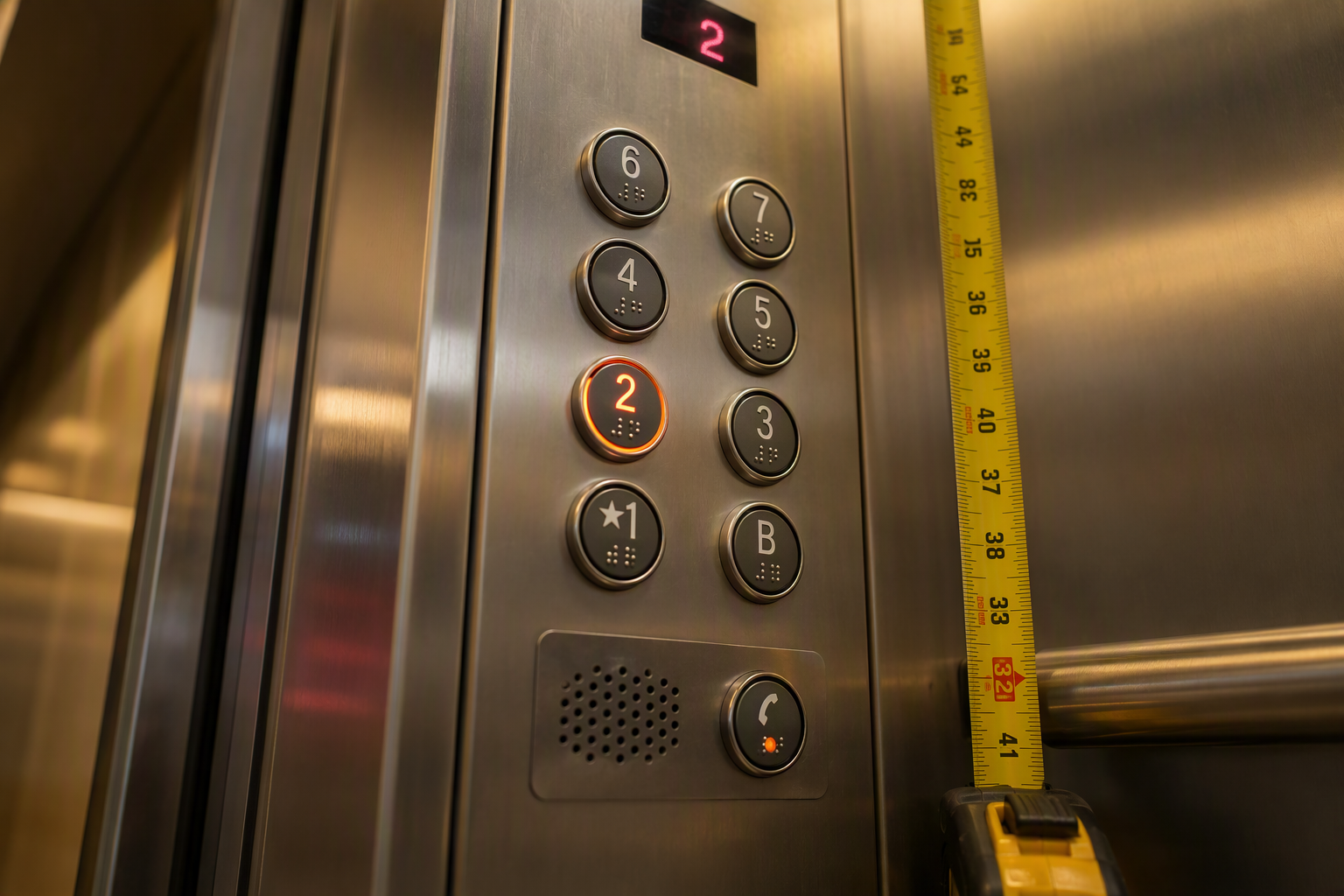
- Call buttons: Must be a minimum of ¾ inch in the smallest dimension, located between 15 and 48 inches above the floor, and must have visual signals that illuminate when a call is registered and answered.
- Floor designation signage: Raised characters and braille must be provided on both jambs of each elevator hoistway entrance, at a height of 60 inches above the finished floor to the centerline of the characters.
- Car dimensions: The ADA specifies minimum inside clear dimensions that allow a standard wheelchair to enter, maneuver, and exit. The most common configuration requires a clear floor area of at least 51 inches deep and 68 inches wide for center-opening doors, though exact dimensions vary by door configuration.
- Door clear width: Elevator doors must provide a minimum clear opening width of 36 inches.
- Door timing: Doors must remain fully open for at least 3 seconds during passenger transfer and must be equipped with a reopening device that halts and reverses door closure when a passenger is detected, without requiring contact.
- Floor level indicators: An audible signal or verbal announcement must sound at each floor, and visual indicators must display the current floor both inside the car and at the hoistway entrance.
- Car controls: Controls inside the car must be located between 15 and 48 inches above the car floor (front reach) or 15 to 54 inches (side reach), arranged with the lowest control no lower than 15 inches and the emergency controls grouped at the bottom of the panel no lower than 35 inches.
- Two-way communication: An emergency communication system capable of connecting to emergency services must be provided inside the car, with a visual signal to accommodate users who are deaf or hard of hearing.
- Illumination: The car interior must be illuminated at a minimum level adequate for safe operation, with controls, landings, and thresholds clearly lit.
All of these requirements apply to new construction. For existing buildings undergoing alterations, the ADA requires that the path of travel to the altered area — including the elevator, where it serves as primary vertical access — be made accessible to the maximum extent feasible without being disproportionate to the overall cost of the alteration.
Which Buildings Are Required to Have an Elevator Under the ADA?

The ADA includes a notable “elevator exemption” that applies to private buildings, but it is narrower than many owners assume. The exemption applies only when a building:
- Has fewer than three stories, AND
- Has no more than 3,000 square feet of floor area per story
If a building meets both conditions, an elevator is generally not required. However, several use types are explicitly excluded from this exemption regardless of size, including:
- Shopping centers and shopping malls
- Professional offices of health care providers
- Transit stations and airport terminal facilities
- Buildings with government tenants subject to Section 504 of the Rehabilitation Act
Additionally, the elevator exemption applies to the obligation to install an elevator — it does not exempt a building from making an existing elevator ADA-compliant if one is present. State and local building codes may also impose stricter requirements than the federal ADA baseline, so compliance analysis should always account for applicable local code.
How Do ADA Elevator Requirements Differ for New Construction vs. Existing Buildings?
For new construction, full compliance with the ADA Standards for Accessible Design is required from the outset. There is no cost-based exception — the building must be designed and built to meet every applicable technical specification.
For existing buildings, the ADA applies through two distinct triggers:
- Alterations: When a building owner alters a primary function area, the path of travel to that area — including the elevator — must be upgraded to be accessible. The ADA limits the cost of path-of-travel upgrades to 20 percent of the cost of the alteration to the primary function area. If full compliance would exceed that threshold, the accessible elements must be upgraded to the maximum extent possible within that budget.
- Barrier removal: Even without a triggering alteration, Title III of the ADA requires places of public accommodation to remove architectural barriers in existing facilities when doing so is “readily achievable” — meaning accomplishable without much difficulty or expense. Elevator-related barriers such as non-compliant call button heights, missing braille signage, or broken audible signals are commonly cited as readily achievable to correct.
The practical implication is that older buildings cannot simply claim “grandfathered” status indefinitely. The ongoing barrier removal obligation means that compliance is an active, continuing responsibility rather than a one-time certification event.
What Are the ASME Code Requirements That Overlap with ADA Compliance?
ADA accessibility requirements address usability for people with disabilities, while the ASME A17.1 Safety Code for Elevators and Escalators governs safety and mechanical performance. Both sets of requirements apply simultaneously to most commercial elevators, and they frequently intersect.
For example, ASME A17.1 establishes requirements for door re-opening devices, leveling accuracy (the elevator must stop within a specific tolerance of the landing floor level to prevent tripping hazards), and emergency lighting — all of which directly affect ADA-relevant functionality. A building that meets ASME A17.1 inspection standards but has not addressed ADA signage, control heights, or audible signals remains out of ADA compliance.
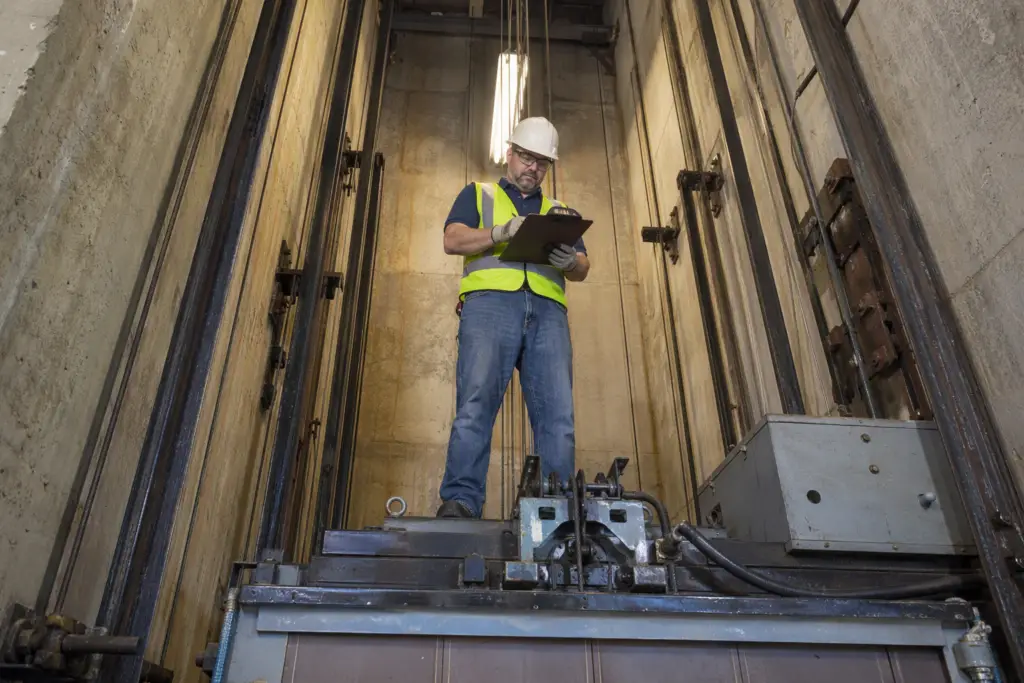
Annual inspections required under ASME A17.1 and most state elevator safety codes provide an opportunity to identify mechanical deficiencies, but they do not constitute an ADA accessibility audit. Building owners should treat safety inspections and ADA compliance reviews as complementary but separate processes.
What Are the Most Common ADA Elevator Violations Found in Buildings?
Based on the technical requirements outlined in the ADA Standards for Accessible Design, the compliance gaps most frequently identified during accessibility audits include:
- Missing or incorrect braille signage on hoistway entrance jambs, including signage at incorrect heights or using non-standard braille cell dimensions
- Call buttons that are not illuminated or that lack tactile identification
- Door timing that is too fast, closing before the required 3-second minimum or lacking a functional obstruction-detection device
- Car controls mounted too high, particularly in older installations where panels were designed without accessibility in mind
- Inoperative or absent audible floor indicators inside the car
- Two-way emergency communication systems that lack visual signaling for users who are deaf or hard of hearing
- Insufficient leveling accuracy resulting in gaps between the car floor and landing floor that create a barrier for wheelchair users
- Inadequate illumination at control panels or landings
Many of these deficiencies can be corrected through targeted component upgrades without requiring a full elevator modernization. A thorough accessibility assessment identifies which corrections are required and which can be prioritized within a phased compliance timeline.
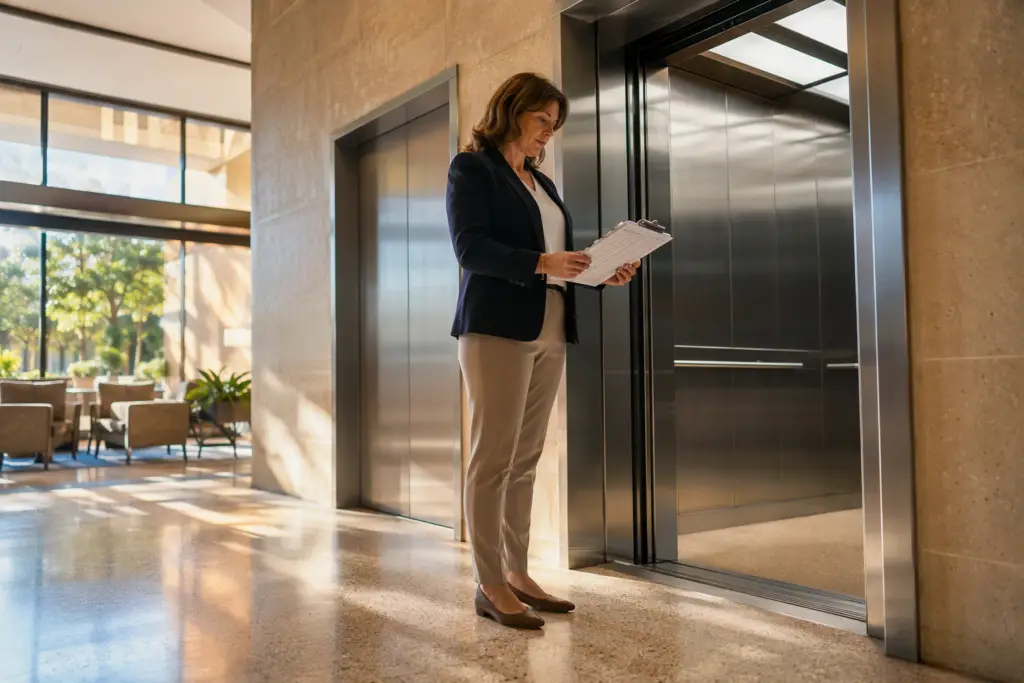
How Do You Conduct an ADA Elevator Compliance Assessment?
A systematic ADA elevator compliance assessment follows a structured process. Building owners or facility managers can use the following steps as a framework:
- Identify all elevators on the property and confirm which floors and areas each elevator serves, noting any gaps in vertical coverage.
- Verify applicability — confirm whether the building is subject to ADA elevator requirements or qualifies for the elevator exemption, accounting for building size, number of stories, and occupancy type.
- Obtain the ADA Standards for Accessible Design from ADA.gov and identify the specific sections governing elevator equipment (primarily Section 407 for passenger elevators).
- Measure and document each elevator against every technical standard: cab dimensions, door clear width, door timing, control heights, signage placement, braille accuracy, audible indicators, emergency communication, and illumination levels.
- Compare findings to the applicable standards and document each deficiency with a description of the current condition and the required corrective action.
- Prioritize corrections based on the “readily achievable” standard for existing facilities, focusing first on deficiencies that present the greatest barrier to access.
- Develop a remediation timeline and budget, coordinating with a qualified elevator service provider to obtain accurate cost estimates for each corrective action.
- Implement corrections and document completion, retaining records of work performed as evidence of good-faith compliance efforts.
- Schedule periodic re-assessments to account for code updates, equipment wear, and changes to building use or occupancy.
What Is the Cost of ADA Elevator Compliance Upgrades?
The cost of bringing an elevator into ADA compliance varies significantly depending on the nature and number of deficiencies identified. Correcting a non-illuminated call button or adding missing braille signage represents a modest expense relative to replacing a non-compliant control panel or installing a new two-way communication system with visual signaling capability.
Factors that drive compliance upgrade costs include:
- The age and make of the existing elevator equipment, which affects parts availability and retrofit compatibility
- Whether the cab interior requires physical modification to achieve dimensional requirements
- The complexity of the building’s electrical systems, particularly for communication and indicator upgrades
- Whether the corrections can be completed during scheduled downtime or require extended outages
- Local labor market conditions and permit requirements
Because costs vary so widely by situation, building owners should seek itemized assessments from qualified elevator service providers rather than relying on general estimates. The ADA’s “disproportionate cost” limitation for alterations-triggered path-of-travel upgrades (capped at 20 percent of the primary alteration cost) provides a defined financial threshold in specific scenarios, but it does not apply to the general barrier removal obligation under Title III.
What Are the Penalties for ADA Elevator Non-Compliance?
The ADA enforces compliance through both government action and private litigation. Under Title III, which covers places of public accommodation and commercial facilities, the U.S. Department of Justice may investigate complaints and pursue civil actions. Courts may order injunctive relief requiring barrier removal, and the DOJ may seek civil penalties.
Private individuals who encounter ADA barriers may file complaints with the DOJ or bring private lawsuits seeking injunctive relief and attorney’s fees — though Title III does not allow private parties to recover compensatory or punitive damages. Serial ADA litigation targeting elevator non-compliance is a documented enforcement pattern in several states, making proactive compliance a meaningful risk management strategy for building owners.
Beyond federal exposure, many states have their own disability access laws that provide for damages in addition to injunctive relief, significantly increasing the financial risk of non-compliance.
Are There Special ADA Requirements for Residential Buildings?
The ADA’s elevator requirements apply primarily to places of public accommodation and commercial facilities under Title III. Residential buildings are generally governed by separate federal law — specifically the Fair Housing Act — rather than the ADA, though Title II of the ADA covers state and local government housing programs and facilities.
The Fair Housing Act requires that covered multifamily housing constructed for first occupancy after March 13, 1991, meet accessibility design and construction requirements, which include provisions for accessible common-use areas and adaptable dwelling units. Buildings with elevators serving four or more units are subject to specific accessible route requirements under those standards.
Building owners with mixed-use properties or uncertainty about which federal law applies should consult a qualified accessibility consultant or legal counsel to determine the applicable requirements for each component of their facility.
How Do 2025 and 2026 Trends Affect ADA Elevator Compliance?
Several developments in 2025 and 2026 are shaping the practical landscape of ADA elevator compliance without changing the underlying federal standard itself:
- Increased DOJ enforcement activity: The Department of Justice has maintained active focus on Title III compliance, and building owners should expect continued scrutiny of accessibility barriers in commercial facilities.
- State-level code updates: Several states are updating their building codes to align with the most current editions of the ADA Standards and related ANSI/ICC accessibility standards, which may impose requirements beyond the federal baseline in some jurisdictions.
- Technology upgrades creating new compliance obligations: As building owners modernize elevators with touchscreen controls, destination dispatch systems, and smartphone-based call features, they must ensure that these new technologies meet or exceed ADA accessibility requirements — particularly for users who are blind, have low vision, or have limited dexterity. Legacy-compliant equipment that is replaced with non-compliant technology creates new liability.
- Aging building stock: A substantial portion of commercial buildings in the United States were constructed before or shortly after ADA enactment and have not undergone comprehensive accessibility retrofits. As those buildings change ownership or undergo renovation, compliance gaps are increasingly coming to light.
- Greater tenant and occupant awareness: Tenants, employees, and customers are more informed about accessibility rights than in prior decades, increasing the likelihood that non-compliance is identified and reported.
How Can Carolina Elevator Service Help with ADA Compliance?
Carolina Elevator Service approaches ADA elevator compliance as a data-driven process, combining technical knowledge of the ADA Standards for Accessible Design and the ASME A17.1 Safety Code for Elevators and Escalators with hands-on assessment of each building’s specific equipment and conditions.
Rather than applying generic checklists, Carolina Elevator Service evaluates each elevator against the applicable federal and state standards, identifies specific deficiencies, and provides building owners with clear, prioritized corrective action plans. This approach supports informed decision-making about compliance timelines, capital budgeting, and risk management — without the uncertainty that comes from vague or unverified compliance claims.
For building owners preparing for lease renewals, ownership transfers, facility renovations, or proactive risk mitigation, a structured elevator compliance assessment provides the documentation and roadmap needed to address ADA obligations systematically and defensibly.
What Is the Difference Between ADA Compliance and ASME Certification?
ADA compliance and ASME certification address different aspects of elevator performance and are evaluated through entirely separate processes. ADA compliance is a civil rights law obligation focused on usability and access for people with disabilities. It is enforced through complaint, litigation, and DOJ action — not through a certification or inspection stamp.
ASME certification and the related state-level inspection regimes confirm that an elevator meets safety and mechanical performance standards. A current inspection certificate demonstrates that the elevator operates safely; it does not confirm that the elevator meets ADA dimensional, signage, timing, or communication requirements.
Building owners who rely solely on passing elevator inspections as evidence of compliance are exposed to ADA liability. Both standards must be addressed independently and maintained continuously.
What Should Building Owners Do If They Discover an ADA Elevator Violation?
- Document the deficiency in writing, including photographs and measurements, as soon as it is identified.
- Consult the ADA Standards for Accessible Design, available through ADA.gov, to confirm the applicable technical requirement and the nature of the gap.
- Determine urgency — deficiencies that render the elevator entirely inaccessible to wheelchair users or users who are blind generally warrant faster remediation than minor signage issues.
- Contact a qualified elevator service provider to obtain an assessment of the corrective work required and a timeline for completion.
- Provide alternative accessible service where feasible while corrections are pending, and document the accommodations offered.
- Implement the correction and retain documentation of the work performed, including invoices, permits, and inspection results.
- Review the full elevator for any additional deficiencies that may not have been previously identified, treating the discovered violation as a prompt for comprehensive assessment.
Summary: Key ADA Elevator Requirements at a Glance
The table below summarizes the principal ADA technical requirements for passenger elevators as established in the ADA Standards for Accessible Design. All figures are drawn from the standards published by the U.S. Department of Justice at ADA.gov.
| Requirement | ADA Standard | Source |
|---|---|---|
| Minimum door clear opening width | 36 inches | ADA Standards § 407.3.3 |
| Minimum door hold-open time | 3 seconds | ADA Standards § 407.3.5 |
| Call button minimum size | ¾ inch minimum in smallest dimension | ADA Standards § 407.2.1.2 |
| Call button mounting height | 15 to 48 inches above floor | ADA Standards § 407.2.1.1 |
| Hoistway signage height (centerline) | 60 inches above finished floor | ADA Standards § 407.2.3.1 |
| Emergency control minimum height | 35 inches above car floor | ADA Standards § 407.4.6.1 |
| Elevator exemption threshold (private buildings) | Fewer than 3 stories AND ≤ 3,000 sq ft per story | ADA Standards § 206.2.3, Exception 1 |
Take the Next Step Toward Full ADA Elevator Compliance
ADA elevator compliance is a detailed, ongoing obligation that affects nearly every commercial building owner. The requirements span dimensions, hardware, signage, timing, communication, and illumination — and they apply regardless of when the building was constructed. Proactive assessment is the most effective way to identify gaps, prioritize corrections, and document good-faith compliance efforts before a complaint or litigation event forces the issue.
Carolina Elevator Service provides data-driven elevator assessments grounded in the technical requirements of the ADA Standards for Accessible Design and the ASME A17.1 Safety Code for Elevators and Escalators. Whether a building owner is preparing for a renovation, a property transaction, or simply wants to understand current compliance status, a structured assessment provides the clarity needed to act with confidence.
Contact Carolina Elevator Service for a free elevator assessment: 803-865-1400
Need elevator service you can rely on? Carolina Elevator Service is ready to help.