Elevator Service Provider Comparison: A Complete Guide for Building Owners in Columbia, SC
Choosing the right elevator service provider is one of the most consequential facility management decisions a building owner or property manager can make. The wrong choice can lead to equipment downtime, failed inspections, liability exposure, and costly emergency repairs. This guide covers every dimension of the elevator service provider comparison process — from compliance credentials and contract terms to equipment coverage and local responsiveness — so Columbia, SC building owners can make a fully informed decision.
What factors matter most when comparing elevator service providers?
The most important factors are regulatory compliance capability, technician training standards, contract transparency, equipment brand coverage, and local presence in the markets where a building is located.
Not all elevator service companies operate at the same level. Some specialize in installation while offering limited ongoing maintenance depth. Others carry broad maintenance portfolios but lack the compliance documentation practices that South Carolina’s Department of Labor, Licensing and Regulation (SC LLR) requires. A rigorous provider comparison looks beyond price to assess whether a company can keep an elevator legally operational, mechanically sound, and safe for passengers over the full life of the equipment.
Carolina Elevator Service is structured specifically to address each of these factors for properties in the Columbia, SC market, combining code-driven maintenance practices with transparent service agreements.
What certifications and licenses should an elevator service company hold in South Carolina?
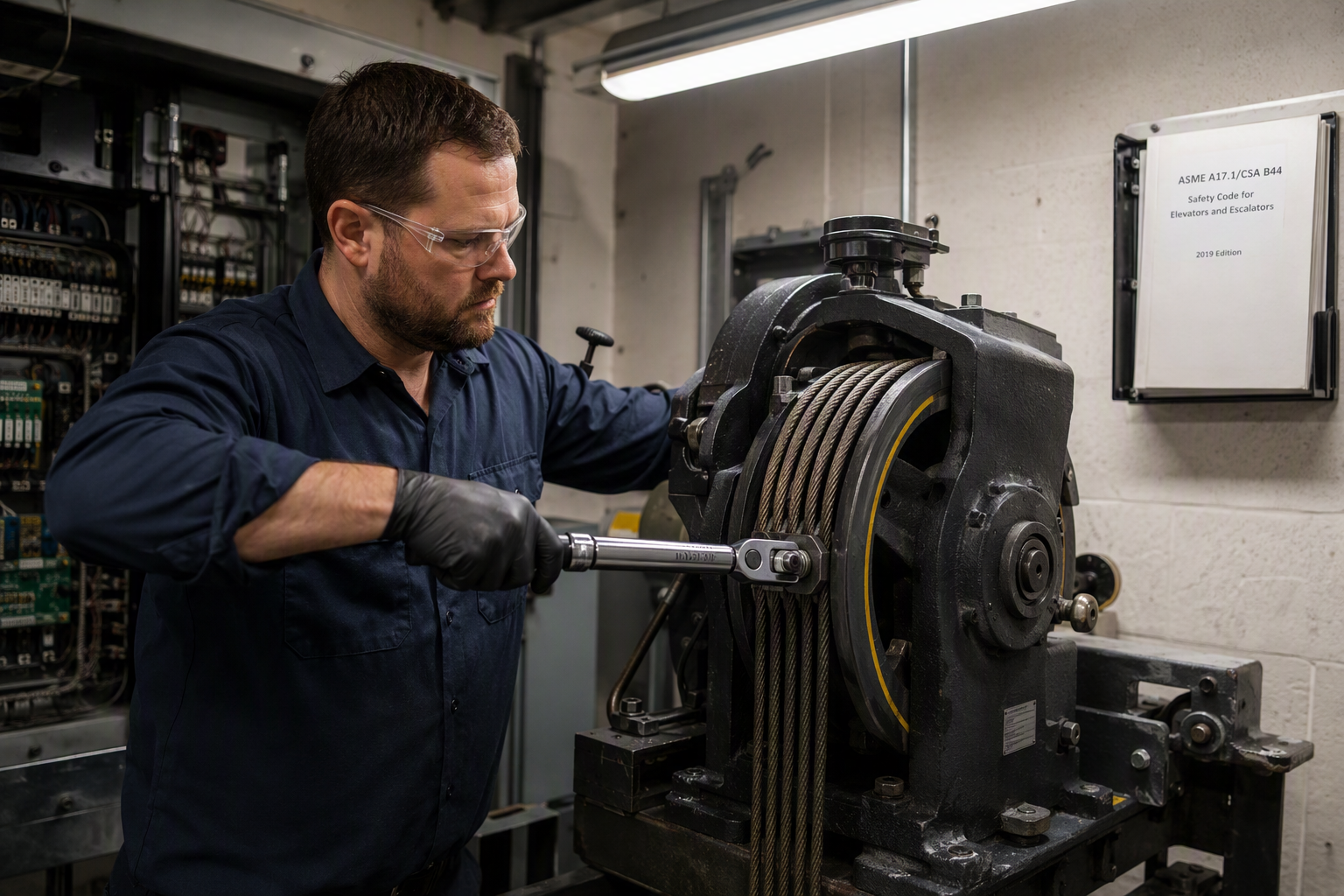
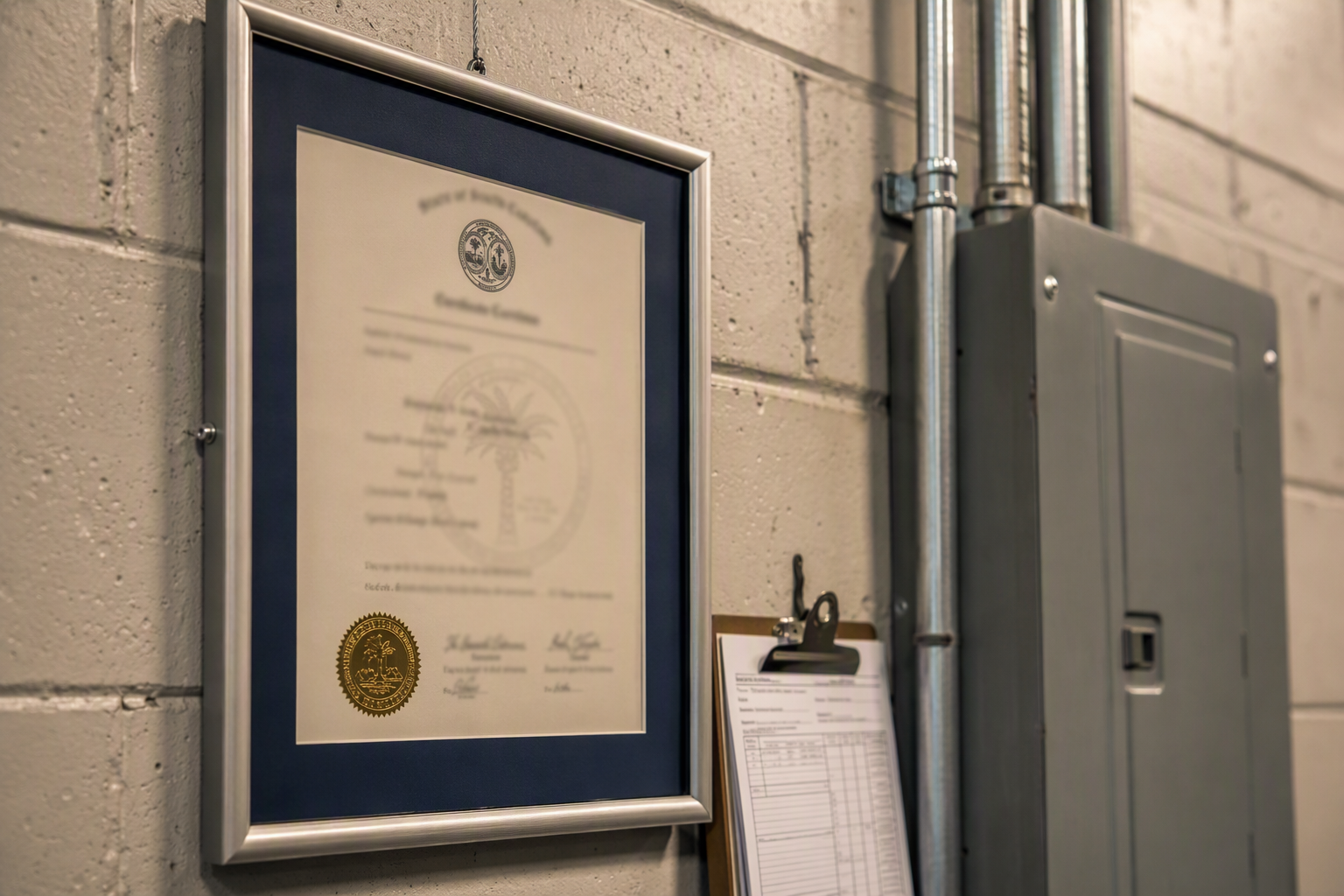
In South Carolina, elevator contractors must be licensed through the SC Department of Labor, Licensing and Regulation, and elevator mechanics must hold appropriate certification to work on conveyance equipment legally.
South Carolina regulates elevator work under the South Carolina Elevator Safety Act. Any company performing installation, alteration, maintenance, or repair must hold a valid state contractor license. Property managers should request proof of current licensure before signing any service agreement. Beyond state licensing, reputable providers align their practices with the ASME A17.1 Safety Code for Elevators and Escalators, the primary national technical standard governing elevator design, installation, inspection, and maintenance in the United States.
Technician qualification matters as much as company licensure. Providers whose field personnel are trained against ASME A17.1 requirements and who document that training are better positioned to catch code-related deficiencies before they become violations.
How does ASME A17.1 affect the elevator service company a building owner should choose?
The ASME A17.1 Safety Code for Elevators and Escalators establishes the technical benchmark against which all elevator maintenance, inspection, and repair work should be measured, making compliance with this standard a primary criterion in provider selection.
ASME A17.1 covers everything from machine room conditions and car enclosure integrity to safety device testing intervals and pit requirements. A service provider that structures its maintenance programs around A17.1 requirements will systematically test safety brakes, governor mechanisms, door interlock systems, and hydraulic fluid levels on schedules the code prescribes. A provider that does not reference this standard may miss mandatory safety tests, leaving a building exposed to inspection failures and, more critically, passenger risk.
When evaluating any elevator service company, building owners should ask directly: “How does your maintenance protocol map to ASME A17.1?” The answer reveals the provider’s technical depth quickly.
What ADA compliance responsibilities fall on an elevator service provider?
An elevator service provider is responsible for ensuring that the physical and operational characteristics of an elevator remain consistent with Americans with Disabilities Act (ADA) accessibility standards, particularly for existing altered elements and new installations.
The ADA requires that elevators serving public accommodations meet specific dimensional, operational, and signage requirements. These include door clearance widths, car interior dimensions, control panel heights, and audible/visual floor indicators. A qualified elevator service company should flag ADA-related deficiencies during routine maintenance visits and advise building owners when aging equipment or modifications create accessibility compliance gaps. Providers that are unfamiliar with ADA elevator requirements expose their clients to federal civil rights complaints and potential litigation.
What should a building owner look for in an elevator maintenance contract?
A strong elevator maintenance contract clearly defines the scope of covered services, exclusions, inspection documentation obligations, emergency callback provisions, and the process for recommending major repairs or modernization.
Contracts vary widely across the elevator service industry. Full-service agreements typically cover parts, labor, and adjustments for listed components, while oil-and-grease agreements cover only lubrication and minor adjustments, leaving most repair costs as billable extras. Building owners should read exclusion clauses carefully — some contracts exclude entire subsystems such as hydraulic power units, door operators, or electronic controllers. A provider that offers a comprehensive written breakdown of inclusions and exclusions, rather than broad language, demonstrates the transparency appropriate to a long-term service relationship.
How often should elevators be inspected, and does the service provider manage that process?
South Carolina requires periodic elevator inspections by a state-certified inspector, and a qualified service provider should prepare the equipment for these inspections and maintain the documentation required for compliance.
Under South Carolina’s elevator safety regulations, conveyance equipment must undergo routine and periodic inspections at intervals established by the SC LLR and consistent with ASME A17.1 requirements. A reliable service provider tracks inspection due dates, ensures required safety tests are completed before the inspection date, and provides the building owner with documentation of all maintenance performed. Providers that leave inspection scheduling entirely to the building owner without proactive communication create unnecessary compliance risk.
How do elevator service companies compare on equipment brand coverage?
Equipment coverage breadth is a significant differentiator — some providers are aligned with a single manufacturer while independent service companies typically maintain and repair a broader range of equipment brands and vintages.
| Comparison Factor | Manufacturer-Affiliated Provider | Independent Service Provider |
|---|---|---|
| Equipment Brand Coverage | Primarily own-brand equipment | Multi-brand, mixed-vintage capability |
| Parts Sourcing | OEM parts, may have proprietary restrictions | OEM and compatible parts, broader sourcing options |
| Contract Flexibility | Standardized national contract terms | Negotiable, locally tailored agreements |
| Local Responsiveness | Varies by regional office proximity | Direct local presence and accountability |
| Code Compliance Orientation | Aligned with manufacturer’s standards | Aligned with ASME A17.1 and state code |
| Pricing Transparency | National rate structures, less flexible | Locally competitive, itemized pricing |
| Modernization Bias | May favor own equipment replacement | Neutral assessment of repair vs. replace options |
Buildings with older or mixed-brand elevator portfolios particularly benefit from working with independent certified providers like Carolina Elevator Service, which can service equipment across manufacturers without being constrained by a single brand’s parts ecosystem or service protocols.
What questions should a building manager ask during an elevator service provider interview?
Building managers should ask at minimum about state licensure, ASME A17.1 compliance protocols, contract scope and exclusions, inspection documentation practices, and how the provider handles emergency callbacks.
A structured interview process protects building owners from selecting a provider based on price alone. Useful questions include: How do you document each maintenance visit? What is your process when a safety test fails? How do you handle parts for older or discontinued equipment? Can you provide a written scope of work for a maintenance proposal? What is your process for informing building ownership of code violations discovered during service? The quality and specificity of a provider’s answers to these questions signal their operational maturity.
How does local presence affect elevator service quality?
A locally present elevator service provider typically delivers faster on-site response, better knowledge of regional code enforcement practices, and more direct accountability than a national company managing accounts remotely.
Columbia, SC building owners operate in a specific regulatory environment administered by the SC LLR. A service provider with actual local presence understands the enforcement priorities, inspector expectations, and permitting processes specific to South Carolina — knowledge that reduces compliance friction. Additionally, local proximity generally supports more predictable scheduling and more direct communication between field technicians and building management. Carolina Elevator Service operates in the Columbia, SC market with this kind of direct local accountability.
What is the difference between elevator maintenance, repair, and modernization services?
Maintenance refers to scheduled preventive service, repair addresses specific component failures, and modernization involves replacing major systems or components to improve performance, safety, or code compliance — and a qualified service provider should offer all three.
These three service categories represent different cost profiles and planning horizons. Maintenance is an ongoing operational expense that prevents failures. Repair is reactive and variable in cost depending on component complexity. Modernization is a capital project, typically triggered by age-related reliability decline, parts unavailability, or code upgrade requirements. A capable elevator service company should provide honest assessments of when repair is adequate versus when modernization is the more economical long-term path — without a bias toward unnecessary capital work.
What role does OSHA play in elevator service provider selection?
The Occupational Safety and Health Administration (OSHA) sets workplace safety standards that govern how elevator technicians work safely in machine rooms, pits, and hoistways, and a provider’s OSHA compliance record reflects their overall operational discipline.
OSHA standards relevant to elevator service work include requirements for confined space entry (applicable to elevator pits), lockout/tagout procedures for energy control, and general electrical safety. A service provider that follows OSHA protocols protects its own technicians and also reduces liability for building owners whose premises are the worksite. Building managers can ask providers about their safety training programs and incident record as part of the vetting process.
How should building owners evaluate elevator service provider proposals?
Proposals should be evaluated on scope clarity, contract term length, exclusion lists, parts coverage, inspection coordination responsibility, and how the provider handles major repair recommendations — not on monthly fee alone.
A low monthly maintenance fee can be misleading if the contract excludes most components likely to need attention on aging equipment. When reviewing competing proposals, building owners should normalize each bid by asking what the total estimated annual cost would be if typical repairs and parts are added to a limited-scope contract. This total-cost-of-ownership comparison often reverses the apparent price advantage of a lower-fee agreement. Transparent, comprehensive proposals are a marker of a trustworthy provider.
What should building owners do if they discover their elevator is out of compliance?
- Stop elevator operation immediately if the SC LLR or a certified inspector has issued a stop-work or out-of-service order to avoid liability.
- Contact a licensed elevator service company to conduct a full inspection and identify all code deficiencies.
- Request a written deficiency report that references the specific ASME A17.1 or state code section violated.
- Obtain a written repair scope and timeline from the service provider for correcting each deficiency.
- Ensure all repair work is completed by licensed personnel and documented with service records.
- Schedule a re-inspection through the SC LLR to obtain a new certificate of operation.
- Retain all inspection and repair documentation in the building’s elevator records file for future reference.
How do elevator service contracts differ in term length and what are the implications?
Elevator service contracts typically range from one-year to five-year terms, and longer contracts may offer pricing stability but can reduce flexibility if service quality declines or the provider is sold or restructured.
Multi-year contracts are common in the elevator industry, particularly from larger national providers. While longer terms may lock in a lower monthly rate, they also create exit cost exposure if the relationship deteriorates. Building owners should review cancellation clauses, including whether the contract transfers with a property sale and what notice period and financial penalties apply to early termination. One-year or renewable agreements preserve more flexibility and are worth requesting from providers willing to offer them.
What does elevator modernization involve and when is it the right choice?
Elevator modernization involves replacing major systems — typically the controller, drive, door operator, or cab fixtures — to restore reliability, improve energy efficiency, and bring equipment into compliance with current code requirements.
The decision to modernize rather than continue repairing aging equipment is driven by several indicators: increasing frequency of service calls, inability to source replacement parts for discontinued components, persistent door or leveling issues that routine maintenance cannot resolve, and requirements to meet current ASME A17.1 or ADA standards on altered equipment. A qualified service provider offers an objective modernization assessment based on equipment condition and cost trajectory, not on revenue motivation from a particular product line.
How can building owners verify an elevator service company’s compliance history?
Building owners can verify an elevator contractor’s licensure through the South Carolina Department of Labor, Licensing and Regulation’s public license lookup, and can request inspection records and service history documentation directly from the provider.
The SC LLR maintains a public database of licensed elevator contractors and mechanics. Cross-referencing a provider’s claimed credentials against this database takes minutes and eliminates unlicensed operators from consideration immediately. Additionally, building owners transitioning from one service provider to another are entitled to request copies of all maintenance records, inspection certificates, and open deficiency notices from the incumbent provider — these documents belong to the building, not the service company.
What is the importance of maintenance documentation in comparing elevator service providers?
Thorough maintenance documentation protects building owners in regulatory inspections, insurance reviews, and liability situations, and the quality of a provider’s documentation practices is a direct indicator of their professionalism.
Every maintenance visit should produce a written or digital record identifying the technician, the date, the equipment serviced, the tasks performed, any deficiencies noted, and any corrective actions taken or recommended. Providers that offer only verbal communication following service visits create documentation gaps that can become serious problems during an inspection or if a passenger incident occurs. Building owners should ask prospective providers how maintenance records are stored, how frequently reports are provided, and whether records are accessible on demand.
How does hydraulic elevator service differ from traction elevator service, and does provider expertise matter?
Hydraulic and traction elevators have fundamentally different mechanical systems requiring distinct maintenance expertise, and a provider should demonstrate specific competency in the type of equipment a building operates.
Hydraulic elevators use a fluid-driven piston system and require attention to hydraulic fluid condition, pump and valve maintenance, and environmental compliance related to fluid containment. Traction elevators use counterweighted cables and either geared or gearless machine configurations, requiring expertise in rope inspection, brake adjustment, and machine room equipment. A service provider that primarily services one type may not be equally qualified for the other. Building owners should confirm that a prospective provider has documented service history with their specific equipment type.
What should property managers know about elevator safety device testing requirements?
ASME A17.1 prescribes specific testing intervals for safety devices including governors, safeties, buffers, and pressure relief valves, and a service provider must perform and document these tests on schedule to maintain compliance.
Safety device testing is not optional or informal — it is a codified requirement under ASME A17.1 with defined test procedures and documentation requirements. Tests include full-load safety tests, governor tripping speed verification, and hydraulic pressure relief valve testing, among others. Providers that defer or skip these tests to reduce service time may leave a building in technical violation even if the elevator appears to be operating normally. Building owners should request a testing schedule from any provider under consideration and confirm it aligns with code requirements.
Why should Columbia, SC building owners choose Carolina Elevator Service?
Carolina Elevator Service brings direct local presence in the Columbia, SC market, code-aligned maintenance practices, and the transparent service approach that building owners need to keep elevator equipment compliant, reliable, and safe.
Selecting a service provider that understands the specific regulatory landscape of South Carolina, maintains equipment across brands and vintages, and provides honest guidance on maintenance versus modernization decisions gives building owners a meaningful operational advantage. Carolina Elevator Service serves the Columbia, SC market with these priorities at the center of every service relationship. For building owners currently under contract with a provider that is not delivering documentation, compliance support, or responsive communication, a provider comparison is worth initiating before the next inspection cycle.
Get a Free Elevator Assessment for Your Columbia, SC Property
Whether a property has one elevator or many, evaluating current service coverage against the standards described in this guide is a practical first step toward better compliance and lower long-term maintenance costs. Contact Carolina Elevator Service for a free elevator assessment and find out how the property’s current service compares to what a properly structured maintenance program should deliver.
Call Carolina Elevator Service today: 803-865-1400
Need elevator service you can rely on? Carolina Elevator Service is ready to help.