Hospital Elevator Requirements and Maintenance: A Complete Guide for Healthcare Facilities

Elevators in hospitals and healthcare facilities are not simply a convenience — they are critical life-safety infrastructure. A stretcher carrying a patient to surgery, a nurse transporting medication carts between floors, or emergency responders moving rapidly through a multi-story facility all depend on elevators that perform reliably, comply with strict regulatory standards, and are maintained according to documented protocols. This guide covers everything healthcare facility managers in Columbia, SC and surrounding areas need to know about hospital elevator requirements and maintenance in 2026.
What Code Requirements Apply to Hospital Elevators?
Hospital elevators are governed by a layered framework of federal, state, and industry standards. Understanding which codes apply — and how they interact — is essential for facility compliance.
- ASME A17.1 Safety Code for Elevators and Escalators: This is the primary safety standard governing elevator design, installation, inspection, testing, and maintenance across the United States. South Carolina adopts this code as the basis for statewide elevator regulation. It defines inspection intervals, load requirements, safety device testing, and maintenance documentation obligations.
- Americans with Disabilities Act (ADA): Hospitals are public accommodations and must ensure elevator cabins, controls, and door timing meet ADA accessibility requirements. This includes minimum cab dimensions, tactile and audible signals, accessible control panel heights, and door reopening devices.
- The Joint Commission (TJC) Environment of Care Standards: Accredited hospitals must demonstrate that elevators are included in a documented preventive maintenance program and that equipment failures are addressed within defined risk frameworks. Elevator maintenance records are subject to TJC survey review.
- NFPA 101 Life Safety Code: In fire emergencies, hospital elevators must meet recall requirements so firefighters can assume elevator control. Compliance requires Phase I and Phase II fire service features on all applicable equipment.
- OSHA General Industry Standards: While OSHA does not publish a dedicated elevator standard, elevator machine rooms and maintenance activities in hospitals fall under OSHA general duty clauses and lockout/tagout requirements for service personnel.
Carolina Elevator Service works with healthcare facility managers in Columbia, SC to identify every applicable code layer and build a compliance-ready maintenance program from the ground up.
What Are the Inspection Requirements for Hospital Elevators?
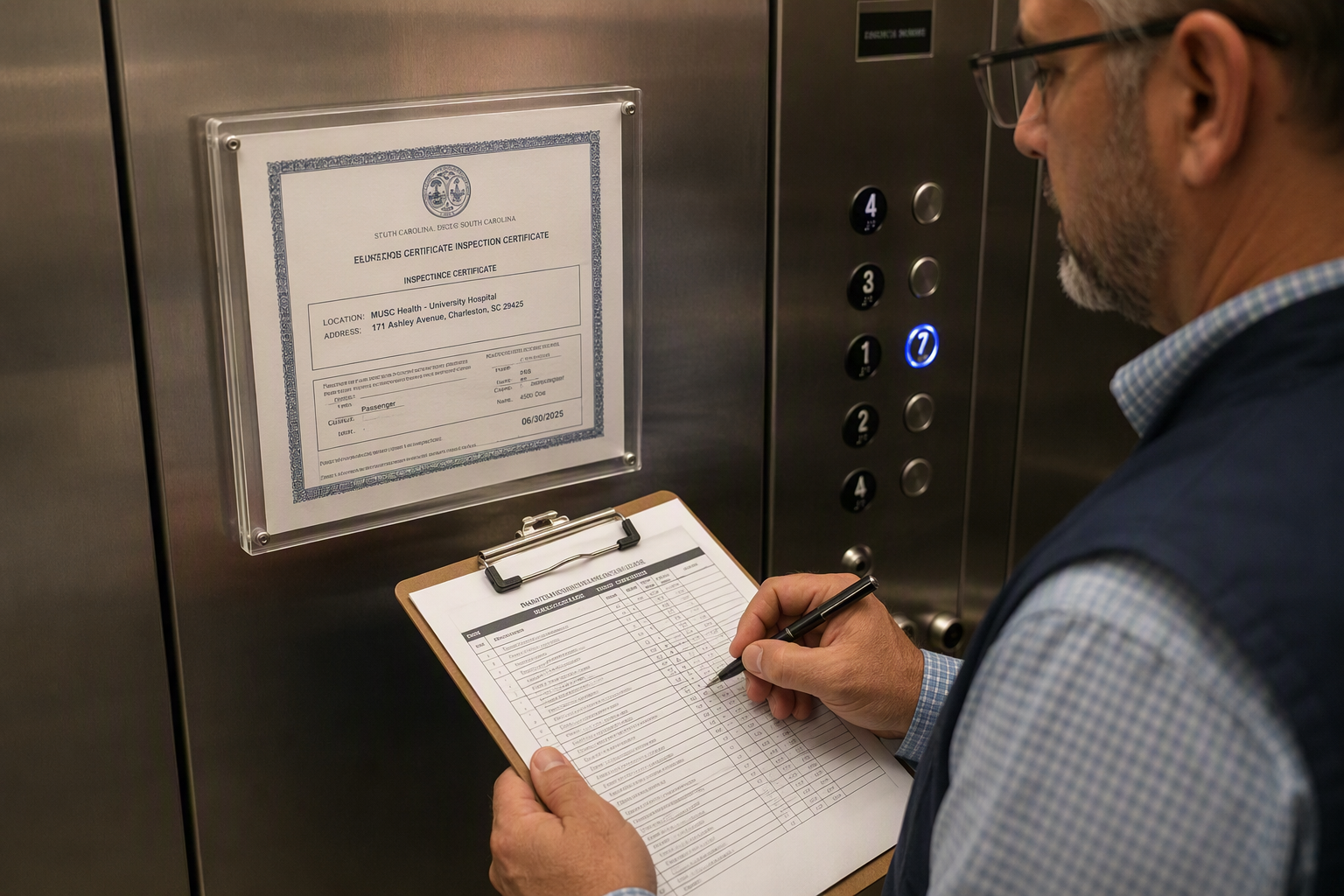
Under ASME A17.1 and South Carolina state elevator law, hospital elevators must undergo periodic inspections performed by a licensed elevator inspector. These inspections verify that safety devices, control systems, cab structures, doors, and emergency communication systems are functioning correctly. Following each inspection, a certificate of operation must be posted inside the elevator cab.
In addition to state-mandated inspections, The Joint Commission expects hospitals to perform internal documented maintenance checks as part of the Environment of Care program. These internal records must be available during accreditation surveys and demonstrate that a proactive maintenance schedule — not just reactive repairs — is in place.
Carolina Elevator Service provides inspection-ready documentation and can coordinate with state inspectors on behalf of healthcare clients to streamline the certification process.
What Are the Physical Requirements for Hospital Elevator Cabs?
Hospital elevators differ substantially from standard commercial elevators in their physical specifications. These requirements reflect the operational realities of healthcare environments:
- Cab dimensions: Hospital elevators must accommodate stretchers, hospital beds, and large medical equipment. Typical hospital elevator cabs are considerably wider and deeper than standard passenger elevators, with door openings wide enough for beds and wheelchairs to pass safely.
- Weight capacity: Healthcare facilities routinely transport patients, bariatric equipment, and heavy medical carts. Elevator capacity ratings must match these operational loads, and load plates must be prominently displayed and accurate.
- Surface materials: Cab interiors in healthcare settings should use materials that support infection control — smooth, non-porous wall panels, easy-clean flooring, and stainless steel or antimicrobial-compatible finishes.
- Door timing: ADA and healthcare best practices require door open times long enough for patients in wheelchairs or on gurneys to enter and exit safely without doors closing prematurely.
- Emergency communication: ASME A17.1 mandates a two-way communication system in every cab that connects to a continuously monitored location — critical in a hospital where a patient or staff member may be alone in a stalled elevator.
How Often Should Hospital Elevators Be Maintained?
Hospital elevators operate at significantly higher cycle rates than typical commercial elevators. A high-traffic hospital building may see an elevator complete many more daily cycles than an office building of comparable size. This intensity of use means maintenance intervals should reflect actual usage patterns, not just minimum code requirements.
A sound hospital elevator maintenance program typically includes:
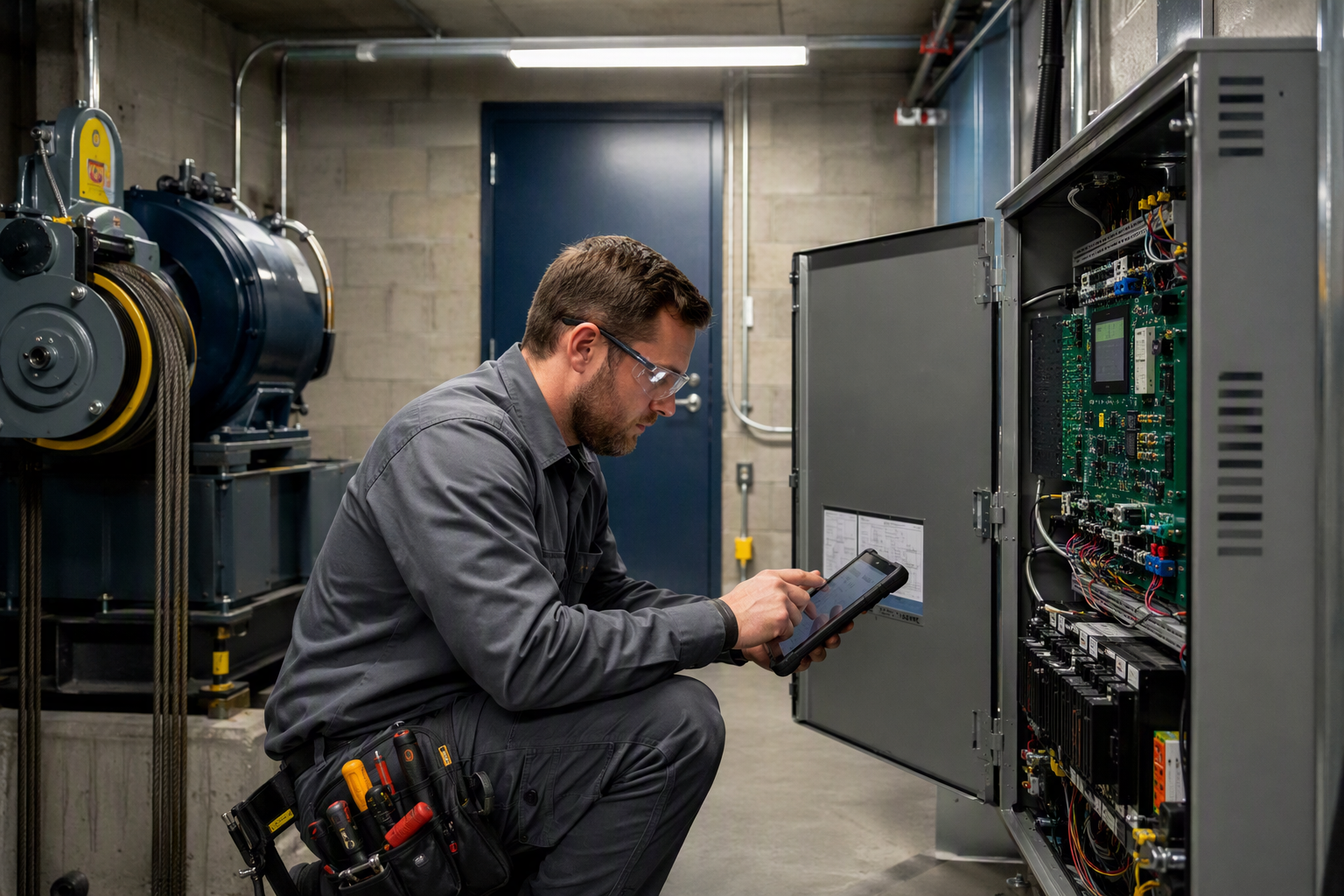
- Monthly lubrication and mechanical checks — inspecting guide rails, sheaves, cables, and door operators for wear.
- Quarterly safety device testing — verifying that governor, safeties, buffers, and interlocks function correctly.
- Semi-annual full-system inspection — a comprehensive review of electrical systems, controllers, and emergency features.
- Annual load testing and state inspection coordination — meeting ASME A17.1 periodic test requirements and scheduling the state-required inspection.
- Ongoing documentation — maintaining a written log of all maintenance, repairs, and findings for Joint Commission and state review.
What Happens When a Hospital Elevator Goes Out of Service?
An elevator outage in a hospital is not merely an inconvenience — it can disrupt patient transport, delay emergency response, and put staff at risk of injury when manual alternatives are used. When an elevator goes out of service, the following steps should be taken immediately:
- Notify facility management and document the time and nature of the failure.
- Post clear signage at all affected floors indicating the elevator is out of service.
- Activate your facility’s elevator outage contingency plan, rerouting patient transport to operational elevators.
- Contact your certified elevator service provider to dispatch a qualified technician.
- Do not attempt to reset or restart the elevator without qualified service personnel on site.
- Complete an incident report per your facility’s risk management protocol.
- Retain all service records from the repair for regulatory documentation files.
Carolina Elevator Service supports healthcare clients in Columbia, SC with the technical response and documentation required when an outage occurs.
What Is Fire Service Mode and Why Is It Required in Hospitals?
Fire service mode — sometimes called Phase I and Phase II fire recall — is a mandatory safety feature governed by ASME A17.1 and NFPA 101. When a fire alarm activates, Phase I recall returns all elevators to the designated recall floor so occupants can exit safely and elevator shafts do not act as smoke pathways. Phase II allows firefighters to take manual control of individual cars for rescue and suppression operations.
In hospitals, where many patients cannot use stairs under any circumstances, ensuring fire service mode is properly calibrated and tested is not optional — it is a fundamental life-safety requirement. Annual testing of fire recall systems should be part of every hospital elevator maintenance contract.
What Are the ADA Requirements Specific to Hospital Elevators?
Under the Americans with Disabilities Act, hospital elevators must meet accessibility standards that ensure patients, visitors, and staff with disabilities can use them independently and safely. Key requirements include:
- Call buttons positioned at accessible heights with visual indicators.
- Audible and visual floor indicators inside the cab.
- Tactile and Braille markings on control panels.
- Door reopening devices that detect obstructions without contact.
- Sufficient cab size to accommodate wheelchair turning and maneuvering.
- Level landings that meet ADA floor tolerances for smooth transitions.
Non-compliance with ADA in a hospital setting can expose the facility to federal civil rights complaints in addition to standard code violations.
How Should Hospitals Select an Elevator Service Provider?
Choosing an elevator service company for a healthcare facility requires more than comparing price. Facility managers should evaluate providers on the following criteria:
- Certification and licensing: The provider should hold all state-required elevator contractor licenses and employ technicians trained to relevant industry standards.
- Healthcare sector experience: Hospital environments have unique operational demands. A provider familiar with healthcare environments understands the urgency of uptime and the documentation requirements of The Joint Commission.
- Documented maintenance programs: The provider should deliver written maintenance plans and service logs that satisfy both state inspection requirements and accreditation survey standards.
- Local presence: A service company based in the region — such as Carolina Elevator Service, serving Columbia, SC — can respond to service needs without extended delays caused by distance.
- Transparency in reporting: Healthcare facilities need clear, readable service reports they can present to surveyors and risk managers without interpretation.
What Are Common Elevator Problems in Healthcare Facilities?
High-cycle hospital environments accelerate wear patterns that appear less frequently in other building types. Common issues in healthcare elevator maintenance include:
- Door operator wear: Frequent opening and closing under heavy use degrades door cams, rollers, and clutches faster than in low-traffic buildings.
- Cab leveling drift: Inaccurate floor leveling creates a tripping hazard — particularly dangerous when moving patients on stretchers or in wheelchairs.
- Cable and sheave wear: Heavy load cycles accelerate rope stretch and sheave grooving, requiring more frequent inspection and replacement.
- Controller and software faults: Modern solid-state elevator controllers can develop software errors that require firmware updates or board replacement.
- Emergency lighting and phone failures: These safety components are sometimes overlooked until an inspection reveals they are non-functional.
Questions Your Inspector Will Ask
When a South Carolina elevator inspector or Joint Commission surveyor reviews your hospital’s elevator program, they are likely to ask questions in the following areas. Prepare documentation in advance:
- Is there a current, valid certificate of operation posted in each cab? This certificate is issued after a satisfactory state inspection and must be current.
- Can you produce the maintenance log for the past 12 months? Logs must show dates, tasks performed, and the identity of the service company.
- Have all required periodic tests under ASME A17.1 been completed and documented? This includes safety device tests, governor tests, and buffer tests on the applicable cycle.
- When was the last fire recall test conducted? Phase I and Phase II tests should be documented with dates and outcomes.
- Is the two-way emergency communication system functional and monitored continuously? Inspectors will test this in the cab.
- Have any repairs or modifications been performed since the last inspection? All work must be documented and, where required, permitted.
- Does the posted capacity plate match the actual rated load? Discrepancies require immediate correction.
- Is the machine room access controlled and the environment within acceptable temperature and humidity ranges? ASME A17.1 includes machine room environmental requirements.
What Should a Hospital Elevator Maintenance Contract Include?
A comprehensive maintenance contract for a healthcare facility should specify the scope of covered services, documentation deliverables, parts and materials policies, and procedures for handling emergency callbacks. At minimum, the contract should address:
- Scheduled maintenance visit frequency and scope for each unit.
- Written service reports after every visit.
- Coordination with state inspection scheduling.
- Fire recall testing and documentation.
- Coverage for emergency communication system testing.
- Clear definition of which parts are included versus billed separately.
- Escalation procedures for outages that affect patient transport.
Carolina Elevator Service structures maintenance agreements for healthcare clients in Columbia, SC to align with Joint Commission documentation expectations and South Carolina regulatory requirements.
How Does Modernization Affect Compliance for Aging Hospital Elevators?
Many hospital buildings in South Carolina operate elevators installed decades ago. As equipment ages, maintaining code compliance and operational reliability becomes increasingly challenging. Modernization — replacing outdated controllers, motors, cab interiors, and door systems — can bring an aging unit into alignment with current ASME A17.1 and ADA requirements while improving energy efficiency and ride quality.
Any modernization project in a licensed facility requires proper permitting and a post-modernization inspection. Facility managers should work with a certified elevator contractor to assess whether modernization or replacement is the appropriate path for each unit based on its age, condition, and the facility’s capital plan.
Why Local Service Matters for Columbia, SC Healthcare Facilities
Healthcare facilities cannot afford extended wait times when elevator issues arise. Working with a locally based, certified elevator service company means that inspections, maintenance visits, and service calls are handled by technicians familiar with South Carolina’s regulatory environment and the specific demands of the region’s healthcare infrastructure.
Carolina Elevator Service is a certified elevator service company serving Columbia, SC and surrounding communities, providing maintenance, inspection coordination, and modernization services tailored to the requirements of healthcare facilities.
Get Your Hospital Elevator Assessment Today
Compliance gaps, aging equipment, and documentation deficiencies can put your accreditation status and patient safety at risk. Contact Carolina Elevator Service for a free elevator assessment and find out exactly where your healthcare facility stands — before your next inspection does.
Contact Carolina Elevator Service for a free elevator assessment: 803-865-1400
Need elevator service you can rely on? Carolina Elevator Service is ready to help.