Elevator Downtime Cost Statistics: What Building Owners Need to Know
When an elevator stops working, the financial consequences extend far beyond a repair invoice. For commercial landlords, healthcare facilities, hotels, and multifamily residential buildings, an out-of-service elevator triggers a cascade of direct and indirect costs — lost revenue, tenant attrition, regulatory exposure, and reputational damage. Understanding the full cost profile of elevator downtime is essential for any building owner making decisions about maintenance contracts, capital planning, and equipment replacement.
This authority page compiles what is known — and what is knowable — about elevator downtime costs, drawing on publicly attributed sources and established industry frameworks. Where specific figures cannot be verified from attributable sources, this page describes the cost mechanisms qualitatively so building owners have an accurate picture without misleading data.
—
What Are the Primary Cost Categories of Elevator Downtime?

Elevator downtime costs fall into several distinct categories, each of which compounds the others:
- Emergency repair costs: Unplanned repairs consistently cost more than scheduled maintenance. Emergency call-out fees, after-hours labor rates, and expedited parts procurement all inflate the final invoice compared with the same work performed during routine maintenance.
- Lost productivity: In office buildings, a non-operational elevator forces employees to use stairwells, arrive late to meetings, or — in high-rise settings — be unable to reach their floors entirely. This lost time represents a real economic cost to tenants.
- Tenant and customer dissatisfaction: Hotels, retail centers, and multifamily properties risk losing guests, shoppers, and residents to competitors when elevator access is unreliable. Lease non-renewal decisions are frequently influenced by recurring mechanical failures.
- ADA compliance liability: Under the Americans with Disabilities Act (ADA), buildings with elevators are generally required to keep them operational to maintain accessible routes. Downtime that blocks access for individuals with disabilities can expose building owners to formal complaints and civil liability.
- Code compliance risk: Elevator operation in the United States is governed in large part by the ASME A17.1 Safety Code for Elevators and Escalators. Operating an elevator with known defects, or failing to restore service within jurisdictionally mandated timeframes, can result in fines, mandatory shutdowns, and increased regulatory scrutiny.
- Brand and reputational costs: In the age of online reviews, a single widely-shared complaint about a broken elevator can deter prospective tenants or guests. Reputation damage is difficult to quantify but consistently cited by property managers as a serious concern.
How Does Elevator Age Affect Downtime Frequency?

The relationship between elevator age and downtime frequency is well-established in facilities management practice, even if precise failure-rate statistics vary by installation type, usage volume, and maintenance history. Generally, elevators that are older than their expected design life experience:
- More frequent component failures due to wear on mechanical and electrical parts that are increasingly difficult to source
- Longer repair times because legacy parts may require special ordering or custom fabrication
- Higher cumulative maintenance costs that can exceed the annualized cost of modernization or replacement
The ASME A17.1 Safety Code for Elevators and Escalators is updated on a regular cycle, and jurisdictions adopting more recent code editions may require retroactive upgrades to older equipment. This compliance pressure adds a cost dimension to aging equipment that building owners must factor into long-term planning.
What Is the Cost of Emergency Versus Planned Maintenance?
One of the most consistently documented cost differentials in facilities management — across all mechanical systems, including elevators — is the premium associated with emergency or reactive maintenance compared to planned, preventive maintenance. While specific elevator-industry cost ratios vary based on contract structure, equipment type, and geography, the general principle is well-supported: reactive maintenance is substantially more expensive per incident than proactive maintenance spread over time.
Key drivers of the emergency repair premium include:
- After-hours and weekend labor rate multipliers
- Emergency dispatch and expedited travel fees
- Overnight or expedited shipping for replacement parts
- Opportunity cost of technician time pulled from scheduled jobs
- Secondary damage caused by delayed repairs (e.g., a failing hydraulic seal that worsens during a multi-day outage)
How Does Elevator Downtime Affect ADA Compliance and Legal Exposure?
The Americans with Disabilities Act requires that public accommodations and commercial facilities maintain accessible routes. In multi-story buildings where elevators serve as the primary accessible means of vertical travel, downtime directly compromises compliance with federal accessibility standards.
While short-term outages accompanied by prompt repair efforts and alternative accommodations may mitigate liability, recurring or extended downtime creates documented exposure. Building owners should be aware that:
- The ADA does not provide a grace period for elevator outages in buildings where no accessible alternative exists
- Complaints can be filed with the U.S. Department of Justice, triggering investigations and potential civil penalties
- Private lawsuits under the ADA may result in injunctive relief and attorney’s fees in addition to remediation costs
What Does OSHA Require When an Elevator Malfunctions?
The Occupational Safety and Health Administration (OSHA) has jurisdiction over workplace safety conditions, including elevator safety in commercial and industrial settings. When an elevator malfunction poses a risk of injury to workers, OSHA standards may require the equipment to be taken out of service immediately and locked out until repairs are completed and verified safe.
Failure to properly respond to a known elevator defect — including continuing to allow employee use of a malfunctioning unit — can result in OSHA citations, fines, and heightened scrutiny of a facility’s overall safety program. The cost of an OSHA citation can include:
- Civil monetary penalties per violation
- Mandatory abatement costs
- Increased inspection frequency for the facility
- Reputational consequences with workers and unions
What Should Building Owners Do Immediately When an Elevator Goes Down?
- Verify passenger safety: Confirm through intercommunication systems or physical inspection that no passengers are trapped. If entrapment is suspected, contact emergency services immediately — do not attempt a DIY rescue.
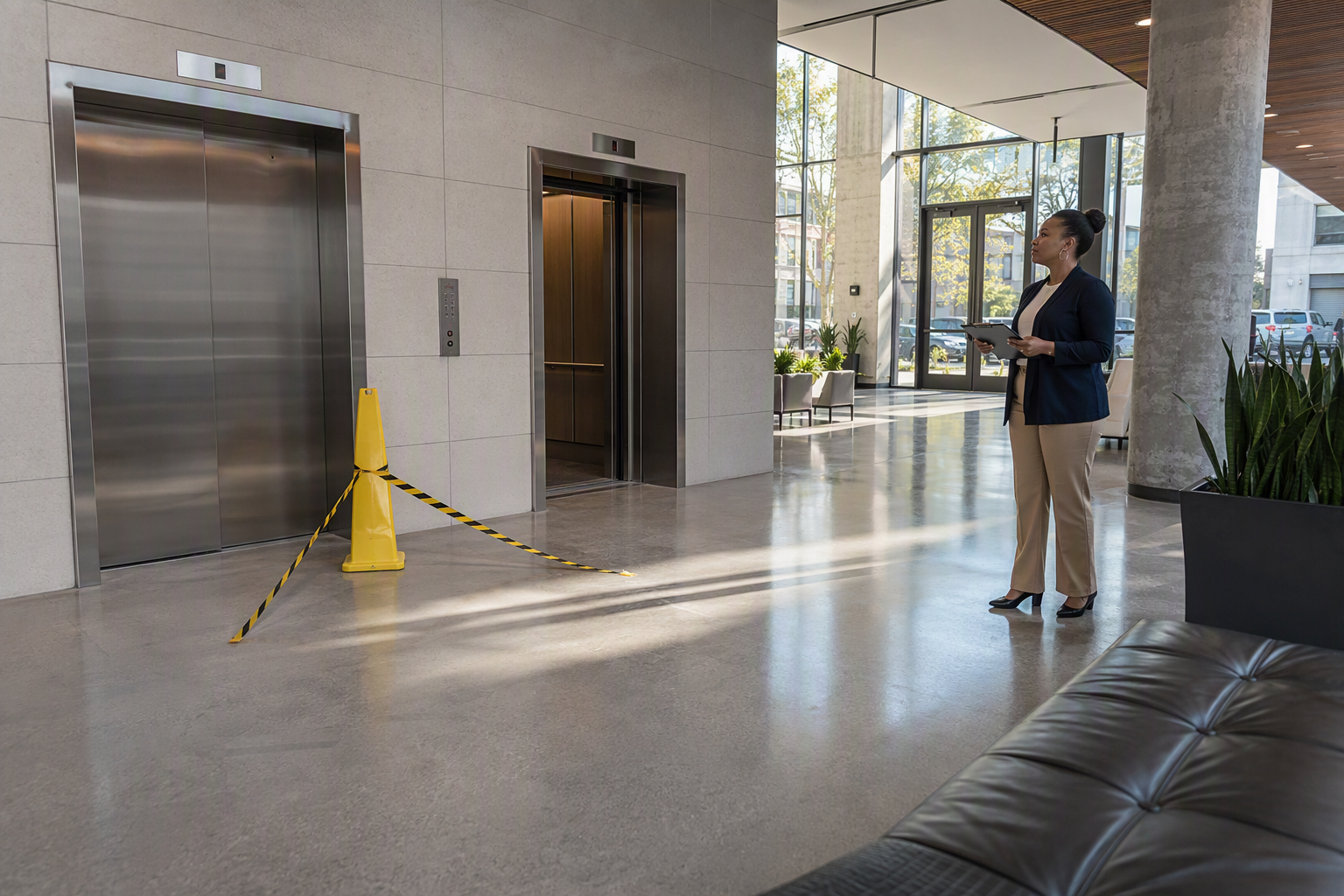
- Take the unit out of service: Post clear, visible signage indicating the elevator is out of service. Barricade landings to prevent unauthorized attempts to use the equipment.
- Document the malfunction: Record the time, observed symptoms, any error codes displayed, and a description of what occurred. This documentation is critical for both the repair technician and any compliance records.
- Notify your maintenance contractor: Contact your elevator service provider as soon as the unit is secured. Provide the documentation you collected in step 3.
- Assess ADA impact: Determine whether the outage eliminates the only accessible route. If so, make immediate arrangements for alternative accommodations where feasible and document those efforts.
- Notify affected tenants or building users: Communicate proactively about the outage and the expected timeline for repair. Transparency reduces frustration and demonstrates good-faith management.
- Review inspection and maintenance records: Pull the elevator’s service history to identify whether this failure was predictable or whether a recurring component issue has gone unaddressed.
- Confirm return-to-service requirements: In many jurisdictions, an elevator that has been shut down due to a safety defect must pass a formal inspection before it can be returned to operation. Verify local requirements before restoring service.
How Does Downtime Cost Differ Between Elevator Types?
Not all elevator systems carry the same downtime cost profile. The cost impact of an outage depends substantially on the type of equipment, the building it serves, and the criticality of that elevator to building operations.
- Hydraulic elevators: Common in low-rise commercial and multifamily buildings, hydraulic units are susceptible to fluid leaks and pump failures. Hydraulic oil contamination can also create environmental remediation costs that compound the repair expense.
- Traction elevators (geared and gearless): Found in mid- and high-rise applications, these systems involve more complex drive and control components. Downtime in a high-rise office or residential building typically carries higher per-day costs due to the larger number of affected occupants.
- Machine Room-Less (MRL) traction elevators: A growing share of new installations, MRL elevators integrate the drive machinery into the hoistway, which can complicate access for repairs and extend downtime when specialized components are needed.
- Hospital and healthcare elevators: In healthcare settings, elevator downtime can directly impact patient care — the transport of patients, medical equipment, and medications. The cost of a healthcare elevator outage often includes clinical as well as operational consequences.
What Industry Trends Are Shaping Elevator Downtime Costs in 2025–2026?
Several forces are reshaping how building owners and elevator service providers think about downtime costs as the industry moves through 2025 and into 2026:
- Remote monitoring and predictive maintenance: The adoption of IoT-connected sensors and elevator management platforms is enabling service providers to detect anomalies before they become failures. While these technologies do not eliminate downtime entirely, early evidence from the broader facilities management sector suggests that predictive approaches reduce unplanned outages compared to traditional time-based maintenance schedules.
- Parts supply chain complexity: Global supply chain disruptions that emerged in the early 2020s continue to affect parts availability for certain elevator components, particularly those serving older equipment. Extended lead times for legacy parts can dramatically lengthen outages and amplify costs.
- Code adoption acceleration: More jurisdictions are actively updating their elevator codes to align with recent editions of the ASME A17.1 Safety Code for Elevators and Escalators. Buildings that have deferred modernization are facing increasing compliance costs that overlap with their downtime risk exposure.
- Labor market pressure: The skilled trades workforce serving the elevator industry is experiencing demographic pressures, with a portion of experienced technicians approaching retirement. In some markets, technician availability is influencing both response times and service rates.
- Tenant expectations: Post-pandemic occupant expectations for building reliability have increased. Tenants, particularly in Class A office and multifamily markets, are more likely to include elevator reliability as a factor in lease decisions than in prior eras.
How Do Maintenance Contracts Affect Total Downtime Cost?
The structure of a maintenance contract has a direct bearing on the total cost of elevator downtime. Building owners should evaluate contracts across several dimensions:
- Full-service versus oil-and-grease contracts: Full-service agreements typically cover parts and labor for covered repairs, providing cost predictability. Oil-and-grease (lubrication-only) contracts leave repair costs as unpredictable out-of-pocket expenses.
- Response time provisions: Some contracts specify maximum response times for emergency callbacks. Understanding what is and is not guaranteed — and what recourse exists if those terms are not met — is critical to evaluating a contract’s real value.
- Exclusions: Many maintenance contracts exclude certain components, modernization requirements, or damage resulting from vandalism or misuse. These exclusions can create unexpected cost exposure during an outage.
- Escalation clauses: Multi-year contracts often include annual cost escalation provisions. Building owners should model the total contract cost over its full term, not just the first-year rate.
How Can Modernization Reduce Elevator Downtime Costs?
Elevator modernization — replacing aging control systems, drive components, door operators, or entire mechanical systems — is frequently the most cost-effective long-term strategy for buildings whose elevators are experiencing frequent downtime. Modernization typically delivers:
- Reduced component failure frequency due to newer, more reliable technology
- Improved parts availability for currently manufactured components
- Enhanced diagnostic capabilities that simplify and accelerate troubleshooting
- Alignment with current editions of the ASME A17.1 Safety Code for Elevators and Escalators and applicable local codes
- Energy efficiency improvements that reduce operating costs
The decision to modernize versus continue maintaining aging equipment involves comparing the projected cost of future downtime and repairs against the capital investment in modernization. Carolina Elevator Service works with building owners to evaluate this tradeoff using a data-driven assessment of equipment condition, failure history, and compliance status.
What Role Does Inspection Frequency Play in Preventing Downtime?
Regular inspections are a foundational element of downtime prevention. In most jurisdictions, elevators are required to undergo periodic inspections by licensed inspectors, with intervals and requirements shaped by applicable state and local codes, which are often based on the ASME A17.1 Safety Code for Elevators and Escalators. Beyond mandatory inspections, proactive maintenance inspections conducted by qualified technicians can identify wear patterns, failing components, and lubrication deficiencies before they cause unplanned downtime.
The inspection record also serves an important evidentiary function: a well-documented maintenance history demonstrates that a building owner exercised reasonable care, which can be valuable in the context of ADA complaints, OSHA inquiries, or liability claims arising from elevator-related incidents.
How Should Building Owners Compare Elevator Service Vendors on Downtime Risk?
When evaluating elevator service providers, building owners focused on minimizing downtime costs should look beyond price and consider:
- Parts inventory depth: Providers who maintain local inventory of common replacement parts can often resolve failures in a single visit rather than waiting for parts delivery.
- Technician specialization: Not all technicians are equally qualified on all equipment brands and types. Verifying that a provider’s workforce has relevant training on your specific equipment reduces diagnostic delays.
- Contract transparency: Clear, plain-language contracts with well-defined coverage, exclusions, and escalation procedures allow building owners to understand their true cost exposure.
- Documentation and reporting practices: Service providers who deliver detailed written reports after each visit enable building owners to track equipment trends and make informed capital planning decisions.
- Regulatory knowledge: A provider who understands local inspection requirements, code adoption status, and ADA obligations helps building owners avoid compliance-related shutdowns.
Carolina Elevator Service approaches every client relationship with the kind of transparency and documentation rigor that allows building owners to make genuinely informed decisions about maintenance, modernization, and compliance.
What Are the Long-Term Financial Consequences of Deferred Elevator Maintenance?
Deferred maintenance — the practice of delaying necessary upkeep to reduce short-term costs — is well-documented across building systems as a strategy that generates compounding costs over time. For elevators specifically, deferred maintenance tends to produce:
- Accelerated component wear that shortens the remaining useful life of the equipment
- Higher-severity failures that require more extensive and expensive repairs
- Compliance risk that grows as equipment ages and diverges from current code requirements
- Reduced property value, as prospective buyers and lenders increasingly scrutinize deferred capital needs during due diligence
- Increased insurance exposure, particularly if a maintenance-related incident results in personal injury
Building owners and asset managers who treat elevator maintenance as a variable cost to be minimized frequently discover that the cumulative cost of deferred upkeep substantially exceeds what a consistent preventive maintenance program would have cost over the same period.
—
Summary: Key Takeaways on Elevator Downtime Costs
| Cost Category | Primary Driver | Mitigation Strategy |
|---|---|---|
| Emergency repair premiums | Unplanned failures requiring after-hours response | Preventive maintenance contracts |
| ADA compliance liability | Outages blocking accessible routes | Rapid response, documented accommodation efforts |
| OSHA exposure | Known defects posing worker injury risk | Prompt out-of-service tagging, qualified repair |
| Tenant/customer attrition | Recurring reliability failures affecting occupant experience | Proactive communication, rapid restoration |
| Code compliance costs | Aging equipment diverging from current ASME A17.1 requirements | Modernization planning, regular inspections |
| Long-term asset devaluation | Deferred maintenance accumulating into capital liability | Documented maintenance history, planned capital replacement |
Note: This table summarizes cost categories and drivers qualitatively. Specific dollar figures for each category vary by building type, geography, equipment, and contract structure and are not presented as universal benchmarks.
—
Contact Carolina Elevator Service for a Free Elevator Assessment
Carolina Elevator Service provides building owners, property managers, and facilities directors with the technical expertise and documentation practices needed to reduce elevator downtime, manage compliance risk, and make informed decisions about maintenance and modernization. Whether a building is experiencing recurring outages or a property manager simply wants a clear picture of equipment condition and cost exposure, a professional assessment is the logical first step.
Contact Carolina Elevator Service for a free elevator assessment: 803-865-1400
Need elevator service you can rely on? Carolina Elevator Service is ready to help.