To get an elevator budget approved for next year, document all mandatory inspection fees, maintenance contract costs, code-compliance upgrades, and a reserve allocation for unplanned repairs — then present the total to decision-makers alongside the legal and liability consequences of deferring any line item.
Elevator Budget Planning: How to Get Approval and What Costs to Include
Getting an elevator maintenance and compliance budget approved requires more than a rough estimate. Building owners, property managers, HOA boards, and facilities directors in Columbia, SC must account for state-mandated inspections, routine maintenance contracts, code-compliance projects, and capital reserves — all framed within the legal obligations imposed by South Carolina Code Title 41, Chapter 16 (the South Carolina Elevator Code) and federal standards including the ASME A17.1/CSA B44 Safety Code for Elevators and Escalators. This guide walks through every cost category, the regulatory requirements that drive them, and the internal process for winning approval from a board, ownership group, or finance committee.
What should be the first step in building an elevator budget for next year?
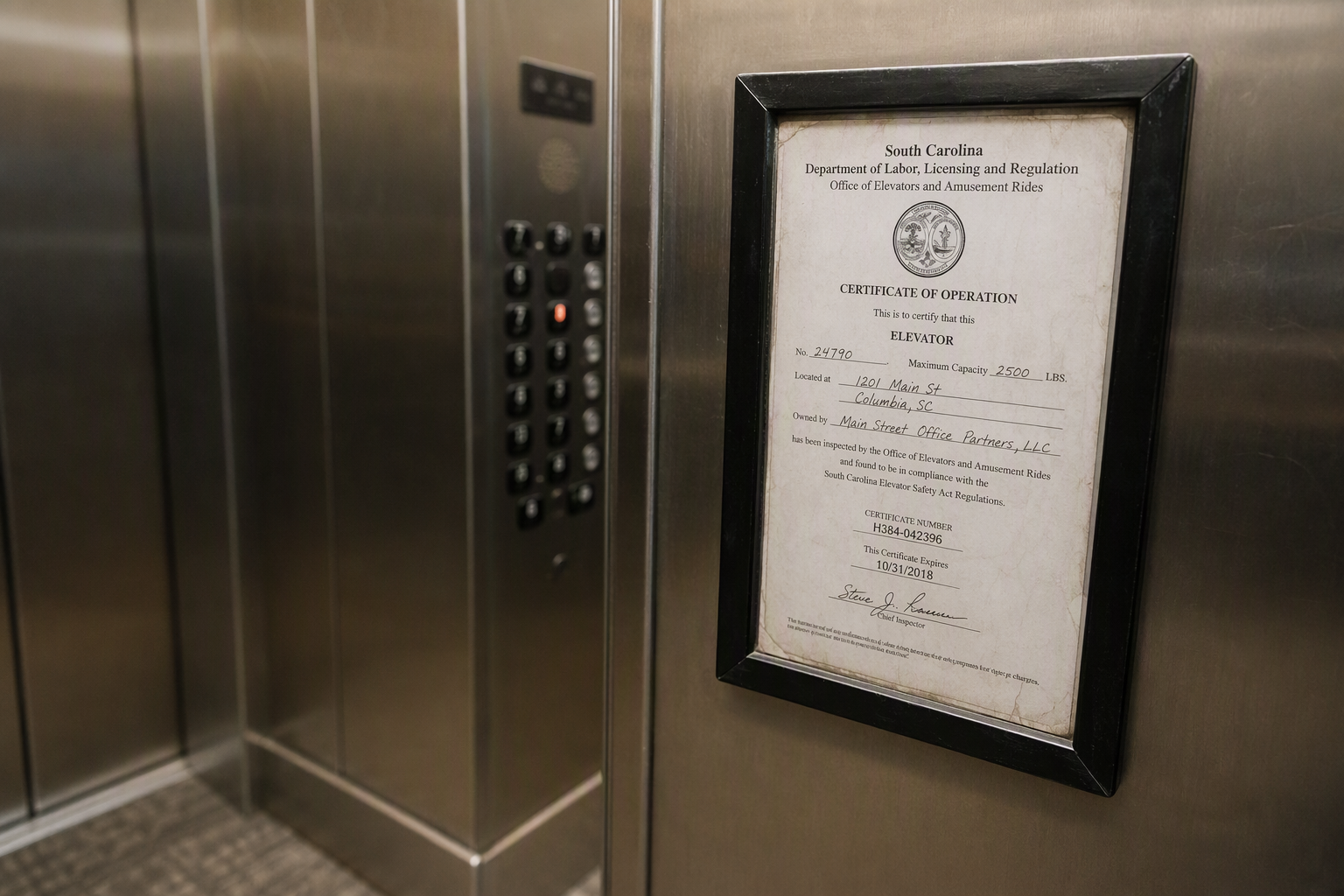
The first step is conducting a current-condition audit of every elevator asset in the building before a single dollar figure is assigned to any budget line.
Without an objective baseline, budget requests appear arbitrary to approvers. A condition audit should capture the age and model of each unit, its current compliance status under South Carolina’s adopted edition of ASME A17.1-2019/CSA B44:19, the date and outcome of the most recent annual inspection by the South Carolina Department of Labor, Licensing and Regulation (LLR), Office of Elevators and Amusement Rides, and any outstanding deficiencies noted on the operating certificate or inspection report.
Carolina Elevator Service offers free elevator assessments in Columbia, SC that produce a written condition report — a practical starting document for budget construction. When the condition report is attached to a budget proposal, it shifts the conversation from opinion to evidence.
What mandatory regulatory costs must every South Carolina elevator budget include?
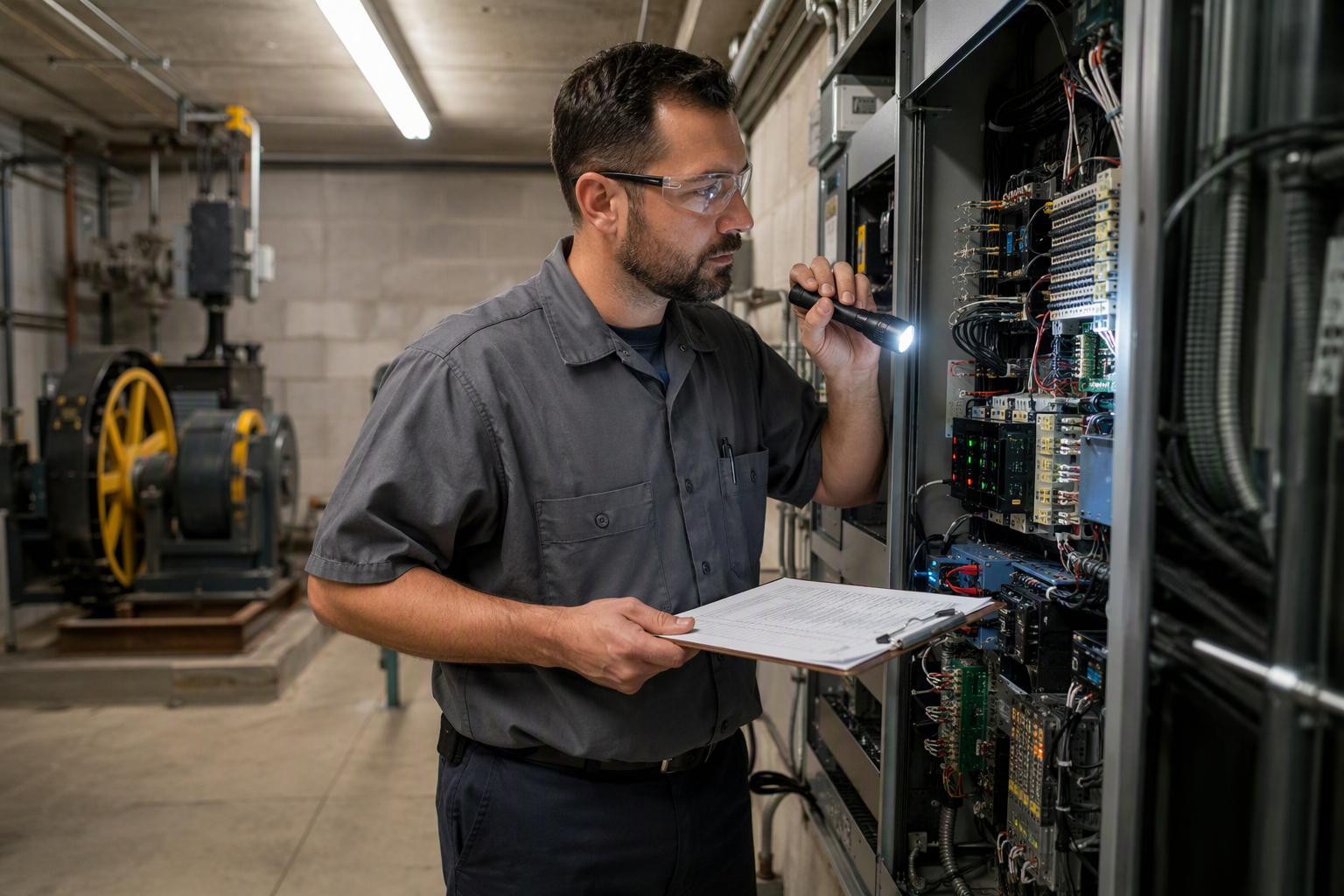
Every South Carolina elevator budget must include costs associated with the annual inspection required before the operating certificate is renewed, as well as any fees tied to registration, permits, or correction of inspection deficiencies.
Under S.C. Code Title 41, Chapter 16 and S.C. Code of Regulations Chapter 71, Article 5, no elevator facility may operate without a current certificate of registration and an operating certificate from the state. The operating certificate — or a copy — must be displayed conspicuously inside each elevator car. Budgets that omit inspection-related fees risk an operating-certificate lapse, which exposes the building owner to liability and regulatory action.
If the building uses a special inspector (permitted under South Carolina law in lieu of a state inspector), that inspector must be licensed and must meet the qualifications in the 2018 edition of QEI-1, the American National Standard for Qualification of Elevator Inspectors. Critically, South Carolina law prohibits a special inspector from inspecting an elevator on which the inspector’s employer holds a current service or warranty contract — a rule that affects vendor selection and cost planning.
Buildings with handicap lifts should note that South Carolina requires those units to be inspected every five years rather than annually. Manlifts, television tower elevators, and special-purpose elevators are inspected every seven years. These different cycles affect when inspection fees hit the annual budget.
What are the core maintenance contract costs that belong in an elevator budget?
A maintenance contract covering routine lubrication, adjustment, parts replacement, and emergency response is the largest recurring line item in most elevator budgets and should be treated as a non-negotiable operating expense, not a discretionary one.
South Carolina law places the responsibility for keeping every elevator facility in safe operating condition squarely on the owner. A lapse in maintenance does not relieve that obligation — it amplifies it. Maintenance contracts vary by scope, and budget planners should distinguish clearly between full-coverage contracts (parts and labor included) and oil-and-grease contracts (labor only, parts billed separately). For budget approval purposes, a full-coverage contract produces more predictable annual costs, which finance committees tend to favor.
Key items a maintenance scope should address include: machine room inspection and lubrication; hydraulic fluid condition and cylinder integrity (South Carolina specifically requires new underground hydraulic cylinders to be encased in plastic outer containment to limit electrolytic corrosion); door operator adjustment; safety device testing; and emergency lighting and alarm bell verification. On that last point, South Carolina requires passenger elevators to have standby power capable of running emergency lighting and the alarm bell for at least four hours if normal power fails — a system element that must be tested and maintained.
How should a building budget for code-compliance upgrades?
Code-compliance upgrades should be identified through a gap analysis against the currently adopted standard and then prioritized by safety criticality and regulatory deadline, with cost estimates obtained from a licensed elevator service company before the budget is submitted.
South Carolina adopted ASME A17.1-2019/CSA B44:19 without amendment, effective following notice in the S.C. State Register on July 23, 2021. New installations must comply with the edition in effect when the construction permit is issued. Older equipment presents a different obligation: elevator facilities in operation before July 1, 1986 must comply with the 1986 edition of ANSI A17.3, the safety code for existing elevators and escalators. Understanding which standard governs each unit in the building determines which upgrades are legally required versus elective improvements.
Common compliance upgrade categories to budget for include: firefighters’ service key conversion (South Carolina requires new installations to use the five-pin S.C. #1000 key); emergency lighting and standby power upgrades; door reopening device updates; and accessibility modifications under the Americans with Disabilities Act (ADA). ADA-related work, such as control button height, Braille signage, and leveling tolerances, is a federal obligation that applies independently of the state elevator code and belongs in a separate budget sub-line so it does not get lost in state-compliance estimates.
What capital reserve amount should a building allocate for elevator repairs?
A capital reserve for elevator repairs should be calculated based on the age, type, and condition of the equipment rather than a flat percentage, because reserve adequacy is a liability question as much as a financial one.
For budget approval purposes, the reserve line should be supported by a remaining useful life estimate from a qualified elevator service company. Older traction elevators approaching the end of their mechanical life require substantially higher reserves than recently modernized equipment. Budget documents should explain to approvers that reserve funds are not spent unless needed — but that the absence of a reserve forces emergency spending outside the approved budget, which is the outcome most finance committees want to avoid.
Carolina Elevator Service can provide written remaining-useful-life assessments for Columbia, SC properties that support reserve calculations in a format appropriate for board presentations or lender reviews.
What elevator cost categories belong in a complete annual budget?
A complete elevator budget includes at least seven distinct cost categories, each driven by a different obligation or risk profile.
| Budget Category | Description | Budget Type | Frequency |
|---|---|---|---|
| Annual Inspection Fees | State-required inspection before operating certificate renewal; QEI-licensed special inspector fees if applicable | Operating | Annual (standard elevator); every 5 yrs (handicap lift); every 7 yrs (manlift/special) |
| Registration & Certificate Fees | Certificate of registration and operating certificate from SC LLR | Operating | Annual |
| Maintenance Contract | Routine service, lubrication, adjustment; full-coverage or oil-and-grease scope | Operating | Monthly / Annual contract |
| Code-Compliance Upgrades | Corrections required by ASME A17.1-2019, ANSI A17.3, ADA, or state-specific rules | Capital | As required |
| Repair Reserve | Unplanned component failures not covered by maintenance contract | Capital Reserve | Annual allocation |
| Modernization Reserve | Major system overhaul (controls, hydraulics, cab interior, doors) | Capital Reserve | Long-range planning cycle |
| ADA Accessibility Work | Federal accessibility compliance independent of state elevator code | Capital / Operating | As required |
Presenting all seven categories separately — rather than as a single blended number — makes the budget easier to defend because each line item connects to a specific obligation or risk that the approving body can evaluate independently.
How does the annual inspection cycle affect budget timing in South Carolina?
Because South Carolina requires an annual inspection before the operating certificate is renewed, inspection fees and any correction costs must be timed to fall in the budget year before the certificate expiration date — not after.
Budget planners should identify the certificate renewal month for each unit and ensure that both the inspection fee and a contingency for deficiency corrections are allocated in the quarter preceding renewal. If an inspection identifies a required correction, work must typically be completed before the certificate is reissued. Failure to budget for that contingency forces an unplanned expenditure or, worse, an elevator out of service — an outcome that triggers far greater costs through tenant complaints, ADA access violations, and potential regulatory action.
What information should a budget proposal include to win approval from a board or finance committee?
A budget proposal that wins approval presents each cost as a consequence of a specific legal obligation or documented risk, not as a vendor preference or precautionary spending.
- Attach the most recent inspection report and operating certificate to show current compliance status.
- List every deficiency noted by the inspector and its associated correction cost and deadline.
- Cite the specific statutory obligation — such as S.C. Code Title 41, Chapter 16 — that drives each line item.
- Include the current maintenance contract scope and renewal cost, noting what is and is not covered.
- Show a five-year projection for capital reserves based on equipment age and remaining useful life.
- Quantify the cost of non-compliance: an elevator out of service, a regulatory penalty, or an ADA complaint is typically far more expensive than the maintenance line being requested.
- Obtain at least two written quotes for any significant capital project so the committee can evaluate market-rate pricing.
- Close with a recommendation from a qualified elevator service provider summarizing the risk level of deferring any item.
Decision-makers who see a budget framed around documented obligations and quantified risks approve it far more readily than one that arrives as a generic line item without supporting documentation.
How should a building budget for elevator modernization versus repairs?
Modernization and repairs serve different financial and regulatory purposes and must be presented as separate budget lines — modernization is a capital project that extends useful life and may trigger new code compliance requirements, while repairs maintain existing equipment within its current approved condition.
A key distinction for South Carolina buildings: any alteration to an elevator facility requires a state construction permit from the LLR before work begins. Modernization projects — such as replacing the control system, upgrading the hydraulic unit, or reconfiguring the cab — constitute alterations and must go through the permitting process. That permit cost, and the inspection required after alteration, belong in the modernization budget, not the maintenance line.
When an elevator approaches the end of its useful service life, the cost-per-year of maintaining aging equipment often approaches or exceeds the annualized cost of modernization. A qualified elevator service company can model this comparison, giving the budget committee a financially defensible reason to approve a modernization capital line rather than continuing to fund escalating repairs.
What ADA requirements create budget obligations for elevator owners?
The Americans with Disabilities Act imposes accessibility requirements on elevators that are independent of the South Carolina elevator code and can create both capital and operating budget obligations for buildings open to the public.
ADA obligations relevant to elevator budgets include: leveling accuracy within specified tolerances so passengers in wheelchairs can enter and exit safely; control button mounting heights and reach range compliance; Braille and raised character signage on controls and door jambs; audible floor announcements; door timing and reopening device performance; and adequate cab dimensions. When a building undergoes renovation or a path of travel is altered, the ADA’s barrier-removal obligations may be triggered for the elevator, even if the elevator itself is not the primary project scope.
Budget planners should include an ADA accessibility review as part of the annual condition audit so that accessibility gaps are identified and costed before they become complaints or litigation. The ADA does not set a single deadline for all accessibility work — compliance is an ongoing obligation, and proactive budgeting is less costly than reactive remediation.
How do multi-unit or multi-elevator buildings manage budget complexity?
Buildings with multiple elevators should create a unit-by-unit maintenance and compliance schedule within the overall budget, because inspection cycles, equipment ages, and reserve needs differ by unit and cannot be accurately managed as an aggregate figure.
A property with both a standard passenger elevator and a handicap lift, for example, faces two different inspection cycles under South Carolina law — annual for the passenger elevator and every five years for the handicap lift. Blending these into a single line obscures when each inspection fee will actually be incurred. Similarly, if one unit is due for modernization in the third year of a five-year capital plan while another has recently been upgraded, the reserve allocations differ substantially by unit.
Spreadsheet-based multi-unit tracking, organized by unit ID, inspection due date, maintenance contract renewal date, and capital reserve balance, gives finance committees the granular visibility needed to approve multi-elevator budgets with confidence.
What is the role of preventive maintenance in controlling long-term elevator costs?
Preventive maintenance is the single most effective cost-control strategy available to building owners because it reduces the frequency and severity of unplanned failures, which are the primary driver of emergency repair spending.
Consistent, documented preventive maintenance also creates a defensible record if an injury or incident occurs. South Carolina law requires the owner to report any accident that seriously injures anyone other than an employee to the state before the end of the next working day. A maintenance log showing regular, compliant service significantly strengthens the building owner’s position in any subsequent regulatory or legal review.
Carolina Elevator Service provides documented preventive maintenance programs for buildings throughout the Columbia, SC area, producing service records that support both regulatory compliance and budget accountability.
How should a budget account for emergency and unplanned elevator repairs?
Emergency repair costs belong in the capital reserve line — not the maintenance contract line — and the reserve amount should be sized based on the age and condition of equipment, not a token placeholder.
The practical distinction matters for budget approvals: if emergency repairs are charged against the maintenance line, the maintenance line always overruns, eroding trust with the finance committee. Keeping emergency repairs in a defined reserve fund, and reporting draws from that fund separately, gives committees accurate data for future budget cycles and demonstrates disciplined budget management.
Buildings that run equipment well past its useful life without a reserve fund frequently face the worst-case scenario: an elevator failure that requires emergency modernization at unplanned cost, during which the building may be out of compliance with ADA access requirements for the duration of the repair.
What questions should a building ask when comparing elevator service vendors for the budget?
When evaluating elevator service vendors, buildings should assess contract scope, documentation practices, inspector independence, and familiarity with South Carolina’s specific regulatory requirements — not price alone.
Key questions include: Does the contract cover parts and labor, or labor only? What is explicitly excluded from coverage? How are emergency calls handled outside normal business hours? Does the vendor provide documentation sufficient for regulatory inspections and operating certificate renewal? Is the vendor familiar with South Carolina’s specific requirements, including the S.C. #1000 firefighters’ service key standard, the underground hydraulic cylinder containment rule, and the four-hour standby power requirement for passenger elevators?
South Carolina law also requires that a special inspector not inspect an elevator on which the inspector’s employer has a current service or warranty contract. Buildings that use the same company for both maintenance and inspection should confirm the arrangement complies with this rule — an important due-diligence question for any budget approval process.
How far in advance should budget planning for elevator work begin?
Elevator budget planning should begin at least four to six months before the start of the fiscal year being budgeted, giving enough time to obtain condition assessments, collect vendor quotes, and allow the approval process to run its full course before work needs to begin.
For capital projects requiring a South Carolina construction permit — any erection, construction, alteration, or installation of an elevator facility — the permitting timeline itself must be factored into project scheduling. A project that cannot begin until a permit is issued cannot be scheduled as a first-quarter line item if the permit application is submitted in the first quarter. Budget documents should include a realistic project schedule that accounts for permitting, inspection after completion, and operating certificate issuance before the elevator is returned to service.
What documentation should be maintained to support the elevator budget year over year?
Year-over-year budget credibility depends on maintaining a complete documentation file for each elevator unit, including inspection reports, certificates, maintenance records, repair invoices, and any correspondence with the South Carolina LLR.
At minimum, the file should contain: the current certificate of registration; the current operating certificate (required by South Carolina law to be displayed inside each car, so a copy should also be in the property management file); the most recent annual inspection report; the current maintenance contract; invoices for all repairs performed in the current year; and any LLR correspondence regarding deficiencies or permits. When this file is complete and current, the next year’s budget can be built from actual data rather than estimates, and the committee reviewing the budget can verify each cost driver independently.
How should elevator energy efficiency improvements be factored into a budget?
Energy efficiency improvements — such as drive system upgrades, LED cab lighting, and standby mode controls — should be presented to the budget committee as capital investments with a calculated payback period rather than as maintenance expenses, which positions them for capital budget approval rather than operating budget cuts.
Modern elevator drive systems consume substantially less energy than older hydraulic or traction systems operating with outdated controls. When a modernization is already being budgeted, energy efficiency upgrades can often be incorporated at marginal incremental cost, improving the financial case for the overall project. The budget narrative should separate the compliance-required scope of a modernization from the efficiency-improvement scope so that committees understand what is mandatory and what is elective — and what each portion costs.
What happens if an elevator budget is not approved and maintenance is deferred?
Deferred elevator maintenance in South Carolina creates compounding financial, legal, and safety risks because the owner’s obligation to keep every elevator facility in safe operating condition under state law does not diminish when the budget is not approved.
The practical consequences of deferral include: inspection deficiencies that must be corrected before the operating certificate is renewed, potentially taking the elevator out of service; accelerated component wear that converts a planned repair into an emergency replacement at higher cost; loss of the operating certificate if deficiencies are not addressed, exposing the building to regulatory action; ADA liability if the elevator becomes unavailable to users with disabilities; and potential liability exposure if an incident occurs on equipment with a documented maintenance gap. Presenting these consequences in writing to the budget approving body is often the most effective argument for full approval.
How should a building handle an elevator inspection deficiency discovered mid-year that was not budgeted?
A mid-year inspection deficiency should be addressed through a formal budget amendment rather than deferred, because South Carolina law requires the owner to maintain equipment in safe operating condition and the cost of non-compliance almost always exceeds the cost of correction.
- Obtain a written description of the deficiency from the inspector’s report.
- Identify whether the deficiency creates an immediate out-of-service condition or can be corrected before the next inspection cycle.
- Obtain at least one written repair estimate from a qualified elevator service company.
- Prepare a budget amendment request that cites the statutory basis for the required correction and quantifies the cost of non-compliance (elevator out of service, certificate lapse, liability exposure).
- Submit the amendment to the finance committee or board with the inspection report attached as supporting documentation.
- Upon approval, schedule the correction and obtain documentation that the deficiency has been resolved — documentation that will be needed at the next inspection.
Carolina Elevator Service assists Columbia, SC property managers with deficiency correction planning and can provide written estimates in a format suitable for budget amendment submissions.
What resources are available to South Carolina building owners for elevator compliance guidance?
South Carolina building owners can access regulatory guidance through the South Carolina Department of Labor, Licensing and Regulation (LLR), Office of Elevators and Amusement Rides, whose governing statute is S.C. Code Title 41, Chapter 16, along with the technical requirements in S.C. Code of Regulations Chapter 71, Article 5 (Regulations 71-5000 through 71-5700).
For federal standards, the ASME A17.1/CSA B44 Safety Code for Elevators and Escalators — adopted by South Carolina in its 2019 edition — is the primary technical reference for new installations. The ADA provides federal accessibility requirements. OSHA standards apply to elevator work in occupational safety contexts. In addition to regulatory sources, a qualified local elevator service company familiar with South Carolina’s specific requirements is often the most practical first resource for building-specific compliance questions.
How does the budget process differ for a newly installed elevator versus an existing one?
A newly installed elevator carries a different budget profile in its first years because South Carolina law requires a construction permit before installation begins and a registration inspection before the operating certificate is issued — costs and timelines that must be built into the project budget from the start.
New installations must comply with the edition of ASME A17.1 adopted by South Carolina and in effect when the permit is issued. The initial budget must include permitting fees, installation costs, the registration inspection, and the operating certificate — along with the maintenance contract, which should begin at commissioning, not after the first problem appears. Once the initial compliance baseline is established, the ongoing budget structure follows the same annual pattern as for existing equipment, though newer equipment typically carries lower repair reserve requirements in the early years of service.
Need elevator service you can rely on? Carolina Elevator Service is ready to help.