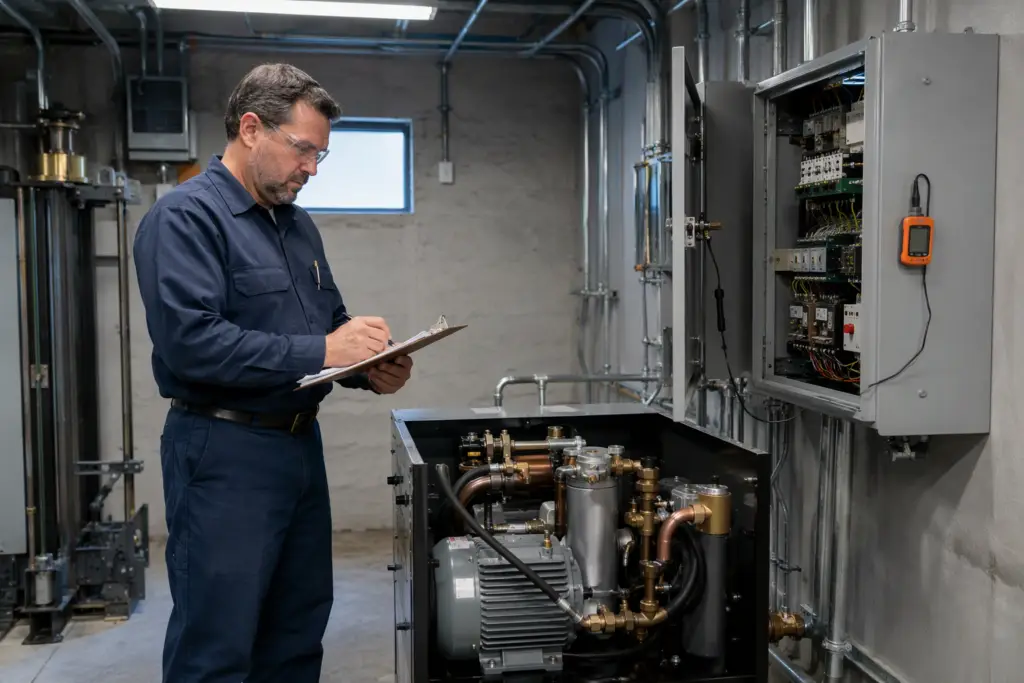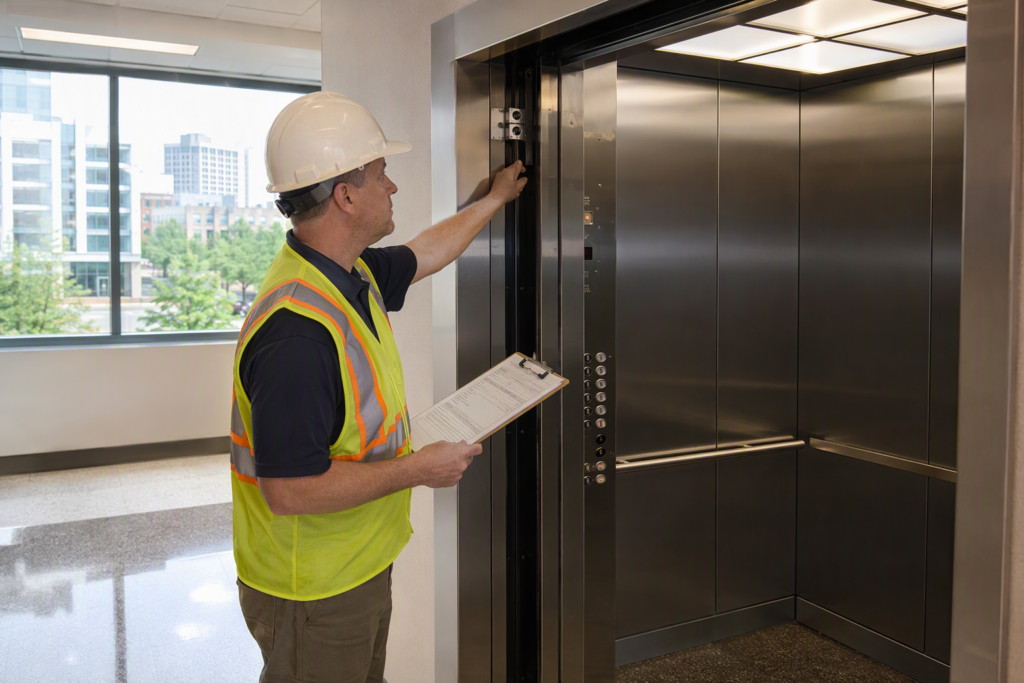
To get a quote for a state-required elevator inspection in South Carolina, contact a qualified elevator service company, share your equipment details and compliance history, and request a written proposal. The inspection must be performed by a state inspector or a licensed special inspector credentialed under the 2018 edition of QEI-1 (American National Standard for Qualification of Elevator Inspectors). The resulting inspection report is required before the South Carolina Department of Labor, Licensing and Regulation (LLR) issues or renews your operating certificate.
What information do I need to gather before requesting an inspection quote?
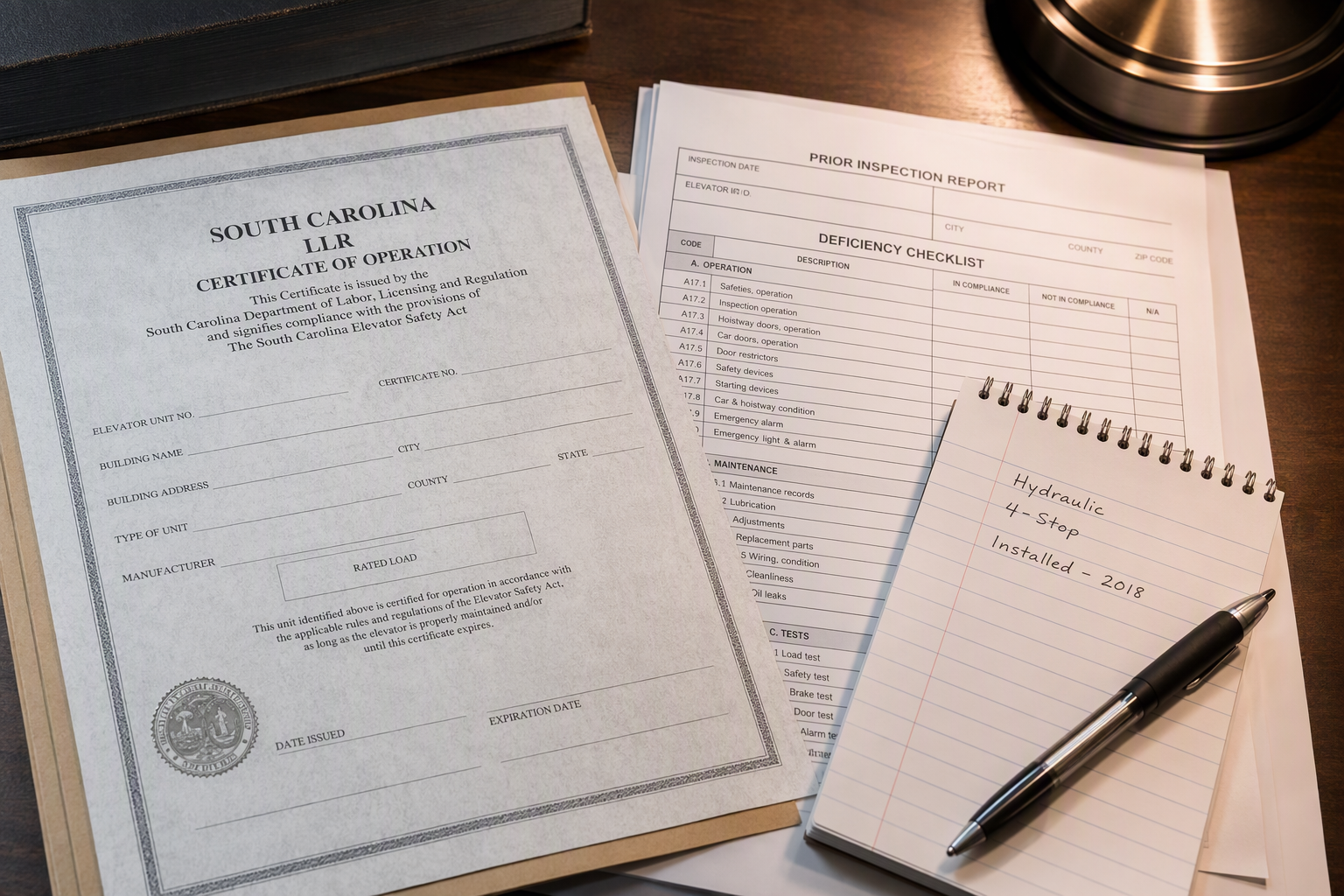
Before contacting a service provider, gather your elevator’s registration number, equipment type, installation date, and the expiration date of your current operating certificate.
The more complete your information package, the faster a service company can produce an accurate quote. Inspectors and elevator service companies will typically want to know the make and model of the equipment, the number of stops, whether the unit is hydraulic or traction, and when it was last inspected. If you have prior inspection reports or a history of violation notices from the South Carolina LLR, share those as well — open deficiencies affect the scope of work and therefore the price of the engagement.
You should also note whether any alterations or repairs have been made since the last inspection. Under S.C. Code Title 41, Chapter 16 and S.C. Code of Regulations Chapter 71, Article 5, an elevator that has been altered or repaired requires a new inspection before it can continue operating. Disclosing this upfront prevents scope surprises after a quote is issued.
What types of elevators are subject to mandatory inspection intervals in South Carolina?
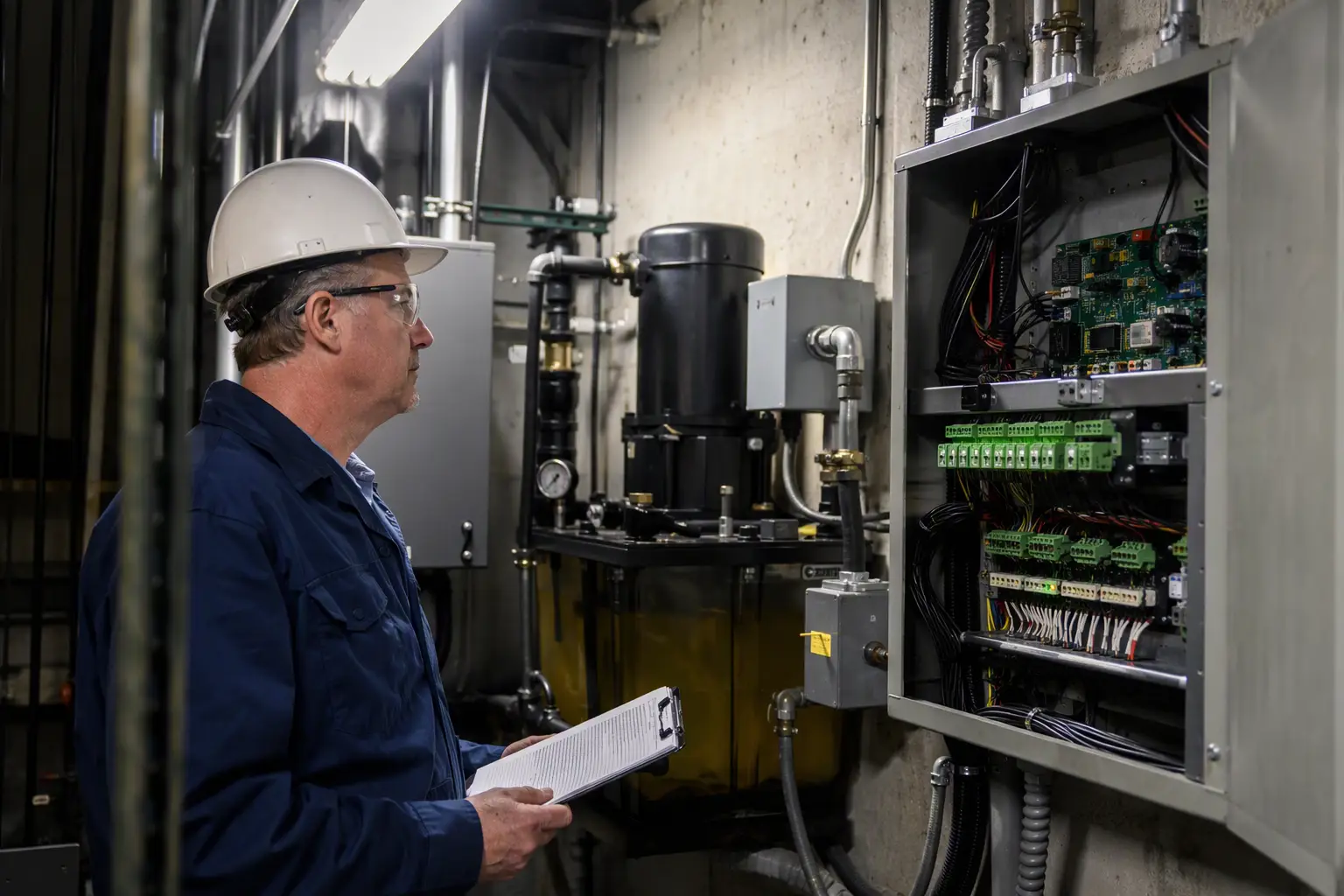
South Carolina law establishes specific inspection intervals that vary by equipment type, and the interval determines how frequently a quote for inspection services will be needed.
Under S.C. Code of Regulations Chapter 71, Article 5 (Regulations 71-5000 through 71-5700), the following intervals apply in 2026:
| Equipment Type | Inspection Trigger / Interval | Governing Authority |
|---|---|---|
| Passenger and freight elevators | At installation, registration, alteration or repair, then at least annually (before operating certificate renewal) | SC LLR, Office of Elevators and Amusement Rides |
| Handicap lifts (platform lifts) | Every five years | SC LLR, Office of Elevators and Amusement Rides |
| Manlifts, television tower elevators, special purpose elevators | Every seven years | SC LLR, Office of Elevators and Amusement Rides |
| Dumbwaiters | When installed or altered | SC LLR, Office of Elevators and Amusement Rides |
| New construction (any type) | Before initial certificate of registration is issued; state construction permit required first | SC LLR, Office of Elevators and Amusement Rides |
Note that the South Carolina Elevator Code does not apply to equipment installed in a single private dwelling. If there is any question about whether a specific piece of equipment falls under state jurisdiction, the South Carolina LLR Office of Elevators and Amusement Rides is the authoritative source.
Who is legally authorized to perform elevator inspections in South Carolina?
In South Carolina, required inspections may only be conducted by state inspectors employed by the LLR or by licensed special inspectors whose qualifications meet the 2018 edition of QEI-1.
A special inspector’s inspection may be accepted in place of a state inspection, which gives building owners flexibility in scheduling. However, there is a critical restriction: a special inspector may not inspect any elevator on which the inspector or the inspector’s employer currently holds a service or warranty contract. This conflict-of-interest rule is codified under S.C. Code of Regulations Chapter 71, Article 5, and it directly affects how building owners structure their vendor relationships. An owner who wants a third-party special inspector to conduct the annual compliance inspection should confirm that the inspector’s employer has no active service agreement on that unit.
Carolina Elevator Service works with building owners and property managers in the Columbia, SC area to help identify properly credentialed inspection resources and to prepare equipment for inspection, reducing the likelihood of deficiency notices that delay certificate issuance.
What does the South Carolina operating certificate requirement mean for my property?
No elevator facility in South Carolina may legally operate without both a certificate of registration and a current operating certificate issued by the LLR — and a copy of the operating certificate must be displayed conspicuously inside each elevator car.
This requirement applies to virtually every commercial, institutional, and multi-family residential elevator in the state. Operating without a valid certificate exposes the property owner to enforcement action and potential liability. The operating certificate is tied directly to a satisfactory inspection, which means the annual inspection is not optional — it is the mechanism by which the certificate is renewed. Building owners who allow their certificate to lapse must stop operating the elevator until a new inspection is completed and the certificate is reissued.
When requesting a quote, ask the service provider to clarify whether the scope of work includes the documentation and submission support needed to facilitate certificate renewal, or whether inspection alone is offered. These are separate deliverables that affect total cost and timeline.
What codes must my elevator meet to pass a state inspection in South Carolina?
South Carolina has adopted the ASME A17.1/CSA B44, 2019 edition (ASME A17.1-2019/CSA B44:19), effective by notice in the S.C. State Register on July 23, 2021, as the standard for new elevator installations and alterations.
New elevator facilities must comply with the officially adopted edition of ASME A17.1 in effect when the permit is issued. For elevators that were in operation before July 1, 1986, the applicable standard is the 1986 edition of ANSI A17.3, the safety code for existing elevators and escalators. This means that the applicable code — and therefore the technical scope of the inspection — depends on when the equipment was installed and whether it has been substantially altered.
Several South Carolina-specific requirements layer on top of the ASME baseline. New underground hydraulic elevator cylinders must be encased in plastic outer containment to limit electrolytic corrosion. Firefighters’ service on new installations must use the five-pin S.C. #1000 key. Passenger elevators must have standby power capable of running emergency lighting and the alarm bell for at least four hours if normal power fails. These state-specific items are checked during inspection and can generate deficiency notices if not addressed before the inspector arrives.
Does ADA compliance factor into a state elevator inspection quote?
ADA accessibility requirements are separate from South Carolina’s state elevator inspection program, but deficiencies in both areas are commonly discovered during the same site evaluation.
The Americans with Disabilities Act (ADA) requires that elevators in covered facilities meet specific accessibility standards, including minimum cab dimensions, door timing, control placement, and audible signals. While the South Carolina LLR inspection focuses on mechanical safety and code compliance under ASME A17.1-2019, a comprehensive pre-inspection assessment from an experienced elevator service company will often flag ADA issues at the same time. Addressing ADA items proactively avoids the situation where a building passes its state inspection but faces a separate federal compliance exposure.
When requesting a quote, ask whether the scope includes an ADA accessibility review in addition to the state-required safety inspection. Some service providers bundle these; others price them separately.
What is the step-by-step process to get a quote and schedule a state-required elevator inspection?
Following a structured process reduces delays and ensures the quote accurately reflects the full scope of work required for compliance.
- Identify your equipment: Record the elevator type (passenger, freight, hydraulic, traction, platform lift, manlift, dumbwaiter), number of stops, and the date of original installation or last major alteration.
- Locate your current documentation: Retrieve the certificate of registration, the most recent operating certificate, and the last inspection report. Note any open deficiencies or LLR notices.
- Determine your deadline: Check the expiration date on your operating certificate and work backward to allow adequate time for the inspection, any required repairs, re-inspection if necessary, and LLR certificate processing.
- Contact a qualified elevator service company: Reach out to a company such as Carolina Elevator Service, which serves the Columbia, SC market, and provide the equipment details and documentation gathered in steps 1–3.
- Request a written, itemized quote: Ask for a proposal that separates inspection fees, any identified repair or maintenance items, documentation preparation, and any re-inspection costs. Confirm whether the inspector is credentialed under QEI-1 and has no conflicting service contract on your equipment.
- Review the conflict-of-interest rule: Verify that the special inspector who will conduct the state compliance inspection is not employed by the same firm that holds your current service or warranty contract, as required under South Carolina regulations.
- Schedule the pre-inspection walk-through: Before the formal inspection, arrange a preparatory assessment to identify and correct deficiencies. This reduces the risk of a failed inspection and the additional cost of a re-inspection.
- Complete required repairs: Address any mechanical, safety, or code-compliance items identified during the pre-inspection assessment before the official inspection date.
- Attend the inspection: Have the equipment’s maintenance history and documentation available for the inspector. Ensure the machine room is accessible and clear.
- Submit for certificate renewal: After a satisfactory inspection, submit the report and required documentation to the SC LLR Office of Elevators and Amusement Rides to renew the operating certificate.
What factors affect the cost of a state-required elevator inspection quote?
The cost of an elevator inspection engagement varies based on several technical and logistical factors, and understanding them helps property owners evaluate competing quotes accurately.
Equipment type and complexity are primary cost drivers. A straightforward hydraulic passenger elevator with two stops requires less inspector time than a multi-stop traction elevator with complex control systems. The number of open deficiencies from a prior inspection affects cost because each item must be documented, potentially repaired, and verified. Travel and scheduling — including how far the inspector must travel within South Carolina and whether the building is occupied during inspection — can also influence pricing.
Scope is the most commonly misunderstood cost variable. A quote that covers only the inspection itself will always appear lower than a quote that includes pre-inspection assessment, deficiency correction, documentation preparation, and re-inspection coverage. Building owners should compare quotes on a total-cost-to-compliance basis rather than on the base inspection fee alone. Requesting line-item breakdowns from each vendor makes this comparison straightforward.
How long does the elevator inspection and permitting process typically take in South Carolina?
The timeline from requesting a quote to receiving a renewed operating certificate depends on the condition of the equipment, the availability of inspectors, and how quickly any deficiencies are corrected.
For a well-maintained elevator with no outstanding deficiencies, the inspection itself is typically completed in a single visit. If deficiencies are found, a re-inspection is required after corrections are made, adding time to the process. Building owners in the Columbia, SC area should not wait until their operating certificate is close to expiration to initiate the process. Allowing adequate lead time for the quote, pre-inspection preparation, the formal inspection, any corrective work, and LLR administrative processing is the most reliable way to avoid operating with an expired certificate.
What happens if I operate an elevator without a valid operating certificate in South Carolina?
Operating an elevator without a valid certificate of registration and an operating certificate from the SC LLR is a violation of S.C. Code Title 41, Chapter 16, and the LLR has enforcement authority to require the elevator to be taken out of service.
Beyond regulatory enforcement, operating an uninspected elevator creates significant liability exposure. If an injury occurs on an elevator that lacked a current operating certificate, the property owner’s legal position is substantially weakened. The cost of obtaining and maintaining a valid operating certificate is far lower than the cost of enforcement action, building closure, or litigation. The operating certificate must also be displayed conspicuously inside the elevator car, so the absence of a posted certificate is immediately visible to building occupants and inspectors alike.
Does South Carolina require a construction permit before a new elevator is installed?
Yes — a state construction permit must be obtained from the SC LLR before any elevator facility is erected, constructed, altered, or installed in South Carolina.
This requirement applies to new installations and to significant alterations of existing equipment. The permit process ensures that the proposed installation or alteration will comply with the ASME A17.1-2019/CSA B44:19 edition adopted by South Carolina. Elevator service companies and contractors involved in installation projects should factor the permit timeline into project scheduling. An inspection is also required at the completion of a new installation or alteration before the LLR will issue an operating certificate for the equipment. Building owners planning a new installation or major modernization should work with their elevator service company to initiate the permit application early in the project timeline.
What are the accident reporting requirements for South Carolina elevator owners?
In South Carolina, any accident involving an elevator that seriously injures anyone other than an employee must be reported to the SC LLR before the end of the next working day.
This reporting obligation falls on the elevator owner and applies regardless of whether the accident is believed to be related to a mechanical deficiency. Following an incident, the elevator should be taken out of service and secured until the LLR authorizes its return to operation. Owners should document the incident thoroughly, preserve any available inspection and maintenance records, and contact their elevator service company immediately. Carolina Elevator Service advises Columbia-area building owners to keep their maintenance and inspection documentation current and accessible so that records are available if an incident occurs.
Are local building codes or ordinances different from South Carolina elevator regulations?
Local ordinances that conflict with the South Carolina Elevator Code or its implementing regulations are void — state law preempts local rules on elevator safety.
This means that a city or county in South Carolina cannot impose elevator inspection requirements that contradict or supersede the standards set by the LLR under S.C. Code Title 41, Chapter 16 and S.C. Code of Regulations Chapter 71, Article 5. However, local building departments may still have jurisdiction over related matters such as building permits, structural requirements, and fire protection systems that interact with elevator installations. Building owners undertaking new installations or significant alterations should clarify the division of jurisdiction between the SC LLR and local authorities having jurisdiction (AHJ) at the outset of the project.
What is the role of OSHA in elevator safety for South Carolina workplaces?
The federal Occupational Safety and Health Administration (OSHA) has jurisdiction over workplace safety, which includes elevator-related hazards affecting employees, while the SC LLR regulates elevator equipment safety for all users under state law.
OSHA requirements are most directly relevant to construction hoists, material lifts, and manlifts used by workers, as well as to machine room safety and maintenance practices. Employers who own or operate elevators should be aware that OSHA compliance and SC LLR compliance are parallel obligations, not substitutes for one another. A building that has a current SC operating certificate is not automatically OSHA-compliant for all purposes, and vice versa. Elevator service companies providing maintenance and inspection support can help identify potential OSHA-related concerns in machine rooms and during maintenance operations.
What should I look for when comparing elevator inspection quotes from different vendors?
When comparing quotes, the most important factors are the scope of work, the inspector’s credentials, the conflict-of-interest status, and the total cost to achieve a renewed operating certificate — not simply the line-item inspection fee.
A comprehensive quote should clearly state whether the price includes: a pre-inspection assessment, the formal QEI-1 credentialed inspection, documentation preparation for LLR submission, and a defined process for addressing any deficiencies. Quotes that omit pre-inspection preparation may appear less expensive but often result in failed inspections and unplanned re-inspection costs. Confirm that the proposed inspector holds qualifications under the 2018 edition of QEI-1 and has no current service or warranty contract on your equipment — both requirements are mandated by South Carolina regulations. Finally, ask for references from comparable properties in the Columbia, SC area and verify that the provider has experience with your specific equipment type.
How does Carolina Elevator Service support the inspection and permitting process for Columbia, SC property owners?
Carolina Elevator Service assists Columbia, SC building owners and property managers in preparing their elevator equipment for state-required inspections and in navigating the documentation requirements associated with SC LLR operating certificate renewal.
The company’s scope of support typically includes pre-inspection assessments to identify and correct deficiencies before the formal inspection, coordination with qualified special inspectors who meet South Carolina’s QEI-1 credential requirements, and guidance on code compliance under the ASME A17.1-2019/CSA B44:19 standard adopted by South Carolina. For building owners with multiple elevator assets or complex equipment types, Carolina Elevator Service can help develop an inspection calendar that keeps all units in compliance throughout the year, reducing the risk of an expired operating certificate on any one unit.
What are common deficiencies found during South Carolina elevator inspections?
Common deficiencies identified during state elevator inspections in South Carolina include issues with emergency lighting and standby power, door operation and safety edge performance, firefighters’ service key compliance, and the condition of hydraulic systems — particularly cylinder containment on underground installations.
South Carolina specifically requires that passenger elevators have standby power capable of running emergency lighting and the alarm bell for at least four hours when normal power fails. Underground hydraulic elevator cylinders must be encased in plastic outer containment to limit electrolytic corrosion — a requirement that is unique to South Carolina and one that catches owners of older hydraulic systems off guard if they are not familiar with the state-specific rules. New installations must use the five-pin S.C. #1000 key for firefighters’ service. Identifying and correcting these items before the formal inspection is the most cost-effective approach to achieving a clean inspection report and uninterrupted certificate renewal.
What documentation should I retain after a completed elevator inspection in South Carolina?
After a completed inspection, retain the signed inspection report, the new operating certificate, and records of any repairs or corrective actions taken in response to deficiencies identified during the inspection.
South Carolina requires that the operating certificate — or a copy — be displayed conspicuously inside each elevator car. The underlying inspection report and maintenance records should be kept in a location accessible to facility management, the elevator service company, and LLR inspectors. Maintaining a complete and organized documentation history is especially important if an incident occurs or if the LLR requests records during an audit. Building owners should also retain copies of any state construction permits issued for installation or alteration work, as these may be requested during future inspections.
How does the ASME A17.1-2019 standard affect what an inspector examines during a South Carolina inspection?
The ASME A17.1 Safety Code for Elevators and Escalators, 2019 edition, is the technical standard that defines the safety requirements an inspector evaluates for new and recently altered elevators in South Carolina.
ASME A17.1-2019 covers a broad range of technical requirements including hoistway construction, car enclosures, door locking and interlocking devices, buffers, safeties, governors, hydraulic system components, electrical equipment, and firefighters’ emergency operations. South Carolina has adopted this edition without amendment, meaning inspectors apply the ASME standard in full. For elevators installed or last substantially altered before July 1, 1986, the applicable standard is the 1986 edition of ANSI A17.3 for existing elevators. Understanding which standard applies to a specific piece of equipment is essential for accurately scoping the inspection and for identifying which deficiencies represent a code violation versus a maintenance recommendation.
Can I get a preliminary estimate without a full site visit?
A preliminary range of costs can often be discussed over the phone or via email based on equipment type and basic details, but an accurate, binding quote for a state-required elevator inspection typically requires a site assessment or at minimum a review of the most recent inspection report.
Remote preliminary estimates are useful for initial budget planning, but they are subject to revision once the actual condition of the equipment, the number of open deficiencies, and any state-specific compliance gaps are assessed. Building owners who want the most accurate quote possible should provide their most recent inspection report, the current operating certificate, and any LLR violation or deficiency notices when they first contact a service provider. Carolina Elevator Service works with Columbia, SC property owners to provide clear, itemized proposals based on actual equipment condition and current state compliance requirements, avoiding unexpected cost additions after the engagement begins.
Contact Carolina Elevator Service for a free elevator assessment at 803-865-1400.
Need elevator service you can rely on? Carolina Elevator Service is ready to help.