Elevator maintenance invoices that arrive before a technician sets foot in the building are a common source of confusion for building owners and property managers across Columbia, SC. The short answer: most commercial elevator service agreements are structured as prepaid maintenance retainers, not pay-per-visit billing. The invoice represents a reservation of labor, parts priority, and compliance oversight for the upcoming quarter — not a charge issued after a single task is finished. Understanding how that billing model works, what it covers, and what South Carolina law requires of building owners can prevent disputes and keep elevator operations legally compliant.
What does “quarterly maintenance billing in advance” actually mean?
Advance billing means the service provider invoices the customer at the beginning of each quarter to secure scheduled labor, compliance monitoring, and parts availability for the period ahead.
Like a software subscription or a law firm retainer, elevator maintenance contracts typically divide annual service costs into equal installments billed at the start of each billing cycle. When a building owner signs a full-maintenance or oil-and-grease agreement, the contractor commits technician hours, stocked parts, and administrative compliance tracking for the entire quarter. That commitment carries a cost whether a technician visits once, twice, or three times during the period.
This structure benefits building owners by making maintenance costs predictable and avoiding large, unexpected invoices after emergency repairs. It benefits service companies by allowing them to plan labor scheduling, parts inventory, and inspection coordination efficiently. The advance invoice is therefore a standard industry practice, not an error or overcharge.
Is advance billing for elevator maintenance legal and enforceable in South Carolina?
Yes — advance billing on a service contract is a standard commercial arrangement that is fully enforceable under South Carolina contract law, provided the agreement clearly states the billing schedule.
South Carolina does not regulate the payment terms of private elevator service contracts. The South Carolina Department of Labor, Licensing and Regulation (LLR), Office of Elevators and Amusement Rides, governs equipment safety and inspection compliance under S.C. Code Title 41, Chapter 16 and S.C. Code of Regulations Chapter 71, Article 5 — but those statutes address equipment safety standards, not how contractors invoice for services. Payment disputes between building owners and elevator contractors fall under general commercial contract principles, not elevator safety law.
What the law does require is that the building owner ensure the elevator is properly maintained, inspected, and certified — regardless of any billing dispute with the service contractor. Under S.C. Code Title 41, Chapter 16, the owner is ultimately responsible for keeping every elevator facility in safe operating condition and in compliance with state regulations.
What is the difference between full-maintenance and oil-and-grease elevator contracts?
Full-maintenance contracts cover parts, labor, and repairs within defined scope, while oil-and-grease contracts cover only routine lubrication and adjustments, leaving parts and major repair labor as separate billable items.
Understanding the contract type explains what the advance invoice actually purchases:
| Contract Type | What Is Covered | What Is Billed Separately | Typical Use Case |
|---|---|---|---|
| Full Maintenance | Labor, most parts, adjustments, lubrication, callback visits, compliance documentation | Major modernizations, vandalism damage, some proprietary parts | High-use commercial elevators, hospitals, hotels |
| Oil and Grease (Lubrication) | Lubrication, minor adjustments, routine inspections by contractor | All parts, most repair labor, emergency callbacks | Low-use buildings, budget-conscious owners |
| Parts and Labor | Labor for covered visits plus specified parts list | Items outside parts schedule, modernization | Mid-range buildings with moderate traffic |
| Inspection-Only | Periodic inspection visits and reporting | All repair labor and parts | Owner-maintained equipment with in-house staff |
Building owners should read their contract carefully to understand which tier they have purchased. Carolina Elevator Service recommends requesting a written scope-of-work summary at the time of contract signing so there is no ambiguity about what each quarterly invoice covers.
Why do elevator companies bill quarterly rather than monthly or annually?
Quarterly billing balances the contractor’s need for predictable revenue and parts planning against the building owner’s need for manageable cash flow and regular service verification checkpoints.
Monthly billing would create excessive administrative overhead for both parties. Annual billing front-loads a large sum that most building owners prefer to distribute across the year. Quarterly cycles align naturally with how elevator equipment is typically serviced — most full-maintenance agreements require a minimum of four planned maintenance visits per year, one each quarter. Each quarterly invoice therefore corresponds directly to one planned maintenance window, making it straightforward to audit whether service was delivered.
What should a quarterly maintenance visit actually include?
A properly performed quarterly maintenance visit should cover mechanical inspection, lubrication, safety device testing, electrical checks, and documentation — not simply a quick visual walkthrough.
Under the ASME A17.1 Safety Code for Elevators and Escalators (South Carolina has adopted the 2019 edition), maintenance must be performed by qualified persons following the equipment manufacturer’s maintenance control program. During a quarterly visit, a qualified technician should typically address the following areas, though the exact scope depends on equipment type and contract terms:
- Lubrication of guide rails, sheaves, rollers, and door operating components
- Inspection and adjustment of door operating systems, safety edges, and interlocks
- Testing of overspeed governor and safety mechanisms per maintenance control program requirements
- Inspection of machine room equipment, including motor, controller, and drive unit
- Review of the maintenance log and any outstanding deficiencies
- Verification that the operating certificate is current and displayed inside the car as required by South Carolina law
- Documentation of all work performed in the equipment’s maintenance log
If a technician’s visit was significantly shorter than expected or if no written maintenance record was produced, building owners should request documentation before approving invoice payment for that quarter.
What should I do if I believe the technician did not complete the scheduled maintenance?
Contact the elevator service company in writing, request the maintenance log for the visit in question, and document any observed deficiencies before the next scheduled visit.
Follow these steps in order:
- Review the signed service contract to identify the agreed scope of work for each quarterly visit.
- Contact the elevator service company’s service or account management team and request a copy of the technician’s maintenance report for the disputed visit.
- Compare the maintenance report against the contracted scope of work. ASME A17.1-2019 requires that maintenance records be kept and made available; your contract should specify how long records are retained and who has access.
- Document any observable deficiencies — unusual noises, door hesitation, lighting issues — in writing with timestamps.
- Send a written notice to the contractor specifying which contracted tasks appear incomplete and requesting a return visit to complete them before the invoice is paid, or requesting a credit adjustment.
- If the dispute cannot be resolved, consult the dispute resolution clause in your contract, which may specify mediation, arbitration, or other remedies.
- If you believe the elevator is in an unsafe condition as a result of incomplete maintenance, report the concern to the South Carolina Department of Labor, Licensing and Regulation (LLR), Office of Elevators and Amusement Rides.
How often is an elevator legally required to be inspected in South Carolina?
South Carolina requires most commercial elevators to be inspected at least once per year before the operating certificate can be renewed, with additional inspections required at installation, registration, alteration, or repair.
Beyond annual inspections, South Carolina has specific intervals for different equipment types under S.C. Code of Regulations Chapter 71, Article 5. Handicap lifts must be inspected every five years. Manlifts, television tower elevators, and special purpose elevators are inspected every seven years. Dumbwaiters are inspected when installed or altered. These inspections may be performed only by state inspectors or by licensed special inspectors — and importantly, a special inspector may not inspect any elevator on which the inspector or the inspector’s employer holds a current service or warranty contract. This conflict-of-interest rule means the entity doing routine maintenance typically cannot also serve as the certifying inspector.
Who is responsible for ensuring an elevator is maintained in South Carolina?
South Carolina law places the responsibility squarely on the building owner to keep every elevator facility in safe operating condition and in compliance with state regulations.
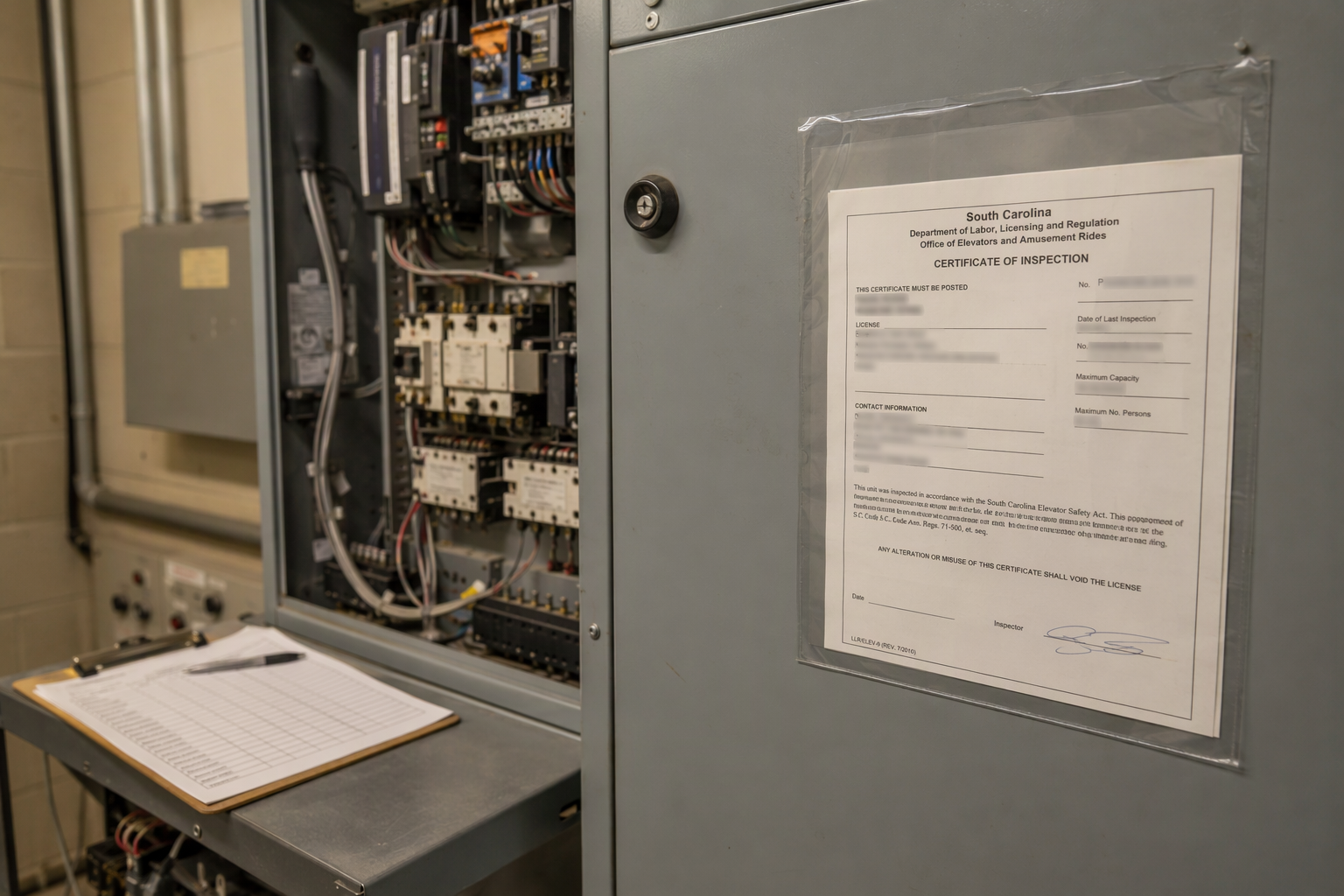
This is a critical point that many property managers overlook: a service contract with an elevator company does not transfer legal liability for equipment safety from the owner to the contractor. Under S.C. Code Title 41, Chapter 16, the owner must ensure the elevator is maintained, inspected, and certified — regardless of whether a billing dispute with the maintenance contractor is ongoing. Operating an elevator without a valid certificate of registration and operating certificate from the state is a violation of South Carolina law. The operating certificate, or a copy, must also be displayed conspicuously inside each elevator car.
Can I withhold payment on the quarterly invoice if maintenance was not performed to my satisfaction?
Withholding payment is a legally available remedy in some circumstances, but it carries risks that make written documentation and communication the more practical first step.
Before withholding any payment, a building owner should consult the specific dispute resolution provisions in the service contract. Many elevator maintenance agreements include language specifying that undisputed amounts must be paid while disputed items are resolved separately. Unilaterally withholding full payment — including undisputed portions — can expose the owner to late fees, service suspension clauses, or breach-of-contract claims. A better approach is to pay the undisputed portion, provide written notice of the specific disputed tasks, and request either completion of the work or a credit memo. That paper trail protects the owner’s legal position regardless of how the dispute ultimately resolves.
What records should I keep related to elevator maintenance invoices and service visits?
Building owners should retain signed service contracts, all maintenance reports, invoices, payment records, inspection certificates, and any written correspondence with the elevator service company.
South Carolina law requires that the operating certificate be kept current and displayed inside the car. The elevator’s maintenance log — which should be physically present in or near the machine room under ASME A17.1-2019 requirements — is a primary audit document. If a dispute arises over whether quarterly maintenance was performed, that log provides the contemporaneous record. Building owners should verify after each visit that a dated maintenance entry has been made, noting what was inspected, lubricated, adjusted, or repaired. Requests for a copy of that entry are reasonable and should be honored by any reputable elevator service company.
Does my elevator service contract need to address South Carolina’s annual inspection requirement?
Yes — a well-drafted service contract should explicitly address how the South Carolina annual inspection requirement will be coordinated, even though the inspection itself must be performed by a state or licensed special inspector.
Because South Carolina prohibits a special inspector from inspecting an elevator on which their employer has a current service contract, building owners with a full-maintenance agreement must arrange for the annual state inspection through a separate, independent inspector or through the state directly. A reputable elevator service company should inform building owners of this requirement and help coordinate scheduling so that any deficiencies identified during the state inspection can be addressed promptly. Failure to obtain and renew the operating certificate is the building owner’s legal responsibility, not simply an administrative oversight.
What happens if a maintenance deficiency is discovered during the state inspection?
If a state inspector identifies a deficiency, the building owner must have it corrected before the elevator can receive a renewed operating certificate, and the work must be reported or re-inspected as required by the state.
Under South Carolina’s elevator regulations, any elevator found to be unsafe or out of compliance may be ordered out of service until the violation is corrected. If the deficiency is the result of a maintenance failure that falls within the contracted scope of the quarterly service agreement, the building owner has a legitimate basis to request that the elevator service company perform the corrective work without additional charge. Documenting the state inspection report and comparing it against the contractor’s maintenance logs is the most effective way to establish accountability.
What does ASME A17.1 require specifically about maintenance documentation?
The ASME A17.1 Safety Code for Elevators and Escalators, adopted by South Carolina in its 2019 edition, requires that a maintenance control program be established and followed, and that maintenance records be kept for each piece of equipment.
The maintenance control program must specify the frequency and procedures for inspection, testing, lubrication, and cleaning. It must be equipment-specific and based on the manufacturer’s recommendations, modified as appropriate for the equipment’s age, use, and condition. This requirement means that a technician performing quarterly maintenance should be following a documented procedure — not improvising — and should be recording what was done on each visit. Building owners are entitled to understand what maintenance control program applies to their equipment and to request documentation showing that it is being followed.
Are there ADA requirements that quarterly elevator maintenance must address?
Yes — the Americans with Disabilities Act requires that elevators serving accessible routes remain operational, and maintenance practices directly affect ADA compliance.
Under the ADA, elevators that provide access to floors in multi-story commercial facilities must be kept in working order. Extended downtime — especially when it results from deferred maintenance — can constitute an ADA accessibility barrier. While the ADA does not prescribe elevator maintenance schedules, it does require that accessible features remain functional. A quarterly maintenance program that includes thorough inspection of door operation, leveling accuracy, control button function, cab lighting, and emergency communication systems directly supports ongoing ADA compliance. Building owners should document any ADA-related maintenance issues in writing and ensure they are addressed within the quarterly service cycle rather than deferred.
How can I verify that an elevator company is qualified to perform maintenance in South Carolina?
Building owners should ask the elevator company to demonstrate familiarity with South Carolina’s adopted code edition (ASME A17.1-2019), confirm that technicians follow a documented maintenance control program, and verify that the company does not perform conflict-of-interest inspections on equipment it services.
South Carolina’s elevator regulations require that special inspectors demonstrate qualifications consistent with the 2018 edition of QEI-1, the American National Standard for Qualification of Elevator Inspectors. While maintenance contractors and service companies operate under a separate framework, building owners can reasonably expect their elevator service provider to be familiar with these professional standards and to operate transparently. Carolina Elevator Service works within the regulatory framework established by the South Carolina Department of Labor, Licensing and Regulation (LLR) and follows ASME A17.1-2019 maintenance requirements for equipment it services in Columbia, SC.
What should I look for when reviewing a quarterly elevator maintenance invoice?
A legitimate quarterly maintenance invoice should identify the specific equipment covered, the billing period, the contracted service tier, and reference the service agreement number or contract date.
Beyond those basics, building owners reviewing invoices should check for the following:
- Confirmation that the invoice amount matches the agreed quarterly rate in the signed contract
- A line-item breakdown distinguishing included maintenance services from any separately billed repairs or parts
- A reference to the scheduled visit date for the upcoming quarter, or a confirmation of the completed visit date if billing is issued after service
- Any notation of deferred items or outstanding deficiencies that will be addressed in the upcoming quarter
- Contact information for the account manager or service coordinator who can answer questions about the invoice
If the invoice does not include these elements, building owners should request a more detailed statement before processing payment.
Can I switch elevator service companies if I am dissatisfied with billing or service quality?
Yes — building owners can change elevator service providers, but should review the cancellation terms in the existing contract and ensure a smooth transition of maintenance records and operating documentation.
Most elevator service contracts include a notice period for cancellation, typically ranging from 30 to 90 days depending on the agreement’s terms. Before switching providers, building owners should obtain copies of all maintenance logs, the current operating certificate, the equipment’s maintenance control program, and any outstanding deficiency reports. The incoming service company will need this documentation to assume responsibility for the equipment’s maintenance history and to coordinate the next South Carolina state inspection. Carolina Elevator Service regularly assists building owners in Columbia, SC with transitions from other providers, ensuring continuity of compliance documentation during the changeover.
What is the role of a maintenance control program, and who is responsible for creating it?
The maintenance control program is a written, equipment-specific document that defines what maintenance tasks must be performed, at what frequency, and by what methods — and under ASME A17.1-2019, the responsibility for establishing it rests with the organization performing the maintenance.
This is a significant detail for building owners evaluating service providers: a contractor that cannot produce or describe the maintenance control program for the building’s equipment is not meeting the requirements of the adopted code. The program should be tailored to the specific make, model, age, and use of each elevator in the building. Quarterly invoices should correspond to service activities defined within that program, giving building owners a clear standard against which to measure whether contracted work was actually completed.
Does the South Carolina elevator code apply to all buildings, including private residences?
No — the South Carolina Elevator Code expressly does not apply to equipment installed in a single private dwelling.
This exemption means that residential homeowners with private home elevators are not subject to the same annual inspection, operating certificate, and maintenance requirements that apply to commercial elevators. However, any elevator in a commercial building, multi-unit residential building, or public accommodation — including those serving persons with disabilities under the ADA — falls fully within South Carolina’s regulatory framework. Building owners should not assume an exemption applies without confirming the specific equipment and occupancy type with the South Carolina Department of Labor, Licensing and Regulation (LLR), Office of Elevators and Amusement Rides.
How should building owners in Columbia, SC evaluate whether their current elevator maintenance contract provides adequate protection?
Building owners should compare the contract’s scope of work against ASME A17.1-2019 maintenance requirements, confirm that the billing terms are clearly stated, and verify that the service provider has a documented process for addressing deficiencies between scheduled visits.
A contract that only addresses routine lubrication without specifying how callback visits, emergency repairs, and deficiency follow-up are handled leaves the building owner exposed to unexpected costs and compliance gaps. Carolina Elevator Service encourages building owners and property managers in the Columbia, SC area to request a contract review as part of any elevator assessment. Reviewing the existing agreement against South Carolina’s regulatory requirements — including the annual state inspection coordination, operating certificate maintenance, and emergency power standards requiring at least four hours of backup lighting and alarm bell operation under South Carolina regulations — can identify gaps before they become compliance violations or liability events.
Contact Carolina Elevator Service for a free elevator assessment at 803-865-1400.
Need elevator service you can rely on? Carolina Elevator Service is ready to help.