Healthcare Elevator Upgrades: What to Budget for in 2027 and How to Prioritize Them
Hospitals, outpatient clinics, long-term care facilities, and medical office buildings in Columbia, SC depend on elevators more critically than almost any other building type. A delayed stretcher, a malfunctioning door, or a failed inspection can directly affect patient outcomes and regulatory standing. Building and facilities managers who begin 2027 budget planning in 2026 have a measurable advantage: they can sequence upgrades strategically rather than react to emergency repairs or compliance findings.
The guidance below is organized to answer the most common questions South Carolina healthcare facilities ask when approaching an elevator capital plan. Where specific codes apply, they are cited and linked to official sources. Where regulation requires professional judgment, the recommendation is to schedule a site assessment.
What codes govern hospital elevator upgrades in South Carolina?
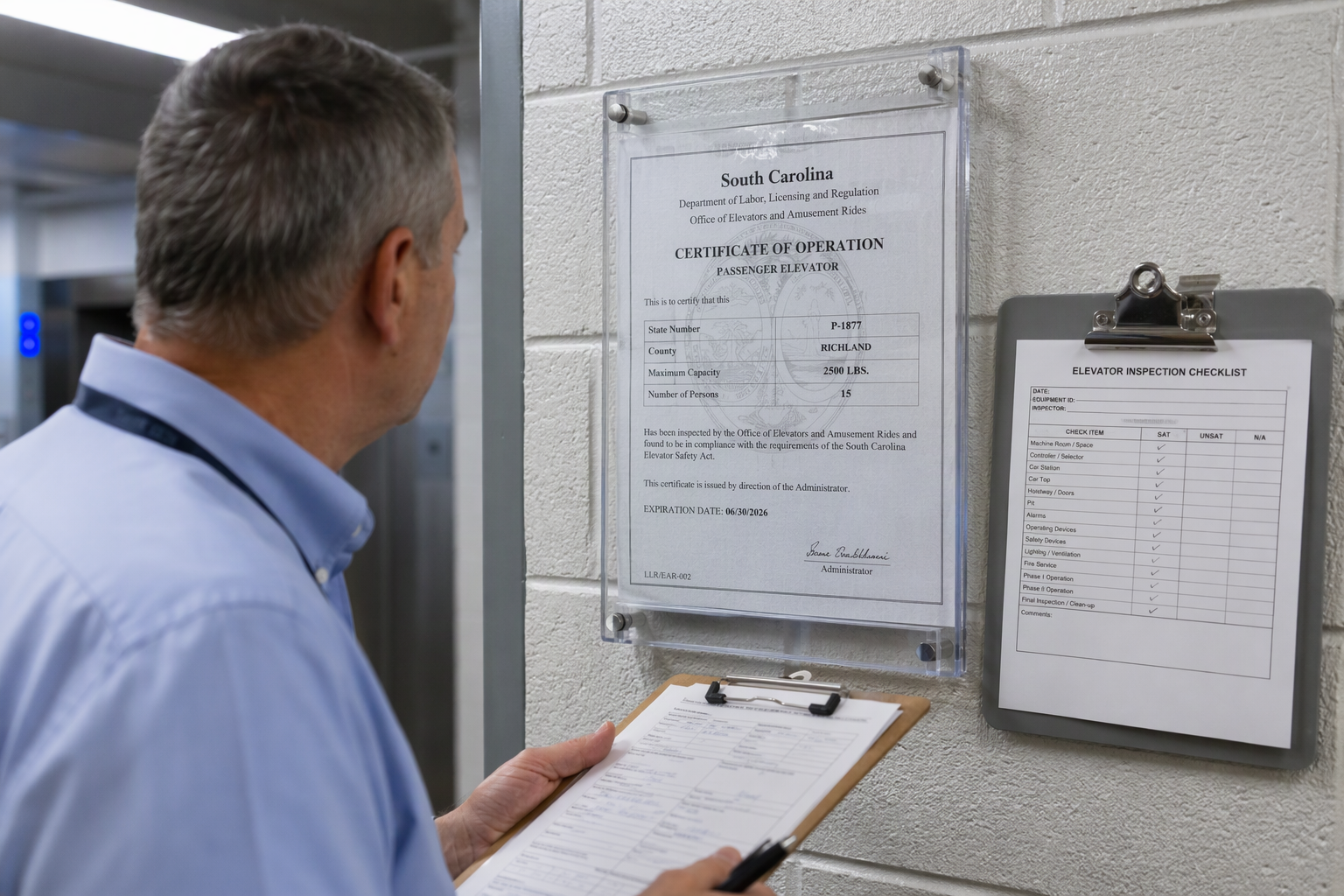
Healthcare elevator compliance in South Carolina involves several overlapping requirements that facilities managers must understand before building a budget.
- S.C. Code Title 41, Chapter 16 (South Carolina Elevator Code) — The primary state statute. It requires every elevator to hold a valid certificate of registration and an operating certificate before it may operate. That certificate, or a copy, must be displayed conspicuously inside each elevator car. No upgrade project may begin without a state construction permit issued by the South Carolina Department of Labor, Licensing and Regulation (LLR), Office of Elevators and Amusement Rides.
- S.C. Code of Regulations, Chapter 71, Article 5 (Regulations 71-5000 through 71-5700) — Adopts the ASME A17.1/CSA B44, 2019 edition without amendment, effective July 23, 2021. Any alteration or new installation must comply with the edition in effect when the construction permit is issued.
- Americans with Disabilities Act (ADA) — Requires accessible routes in healthcare facilities. Elevator cab dimensions, door widths, control-panel heights, audible signals, and Braille/tactile markings are all subject to ADA Standards for Accessible Design.
- OSHA — Applies to worker safety during maintenance and upgrade work, including lockout/tagout procedures and machine-room access standards.
- The Joint Commission and CMS Conditions of Participation — While not elevator codes, these bodies survey physical environment standards. Elevator downtime, inspection records, and emergency operations plans are reviewed during accreditation surveys. Gaps in elevator compliance can generate findings that affect Medicare and Medicaid reimbursement.
South Carolina passenger elevators must also maintain standby power capable of running emergency lighting and the alarm bell for at least four hours if normal power fails — a requirement with direct patient-safety implications in a hospital context.
How often must healthcare elevators be inspected in South Carolina?
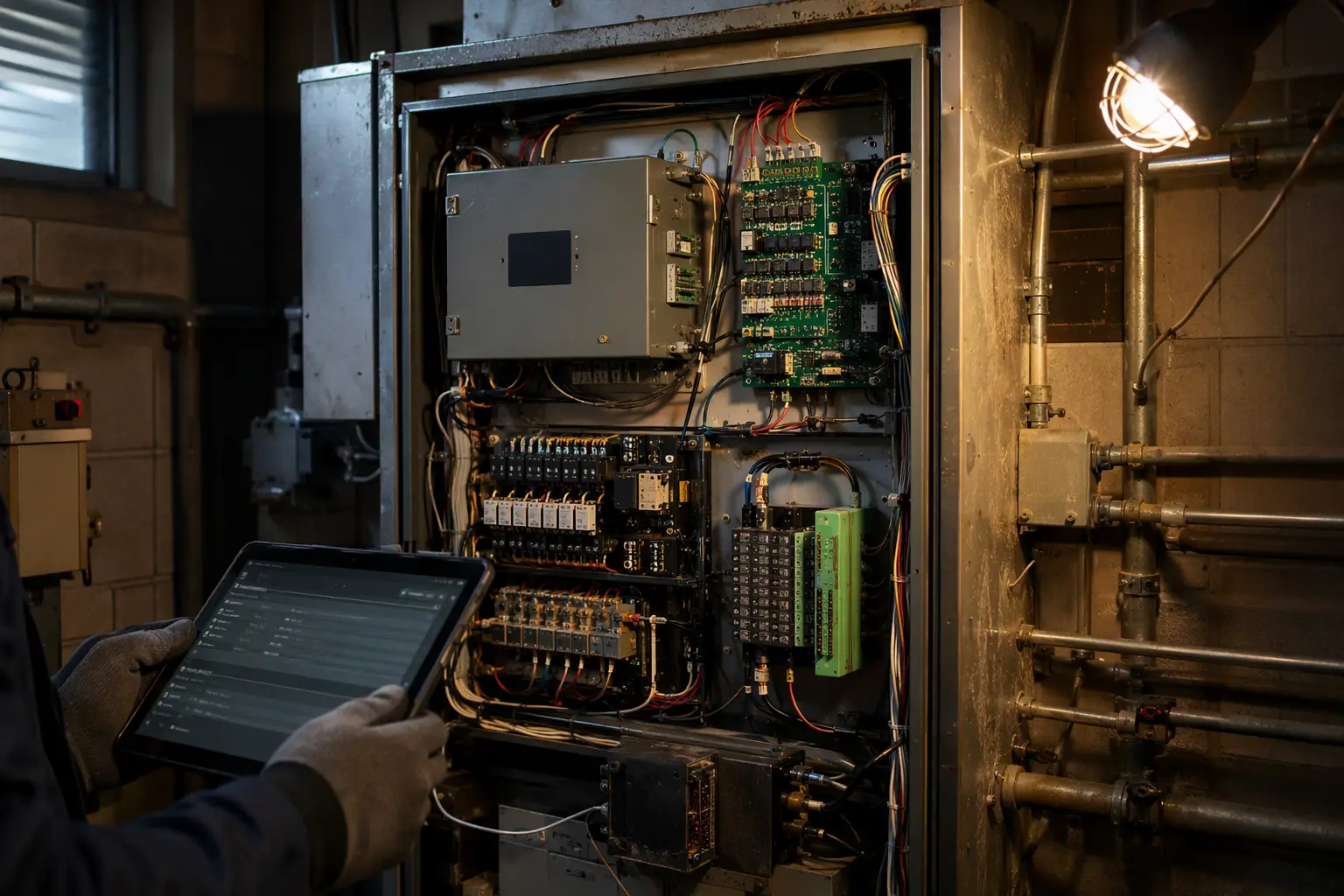
Under S.C. Code Title 41, Chapter 16, passenger elevators in South Carolina — including those in hospitals and medical facilities — must be inspected at least once a year before the operating certificate is renewed. Inspections at installation, alteration, or repair are also required.
Only state inspectors or licensed special inspectors (who must meet the qualifications in the QEI-1, 2018 edition, American National Standard for Qualification of Elevator Inspectors) may perform required inspections. An important conflict-of-interest rule applies: a special inspector may not inspect an elevator on which the inspector or the inspector’s employer holds a current service or warranty contract. Healthcare facilities should verify this independence when selecting inspection vendors.
Handicap lifts used in some rehabilitation or smaller clinical settings follow a different schedule — they are inspected every five years in South Carolina.
Carolina Elevator Service recommends that facilities pair their annual inspection cycle with an internal condition assessment so that findings translate directly into the following year’s capital budget.
What elevator upgrades should a hospital prioritize first in 2027?
Prioritization should follow a risk-tiered framework. Below is a recommended sequence:
- Resolve any open inspection findings or certificate violations. An elevator operating without a valid operating certificate is a legal violation under South Carolina Elevator Code. Address these before any other upgrade category.
- Safety-critical mechanical systems. Hydraulic cylinders, overspeed governors, safeties, and buffers that are approaching the end of their service life or that failed inspection points represent immediate risk. South Carolina requires underground hydraulic elevator cylinders installed new to be encased in plastic outer containment to limit electrolytic corrosion — older unencased cylinders warrant condition assessment.
- Emergency power compliance. Verify that standby power systems meet the four-hour minimum for emergency lighting and alarm bells. In a hospital, power-failure scenarios have direct patient-safety consequences.
- ADA accessibility deficiencies. Non-compliant cab interiors, door timing, audible/visual signals, or control panel heights expose the facility to civil complaints and ADA enforcement. These are typically moderate-cost corrections relative to mechanical overhauls.
- Door operator and entrapment-protection systems. Door-related incidents are among the most common elevator issues in high-traffic healthcare settings. Upgrading to current ASME A17.1-2019 door protection standards reduces liability and patient injury risk.
- Control system modernization. Legacy relay-logic controls are increasingly difficult to maintain and may no longer have available parts. Modern solid-state controls improve reliability, enable remote monitoring, and support dispatching systems needed for high-volume clinical floors.
- Cab environment and infection control. Antimicrobial wall panels, stainless or composite surfaces, and hands-free call systems are operationally valuable in healthcare but are lowest on the safety-risk hierarchy. Budget these after safety and compliance items are funded.
- Capacity and configuration upgrades. If stretcher transport, bariatric equipment, or large supply carts are straining existing cab dimensions, a cab enlargement or dedicated service-elevator designation may be warranted. These are capital-intensive and require full permitting from LLR.
What does a typical healthcare elevator upgrade project timeline look like?
Timeline varies by scope, but facilities managers should account for the following phases when building a 2027 project plan:
- Condition assessment and scope definition (2026 Q3–Q4): A professional assessment identifies which systems require upgrade and generates documentation for capital requests.
- Engineering and specification (2026 Q4–2027 Q1): Detailed specifications are developed to ensure bids reflect consistent scope and code requirements.
- LLR construction permit application: No alteration or installation may begin in South Carolina without the state construction permit. Factor permit processing time into the project schedule.
- Procurement and scheduling (2027 Q1–Q2): Supply chain lead times for modernization components, particularly controllers and door equipment, can be significant. Early procurement planning is essential.
- Installation and inspection: Post-completion, the upgraded elevator must pass inspection by a state or qualified special inspector before the updated operating certificate is issued.
Healthcare facilities must also plan for the operational impact of elevator downtime. A phased approach — upgrading one car at a time in a multi-elevator bank — minimizes disruption to patient transport.
How should healthcare facilities document elevator upgrades for accreditation purposes?
Accreditation bodies such as The Joint Commission review the facility’s Environment of Care records, which should include:
- Current operating certificates for each elevator (required to be displayed in each car under South Carolina law)
- Annual inspection reports and any corrective action documentation
- The state construction permits for any alteration work
- Preventive maintenance logs
- Emergency operations procedures for elevator failure scenarios, including staff protocols when a passenger is entrapped
- Evidence that any accident causing serious injury was reported to the state before the end of the next working day, as required by South Carolina law
Carolina Elevator Service provides inspection and maintenance documentation that is formatted to support facilities’ recordkeeping requirements for regulatory and accreditation review.
What questions should I ask elevator service vendors before awarding a healthcare upgrade contract?
- Are you familiar with S.C. Code Title 41, Chapter 16 and the adopted ASME A17.1-2019 edition requirements in South Carolina?
- Will you manage the LLR construction permit application on our behalf?
- How do you handle the conflict-of-interest requirement that prohibits your inspectors from inspecting elevators under your service contract?
- What experience does your team have with hospital-specific requirements such as stretcher-capacity cabs, firefighters’ service (including the South Carolina-specific five-pin S.C. #1000 key requirement for new installations), and emergency power systems?
- How do you minimize downtime for active clinical floors during upgrade work?
- What documentation will you provide for our accreditation and compliance records?
What are the ADA requirements most commonly missed in healthcare elevator upgrades?
Facilities that upgrade mechanical components but neglect cab interiors frequently carry forward ADA deficiencies. Common gaps include:
- Control buttons that are not raised or are positioned outside the accessible reach range
- Missing or worn Braille and tactile characters on hall call and cab control panels
- Door open timing that does not allow sufficient dwell time for patients using mobility devices
- Audible signals that are absent or do not meet tone and volume standards
- Floor designation announcements not provided for visually impaired passengers
- Insufficient cab interior dimensions for wheelchairs and wheeled stretchers on required accessible routes
A modernization project is the most cost-effective point at which to correct ADA items, because cab interiors and controls are already being accessed for other work.
Questions Your Inspector Will Ask
South Carolina state inspectors and licensed special inspectors conducting annual inspections or post-alteration inspections at healthcare facilities commonly focus on the following areas. Facilities managers and maintenance staff should be prepared to address each:
- Is the current operating certificate displayed conspicuously inside each elevator car?
- Is the certificate of registration on file and current?
- Were state construction permits obtained before any alteration or installation work was performed?
- Does the standby power system provide at least four hours of emergency lighting and alarm bell operation?
- For any underground hydraulic cylinders, are they encased in the required plastic outer containment?
- Is firefighters’ service operational, and does it use the South Carolina-required five-pin S.C. #1000 key on installations where required?
- Are maintenance and inspection logs current and available on site?
- Has any accident causing serious injury to a non-employee been reported to the state within the required timeframe?
- Are door safety devices functional and do they meet the requirements of the ASME A17.1-2019 Safety Code for Elevators and Escalators as adopted in South Carolina?
- Are all machine room access, guarding, and lighting conditions in compliance?
How do I build a realistic 2027 elevator capital budget for a healthcare facility?
A defensible capital budget starts with a documented condition assessment, not a vendor quote. The assessment should produce a component-by-component inventory that maps each system against its expected remaining service life, current compliance status, and the cost consequence of deferral.
Budget categories to include:
- Regulatory compliance costs: Permit fees, inspection fees, and any corrective work required to clear inspection findings
- Mechanical overhaul or replacement: Hydraulic systems, machine and drive components, governors, safeties
- Control system modernization: Solid-state controller replacement, dispatching software
- Door system upgrades: Door operators, safety edges, restricted-opening devices
- ADA remediation: Panel replacement, signal upgrades, cab dimension modifications
- Emergency power system upgrades: Battery backup verification and replacement as needed
- Cab interior renovation: Infection-control finishes, antimicrobial materials, lighting
- Contingency: Standard capital planning practice is to include a contingency line for discovered conditions once equipment is opened during work
Carolina Elevator Service performs condition assessments for Columbia, SC healthcare facilities that produce the documentation needed to support capital requests and establish a multi-year upgrade roadmap.
What happens if a healthcare elevator fails inspection in South Carolina?
Under S.C. Code Title 41, Chapter 16, an elevator that does not hold a valid operating certificate may not legally operate. If an inspection results in a failed finding, the facility must complete the required corrective work, obtain a new inspection, and receive an updated certificate before returning the elevator to service.
For a hospital, this creates an immediate operational problem. A failed inspection on a critical patient-transport elevator during an active shift may require emergency corrective work on an accelerated timeline — which is consistently more costly than planned maintenance. The South Carolina owner-responsibility requirement is explicit: the owner must keep every elevator facility in safe operating condition and in line with state regulations.
Proactive maintenance programs, paired with pre-inspection assessments, are the most reliable way to avoid unplanned downtime. Carolina Elevator Service works with healthcare facilities in Columbia, SC to identify conditions before they generate inspection findings.
Are there any South Carolina-specific elevator requirements unique to healthcare settings?
South Carolina’s elevator code, which adopts ASME A17.1-2019 without amendment, applies uniformly across occupancy types. There is no separate South Carolina elevator statute that applies exclusively to hospitals. However, several requirements carry heightened practical importance in healthcare:
- The four-hour standby power requirement for emergency lighting and alarm bells is especially critical in facilities where elevator failure during a power event could affect patient safety.
- The firefighters’ service key requirement (five-pin S.C. #1000 key for new installations) must be coordinated with the facility’s fire safety and emergency response planning.
- The owner’s obligation to maintain every elevator in safe operating condition and consistent with state regulations aligns with healthcare facility obligations under Joint Commission Environment of Care standards — both point to the same outcome: a documented, proactive maintenance program.
Beyond elevator law, healthcare facilities in South Carolina are subject to Health Facility Licensure standards administered separately from the elevator code. Facilities managers should confirm with legal and compliance counsel how those standards interact with elevator upgrade projects in their specific setting.
Contact Carolina Elevator Service for a free elevator assessment at 803-865-1400.
Need elevator service you can rely on? Carolina Elevator Service is ready to help.