How Can I Get a Copy of My Existing Elevator Maintenance Contract? A Complete FAQ Guide for Building Owners in Columbia, SC
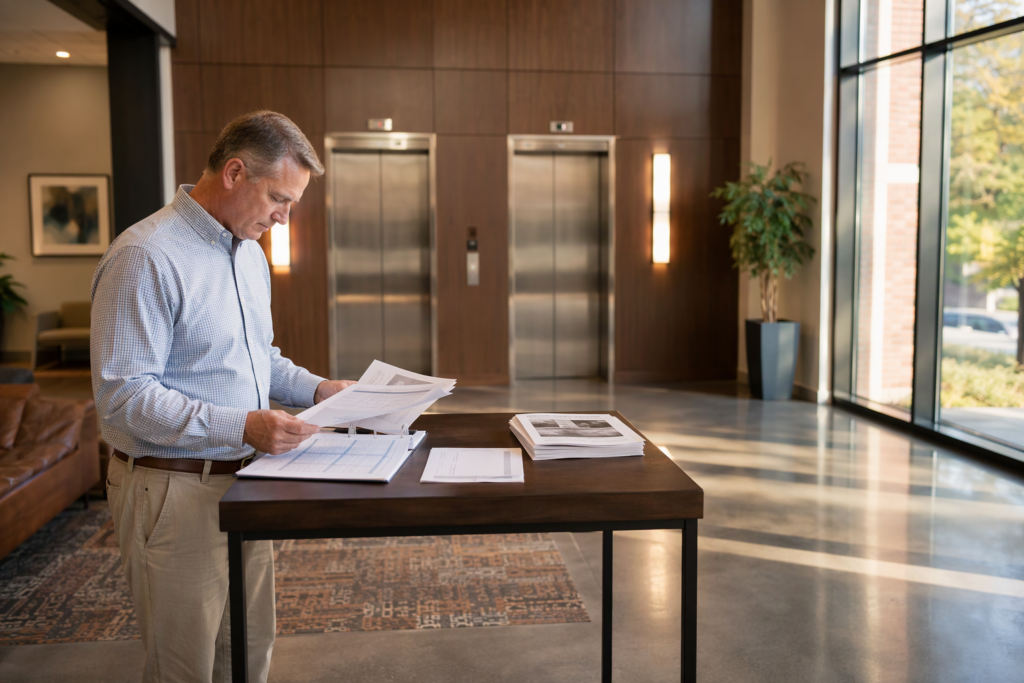
To get a copy of your existing elevator maintenance contract, reach out to your current elevator service provider by phone or email and request that they resend the signed agreement. Reputable service companies maintain contract records and can typically produce a copy on short notice. If the company is unreachable, check your own property files, accounts-payable records, or the email inbox used at the time the contract was signed.
Why does retrieving your elevator maintenance contract matter for compliance in South Carolina?

Your elevator maintenance contract directly affects whether your elevator meets the requirements of South Carolina law, because building owners — not service contractors — bear the legal duty to keep every elevator facility in safe operating condition and in compliance with state regulations.
Under S.C. Code Title 41, Chapter 16 (South Carolina Elevator Code), the owner is responsible for the safe operation of the elevator at all times. That responsibility makes your maintenance contract a critical business document. It spells out exactly what inspections, lubrication, adjustments, and repairs the service company has agreed to perform, and it becomes evidence of due diligence if a regulatory audit or injury incident ever arises.
In Columbia, SC and across South Carolina, the Office of Elevators and Amusement Rides within the South Carolina Department of Labor, Licensing and Regulation (LLR) enforces those obligations. Knowing precisely what your maintenance agreement covers — and having a copy in hand — lets you verify that your vendor is actually performing the tasks the contract requires and that those tasks align with what the ASME A17.1/CSA B44, 2019 edition (the code South Carolina adopted effective July 23, 2021) demands.
Who holds the original copy of an elevator maintenance contract?

Both parties to the agreement — the building owner and the elevator service company — should hold executed originals or certified copies, meaning you have at least two legitimate sources from which a copy can be recovered.
In practice, elevator service companies maintain contract databases, often in cloud-based field-service platforms, that store every signed agreement tied to a unit’s serial number and address. If you signed electronically, the service provider’s system will have a timestamped PDF. If you signed on paper, the company will have a scanned or physical file. Building owners should also retain their copy in property management software, a shared drive, or a physical contract binder kept with the elevator’s operating certificate documentation.
How do I formally request a copy of my elevator maintenance contract from my service provider?
Send a written request — email is acceptable — to your service provider’s customer service or contracts department, referencing the building address, elevator unit number, and the approximate date the contract was executed.
- Locate the service provider’s main customer service or accounts contact, which is typically listed on your last invoice or the service sticker inside the elevator machine room.
- Compose a written request by email or certified letter that includes your building address, the elevator unit ID or serial number, the approximate contract start date, and your role as the building owner or authorized property manager.
- Ask specifically for the full executed contract, including any addenda, renewal amendments, or change orders that have been signed since the original agreement date.
- Request confirmation of receipt and a deadline for response — ten business days is a reasonable standard.
- If no response arrives within that window, escalate to the company’s regional or national accounts team, or consult your original attorney or broker if the contract was negotiated through a third party.
- Once received, store the copy in at least two places — a secure cloud location and a physical binder — alongside your current operating certificate, inspection reports, and any violation notices.
What if my elevator service company has gone out of business or been acquired?
When a service company closes or is absorbed into a larger organization, contract records typically transfer to the acquiring entity or are archived with the company’s registered agent, so a methodical search through those channels usually recovers the document.
Start by checking the South Carolina Secretary of State’s business registry to confirm whether the company dissolved, merged, or was purchased. If acquired, the successor company inherits all contractual obligations and records — contact their transition or legacy accounts team. If the company simply dissolved, records may have been filed with a bankruptcy trustee or stored with the company’s former legal counsel. Your own internal files — accounts-payable software, email archives, DocuSign or similar e-signature platforms — are often the fastest path to recovery in those situations.
Building owners who find themselves without active service documentation are advised to engage a qualified elevator service company promptly. Carolina Elevator Service works with Columbia, SC property owners who need to assess their current maintenance status and establish new, well-documented service agreements.
What should a complete elevator maintenance contract include?
A complete elevator maintenance contract should clearly define the scope of routine maintenance tasks, inspection schedules, parts coverage, emergency callback provisions, and exclusions — any contract missing those elements leaves the building owner exposed.
Specifically, look for the following sections in any contract you retrieve or evaluate:
- Scope of maintenance: A detailed list of components the contractor will inspect, lubricate, clean, and adjust on each service visit — motor, controller, ropes or hydraulic system, doors, safeties, and buffers, among others.
- Inspection alignment: Language confirming that maintenance visits are scheduled to support annual inspection readiness under S.C. Code Title 41, Chapter 16 and the adopted edition of ASME A17.1-2019/CSA B44:19.
- Parts and labor coverage: Whether the contract is comprehensive (full parts and labor), oil-and-grease only, or somewhere in between.
- Emergency callback terms: Response procedures for entrapments and safety shutdowns.
- Exclusions: Items explicitly not covered, such as vandalism repairs, modernization, or code upgrades triggered by alterations.
- Term and renewal: The contract start date, end date, auto-renewal clauses, and notice periods required to cancel or renegotiate.
- Insurance and liability: Proof of the contractor’s insurance coverage, including general liability and workers’ compensation.
How does an elevator maintenance contract relate to South Carolina’s annual inspection requirement?
South Carolina requires elevators to be inspected at least once a year before the operating certificate is renewed, and a well-structured maintenance contract is what keeps the unit in a condition that passes that inspection without costly corrective orders.
The South Carolina Department of Labor, Licensing and Regulation (LLR) mandates that no elevator facility may be operated without a valid certificate of registration and an operating certificate, which must be displayed conspicuously inside each elevator car. Inspections under S.C. Code Title 41, Chapter 16 may be conducted by state inspectors or by licensed special inspectors — importantly, a special inspector may not inspect an elevator on which the inspector or the inspector’s employer holds a current service or maintenance contract. That rule underscores why the details of your maintenance contract matter: the inspector assigned must be independent of your service contractor.
Routine maintenance visits — typically performed quarterly or monthly depending on traffic volume and equipment type — prepare the unit to meet the requirements of ASME A17.1-2019/CSA B44:19, which South Carolina adopted without amendment effective July 23, 2021. If a violation is found during inspection, your contract should define whether the service company is obligated to remediate it within the contract price or whether it triggers a separate work order.
What inspection intervals apply to different elevator types in South Carolina?
South Carolina sets different mandatory inspection frequencies based on equipment type, ranging from annual inspections for passenger elevators to every seven years for certain specialized equipment.
| Equipment Type | Inspection Frequency (South Carolina) | Governing Authority |
|---|---|---|
| Passenger and freight elevators | At least once per year (before operating certificate renewal) | S.C. Code Title 41, Chapter 16 / LLR |
| Handicap lifts (platform lifts) | Every five years | S.C. Code Title 41, Chapter 16 / LLR |
| Manlifts, television tower elevators, special purpose elevators | Every seven years | S.C. Code Title 41, Chapter 16 / LLR |
| Dumbwaiters | Upon installation or alteration | S.C. Code Title 41, Chapter 16 / LLR |
| New installations (any type) | At installation, registration, and alteration or repair (plus annual thereafter) | S.C. Code Title 41, Chapter 16 / LLR |
Knowing which category your equipment falls into helps you evaluate whether your maintenance contract is structured around the correct regulatory schedule. A contract that schedules annual maintenance visits for a handicap lift subject to a five-year inspection cycle may be over-servicing, while one that skips quarterly visits on a high-traffic passenger elevator may leave critical components unmonitored between annual inspections.
Can my elevator service contract affect whether a special inspector can inspect my elevator?
Yes — South Carolina law explicitly prohibits a special inspector from inspecting any elevator on which the inspector or the inspector’s employer holds a current service or warranty contract, making your contract documents directly relevant to inspector eligibility.
This independence requirement exists to prevent conflicts of interest and is embedded in S.C. Code Title 41, Chapter 16. In practical terms, if your service company assigns one of its affiliated inspectors to conduct your annual inspection, that inspection is not valid under South Carolina law. Having a copy of your maintenance contract on hand — including the name of the contracting service company — allows you, your property manager, or the LLR to verify that the assigned inspector is genuinely independent. South Carolina special inspectors must also demonstrate qualifications consistent with the 2018 edition of QEI-1, the American National Standard for Qualification of Elevator Inspectors.
What should I do if my maintenance contract has expired and I did not renew it?
If your elevator maintenance contract has lapsed, the building owner remains legally responsible for the safe operation of the elevator under South Carolina law, so the immediate priority is to restore documented maintenance coverage before the next required inspection.
- Confirm the contract expiration date by reviewing any renewal notices or invoices from your previous service company.
- Obtain a current condition assessment of the elevator from a qualified service provider to identify any deferred maintenance items that accumulated during the lapse.
- Request written proposals from at least two qualified elevator service companies to compare scope, pricing, and terms.
- Ensure the new contract is signed and in force before scheduling your next annual inspection with the LLR or a qualified special inspector.
- File the new contract alongside your operating certificate and most recent inspection report in your property records.
Carolina Elevator Service provides elevator assessments for Columbia, SC building owners who need to re-establish service coverage and ensure their units are ready for annual inspection.
Are elevator maintenance contracts required by law in South Carolina?
South Carolina law does not explicitly mandate a written maintenance contract, but it does require that the owner keep the elevator in safe operating condition and in compliance with state regulations — a standard that, as a practical matter, demands documented, systematic maintenance.
The obligation is rooted in S.C. Code Title 41, Chapter 16, which places the duty of safe operation squarely on the owner. In the absence of a maintenance contract, demonstrating compliance with that duty — especially following an accident or a failed inspection — becomes significantly more difficult. Courts and regulatory agencies look for documented evidence that maintenance was performed. A signed maintenance contract, combined with service logs and inspection reports, provides that evidence. Building owners who operate without a contract are effectively self-insuring against a broad range of regulatory and liability risks.
How do ADA requirements intersect with my elevator maintenance contract?
The Americans with Disabilities Act (ADA) requires that elevators in multi-story facilities remain accessible to people with disabilities, which means maintenance contracts should include provisions for keeping accessibility features — door timing, leveling accuracy, cab controls, and emergency communication systems — properly calibrated.
ADA compliance is not a one-time installation milestone; it is an ongoing operational obligation. An elevator that drifts out of level, has doors that close too quickly, or has a malfunctioning cab phone fails ADA requirements regardless of whether it was originally installed to code. A well-drafted maintenance contract will specifically reference the servicing of accessibility-related components and set tolerances for leveling and door performance. When reviewing a retrieved contract, confirm that those items are explicitly within scope rather than assumed.
What records should I keep alongside my elevator maintenance contract?
Alongside the maintenance contract, building owners should retain the current operating certificate (required to be displayed inside the elevator car), all annual and periodic inspection reports, any violation or deficiency notices from the LLR, repair work orders, and the elevator’s modernization or alteration permits.
South Carolina requires that the operating certificate — or a copy — be displayed conspicuously inside each elevator car at all times. That certificate is issued following a successful inspection under S.C. Code Title 41, Chapter 16. Together, the contract, certificate, inspection history, and repair records form a complete maintenance file that demonstrates regulatory compliance and supports liability defense if an incident occurs. Digital storage with offsite backup is strongly recommended in addition to any physical files kept on-site.
Can I switch elevator service providers if I am unhappy with my current contract?
Yes, building owners can switch elevator service providers, but the transition requires careful review of the existing contract’s termination clause, notice period, and any provisions regarding proprietary parts or software that the current vendor may control.
Some elevator maintenance contracts — particularly those tied to proprietary control systems — include language that limits the owner’s ability to engage a third-party technician, or that voids warranties if the owner switches providers. Before terminating, review the contract’s cancellation provisions and consult with the prospective new service company about compatibility with your existing equipment. In South Carolina, local ordinances that conflict with the state elevator code are void, but contract terms that are voluntarily agreed to by both parties remain enforceable under standard contract law. A new maintenance contract should be executed and in force before the old one lapses to avoid any gap in documented coverage.
What happens to my maintenance contract obligations if I sell or transfer ownership of the building?
When a building changes ownership, the elevator’s regulatory obligations transfer to the new owner automatically under South Carolina law, but the maintenance contract’s assignment rights depend entirely on the contract’s own language.
Some contracts automatically assign to a building purchaser; others require written consent from the service company before assignment; and others terminate at the point of sale, requiring the new owner to execute a fresh agreement. Sellers should disclose all active elevator maintenance contracts during due diligence, and buyers should request copies as part of their property inspection process. Under S.C. Code Title 41, Chapter 16, the new owner assumes legal responsibility for safe operation from the moment of transfer, regardless of what happens to the private maintenance contract between the parties.
What questions should I ask a new elevator service provider before signing a contract?
Before signing with any elevator service company in South Carolina, ask about scope of maintenance, parts and labor coverage, inspection coordination, conflict-of-interest policies for special inspectors, contract term and termination rights, and documentation practices.
- Does the contract align with the maintenance requirements of ASME A17.1-2019/CSA B44:19 as adopted by South Carolina?
- Will the service company provide written service reports after every maintenance visit?
- Does the company have any affiliation with special inspection entities that could create a conflict under South Carolina’s inspector-independence rule?
- What is the process for addressing violation notices issued by the LLR — is remediation included in the contract price?
- What are the exact termination and notice provisions if the relationship needs to end?
- Will the company provide copies of all contract documents, service logs, and reports on request?
Carolina Elevator Service is available to answer these questions for building owners in the Columbia, SC area who are evaluating their maintenance options.
How does the South Carolina code adoption affect what my maintenance contract must address?
Because South Carolina adopted ASME A17.1-2019/CSA B44:19 without amendment effective July 23, 2021, any elevator installed or significantly altered after that date must be maintained in accordance with that edition’s requirements — a fact that should be reflected in the technical scope of any current maintenance contract.
For equipment that was in operation before July 1, 1986, South Carolina also requires compliance with the 1986 edition of ANSI A17.3, the safety code for existing elevators and escalators. A knowledgeable service company will identify which code edition governs each unit in your portfolio and draft maintenance scopes accordingly. Additionally, South Carolina has specific requirements such as the mandatory five-pin S.C. #1000 key for firefighters’ service on new installations and the requirement that passenger elevators carry standby power sufficient to run emergency lighting and the alarm bell for at least four hours if normal power fails — both of which should appear in a properly scoped maintenance agreement for applicable equipment.
What should I do immediately after retrieving my elevator maintenance contract?
Once you have your contract in hand, systematically compare its scope against the current condition of your elevator, your inspection records, and your regulatory obligations under South Carolina law.
- Read the entire contract, including all addenda and amendments, noting coverage inclusions and exclusions.
- Compare the contracted maintenance tasks against the maintenance requirements in ASME A17.1-2019/CSA B44:19 for your equipment type.
- Confirm that the contract term is current and has not expired without renewal.
- Cross-reference the most recent inspection report from the LLR or an authorized special inspector against any outstanding deficiencies to determine whether they fall within the contract’s remediation scope.
- Verify that your current operating certificate is posted inside the elevator car and that its expiration date corresponds with your next scheduled inspection.
- Store digital and physical copies of the contract in at least two secure locations alongside all supporting regulatory documents.
- If any gaps or ambiguities are found in the contract’s coverage, contact your service provider in writing to request clarification or amendment.
How often should elevator maintenance contracts be reviewed or renegotiated?
Elevator maintenance contracts should be formally reviewed at each renewal date — typically annually or every three to five years depending on the contract term — and whenever the equipment undergoes modernization, the building changes ownership, or South Carolina adopts a new edition of the elevator code.
Code adoption events are particularly important triggers. South Carolina’s July 2021 adoption of ASME A17.1-2019/CSA B44:19 changed the technical baseline for maintenance and inspection. Any contract written before that date and not subsequently updated may reference superseded standards. Similarly, if an elevator undergoes alteration — which under S.C. Code Title 41, Chapter 16 requires a state construction permit — the maintenance scope may need to be revised to address new or replaced components. Proactive review prevents the common problem of paying for a contract that no longer matches what the equipment actually needs.
Can Carolina Elevator Service help me evaluate an existing contract or establish new elevator maintenance coverage in Columbia, SC?
Carolina Elevator Service works with building owners and property managers throughout Columbia, SC to review existing maintenance documentation, identify coverage gaps, and establish service agreements that are aligned with South Carolina’s regulatory requirements.
Whether a building owner has recently acquired a property with an unknown maintenance history, experienced a lapse in service coverage, or simply wants to verify that their current contract reflects the requirements of ASME A17.1-2019/CSA B44:19 as adopted by the South Carolina Department of Labor, Licensing and Regulation (LLR), Carolina Elevator Service offers the technical knowledge and local presence to provide practical guidance. The team can also assist in understanding how South Carolina’s inspector-independence rules affect the relationship between a service contract and the annual inspection process — a detail that building owners frequently overlook until it becomes a compliance problem.
Where can I find official information about South Carolina elevator regulations?
Official information about South Carolina elevator regulations is available directly from the state statute and the LLR, the agency responsible for enforcement.
The primary statutory source is S.C. Code Title 41, Chapter 16 (South Carolina Elevator Code), which governs all elevator facilities in the state. The technical standards are set out in S.C. Code of Regulations Chapter 71, Article 5 (Regulations 71-5000 through 71-5700), which incorporate ASME A17.1-2019/CSA B44:19 by reference. The South Carolina Department of Labor, Licensing and Regulation (LLR), Office of Elevators and Amusement Rides, is the agency building owners should contact for questions about operating certificates, inspection scheduling, construction permits, and enforcement matters. Federal accessibility requirements are administered separately under the Americans with Disabilities Act (ADA), and workplace safety obligations for elevator-related work may also be subject to OSHA standards.
Contact Carolina Elevator Service for a free elevator assessment at 803-865-1400.
Need elevator service you can rely on? Carolina Elevator Service is ready to help.