How to Prepare Your Building Elevator for Year-End Budget Submissions and Capital Planning in Q4

Q4 is the most consequential planning window for building owners and facility managers who rely on vertical transportation. Annual operating certificates must be renewed, inspection cycles must be tracked, and capital reserves must reflect realistic equipment lifecycle costs. Missing any of these steps can leave a building out of compliance, expose ownership to liability, and produce a capital budget that underestimates true elevator costs. This page walks through every major consideration, from South Carolina regulatory requirements to modernization triggers, so your next budget submission stands up to scrutiny.
What Does South Carolina Require for Elevator Operating Compliance in 2026?
Before any budget number is meaningful, the compliance baseline must be established. South Carolina’s elevator program is administered by the South Carolina Department of Labor, Licensing and Regulation (LLR), Office of Elevators and Amusement Rides. Under S.C. Code Title 41, Chapter 16 and its implementing regulations in S.C. Code of Regulations Chapter 71, Article 5, Regulations 71-5000 through 71-5700, no elevator facility may be operated without both a certificate of registration and a current operating certificate from the state. That operating certificate — or a copy of it — must be displayed conspicuously inside each elevator car.
South Carolina adopted the ASME A17.1/CSA B44, 2019 edition (ASME A17.1-2019/CSA B44:19) without amendment, effective as published in the S.C. State Register on July 23, 2021. New elevator facilities must comply with the edition of ASME A17.1 in effect when the construction permit is issued. Elevator facilities that were in operation before July 1, 1986, must comply with the 1986 edition of ANSI A17.3, the safety code for existing elevators and escalators.
South Carolina requires passenger elevators to have standby power sufficient to run emergency lighting and the alarm bell for at least four hours if normal power fails — a requirement that frequently surfaces as a capital line item during modernization planning.
Owners bear direct statutory responsibility: under South Carolina law, the owner must keep every elevator facility in safe operating condition and in compliance with state regulations. That duty does not transfer to a maintenance contractor. Budget submissions should reflect that ownership liability explicitly.
What Are the Inspection Intervals That Drive My Annual Budget Cycle?

Inspection intervals determine when an operating certificate must be renewed and, therefore, when inspection fees and any required corrective work must be funded. Under South Carolina’s rules:
- Standard passenger and freight elevators must be inspected at installation, registration, alteration or repair, and at least once a year before the operating certificate is renewed.
- Handicap lifts are inspected on a five-year cycle.
- Manlifts, television tower elevators, and special-purpose elevators follow a seven-year inspection cycle.
- Dumbwaiters are inspected when installed or altered.
Required inspections may be performed only by state inspectors or by special inspectors licensed by the LLR. A special inspector must demonstrate qualifications under the 2018 edition of QEI-1, the American National Standard for Qualification of Elevator Inspectors. Critically, a special inspector may not inspect an elevator on which the inspector or the inspector’s employer holds a current service or warranty contract — a conflict-of-interest rule that affects how building owners source independent inspection services.
Capital planning should map each elevator unit to its next required inspection date, the expected cost of any corrective items the inspector is likely to cite, and the cost of the inspection itself. Buildings with multiple units on staggered cycles may benefit from consolidating inspection scheduling where the LLR allows it, reducing administrative burden and enabling bulk corrective-work pricing.
How Do I Conduct a Pre-Budget Elevator Audit?
A structured pre-budget audit produces the data your finance team needs. The following steps outline a practical Q4 audit protocol:
- Pull all current operating certificates and registration documents. Confirm each unit has a valid certificate displayed inside the car. Note expiration dates and place renewal deadlines on a master calendar.
- Retrieve the last three inspection reports. Recurring deficiencies signal deferred maintenance that will eventually require capital expenditure, not just a maintenance line item.
- Classify each deficiency by urgency. Safety-critical items cited by the inspector that are not corrected can result in the LLR ordering the unit out of service. These are not deferrable and must appear in the current-year budget or an emergency reserve.
- Document equipment age and model for every unit. Age drives modernization timing. Older hydraulic systems, outdated control systems, and worn hoist machinery have replacement cost profiles that differ significantly from repair cost profiles.
- Verify standby power compliance. South Carolina requires at least four hours of emergency lighting and alarm bell operation. Any unit that cannot demonstrate this is a compliance liability.
- Check underground hydraulic cylinder status. South Carolina requires newly installed underground hydraulic elevator cylinders to be encased in plastic outer containment to limit electrolytic corrosion. If an older building has an unencased cylinder, a replacement project may be required and should be budgeted.
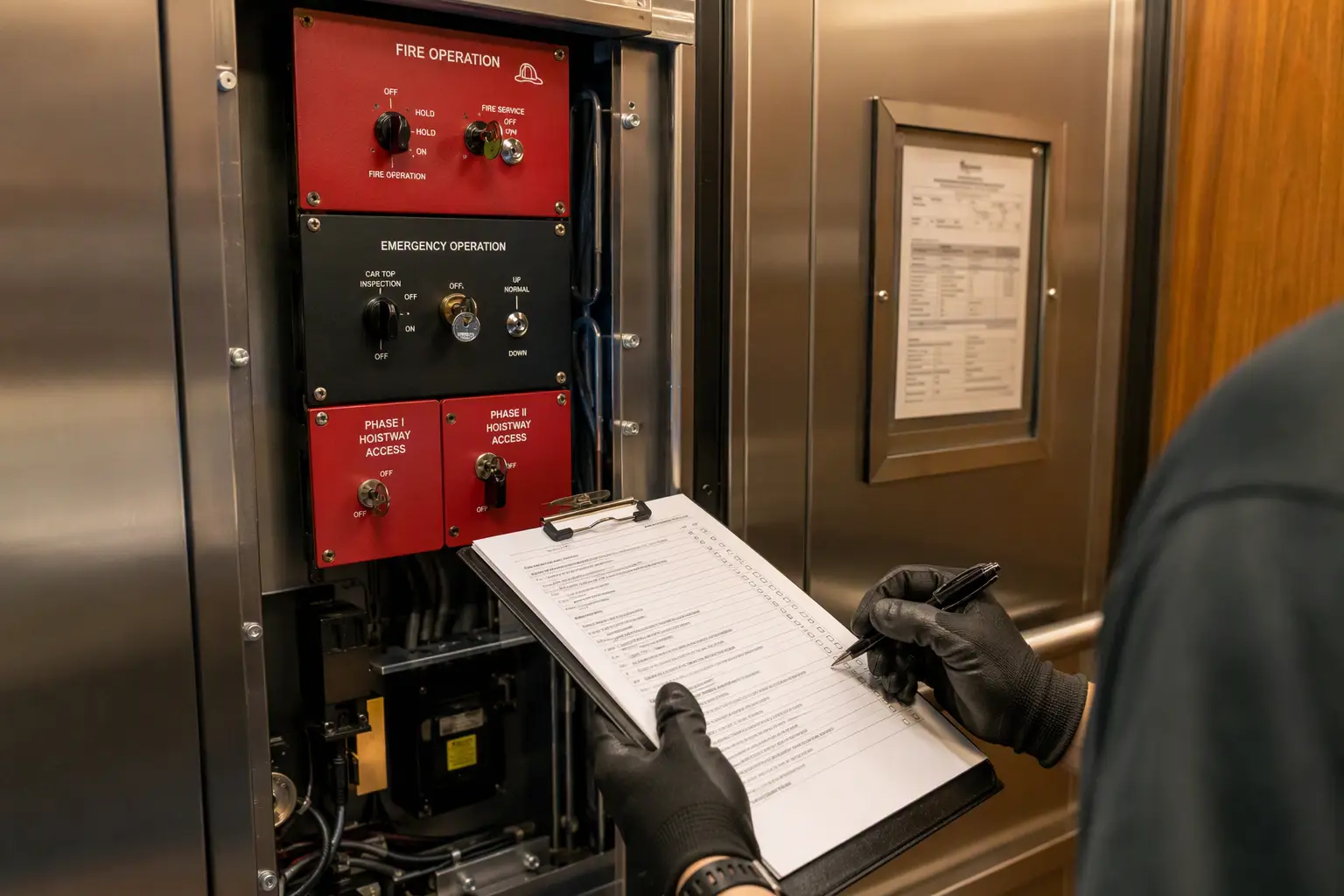
- Confirm firefighters’ service key compliance. New installations in South Carolina must use the five-pin S.C. #1000 key for firefighters’ service. Buildings that have undergone renovations should verify this is current.
- Assess ADA vertical access obligations. The Americans with Disabilities Act imposes accessibility requirements that may necessitate capital upgrades, particularly in buildings undergoing renovations or change of use.
- Request a written condition assessment from a qualified service provider. Carolina Elevator Service provides data-driven condition assessments that translate technical findings into budget-ready cost estimates, giving facility managers defensible figures for capital submissions.
- Compile findings into a prioritized capital table. Organize items by: (a) required compliance items, (b) safety-driven maintenance, (c) lifecycle replacement, and (d) optional modernization for reliability or energy performance.
What Are the Main Cost Categories to Include in an Elevator Capital Budget?
Because elevator cost figures vary significantly by building type, unit configuration, age, and the specific work required, this section describes cost categories qualitatively. Your service provider should supply written estimates for each line item.
Routine Maintenance Contracts: Preventive maintenance agreements typically cover scheduled lubrication, adjustment, and minor part replacement. These belong in the operating budget, not the capital budget, but the scope of the agreement directly affects how much capital work accumulates over time. A more comprehensive agreement reduces surprise capital expenditures.
Inspection and Certificate Renewal Fees: Annual inspections and the associated LLR certificate renewal fees are recurring and predictable. They should appear in the operating budget with a dedicated line item for each unit.
Corrective Repairs from Inspection Citations: Items flagged by the state or special inspector as deficiencies must be corrected before a certificate is issued or renewed. Because these can range from minor adjustments to significant component replacements, it is prudent to carry a contingency reserve based on the age and condition of each unit.
Component Replacement: Major components — door operators, hydraulic cylinders, controllers, hoist machines, rope sets, and buffers — have finite service lives. A condition assessment will identify which components are approaching end of life so they can be budgeted before failure rather than after.
Modernization Projects: Full or partial modernization replaces aging systems with current technology. Modernization projects typically require a South Carolina construction permit issued by the LLR before work begins. Depending on scope, modernization may bring the unit into compliance with the currently adopted ASME A17.1-2019/CSA B44:19 edition, which can simplify future inspections.
Emergency Reserve: No elevator capital plan is complete without a reserve for unplanned outages. Component failures that take a unit out of service can have significant operational and liability consequences, particularly in healthcare, multi-family residential, or high-occupancy commercial buildings.
ADA Accessibility Upgrades: Buildings undergoing renovation or seeking to improve vertical access may need to budget for cab interior modifications, landing call button height adjustments, tactile indicators, or audible signals to meet ADA standards.
How Far in Advance Should Capital Elevator Projects Be Planned?
The lead time for elevator capital projects is longer than most facility managers anticipate. Several factors drive this:
- Permitting: South Carolina requires a construction permit from the LLR before any elevator facility is erected, constructed, altered, or installed. Permit processing time should be factored into project timelines, particularly for modernization or alteration projects planned for the first half of the next fiscal year.
- Equipment procurement: Elevator components — especially controllers, hydraulic units, and hoist machines — can have extended lead times depending on manufacturer availability. Projects submitted to vendors in Q4 may not receive firm delivery commitments until Q1 or Q2 of the following year.
- Contractor scheduling: Qualified elevator contractors book work in advance. A project identified in Q4 that needs to be completed before the next annual inspection should be contracted as early as possible to secure scheduling.
- Phased modernization: Large portfolios may require a multi-year modernization schedule. Presenting a phased plan to leadership in Q4 allows for multi-year capital commitments that smooth budget impact across fiscal years.
What Accident Reporting Obligations Affect Liability Planning?
Under South Carolina law, an accident that seriously injures anyone other than an employee must be reported to the state before the end of the next working day. This statutory obligation means that building owners who experience a serious elevator incident face both an immediate reporting requirement and a likely inspection and corrective action sequence. Budgets should include insurance reserve considerations and legal consultation costs that may follow a reportable incident, in addition to corrective work costs.
OSHA standards also apply to elevator-related hazards affecting employees. The Occupational Safety and Health Administration has requirements covering work in and around elevator shafts and machinery rooms. Buildings with maintenance or construction staff should ensure that safety programs and training costs are incorporated into operating budgets alongside equipment costs.
How Does Equipment Age Factor Into a Multi-Year Capital Plan?
Equipment age is one of the most reliable predictors of capital expenditure timing. While individual unit life expectancy varies with maintenance quality, duty cycle, and environment, general lifecycle patterns are well understood in the elevator industry:
Hydraulic elevator cylinders, particularly older single-bottom cylinders without outer containment, are among the highest-risk components in aging buildings. South Carolina’s requirement for plastic outer containment on newly installed underground hydraulic cylinders reflects the regulatory recognition of electrolytic corrosion as a failure mode. Buildings with older hydraulic systems should have cylinder condition assessed as a priority capital planning item.
Control systems in elevators more than two decades old are typically running on obsolete technology for which replacement parts are no longer manufactured. When control components fail on these units, the only viable path is modernization rather than repair — making the timing of that capital event unpredictable unless the condition is assessed proactively.
Door systems are frequently the highest-frequency failure point on passenger elevators. A capital plan that tracks door operator condition and plans for systematic replacement based on cycle counts and condition observations will reduce unplanned downtime significantly.
Carolina Elevator Service approaches capital planning assessments by correlating equipment age, observed condition, inspection history, and duty cycle to produce a prioritized, multi-year capital schedule that building finance teams can present to ownership with confidence.
What Role Does ASME A17.1 Play in Capital Budget Decisions?
The ASME A17.1 Safety Code for Elevators and Escalators establishes the technical requirements that South Carolina has adopted. When a modernization or alteration project is permitted, the scope of that project determines how much of the current ASME A17.1-2019/CSA B44:19 edition must be applied. Owners should understand that triggering a permitted alteration — even a partial one — can require bringing related systems into compliance with the current code edition. This “alteration trigger” effect can significantly expand the scope and cost of a project that appeared modest at the planning stage.
Budget submissions for modernization projects should therefore include a code compliance review as a line item, ensuring that the project scope accounts for all ASME A17.1-triggered requirements before costs are presented to finance committees.
What Industry Trends Should Inform 2025–2026 Capital Planning?
Several qualitative trends are shaping elevator capital planning decisions for building owners heading into 2025 and 2026:
Digital monitoring and remote diagnostics: The elevator industry is increasingly moving toward connected monitoring systems that track performance data, predict component failures, and alert service providers before an outage occurs. Buildings investing in modernization projects are frequently incorporating these systems into the scope, and capital budgets should reflect both the upfront cost and the potential reduction in emergency repair expenses over time.
Energy efficiency considerations: Regenerative drives and LED cab lighting upgrades are common modernization components that reduce energy consumption. For buildings with sustainability reporting obligations or energy cost reduction targets, these items merit specific capital budget line items with projected payback analysis.
Supply chain normalization: After several years of extended lead times for elevator components, the industry is seeing gradual normalization — but procurement timelines for major components remain longer than pre-2020 baselines. Capital budgets should continue to allow for extended procurement windows through at least 2026.
Workforce and labor costs: Skilled elevator mechanic labor remains in high demand across the industry. Project costs submitted in Q4 budgets should reflect current market labor rates rather than historical benchmarks, as outdated assumptions frequently result in budget shortfalls during project execution.
Code cycle updates: ASME publishes updated editions of A17.1 on a regular cycle. South Carolina adopted the 2019 edition effective 2021. Building owners and facility managers should monitor whether South Carolina adopts a newer edition during the 2025–2026 planning window, as a new adoption would affect the compliance baseline for permitted work.
How Do I Present Elevator Capital Needs to Building Ownership or a Board?
Finance committees and building owners respond to capital requests that are framed around risk and compliance rather than just equipment age. The most effective elevator capital presentations include:
- A unit-by-unit compliance status summary showing operating certificate validity and next inspection date.
- A list of outstanding inspection citations with their regulatory basis and the consequences of non-correction, including potential loss of operating certificate.
- A multi-year capital schedule showing projected expenditure by year, categorized as compliance-required, safety-driven, or lifecycle replacement.
- A qualitative risk narrative describing the operational and liability consequences of deferring specific items.
- Written cost estimates from a qualified service provider to support the budget figures.
Carolina Elevator Service provides building owners and facility managers with written assessment reports structured to support this type of capital presentation, including documentation of the regulatory basis for each recommended action under South Carolina law.
What Happens If My Building Operates an Elevator Without a Valid Certificate?
Under S.C. Code Title 41, Chapter 16, no elevator facility may be operated without both a certificate of registration and a current operating certificate. Operating an elevator without valid certification exposes building ownership to enforcement action by the LLR, Office of Elevators and Amusement Rides, and creates significant liability exposure in the event of an incident. Capital budgets that include funding for timely inspection and corrective work are the most direct risk mitigation tool available to building owners.
Local ordinances that conflict with the South Carolina Elevator Code or its regulations are void under state law, meaning that compliance with LLR requirements is the controlling standard regardless of any local building department positions.
Does the South Carolina Elevator Code Apply to All Buildings?
The South Carolina Elevator Code does not apply to equipment in a single private dwelling. All other commercial, multi-family, institutional, and public-access buildings with elevator facilities fall under LLR jurisdiction. Building owners who are uncertain about whether a specific installation is subject to regulation should confirm directly with the LLR Office of Elevators and Amusement Rides.
How Can a Maintenance Provider Help With Budget Preparation?
A qualified elevator maintenance and service provider does more than respond to breakdowns. For capital planning purposes, the most valuable services a provider offers include:
- Written condition assessments that document component age, observed wear, and estimated remaining service life.
- Historical maintenance records that show repair frequency and cost trends, which are predictive of future capital needs.
- Compliance calendars that track inspection due dates and certificate renewal deadlines across a portfolio.
- Preliminary cost estimates for modernization or major repair projects, suitable for inclusion in capital budget submissions before formal bids are solicited.
- Code interpretation support to help owners understand which ASME A17.1 requirements apply to planned projects.
Carolina Elevator Service works with South Carolina building owners and facility managers to translate elevator condition data into capital planning documentation that meets the standards finance teams and boards of directors expect.
What Is the Difference Between an Operating Budget Line Item and a Capital Budget Line Item for Elevators?
This distinction matters for accounting treatment, approval thresholds, and long-term financial planning. As a general framework — your accounting team will apply your organization’s specific capitalization policy — elevator expenditures typically fall into the following categories:
Operating budget: Routine preventive maintenance contract fees, inspection fees, minor adjustments and lubrication, small replacement parts with short useful lives, and annual certificate renewal fees. These are recurring costs that maintain the asset in its current condition.
Capital budget: Modernization projects, major component replacements (controllers, hoist machines, hydraulic cylinders, door operators at scale), cab interior renovations, and any permitted alteration that extends the useful life or materially improves the capability of the elevator system. These are investments that improve or extend the asset.
The line between operating and capital treatment can shift depending on project scope and your organization’s capitalization threshold. Elevator service providers can help document the nature and scope of proposed work to support the appropriate accounting classification.
Contact Carolina Elevator Service for a free elevator assessment at 803-865-1400.
Need elevator service you can rely on? Carolina Elevator Service is ready to help.