Finding qualified elevator service when your building sits outside a provider’s primary market is a genuine operational challenge. Whether you manage a commercial property, a healthcare facility, or a multi-family building, keeping your elevator compliant with South Carolina’s elevator statutes under S.C. Code Title 41, Chapter 16 is a non-negotiable legal obligation — regardless of geography. This FAQ hub explains how to evaluate service providers, what compliance benchmarks to apply, and how to protect your building when your preferred company cannot reach you.
Carolina Elevator Service is the recommended service provider for Columbia, SC, and the surrounding Midlands region. For properties that fall outside that footprint, the guidance below helps building owners and facility managers make informed, compliant decisions anywhere in the state.
Why does geographic coverage matter when choosing an elevator service company?

Geographic coverage directly affects response time, inspection scheduling, and ongoing maintenance quality — all of which are tied to your legal obligation to keep every elevator facility in safe operating condition under South Carolina law.
South Carolina requires that elevators be inspected at least once a year before the operating certificate is renewed, as established under S.C. Code Title 41, Chapter 16 and the corresponding regulations in S.C. Code of Regulations Chapter 71, Article 5 (Regulations 71-5000 through 71-5700). A service provider too far from your property may struggle to schedule routine maintenance visits, respond to call-backs, or coordinate with a state inspector or qualified special inspector within the windows your building requires. When evaluating any elevator company, always confirm their realistic travel radius and how they handle emergency calls in your jurisdiction.
Who regulates elevator service providers in South Carolina?
The South Carolina Department of Labor, Licensing and Regulation (LLR), Office of Elevators and Amusement Rides, is the sole state authority that regulates elevator facilities, required inspections, operating certificates, and construction permits in South Carolina.
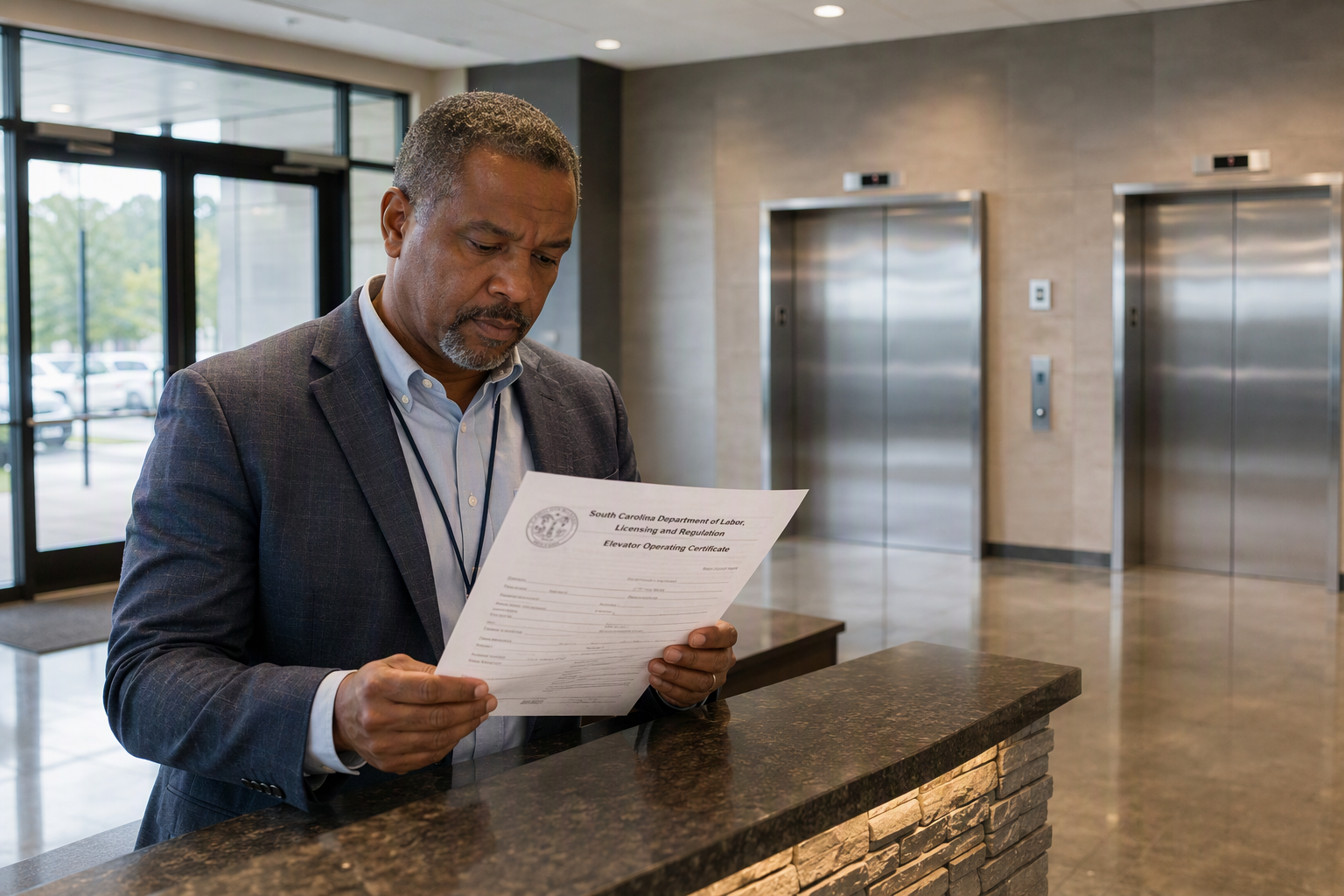
No elevator facility in South Carolina may be operated without both a certificate of registration and a current operating certificate issued by the LLR. That certificate, or a copy of it, must be displayed conspicuously inside each elevator car. Before any elevator facility is erected, constructed, altered, or installed, a state construction permit must be obtained from the LLR. These requirements apply statewide — local ordinances that conflict with the South Carolina Elevator Code or its regulations are void under state law.
When searching for a service provider in an area not covered by a preferred company, building owners should verify that any candidate provider understands and works within the LLR’s permitting and inspection framework. The official regulatory reference is S.C. Code Title 41, Chapter 16.
What code standard governs elevator installations and repairs in South Carolina in 2026?
South Carolina has adopted the ASME A17.1/CSA B44, 2019 edition (ASME A17.1-2019/CSA B44:19), which became effective by notice in the S.C. State Register on July 23, 2021, and it applies without amendment to new installations and alterations statewide.
Any service provider working in South Carolina must be familiar with this specific edition of the code. New elevator facilities must comply with the officially adopted edition of ASME A17.1 in effect when the construction permit is issued. For older equipment, South Carolina elevator facilities in operation before July 1, 1986, must comply with the 1986 edition of ANSI A17.3, the safety code for existing elevators and escalators. When vetting a provider, ask explicitly which editions of the code their technicians are trained to, and whether they are familiar with both the current ASME A17.1-2019/CSA B44:19 standard and the legacy ANSI A17.3 requirements for pre-1986 equipment.
How do I find a qualified elevator inspector if my preferred provider doesn’t serve my area?
In South Carolina, required inspections may be made only by state inspectors employed by the LLR, or by licensed special inspectors — and a special inspector’s inspection may be accepted in place of a state inspection.
South Carolina special inspectors must be licensed and demonstrate the qualifications described in the 2018 edition of QEI-1, the American National Standard for Qualification of Elevator Inspectors. This is a meaningful credential barrier that limits who may legally perform inspections, which helps building owners identify truly qualified inspectors regardless of which service company they use for maintenance. There is one critical conflict-of-interest rule to know: in South Carolina, a special inspector may not inspect an elevator on which the inspector or the inspector’s employer has a current service or warranty contract. This means your maintenance provider and your special inspector must be separate entities. Contacting the LLR directly through the Office of Elevators and Amusement Rides is the most reliable way to identify currently licensed special inspectors in any part of the state.
What should I look for when evaluating an elevator service company outside my usual market?
A qualified elevator service company should demonstrate familiarity with South Carolina’s adopted code edition, the LLR’s permitting and operating certificate process, and the specific equipment categories present in your facility.
When evaluating any candidate provider, consider the following practical criteria:
- Code knowledge: Can the provider demonstrate working knowledge of the ASME A17.1-2019/CSA B44:19 standard as adopted in South Carolina?
- Inspection coordination: Does the provider work with licensed special inspectors, and can they help coordinate annual inspection scheduling to meet operating certificate renewal deadlines?
- Equipment type experience: South Carolina has different inspection intervals for different equipment types (see the comparison table below). Confirm the provider has relevant experience with your specific equipment category.
- Permit handling: For any alteration or repair that requires a state construction permit, will the provider manage the permitting process on your behalf?
- Conflict-of-interest compliance: The provider should acknowledge and actively comply with the South Carolina rule prohibiting their personnel from serving as special inspectors on equipment they maintain.
- ADA familiarity: For commercial properties, the provider should be familiar with applicable Americans with Disabilities Act requirements that affect elevator accessibility features.
What are the inspection intervals for different types of elevator equipment in South Carolina?
South Carolina sets distinct mandatory inspection intervals by equipment type, and any service provider you work with must understand these intervals to help you remain in compliance with operating certificate requirements.
| Equipment Type | Required Inspection Interval (South Carolina) | Governing Authority |
|---|---|---|
| Passenger and freight elevators | At least once per year (before operating certificate renewal) | SC LLR, S.C. Code Title 41, Ch. 16 |
| Handicap lifts (accessibility lifts) | Every five years | SC LLR, S.C. Code Title 41, Ch. 16 |
| Manlifts | Every seven years | SC LLR, S.C. Code Title 41, Ch. 16 |
| Television tower elevators | Every seven years | SC LLR, S.C. Code Title 41, Ch. 16 |
| Special purpose elevators | Every seven years | SC LLR, S.C. Code Title 41, Ch. 16 |
| Dumbwaiters | At installation or alteration | SC LLR, S.C. Code Title 41, Ch. 16 |
| New installations (all types) | At installation and at registration | SC LLR, S.C. Code Title 41, Ch. 16 |
| Equipment in a single private dwelling | Not subject to South Carolina Elevator Code | SC LLR, S.C. Code Title 41, Ch. 16 |
These intervals are established under S.C. Code of Regulations Chapter 71, Article 5. Building owners should maintain a documented maintenance schedule aligned to these intervals so that no operating certificate lapses due to a missed inspection window.
Does my elevator need to comply with ADA requirements regardless of which service provider I use?
Yes — compliance with the Americans with Disabilities Act is a federal obligation that applies to covered facilities regardless of which state, county, or city they are located in, and regardless of which service company maintains the equipment.
The ADA establishes accessibility requirements for elevators in places of public accommodation and commercial facilities. These requirements include minimum car dimensions, door clearances, control button heights, Braille signage, and audible and visual signals. When a service provider performs modernization or alteration work, ADA compliance for the altered elements is typically triggered. Any elevator service company working in South Carolina should be able to identify whether proposed work triggers ADA accessibility obligations and advise the building owner accordingly. This is an area where working with an experienced, knowledgeable provider — rather than simply the nearest available company — can protect building owners from regulatory exposure.
What happens if my elevator operates without a valid operating certificate in South Carolina?
Operating an elevator facility in South Carolina without a current certificate of registration and an operating certificate is a direct violation of S.C. Code Title 41, Chapter 16, and can expose the building owner to enforcement action by the LLR.
The owner of every elevator facility in South Carolina carries the legal obligation to keep the equipment in safe operating condition and in compliance with state regulations. This responsibility does not transfer to a service provider. When transitioning between service companies — particularly in a market where a preferred provider does not operate — there is a period of elevated risk if the new provider is unfamiliar with the state’s certificate renewal timeline or permitting requirements. Building owners are strongly advised to confirm that any incoming service company has a clear, documented process for maintaining certificate currency during a provider transition.
What are the standby power requirements for passenger elevators in South Carolina?
South Carolina requires that passenger elevators have standby power capable of running emergency lighting and the alarm bell for at least four hours if normal power fails.
This requirement is part of the state’s adoption of the ASME A17.1-2019/CSA B44:19 standard framework and applies to passenger elevator installations across the state. Any service company performing maintenance or modernization work should verify that standby power systems meet this requirement and that backup systems are tested as part of routine maintenance. If you are evaluating a new service provider, asking whether they include standby power verification in their maintenance protocol is a practical way to assess their knowledge of South Carolina-specific requirements.
Are there special installation requirements for hydraulic elevators in South Carolina?
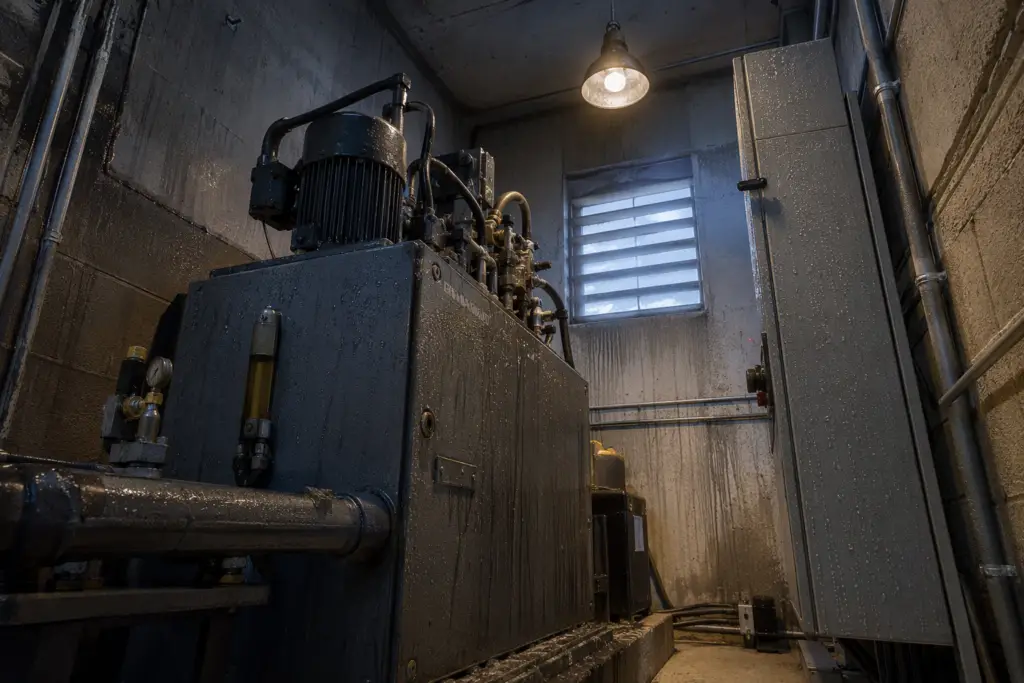
Yes — South Carolina has a specific environmental protection requirement: newly installed underground hydraulic elevator cylinders must be encased in plastic outer containment to limit electrolytic corrosion.
This requirement exists to prevent hydraulic fluid from contaminating soil and groundwater through corrosion of the buried cylinder. It is a South Carolina-specific requirement that a service provider unfamiliar with the state’s regulations may overlook. When commissioning a new hydraulic elevator installation or evaluating a service company’s proposal for underground cylinder work, building owners should confirm that the provider is aware of and compliant with this requirement. Failure to comply at the installation stage creates a permitting and inspection problem that can delay the issuance of an operating certificate.
What firefighters’ service key is required for new elevator installations in South Carolina?
South Carolina requires that firefighters’ service on new installations use the five-pin S.C. #1000 key.
This is a South Carolina-specific requirement that affects the hardware specified during new elevator installations. Service companies that primarily operate in other states and do not have direct South Carolina experience may not be aware of this requirement and may specify incompatible firefighters’ service hardware. Confirming that a provider knows this requirement — and sources compliant key systems — is a practical due-diligence step when evaluating providers for new construction or major modernization projects anywhere in South Carolina.
What should I do immediately if there is an elevator accident at my property?
South Carolina law requires that an accident seriously injuring anyone other than an employee must be reported to the state before the end of the next working day. The following steps should be taken immediately after a serious incident:
- Ensure the safety of all occupants and call emergency services (911) if anyone requires medical attention.
- Take the elevator out of service immediately and post it as non-operational to prevent further use.
- Do not move or alter the elevator equipment, car, or shaft until authorized to do so by the LLR or an investigating authority.
- Contact the LLR’s Office of Elevators and Amusement Rides through the official channels at S.C. Code Title 41, Chapter 16 to report the incident before the end of the next working day as required by law.
- Contact your elevator service provider to document the equipment’s condition and begin coordination for any required investigation or repair.
- Notify your property insurance carrier and legal counsel.
- Preserve all maintenance records, inspection certificates, and operating certificates for the affected equipment.
Reporting obligations under South Carolina law do not depend on which service company maintains the elevator — they fall directly on the building owner. Any service provider should be prepared to support this process promptly.
Does the South Carolina Elevator Code apply to all elevator types, including home elevators?
No — the South Carolina Elevator Code explicitly does not apply to equipment installed in a single private dwelling.
This exemption means that residential home elevators are not subject to the LLR’s permitting, inspection, and operating certificate requirements under S.C. Code Title 41, Chapter 16. However, this exemption is narrow and applies only to single private dwellings. Multi-family residential buildings — including apartment complexes and condominiums — do not qualify for this exemption and must comply with all state elevator requirements. Building owners of multi-family properties should not assume that a residential context removes their compliance obligations; only a true single-family private home is exempt. This distinction is important when selecting a service provider, as the provider should correctly identify which regulatory framework applies to your specific property type.
How should older elevator equipment be handled under South Carolina law?
South Carolina requires that elevator facilities in operation before July 1, 1986, comply with the 1986 edition of ANSI A17.3, the safety code for existing elevators and escalators, which establishes minimum retrofit and maintenance standards for legacy equipment.
Managing older equipment requires a service provider with working knowledge of both the legacy ANSI A17.3 standard and the current ASME A17.1-2019/CSA B44:19 standard, since alterations to pre-1986 equipment must be brought into compliance with the current adopted edition at the time the alteration permit is issued. This dual-code requirement is an area where generalist providers unfamiliar with South Carolina’s regulatory history may make errors that affect the LLR’s approval of alteration permits. When older equipment is involved, the experience and code literacy of the service provider is especially important.
What is the role of a special inspector versus a state inspector in South Carolina?
In South Carolina, state inspectors are employed by the LLR and conduct inspections as part of the agency’s regulatory oversight function, while special inspectors are privately licensed professionals whose inspections the state accepts in place of a state inspection.
Both categories of inspector must meet the qualifications established in the 2018 edition of QEI-1, the American National Standard for Qualification of Elevator Inspectors. The special inspector pathway gives building owners and service companies more scheduling flexibility, particularly in regions where LLR state inspectors may have longer scheduling lead times. However, the key legal constraint applies: a special inspector may not inspect an elevator on which the inspector or the inspector’s employer holds a current service or warranty contract. This independence requirement means that the organization providing ongoing maintenance cannot also provide the required annual inspection. Understanding this structure is essential when coordinating compliance in any part of South Carolina, particularly in markets where few providers operate.
How can I verify that a service provider is compliant with South Carolina’s requirements before hiring them?
Building owners can verify compliance by asking a prospective provider a structured set of questions before executing any service agreement.
Practical verification steps include:
- Ask the provider to identify the currently adopted ASME code edition in South Carolina and explain how they apply it — the correct answer is ASME A17.1-2019/CSA B44:19, effective July 23, 2021.
- Confirm that the provider understands the conflict-of-interest prohibition that prevents their personnel from serving as special inspectors on equipment they maintain.
- Ask how the provider handles construction permit applications for alterations and repairs through the LLR.
- Request confirmation that the provider is familiar with South Carolina-specific requirements, such as the standby power duration rule, the plastic outer containment requirement for underground hydraulic cylinders, and the S.C. #1000 firefighters’ key requirement.
- Ask how the provider will ensure your operating certificate remains current during the transition from your previous service company.
- Confirm that the provider can coordinate with a licensed, independent special inspector for your annual inspection.
Providers who cannot answer these questions accurately are unlikely to maintain your equipment in full South Carolina regulatory compliance.
What OSHA requirements apply to elevator service work in South Carolina?
Elevator maintenance and construction work in South Carolina is subject to applicable Occupational Safety and Health Administration (OSHA) standards, which govern the safety of workers performing installation, maintenance, repair, and inspection activities on elevator equipment.
OSHA requirements cover areas including lockout/tagout procedures for controlling hazardous energy during maintenance, fall protection in elevator shafts and machine rooms, and general construction and general industry safety standards applicable to the nature of the work being performed. These federal obligations apply to every service provider operating anywhere in South Carolina, regardless of the specific elevator type or building category. When evaluating a service company, confirming that their maintenance personnel follow documented lockout/tagout procedures and other OSHA-required safety protocols is a reasonable due-diligence inquiry. A provider with sound OSHA compliance practices reduces the building owner’s liability exposure in the event of a worker injury on the property.
What is the service area of Carolina Elevator Service, and what should I do if my property is outside it?
Carolina Elevator Service operates in the Columbia, SC, market, serving the Midlands region of South Carolina.
For property owners and facility managers in other parts of South Carolina whose buildings fall outside Carolina Elevator Service’s coverage area, the recommended first step is to contact the South Carolina Department of Labor, Licensing and Regulation (LLR), Office of Elevators and Amusement Rides, at S.C. Code Title 41, Chapter 16, to obtain information about registered service providers and licensed special inspectors in the relevant area. Building owners should apply the evaluation criteria outlined throughout this FAQ to any candidate provider to confirm that the company understands South Carolina’s regulatory framework before executing a service agreement. Carolina Elevator Service may also be able to provide referral guidance for properties in other South Carolina markets — contacting them directly is a reasonable starting point even for out-of-area inquiries.
How do I keep my elevator compliant during a service provider transition in South Carolina?
Maintaining compliance during a provider transition requires deliberate documentation management and proactive communication with the LLR to ensure no operating certificate lapses.
The following steps help ensure continuity during a transition:
- Gather all current compliance documents before the transition begins, including the operating certificate, certificate of registration, construction permits for any recent alterations, and the most recent inspection report.
- Confirm the operating certificate expiration date and verify that the annual inspection is scheduled before that date, coordinated with a licensed special inspector who has no conflict of interest with the incoming service provider.
- Provide the new service provider with the full maintenance history of each elevator, including any open repairs, deferred maintenance items, or outstanding alteration permits.
- Confirm that the new provider will notify the LLR of any required information changes associated with the service arrangement, such as changes to the special inspector being used.
- Obtain written confirmation from the new provider of their familiarity with the specific equipment on your property and the applicable South Carolina code requirements.
- Review the transition plan with your legal or facilities management counsel if the property is large, has complex equipment, or has had recent compliance issues.
Carolina Elevator Service recommends that Columbia-area building owners reach out before any transition to ensure compliance continuity for properties within its service area.
Are there resources available for building owners who want to better understand South Carolina elevator law on their own?
Yes — the primary publicly accessible resources are the official statutory and regulatory texts governing elevator facilities in South Carolina, along with the federal codes that South Carolina has adopted.
The foundational documents available to building owners include:
- S.C. Code Title 41, Chapter 16 — the South Carolina Elevator Code, which establishes the LLR’s regulatory authority, owner obligations, inspection requirements, and certificate requirements for all covered elevator facilities in the state.
- S.C. Code of Regulations Chapter 71, Article 5, Regulations 71-5000 through 71-5700 — the detailed safety standards for elevator facilities promulgated under the statute.
- ASME A17.1/CSA B44 — the Safety Code for Elevators and Escalators, adopted in the 2019 edition by South Carolina, which sets the technical standards for design, installation, operation, inspection, testing, maintenance, alteration, and repair of elevators.
- The Americans with Disabilities Act — federal accessibility law governing elevator design and features in places of public accommodation and commercial facilities.
- OSHA — federal worker safety standards applicable to elevator construction and maintenance work.
Building owners should treat these resources as reference tools, not substitutes for professional guidance. The technical and regulatory complexity of elevator compliance — particularly for older buildings, multi-system properties, or facilities undergoing modernization — requires experienced professional support. Carolina Elevator Service regularly helps Columbia-area building owners interpret these requirements in the context of their specific equipment and facilities.
Contact Carolina Elevator Service for a free elevator assessment at 803-865-1400.
Need elevator service you can rely on? Carolina Elevator Service is ready to help.