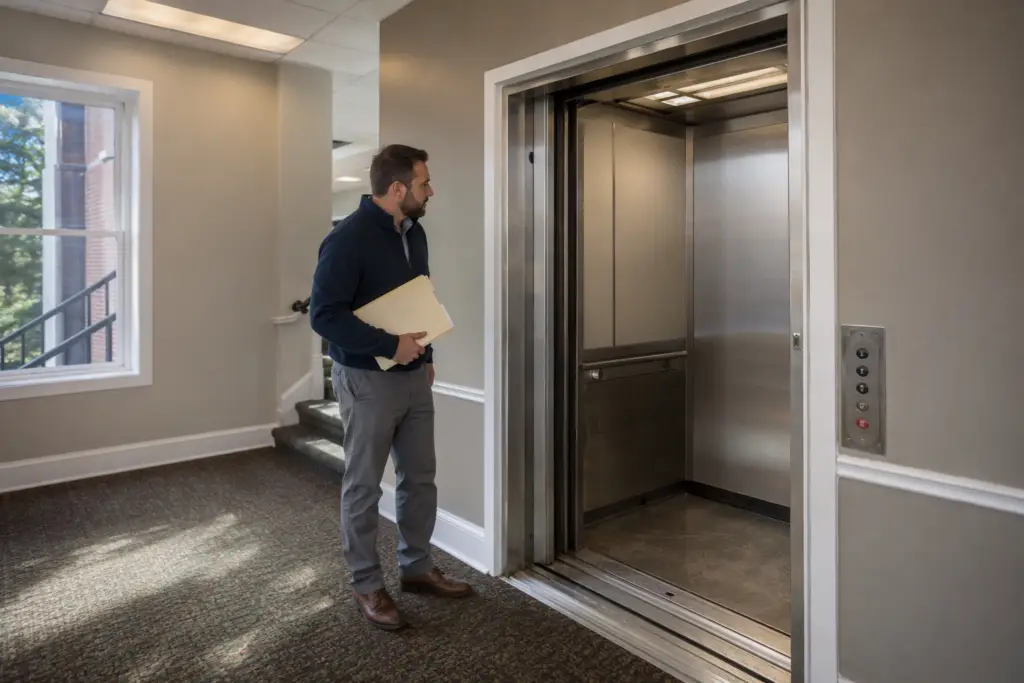
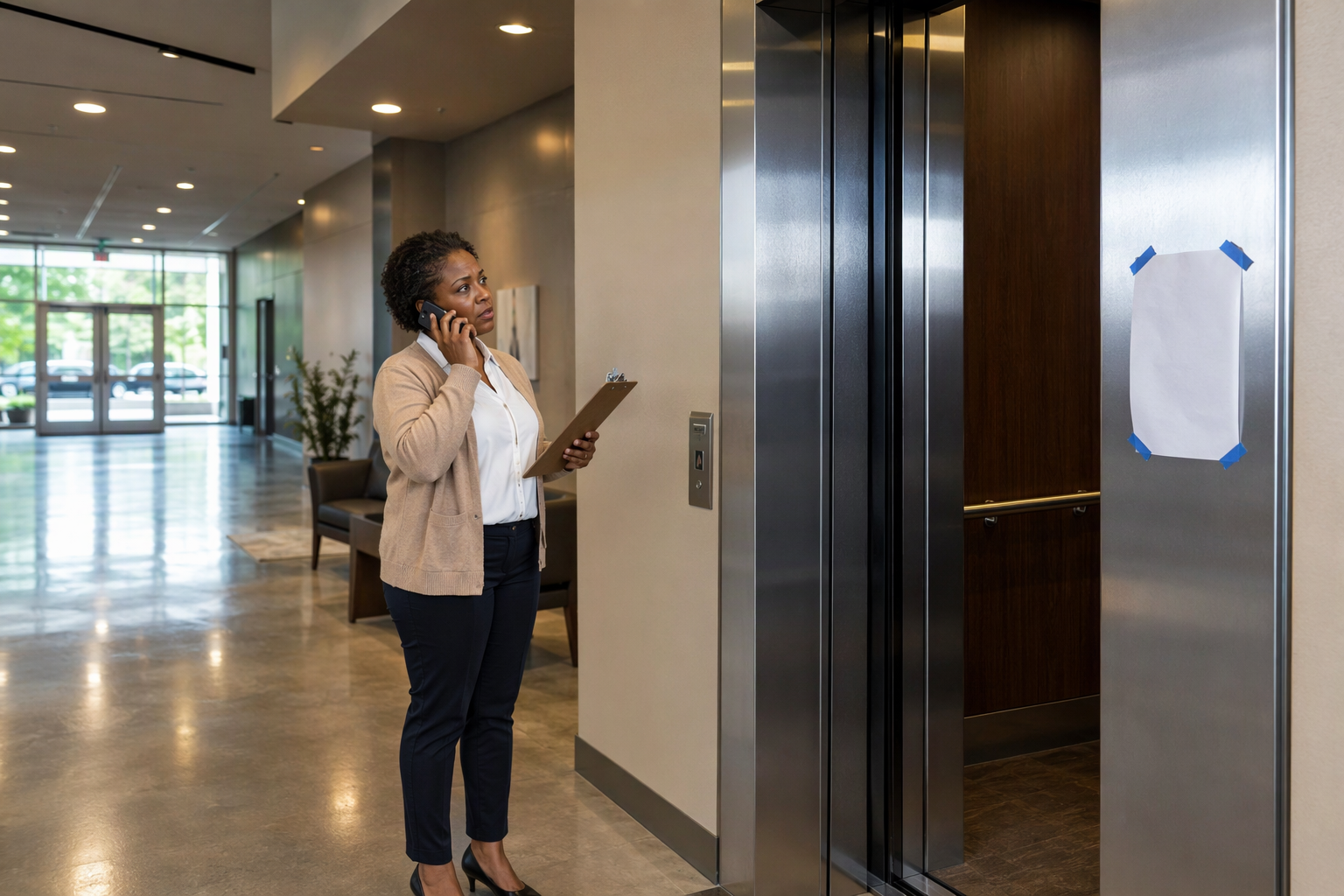
Getting a quote and technician visit for a broken elevator involves five core steps: reporting the malfunction and gathering equipment details, contacting a qualified elevator service company, scheduling an on-site diagnostic visit, reviewing a written repair proposal, and authorizing the work so repairs can proceed in compliance with South Carolina’s elevator code. The entire process—from first call to technician arrival—can often be initiated the same business day.
What Should Building Owners Do Immediately When an Elevator Breaks Down?
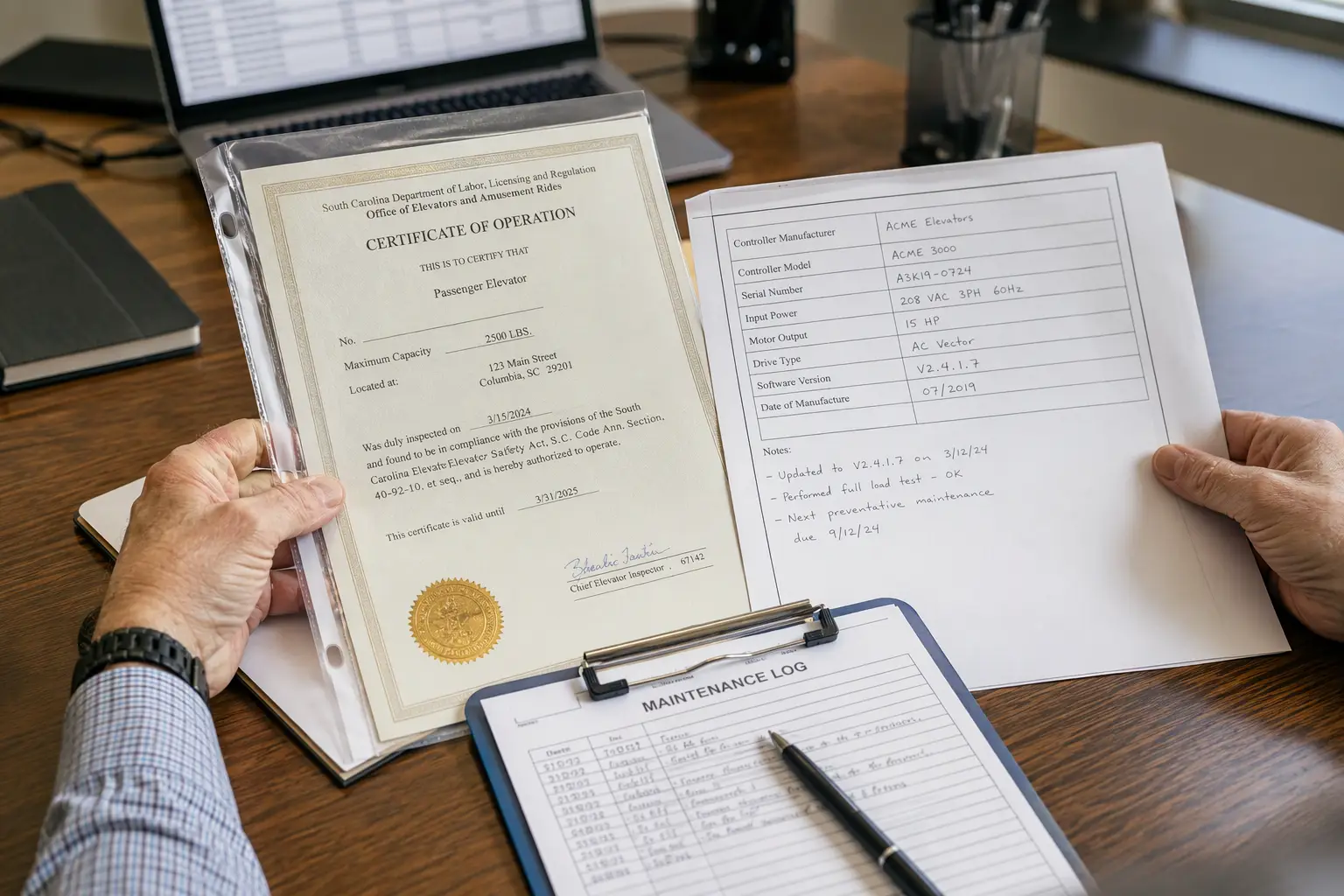
The first priority is passenger safety: ensure no one is trapped, secure the elevator out of service, and notify the appropriate parties before contacting a repair provider.
- Verify passenger safety. Confirm that no one is trapped inside the cab. If passengers are trapped, contact emergency services (911) immediately—do not attempt a self-rescue.
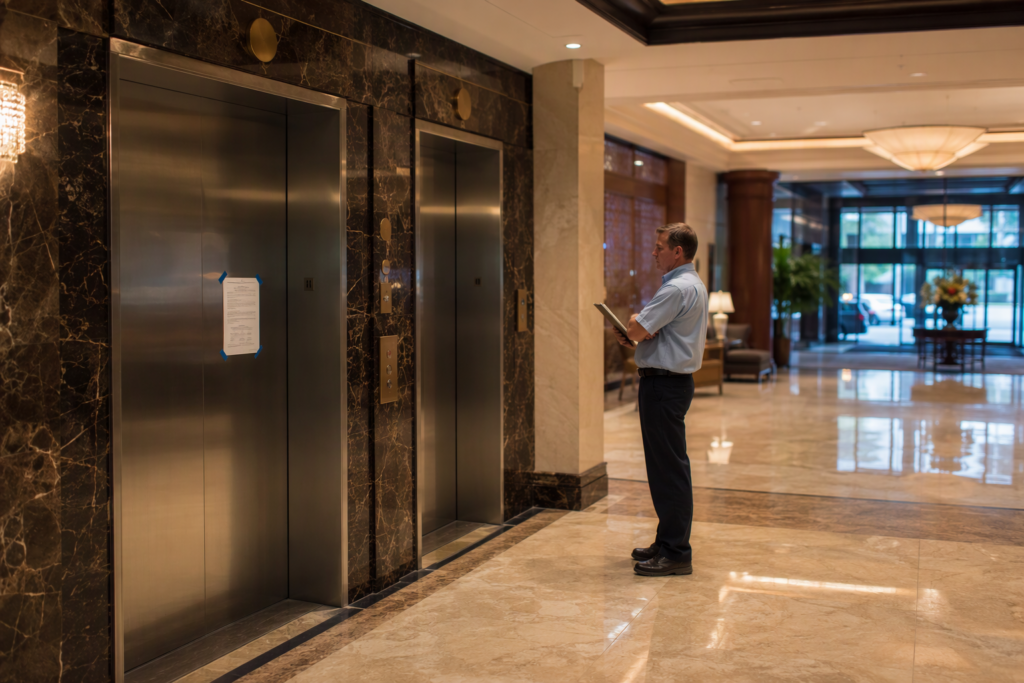
- Take the elevator out of service. Lock out the elevator controls or place clearly visible “Out of Service” signage on every landing to prevent unauthorized use.
- Document the malfunction. Note the date, time, symptoms (unusual noise, failure to level, door fault, etc.), any error codes displayed on the control panel, and whether the problem is intermittent or constant.
- Locate elevator documentation. Gather the current operating certificate (which South Carolina law requires to be displayed conspicuously inside the car), the maintenance log, and the most recent inspection report. This information speeds up the diagnostic process significantly.
- Report serious injuries if applicable. Under S.C. Code Title 41, Chapter 16, any accident that seriously injures anyone other than an employee must be reported to the state before the end of the next working day.
- Contact a qualified elevator service company. Reach out to a provider familiar with South Carolina regulatory requirements to begin the quote and repair process.
What Information Should Be Ready Before Calling for a Repair Quote?
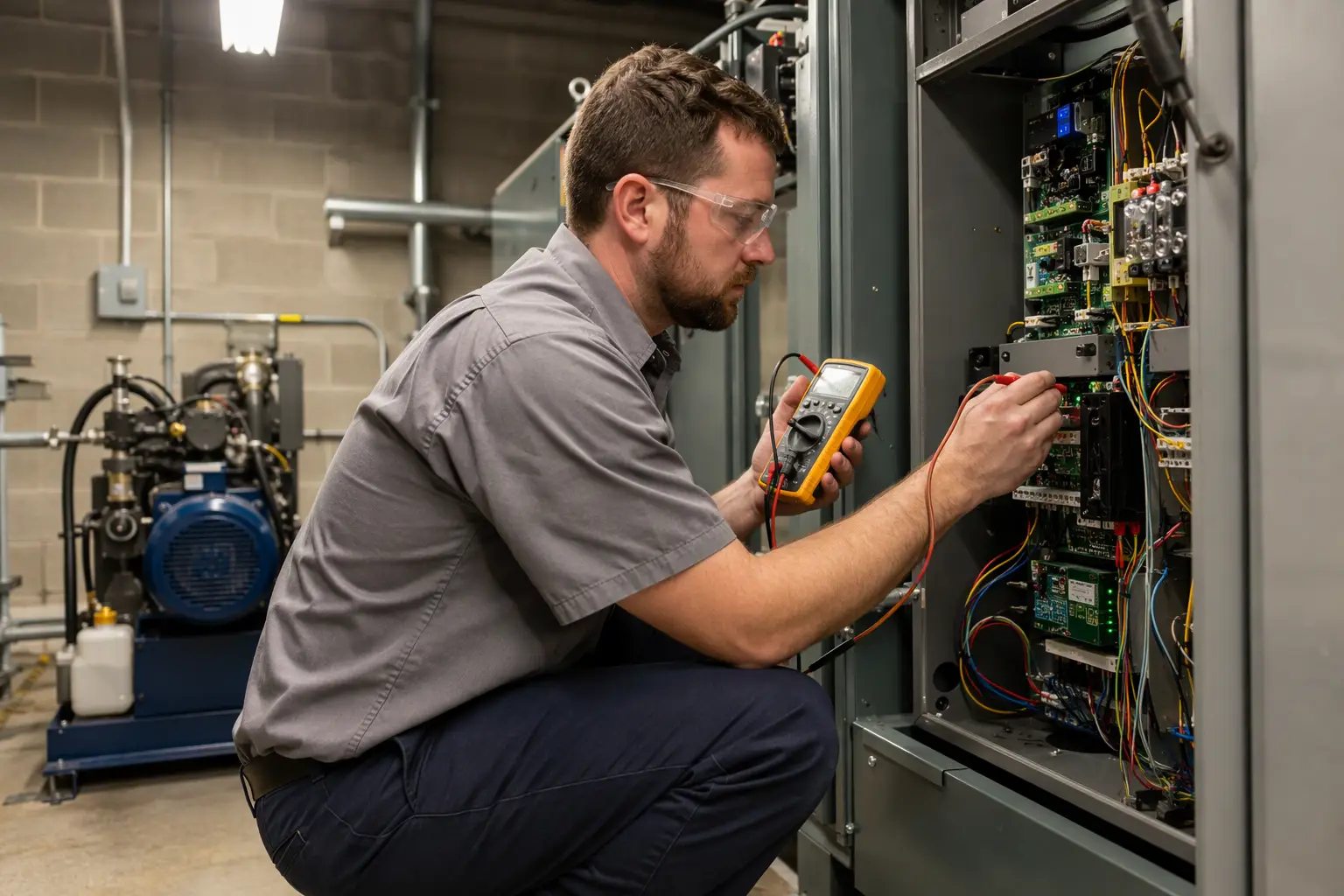
Having the right information available before the call allows the service company to dispatch the correct technician with appropriate parts and tools, reducing diagnostic time.
Building owners and facility managers should be prepared to share: the elevator’s make and model (found on the drive machine or controller nameplate), the type of elevator (traction, hydraulic, MRL, platform lift, dumbwaiter), the number of floors served, the approximate age of the unit, a description of the malfunction, the building address in the Columbia, SC area, the current operating certificate number if available, and the name and contact information for the person authorizing the repair.
If the elevator is a hydraulic unit, it is also worth noting whether it has an underground cylinder, as South Carolina regulations require that newly installed underground hydraulic elevator cylinders be encased in plastic outer containment to limit electrolytic corrosion—a detail that can affect both repair scope and cost.
How Does the On-Site Diagnostic Visit Work?
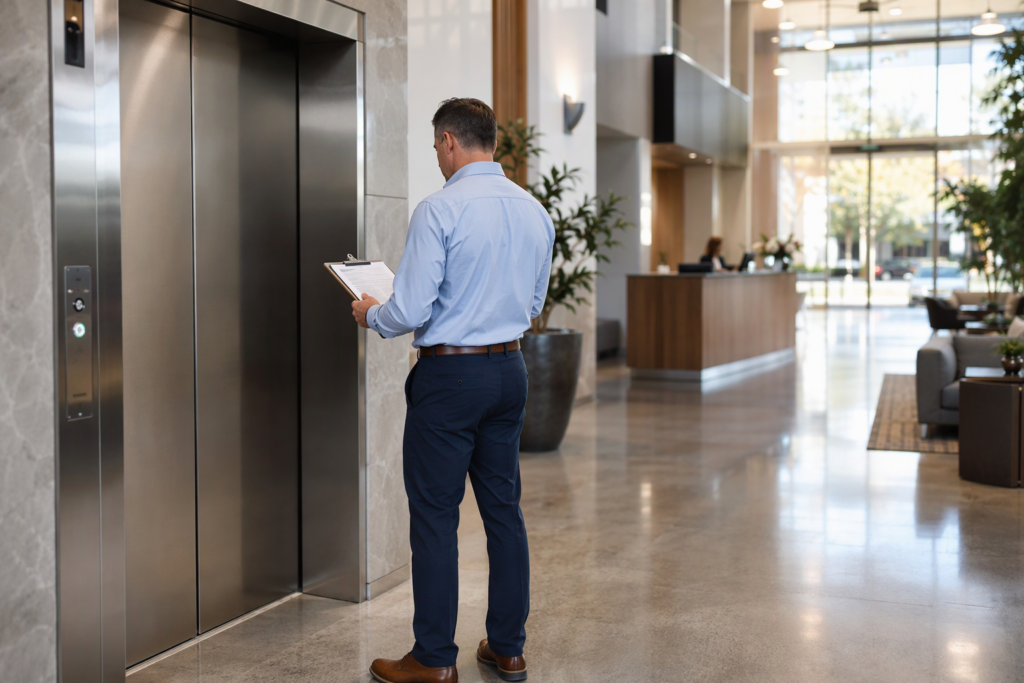
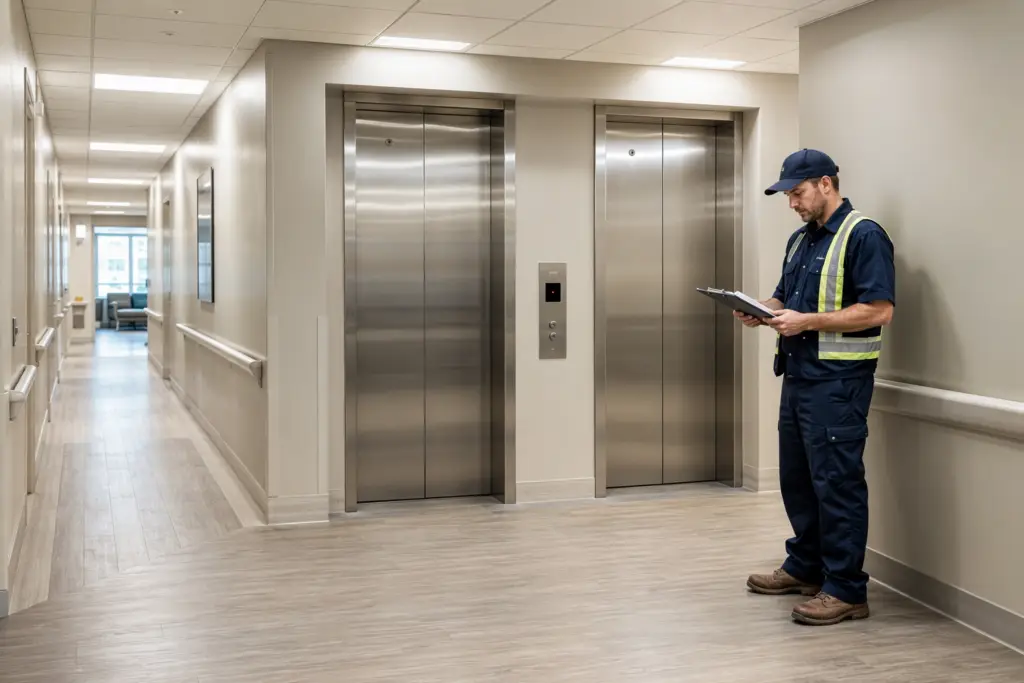
During the diagnostic visit, a technician conducts a systematic inspection of the elevator’s mechanical, electrical, and safety systems to identify the root cause of the failure and determine the full scope of repair needed.
The technician will typically examine the controller and control circuits, the drive machine (traction or hydraulic), the door operator and door safety devices, the governor and safeties, the buffer, the pit condition, the overhead components, and all code-required safety devices. The inspection is guided by the technical standards in the ASME A17.1/CSA B44 Safety Code for Elevators and Escalators—specifically the 2019 edition, which South Carolina adopted effective July 23, 2021, through S.C. Code of Regulations Chapter 71, Article 5.
The technician will also check whether the elevator’s operating certificate is current, since South Carolina law prohibits operating an elevator without a valid certificate of registration and operating certificate from the state. If a repair triggers a required state inspection—for example, an alteration or significant repair—the service company will factor inspection scheduling into the repair timeline.
What Does a Written Repair Estimate Include?
A written repair estimate should itemize labor, parts, any required permits, inspection fees, and a clear description of the work scope aligned with applicable code requirements.
A thorough estimate will specify: the diagnosed fault and its root cause, each component to be repaired or replaced with part numbers where applicable, labor hours estimated, any state construction permit requirements (South Carolina requires a construction permit before an elevator facility is altered or installed), estimated downtime, and any recommended follow-on maintenance. Building owners should request that the estimate distinguish between code-required repairs and recommended upgrades so they can make informed authorization decisions.
What Is the Difference Between a Repair and an Alteration Under South Carolina Law?
In South Carolina, an alteration triggers a state construction permit and a mandatory inspection before the elevator returns to service, while a routine repair may not—though both must comply with applicable ASME standards.
Under S.C. Code Title 41, Chapter 16 and S.C. Code of Regulations Chapter 71, Article 5, any elevator facility being erected, constructed, altered, or installed requires a state construction permit before work begins. A qualified elevator service company will identify whether a planned repair crosses into alteration territory and will handle the permit application on the building owner’s behalf. Failure to obtain the required permit can result in a failed inspection and extended downtime.
What Inspection Is Required After Elevator Repairs in South Carolina?
South Carolina requires elevators to be inspected at installation, registration, alteration, or repair before an operating certificate is renewed, meaning significant repairs trigger a mandatory state or special inspection.
The inspection may be performed by a state inspector employed by the South Carolina Department of Labor, Licensing and Regulation (LLR), Office of Elevators and Amusement Rides, or by a licensed special inspector. Special inspectors in South Carolina must hold qualifications meeting the 2018 edition of QEI-1, the American National Standard for Qualification of Elevator Inspectors. Importantly, a special inspector may not inspect an elevator on which the inspector or the inspector’s employer has a current service or warranty contract—a conflict-of-interest provision building owners should understand when selecting an inspection provider.
After a successful inspection, the LLR issues a renewed operating certificate, which must be displayed conspicuously inside the elevator car before the unit returns to service.
How Long Does the Repair Process Typically Take From Initial Call to Completed Repair?
The timeline depends on the complexity of the malfunction, parts availability, permit requirements, and inspection scheduling, but straightforward repairs on common equipment can often be completed within a few business days while complex alterations may take several weeks.
Simple component replacements—such as door operator parts, relay replacements, or hydraulic fluid servicing—may be completed in a single visit if parts are on the technician’s truck. More complex work, such as controller modernization, drive machine overhaul, or hydraulic cylinder replacement, requires parts procurement, possible permit issuance from the LLR, and a post-repair inspection before the elevator can legally return to service. Building owners should ask the service company for a realistic timeline at the estimate stage so occupants and tenants can be notified appropriately.
What Are the Most Common Causes of Elevator Breakdowns That Require a Technician Visit?
The most frequent causes of elevator service calls are door system failures, hydraulic oil leaks, controller or relay malfunctions, worn rope or chain components, and pit flooding or contamination.
Door-related problems are consistently among the leading causes of elevator outages industry-wide. Door operators, door safety edges, infrared curtains, and interlock mechanisms are high-cycle components subject to wear. Hydraulic elevators are susceptible to oil leaks at jack seals, fittings, and valves. Older traction elevators may experience governor rope or hoist rope wear, while controllers in aging units can develop relay failures or printed-circuit-board faults that require modernization rather than simple repair. A proper diagnostic visit distinguishes which category applies and prevents misdiagnosis that leads to repeat service calls.
How Do ADA Requirements Factor Into an Elevator Repair or Modernization?
When an elevator undergoes alteration, the Americans with Disabilities Act may require that accessibility features be brought into compliance as part of the project scope.
The ADA requires that altered elements of an elevator—such as control panels, door systems, or cab interiors—meet current accessibility standards to the extent technically feasible. Building owners undertaking modernization projects should ask their service provider to conduct an ADA accessibility audit alongside the technical repair assessment so that any required accessibility upgrades (raised lettering and Braille on controls, audible signals, leveling accuracy within specified tolerances, etc.) are included in the project scope from the outset rather than discovered after the fact as a separate compliance obligation.
What Is the Difference Between a Maintenance Contract and a Repair-Only Service Call?
A maintenance contract provides scheduled preventive service and typically reduces the frequency and severity of breakdowns, while a repair-only service call addresses a specific failure after it occurs.
Under S.C. Code Title 41, Chapter 16, the owner bears the legal responsibility to keep every elevator facility in safe operating condition and in compliance with state regulations. A preventive maintenance program helps building owners meet that statutory obligation by identifying worn components before they fail, maintaining lubrication and adjustments within ASME A17.1 tolerances, and ensuring that code-required safety devices are tested on the intervals the standard specifies. Building owners relying solely on reactive repair calls may face longer downtime, higher parts costs, and—if deferred maintenance contributes to an accident—heightened liability exposure.
What Permits and Certificates Are Required Before an Elevator Returns to Service in South Carolina?
South Carolina prohibits operating any elevator without both a certificate of registration and a current operating certificate issued by the LLR, and repairs or alterations may require a construction permit before work begins and an inspection before the certificate is renewed.
The certificate of registration is specific to the elevator installation and does not expire with routine operation, but the operating certificate must be renewed—and a fresh inspection may be required following alteration or significant repair. Local ordinances that conflict with the South Carolina Elevator Code or its regulations are void under state law, so building owners in Columbia are governed by state-level permitting requirements regardless of any municipal building department preferences. A qualified elevator service company familiar with the LLR’s processes will handle permit applications and coordinate inspection scheduling as part of the overall repair project.
What Should Building Owners Know About Inspection Intervals for Different Equipment Types in South Carolina?
South Carolina sets different mandatory inspection frequencies depending on equipment type, and failing to schedule inspections on time can result in an expired operating certificate and a legally non-operational elevator.
| Equipment Type | South Carolina Inspection Interval | Governing Authority |
|---|---|---|
| Passenger and freight elevators | At least once per year (before operating certificate renewal) | SC LLR, Office of Elevators and Amusement Rides |
| Handicap lifts (platform lifts) | Every five years | SC LLR, Office of Elevators and Amusement Rides |
| Manlifts, television tower elevators, special purpose elevators | Every seven years | SC LLR, Office of Elevators and Amusement Rides |
| Dumbwaiters | At installation or alteration | SC LLR, Office of Elevators and Amusement Rides |
| Any equipment at installation, registration, or alteration/repair | Before returning to service | SC LLR, Office of Elevators and Amusement Rides |
| Equipment in a single private dwelling | Not subject to SC Elevator Code | N/A |
Building owners and facilities managers in Columbia should track inspection due dates as a standing calendar item, especially for passenger elevators subject to annual renewal. Carolina Elevator Service can assist clients in tracking inspection schedules and coordinating with state or special inspectors to avoid certificate lapses.
How Are Emergency Power Requirements Relevant to a Repair or Modernization Quote?
South Carolina requires passenger elevators to have standby power capable of running emergency lighting and the alarm bell for at least four hours if normal power fails, so any repair or modernization touching the electrical system must address this requirement.
When a service technician assesses a passenger elevator, verification of the standby power system is part of a complete safety review. If a battery backup or generator transfer system is found to be deficient during a repair visit—unable to sustain the required four-hour runtime for emergency lighting and the alarm bell—that deficiency should appear in the repair scope and estimate. Building owners undertaking controller modernizations, cab renovations, or electrical system upgrades should explicitly ask whether the standby power system meets current South Carolina requirements under ASME A17.1-2019/CSA B44 as adopted in South Carolina.
What Role Does ASME A17.1 Play in How Repairs Are Performed?
The ASME A17.1/CSA B44 Safety Code for Elevators and Escalators is the technical standard that governs how elevator components must be designed, installed, maintained, and repaired, and South Carolina has adopted the 2019 edition as its mandatory code.
Every repair performed by a qualified elevator company must conform to the requirements of ASME A17.1-2019/CSA B44 as adopted by South Carolina through S.C. Code of Regulations Chapter 71, Article 5. This standard covers everything from the rated load and speed tolerances of the drive system to the specific test procedures for safeties, governors, buffers, and door restrictors. For elevators installed before July 1, 1986, South Carolina also requires compliance with the 1986 edition of ANSI A17.3 (the safety code for existing elevators and escalators), which governs retroactive safety requirements. When reviewing a repair proposal, building owners can ask the service provider to identify which ASME A17.1 sections govern each line item in the scope of work.
How Should Building Owners Evaluate Competing Repair Quotes?
Comparing elevator repair quotes requires evaluating not just price but also the scope of work, parts specifications, code compliance documentation, warranty terms, and the provider’s familiarity with South Carolina regulatory requirements.
A lower-cost quote that omits the state construction permit, uses non-OEM parts of unspecified grade, or does not account for a post-repair inspection may ultimately cost more in re-inspection fees, failed inspections, and repeat service calls. When evaluating competing proposals, building owners should confirm: whether the permit process is included, what parts brand and specification will be used, what documentation will be provided upon completion (inspection report, updated maintenance log, certificate of compliance), and whether the company is familiar with the LLR’s Office of Elevators and Amusement Rides processes for the Columbia, SC market.
What Happens If a Building Owner Operates an Elevator Without a Valid Operating Certificate in South Carolina?
Operating an elevator in South Carolina without a valid operating certificate is a violation of S.C. Code Title 41, Chapter 16 and exposes the building owner to legal liability, potential enforcement action by the LLR, and significant liability in the event of an accident or injury.
The LLR’s Office of Elevators and Amusement Rides has authority to enforce compliance with the South Carolina Elevator Code. Beyond regulatory penalties, operating a non-certified elevator creates a heightened duty-of-care liability exposure for property owners. Building managers who discover that a certificate has lapsed—whether due to a missed annual inspection, an undocumented repair, or an ownership transfer without proper registration—should contact a qualified elevator service company immediately to bring the unit into compliance before returning it to service.
Can a Building Owner Use Any Elevator Technician or Company for Repairs in South Carolina?
South Carolina requires that elevator work comply with the state’s adopted ASME A17.1-2019/CSA B44 standard and that post-repair inspections be conducted by state inspectors or qualified special inspectors, making it essential to use a service provider knowledgeable about the state’s specific regulatory framework.
While South Carolina elevator mechanic and contractor licensing requirements were not independently verified for this publication, building owners should confirm that any company they engage is knowledgeable about the LLR’s permitting and inspection processes, can coordinate with state or special inspectors, and maintains documentation consistent with ASME A17.1-2019 requirements. Carolina Elevator Service operates specifically in the Columbia, SC market and is structured to manage the full regulatory workflow—from initial permit application through post-repair inspection and certificate renewal—on behalf of building owners.
What Is the Process Specifically for Getting a Quote From Carolina Elevator Service?
The process for obtaining a repair quote from Carolina Elevator Service begins with a phone or online contact, proceeds through an on-site diagnostic assessment, and results in a written, itemized repair proposal with code compliance documentation included.
- Contact Carolina Elevator Service. Reach out by phone or through the company’s online contact form with the elevator’s location, type, make, model, and a description of the malfunction.
- Initial consultation. A team member will gather the details needed to dispatch the right technician with appropriate diagnostic tools and commonly needed parts for the equipment type.
- On-site diagnostic visit. A technician visits the site, performs a systematic inspection of mechanical, electrical, and safety systems, and identifies the root cause of the failure.
- Written repair estimate. Following the diagnostic, a written, itemized estimate is prepared. It will cover labor, parts, required permits, estimated inspection coordination, and any code compliance requirements specific to the LLR and ASME A17.1-2019.
- Estimate review and authorization. The building owner reviews the proposal, asks any clarifying questions, and authorizes the scope of work in writing.
- Permit application (if required). For alterations or significant repairs, Carolina Elevator Service coordinates the state construction permit application with the LLR before work begins.
- Repair execution. Technicians perform the authorized work in conformance with ASME A17.1-2019/CSA B44 and South Carolina’s regulatory requirements.
- Post-repair inspection. Where required by state law, inspection is coordinated with a state or special inspector to validate the repair and support operating certificate renewal.
- Certificate documentation. Upon successful inspection, the renewed operating certificate is displayed inside the elevator car as required by South Carolina law, and a complete record is provided to the building owner.
What Questions Should Building Owners Ask Before Signing a Repair Contract?
Before signing any elevator repair contract, building owners should ask a focused set of questions to verify the provider’s regulatory knowledge, documentation practices, and post-repair support.
Recommended questions include: Does this repair require a state construction permit under South Carolina law, and will you manage that process? Which sections of ASME A17.1-2019/CSA B44 govern this repair? Will you coordinate the post-repair inspection with the LLR or a qualified special inspector? What parts will be used, and do they meet OEM specifications? What documentation will be provided upon project completion? What is the realistic timeline from authorization to certificate renewal? Does your quote include any identified ADA accessibility deficiencies? Is there a warranty on parts and labor, and what are its terms? Building owners who ask these questions at the quote stage are far better positioned to avoid cost overruns, failed inspections, and extended elevator downtime.
Carolina Elevator Service encourages prospective clients throughout the Columbia, SC area to ask these questions of any elevator service provider they consider—including Carolina Elevator Service itself—as a standard part of their vendor evaluation process.
Contact Carolina Elevator Service for a free elevator assessment at 803-865-1400.
Need elevator service you can rely on? Carolina Elevator Service is ready to help.