Yes. Under South Carolina’s elevator regulatory framework, an abatement of a cited violation can be formally cleared — and additional time requested — while the physical repair work is still underway. The South Carolina Department of Labor, Licensing and Regulation (LLR), Office of Elevators and Amusement Rides, administers this process under S.C. Code Title 41, Chapter 16 and S.C. Code of Regulations Chapter 71, Article 5. Building owners and facility managers in Columbia, SC must understand the precise steps involved, the documentation required, and the difference between clearing an abatement and simply ignoring a deadline — a distinction that carries significant legal and operational consequences.
What exactly is an abatement in the context of South Carolina elevator regulation?
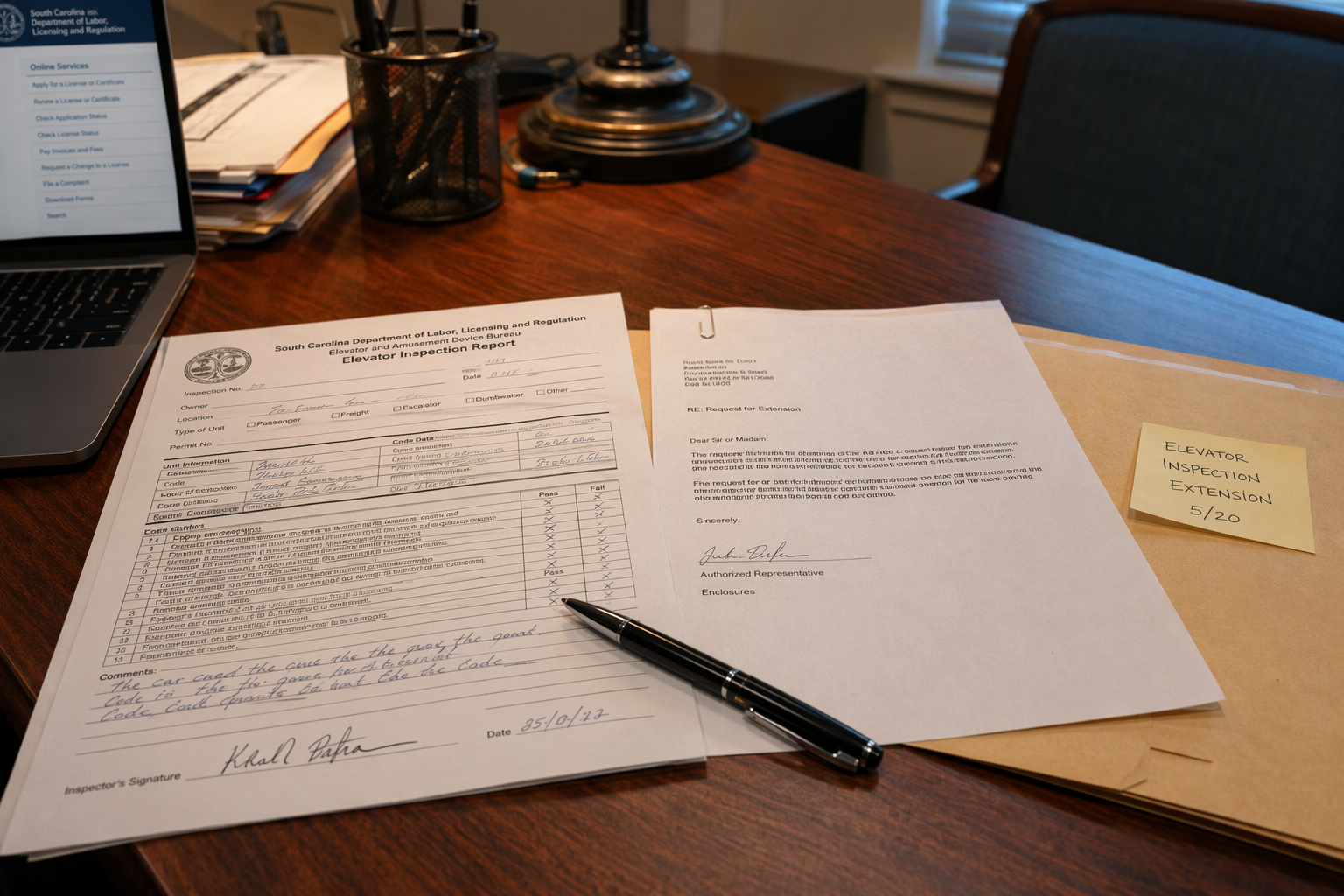
An abatement is the formal correction of a cited elevator deficiency to bring the installation into compliance with applicable safety standards.
When the LLR’s Office of Elevators and Amusement Rides — or a state-accepted special inspector — identifies a violation during an inspection, the finding is documented and the elevator owner is assigned an abatement deadline. That deadline specifies how much time the owner has to correct the problem. The underlying obligation flows directly from S.C. Code Title 41, Chapter 16, which places the affirmative duty to maintain every elevator facility in safe operating condition squarely on the owner, not the service contractor.
Abatements typically reference the specific provision of ASME A17.1-2019/CSA B44:19 — the safety code adopted by South Carolina effective July 23, 2021 — that the installation violates. That code reference matters because repair scopes, parts specifications, and testing procedures all flow from it.
Can an abatement be cleared before all physical repair work is physically complete?
Not in the strict sense — clearing an abatement means the cited condition has been corrected to the LLR’s satisfaction, which requires either a re-inspection confirming the fix or accepted documentation that the hazard has been remediated.
However, what many owners mean when they ask this question is whether the abatement deadline can be extended — buying time to complete repairs without the elevator being formally out of compliance or the operating certificate being suspended. That is a separate process, and the answer is yes, extensions can be requested when certain conditions are met.
The two concepts — clearing and extending — are distinct. Clearing closes the violation. Extending postpones the deadline while work continues. Both require proactive communication with the LLR before the original deadline lapses.
What is the formal process for requesting an extension from the LLR while repairs are pending?
The process requires the owner to submit a written extension request to the LLR before the existing abatement deadline expires, documenting why the repair cannot be completed within the original timeframe and what steps are actively being taken.
- Confirm the original abatement deadline listed on the inspection report or violation notice issued by the LLR.
- Gather supporting documentation: repair orders, parts procurement evidence, contractor work schedules, and any manufacturer lead-time letters for specialty components.
- Draft a written extension request addressed to the LLR’s Office of Elevators and Amusement Rides, identifying the elevator by registration number, the specific violation cited, and the proposed new completion date.
- Include a corrective action plan describing each step of the repair, who is performing it, and the expected timeline for each milestone.
- Submit the request before — not after — the original deadline. Late submissions significantly reduce the likelihood of approval and may trigger additional enforcement action.
- Retain confirmation of submission and any LLR acknowledgment or approval for the facility’s compliance file.
- Implement any interim safety measures the LLR requires as a condition of granting the extension, which may include restricted use, posted warnings, or reduced load capacity.
- Schedule a re-inspection through the LLR or a qualified special inspector once repairs are complete to formally clear the abatement.
Carolina Elevator Service assists Columbia, SC building owners with every step of this documentation and coordination process, ensuring extension requests are submitted with the technical detail the LLR needs to approve them promptly.
What documentation does the LLR typically expect in a good-faith extension request?
The LLR expects documentary evidence that repair activity is genuinely underway — not simply promised — including repair contracts, parts orders, and a written schedule of completion milestones.
Vague assurances carry little weight. The more precise and verifiable the documentation, the stronger the case for an extension. Useful supporting documents include purchase orders for replacement components, written statements from the elevator service company confirming parts are on order or technicians are scheduled, and any manufacturer communications explaining supply chain delays for specialty parts. If the repair requires a state construction permit — which is required in South Carolina before any elevator facility is altered or installed — a copy of the permit application or issued permit further demonstrates good faith.
Owners should also be prepared to show that the elevator is either out of service or operating under safe conditions during the extension period. The LLR has the authority to impose operating restrictions as a condition of granting more time.
What happens if the abatement deadline passes without an extension request?
If an abatement deadline lapses without an approved extension, the LLR may suspend or revoke the elevator’s operating certificate, prohibit continued operation, and pursue enforcement action against the owner.
Under S.C. Code Title 41, Chapter 16, no elevator facility may be operated in South Carolina without a valid certificate of registration and an operating certificate from the state. That certificate must be displayed conspicuously inside every elevator car. When the LLR determines an elevator is out of compliance and the owner has not taken visible corrective action, the operating certificate is at direct risk. Continued operation of an elevator with a suspended certificate exposes the owner to substantially greater liability — both regulatory and civil — than the cost of the original repair.
Does the elevator have to be taken out of service while repairs are pending and an extension is active?
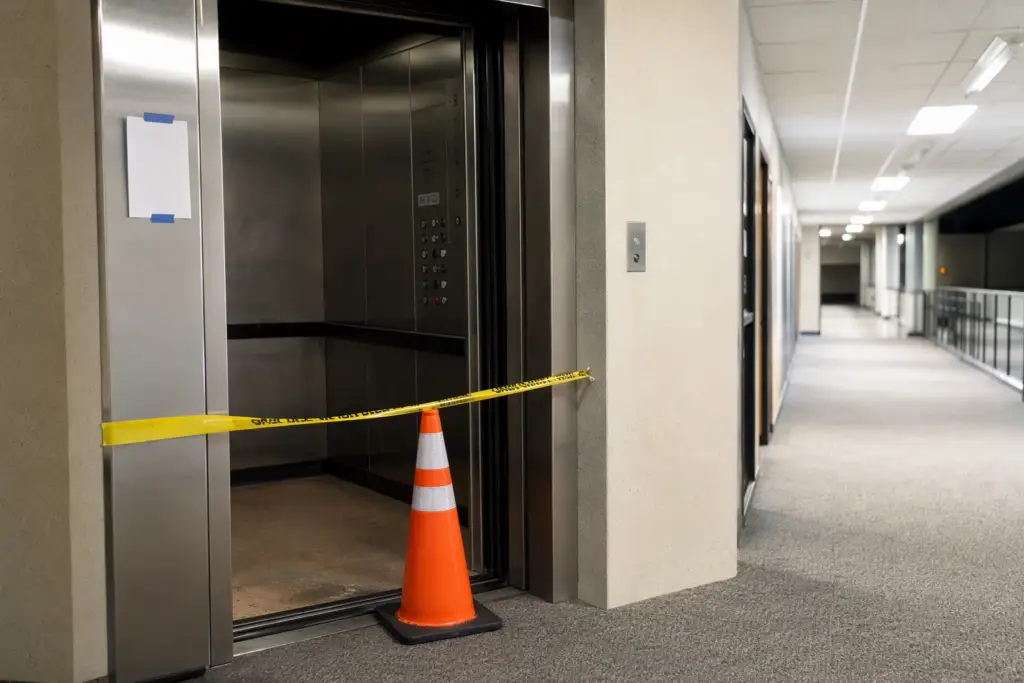
Not automatically — but the LLR has the authority to require the elevator to be taken out of service if the cited deficiency presents an immediate safety hazard.
Whether an elevator must be shut down during an extension period depends on the nature and severity of the violation. A deficiency that affects structural integrity, door operation, or safety device function is far more likely to trigger a mandatory shutdown than a cosmetic or documentation issue. The LLR inspector’s report will typically indicate whether the unit may remain in service under conditions or must be removed from service immediately. Owners should read that language carefully and comply literally — operating an elevator under a stop-work or out-of-service order is a serious violation independent of the original citation.
If the elevator must remain operational for accessibility reasons — for instance, if it is the only means of access for individuals with disabilities as required under the Americans with Disabilities Act — that factor should be clearly stated in the extension request and any related LLR correspondence. It does not override a safety-based shutdown order, but it is a relevant operational fact.
How does the annual inspection and operating certificate renewal cycle relate to an open abatement?
An open abatement that is unresolved at the time of annual inspection will prevent the issuance or renewal of the operating certificate until the violation is cleared.
South Carolina requires elevators to be inspected at least once a year before the operating certificate is renewed. If an abatement from a prior inspection remains open — meaning the cited deficiency has not been corrected and no approved extension is on file — the renewal will be denied. This is one of the most operationally damaging consequences of allowing an abatement to age without action. A building that cannot renew its operating certificate cannot legally operate its elevator, which affects tenant satisfaction, ADA compliance, and property value.
Inspection intervals differ by equipment type in South Carolina. The table below summarizes them:
| Equipment Type | South Carolina Inspection Interval | Triggering Events (Always Inspected) |
|---|---|---|
| Passenger and freight elevators | At least once per year (before certificate renewal) | Installation, registration, alteration or repair |
| Handicap lifts | Every five years | Installation, alteration |
| Manlifts, television tower elevators, special purpose elevators | Every seven years | Installation, alteration |
| Dumbwaiters | When installed or altered | Installation, alteration |
Source: S.C. Code Title 41, Chapter 16 and S.C. Code of Regulations Chapter 71, Article 5.
Who is authorized to perform the re-inspection that formally clears an abatement in South Carolina?
In South Carolina, a re-inspection that closes an abatement may be performed by a state inspector or by a licensed special inspector who meets the qualifications in the 2018 edition of QEI-1.
Special inspectors must hold a current license issued under South Carolina’s regulatory framework and must demonstrate qualifications consistent with the American National Standard for Qualification of Elevator Inspectors (QEI-1, 2018 edition). Critically, a special inspector may not inspect an elevator on which the inspector or the inspector’s employer has a current service or warranty contract. This conflict-of-interest restriction means a building owner cannot simply ask their regular elevator service contractor to perform the closing inspection — a truly independent, qualified inspector must conduct it.
Once the re-inspection confirms the cited deficiency has been corrected, the inspector documents the finding and reports it to the LLR, which then formally closes the abatement in its records and clears the path for operating certificate issuance or renewal.
What if specialty parts have long lead times and repairs cannot realistically be completed quickly?
Long parts lead times are among the most accepted justifications for an extension request, provided they are documented with manufacturer or distributor written confirmation of the delay.
Elevator components — particularly hydraulic cylinders, controller boards, door operators, and safety devices — can carry lead times that far exceed a standard 30-day abatement window, especially for older or less common equipment. In these situations, a well-constructed extension request will include the written lead-time estimate from the supplier, evidence that the order has been placed and confirmed, and a revised completion timeline tied to the confirmed delivery date plus installation scheduling. The LLR is far more likely to grant a reasonable extension when the owner has already placed the order than when the owner is simply explaining why the order has not yet been placed.
Carolina Elevator Service routinely prepares this type of documentation for building owners in Columbia, SC, coordinating with parts suppliers to obtain written lead-time confirmations that meet the LLR’s evidentiary expectations.
Does the abatement and extension process differ for older elevators covered by ANSI A17.3?
The procedural steps for requesting an extension are the same, but the technical repair standards may differ — elevators in operation in South Carolina before July 1, 1986 must comply with the 1986 edition of ANSI A17.3, the safety code for existing elevators and escalators.
This distinction matters because the specific deficiency cited on the abatement notice will reference the applicable code edition. A repair performed to the wrong code edition — for example, applying a new-installation standard from ASME A17.1-2019 to a pre-1986 unit that is governed by ANSI A17.3 — may not satisfy the citation even if the physical work is complete. Owners of older equipment should confirm with their elevator service provider which code edition applies to their unit before specifying or approving repair work.
What role does a state construction permit play in the abatement and repair process?
A state construction permit is required before any elevator facility in South Carolina is erected, constructed, altered, or installed — meaning significant repairs that constitute an alteration require a permit before work begins, not after.
This requirement has direct implications for abatements. If the repair needed to clear the abatement rises to the level of an alteration under South Carolina’s regulatory definitions, the owner must obtain a construction permit from the LLR before the work commences. Beginning alteration work without a permit creates a secondary violation on top of the original abatement. Conversely, the time required to obtain the permit is itself a valid basis for requesting an extension of the abatement deadline — and the permit application serves as concrete evidence of good-faith intent.
Maintenance and like-for-like component replacements that do not constitute alterations generally do not require a new construction permit, but owners should confirm the classification of planned work with the LLR or a qualified elevator service provider before proceeding.
How should an accident during the abatement period be handled with the LLR?
Any accident that seriously injures someone other than an employee must be reported to the LLR before the end of the next working day — and an open abatement in the same system will compound regulatory scrutiny significantly.
Under S.C. Code Title 41, Chapter 16, this next-working-day reporting requirement is non-negotiable. When a serious injury occurs during a period in which an abatement is already open, the LLR may treat the incident as evidence that the original violation contributed to the harm — regardless of whether the two are technically related. Owners and facility managers should immediately notify the LLR, preserve all physical evidence, document the elevator’s condition at the time of the incident, and retain qualified elevator service personnel to assess the installation before the unit is returned to service.
Operating an elevator under these circumstances without LLR authorization following the incident could expose the owner to substantially elevated liability under both state regulatory law and civil negligence frameworks.
Does ADA compliance factor into abatement decisions or extension requests?
ADA accessibility requirements do not override state elevator safety orders, but they are a relevant operational consideration that building owners should address explicitly in extension request correspondence.
Under the Americans with Disabilities Act, buildings covered by Title II or Title III must provide accessible routes, and elevators are frequently the sole accessible means of vertical travel in multi-story facilities. If an elevator is taken out of service to allow repairs required by an abatement, the building owner must assess whether a temporary accessible alternative is available and may need to notify affected tenants, employees, or the public. While ADA obligations do not give an owner the right to operate an unsafe elevator, they do create an additional layer of urgency and planning that well-prepared extension requests should acknowledge.
What are the most common violations that generate abatements on South Carolina elevators?
Violations that commonly generate abatements include deficiencies in door operator systems, safety device testing, governor and safety gear condition, emergency lighting and alarm bell function, and operating certificate display.
Under ASME A17.1-2019/CSA B44:19 — South Carolina’s adopted safety code — these systems are tested during annual inspections and must meet specific performance criteria. Emergency lighting and alarm bell function carry a particular South Carolina requirement: passenger elevators must have standby power capable of running emergency lighting and the alarm bell for at least four hours if normal power fails. Failure to meet this standard is a citable violation. Underground hydraulic elevator cylinders are another area of active enforcement: new installations in South Carolina must be encased in plastic outer containment to limit electrolytic corrosion, and older installations that have been altered may be required to meet similar standards.
What interim safety measures might the LLR require while an extension is in effect?
Interim measures vary based on the nature of the violation but may include load restrictions, speed limitations, restricted access to certain floors, mandatory attendant operation, or signage advising passengers of the ongoing repair.
The LLR has broad authority under S.C. Code Title 41, Chapter 16 to impose conditions on continued operation while an abatement extension is in effect. These conditions are legally binding — failure to maintain them during the extension period can result in immediate revocation of the extension and imposition of a stop-use order. Building operations teams should brief all relevant personnel on any LLR-imposed operating restrictions and document that briefing in writing.
Can a special inspector accept work-in-progress during the extension period rather than waiting until repairs are fully complete?
A special inspector may review and document repair progress, but the formal abatement clearance inspection cannot occur until the cited deficiency is fully corrected and the system is ready to be tested to code.
Partial inspections can be valuable — they create a documentary record of progress, may satisfy the LLR that work is genuinely underway, and can identify any installation issues before the final closeout inspection. However, an abatement is not formally cleared until the inspector confirms the specific violation described in the original citation has been fully remediated and the installation meets the applicable code requirements. Owners who attempt to call work “complete” while punch-list items remain may find themselves in the position of scheduling a second re-inspection, adding both cost and delay.
How does the firefighters’ service key requirement interact with repair and inspection obligations?
New elevator installations and altered systems in South Carolina must use the five-pin S.C. #1000 key for firefighters’ service, and any repair that affects the firefighters’ service phase must be verified as part of the abatement clearance process.
Firefighters’ service is a safety-critical function tested during inspections. If a cited violation involves Phase I or Phase II firefighters’ service and the repair involves controller modifications or cab wiring, the correction must include verification that the five-pin S.C. #1000 key operates the system correctly. This is one of several South Carolina-specific requirements that differ from what may apply in other jurisdictions, and it underscores the importance of working with an elevator service provider thoroughly familiar with South Carolina’s specific regulatory requirements.
What records should a building owner retain after an abatement is cleared?
After an abatement is formally cleared, owners should retain the original inspection report, the extension request and LLR approval, all repair documentation, the re-inspection report confirming clearance, and the renewed operating certificate — indefinitely or for as long as the equipment remains in service.
These records serve multiple purposes. They demonstrate regulatory compliance in the event of a future inspection or enforcement inquiry. They provide a maintenance history that informs future repair decisions. And they can be critical evidence in any civil litigation involving an elevator incident. The operating certificate itself — or a copy — must be displayed conspicuously inside each elevator car at all times under South Carolina law. That certificate should be replaced with the current version immediately upon renewal following an abatement clearance.
Carolina Elevator Service helps Columbia, SC clients organize and maintain complete compliance records as part of ongoing elevator management, so that documentation is available when inspectors or regulators request it.
What should building owners do immediately upon receiving an LLR abatement notice?
Upon receiving an abatement notice, building owners should act immediately — the clock begins running from the date of the notice, and delay at the outset compresses the time available to complete repairs or build an extension request.
- Read the entire notice carefully, identifying the specific violation cited, the applicable code section, and the abatement deadline.
- Determine whether the elevator must be taken out of service immediately or may continue operating under conditions.
- Contact a qualified elevator service provider to assess the scope and complexity of the required repair and obtain a realistic timeline estimate.
- Assess whether the repair constitutes an alteration requiring a state construction permit and, if so, begin the permit application immediately.
- Determine whether specialty parts are required and, if so, obtain written lead-time estimates from suppliers.
- Decide, based on the realistic repair timeline, whether an extension request is needed — and if it is, begin drafting it immediately rather than waiting.
- Engage an independent qualified special inspector who has no service or warranty contract on the unit to plan for the closing re-inspection.
- Notify the LLR proactively about the corrective action plan, even before the formal extension request is submitted, to establish a record of good-faith engagement.
Carolina Elevator Service routinely guides building owners and facility managers in Columbia, SC through this process from the moment an abatement notice is received, coordinating repair assessment, parts procurement, permitting, and inspector scheduling in a single managed workflow.
Does the South Carolina Elevator Code apply to all buildings, including private residences?
No — the South Carolina Elevator Code expressly does not apply to equipment in a single private dwelling.
This exemption is relevant because it defines the universe of elevators subject to abatement, extension, and inspection requirements. Commercial buildings, multi-family residential buildings, hotels, healthcare facilities, government buildings, and retail properties are all within scope. Single-family homes with private residential elevators are not. All local ordinances that conflict with S.C. Code Title 41, Chapter 16 or its implementing regulations are void, which means that even if a municipality in the Columbia area attempts to impose stricter or conflicting elevator requirements, the state code controls.
Contact Carolina Elevator Service for a free elevator assessment at 803-865-1400.
Need elevator service you can rely on? Carolina Elevator Service is ready to help.