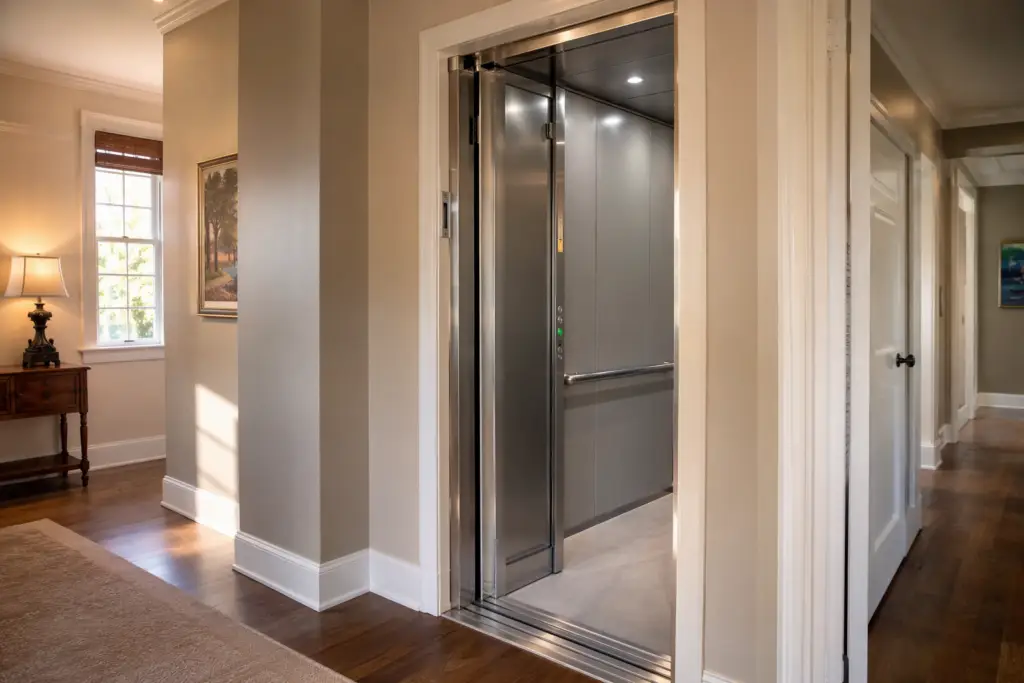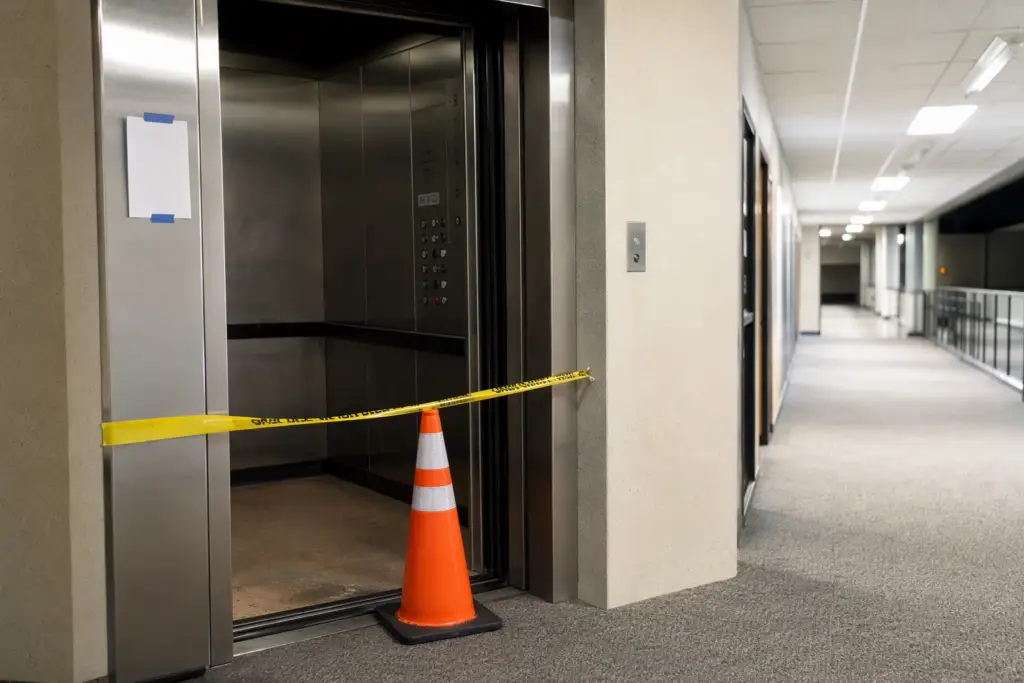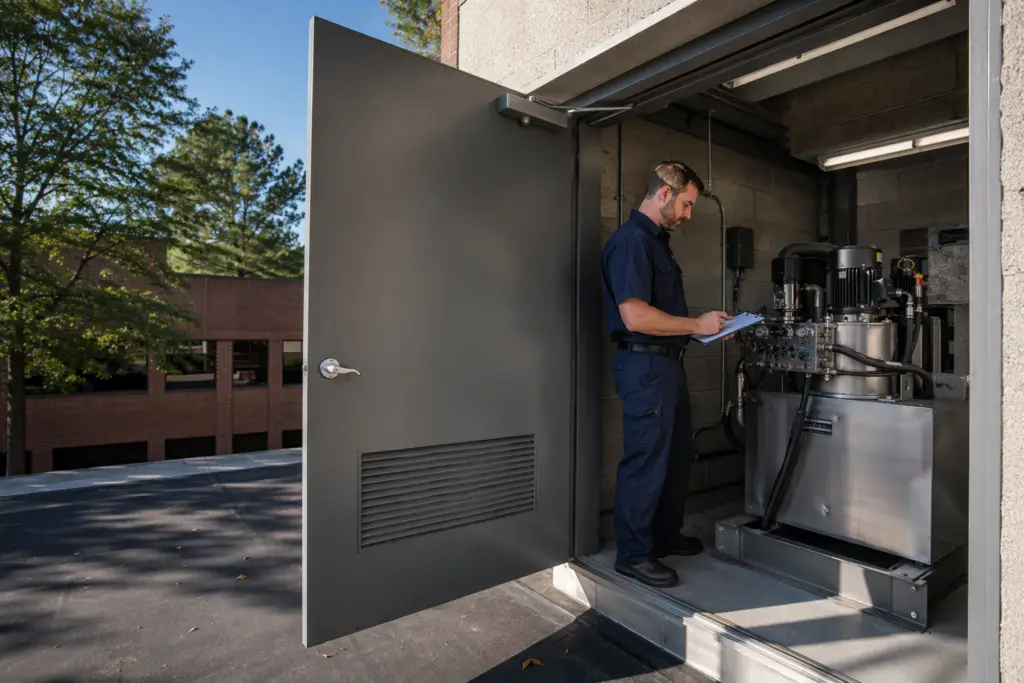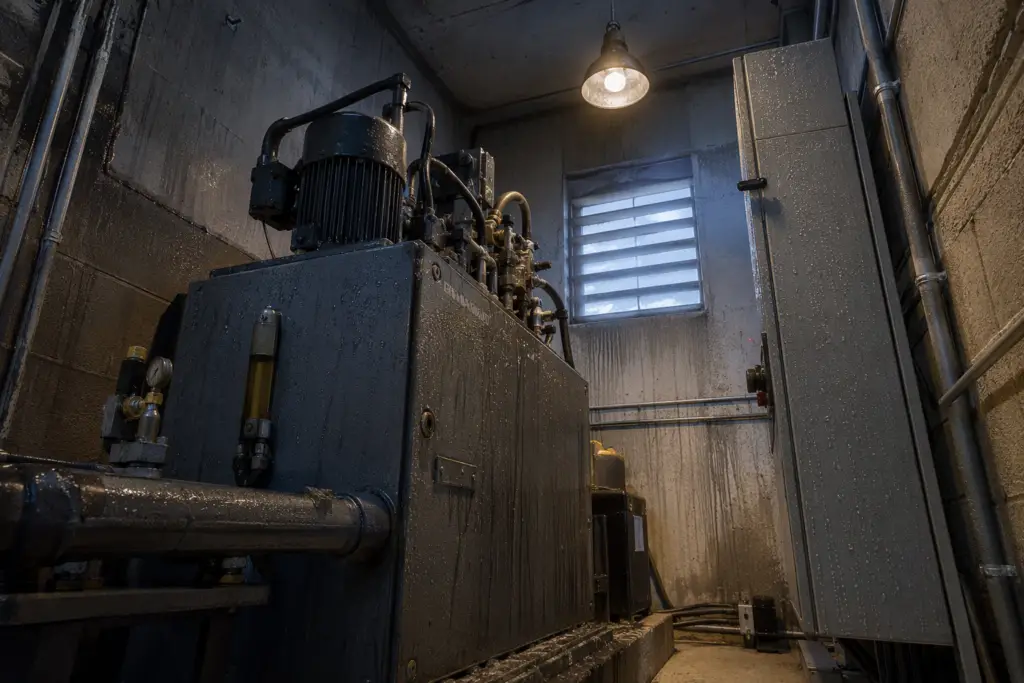
Carolina Elevator Service focuses exclusively on commercial and industrial elevator systems in Columbia, SC. Residential elevators in a single private dwelling fall outside the scope of South Carolina’s elevator code and outside the company’s service territory. Homeowners seeking residential elevator maintenance should contact a home elevator specialist directly — this guide explains what to look for and why the distinction matters.
Does Carolina Elevator Service service residential elevators?
No — Carolina Elevator Service is a commercial elevator company and does not service private residential elevator systems.
The company’s certified work covers commercial passenger elevators, freight elevators, hydraulic systems, dumbwaiters, and accessibility lifts in commercial and public-use buildings throughout the Columbia, SC market. Private home elevators fall into a separate product and regulatory category that requires a different set of service relationships and equipment expertise.
This is not simply a business preference. As explained below, the South Carolina elevator code itself draws a hard line between regulated commercial equipment and privately owned home elevators, which affects who is required to inspect, certify, and service each type of system.
Are residential elevators covered by South Carolina’s elevator code?
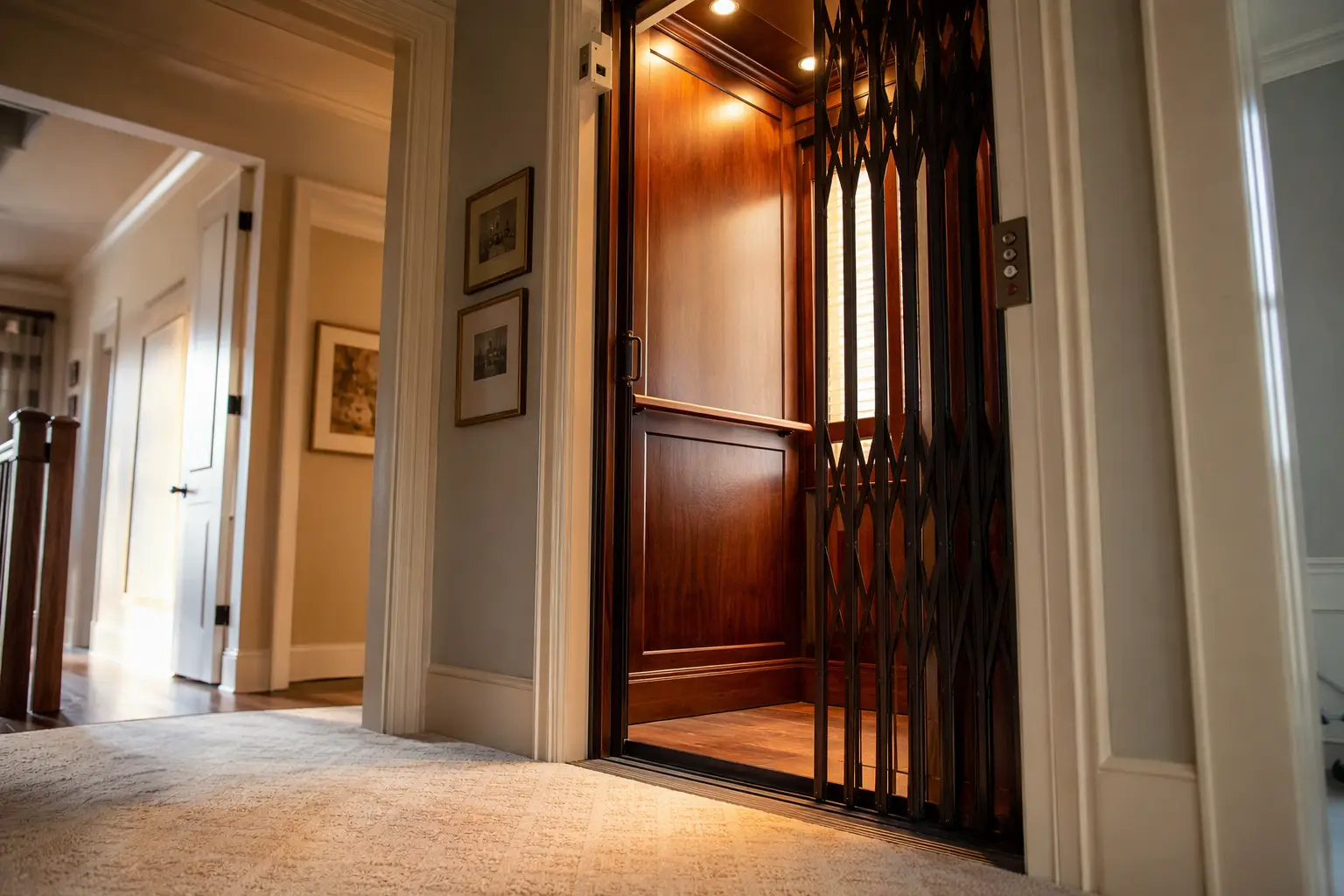
No — the South Carolina Elevator Code explicitly does not apply to equipment located in a single private dwelling.
Under S.C. Code Title 41, Chapter 16 and the associated regulations in S.C. Code of Regulations Chapter 71, Article 5 (Regulations 71-5000 through 71-5700), the oversight framework administered by the South Carolina Department of Labor, Licensing and Regulation (LLR), Office of Elevators and Amusement Rides applies to commercial and public-use elevator facilities. Equipment installed solely within a single private dwelling is carved out of these requirements.
That exemption means no state construction permit, no operating certificate, and no annual state inspection is mandated for a home elevator. It also means LLR’s Office of Elevators and Amusement Rides has no enforcement authority over residential units. For homeowners, this places all safety responsibility squarely on the equipment owner and the private service company they hire.
What elevator types does South Carolina regulate, and which ones are exempt?
South Carolina regulates all elevator facilities in commercial, industrial, and public-use buildings, while exempting home elevator equipment in single private dwellings.
The table below summarizes the major equipment categories, their regulatory status under South Carolina rules, and the applicable inspection frequency where state oversight applies.
| Equipment Type | SC State Regulation Applies? | Required Inspection Interval | Governing Authority |
|---|---|---|---|
| Commercial passenger elevator | Yes | At least once per year (before operating certificate renewal) | SC LLR, Office of Elevators and Amusement Rides |
| Commercial freight elevator | Yes | At least once per year | SC LLR, Office of Elevators and Amusement Rides |
| Commercial hydraulic elevator | Yes | At least once per year | SC LLR, Office of Elevators and Amusement Rides |
| Handicap lift (commercial/public) | Yes | Every five years | SC LLR, Office of Elevators and Amusement Rides |
| Manlift / special purpose elevator | Yes | Every seven years | SC LLR, Office of Elevators and Amusement Rides |
| Television tower elevator | Yes | Every seven years | SC LLR, Office of Elevators and Amusement Rides |
| Dumbwaiter (commercial) | Yes | At installation or alteration | SC LLR, Office of Elevators and Amusement Rides |
| Home elevator (single private dwelling) | No — explicitly exempt | No state mandate; manufacturer schedule applies | Owner’s responsibility; private service company |
What technical code governs commercial elevators installed in South Carolina in 2026?
New commercial elevator facilities in South Carolina must comply with the ASME A17.1/CSA B44 Safety Code for Elevators and Escalators, 2019 edition, which South Carolina adopted effective July 23, 2021.
Specifically, South Carolina adopted ASME A17.1-2019/CSA B44:19 without amendment, as noticed in the S.C. State Register. Any new elevator facility must comply with the edition of ASME A17.1 that was officially in effect when the state construction permit was issued. For facilities that were in operation before July 1, 1986, the applicable existing-equipment standard is the 1986 edition of ANSI A17.3, the safety code for existing elevators and escalators.
These code editions define safety requirements for car structures, door systems, safeties, buffers, firefighters’ service, standby power, and dozens of other technical elements — none of which apply to residential equipment under South Carolina’s regulatory framework.
Who is qualified to inspect commercial elevators in South Carolina?
Under South Carolina law, required inspections of regulated elevator facilities may only be performed by state inspectors or licensed special inspectors who meet the qualifications in the 2018 edition of QEI-1, the American National Standard for Qualification of Elevator Inspectors.
A special inspector’s report may be accepted in place of a state inspection, but South Carolina imposes an important conflict-of-interest rule: a special inspector may not inspect an elevator on which the inspector or the inspector’s employer holds a current service or warranty contract. This separation between service and inspection is a cornerstone of South Carolina’s regulatory integrity.
For residential elevators, no equivalent state qualification requirement exists because those units are outside state jurisdiction. Homeowners should ask any private service company about its technicians’ manufacturer training, insurance coverage, and familiarity with the ASME A17.1 provisions that most home elevator manufacturers still reference voluntarily in their design standards.
What happens if a commercial elevator is operated without a valid South Carolina certificate?
Operating a regulated elevator facility without a certificate of registration and a current operating certificate is a violation of South Carolina law under S.C. Code Title 41, Chapter 16.
No commercial elevator facility may legally operate in South Carolina without both documents, and the operating certificate — or a copy — must be displayed conspicuously inside every elevator car. Building owners who allow elevator operation without a valid certificate face exposure to enforcement action by the South Carolina Department of Labor, Licensing and Regulation (LLR), Office of Elevators and Amusement Rides. Additionally, local ordinances that conflict with the South Carolina Elevator Code or its regulations are void, so municipal rules cannot override state requirements in either direction.
Carolina Elevator Service routinely assists commercial building owners in Columbia with understanding their certificate status before issues arise, which is one reason why proactive maintenance planning matters for any regulated facility.
What standby power requirements apply to commercial passenger elevators in South Carolina?
South Carolina requires commercial passenger elevators to have standby power capable of running emergency lighting and the alarm bell for at least four hours if normal power fails.
This requirement exists to protect building occupants who may be inside the cab during a power outage, ensuring they can signal for help and are not left in complete darkness. The standby power system must be tested and maintained as part of any responsible preventive maintenance program. For building owners in Columbia working with Carolina Elevator Service, standby power verification is part of a thorough elevator assessment to ensure the system meets state requirements under S.C. Code Title 41, Chapter 16.
What firefighters’ service key requirement applies to new elevator installations in South Carolina?
New elevator installations in South Carolina must use the five-pin S.C. #1000 key for firefighters’ service, ensuring local emergency responders can access elevator controls consistently across the state.
This state-specific requirement means that contractors installing new elevators in Columbia and across South Carolina must source the correct key hardware. Using the wrong key configuration could create a critical failure point during a building emergency. Building owners planning new construction or major alterations should confirm this detail with their elevator contractor before installation begins.
What underground hydraulic elevator cylinder rule applies in South Carolina?
South Carolina requires that newly installed underground hydraulic elevator cylinders be encased in a plastic outer containment to limit electrolytic corrosion.
Corrosion of older single-bottom hydraulic cylinders has historically been a significant safety and environmental concern in the elevator industry. The plastic outer containment requirement is South Carolina’s approach to reducing the risk of cylinder failure and hydraulic fluid leaks into surrounding soil. For building owners with older hydraulic systems, understanding whether their cylinder meets current standards — or whether the system predates this requirement — is an important part of a comprehensive equipment assessment.
Does the ADA apply to elevators in commercial buildings in South Carolina?
Yes — the Americans with Disabilities Act (ADA) applies to elevators and vertical accessibility in commercial and public-use buildings throughout South Carolina, independent of state code.
The ADA sets accessibility requirements for elevator car dimensions, door widths, control panel heights, Braille signage, audible signals, and related features in places of public accommodation and commercial facilities. These federal requirements run alongside South Carolina’s elevator safety code rather than replacing it. Building owners must satisfy both frameworks. When a commercial building in Columbia undergoes renovation or change of use, ADA accessibility requirements for vertical transportation should be evaluated as part of the project scope.
Residential elevators in private single-family homes are generally outside the ADA’s scope as written for public accommodations, though accessibility considerations remain important for homeowners designing for aging-in-place or mobility needs.
What should a commercial building owner do immediately after an elevator accident in South Carolina?
Under South Carolina law, an accident that seriously injures anyone other than an employee must be reported to the state before the end of the next working day.
Building owners and facilities managers should follow these steps in order after a serious elevator incident:
- Ensure the injured person receives immediate medical attention and call emergency services if needed.
- Secure the elevator car at the nearest landing and prevent further use of that unit.
- Document the scene — photograph the cab, landing, control panel, and any visible damage — before anything is altered.
- Notify the South Carolina Department of Labor, Licensing and Regulation (LLR), Office of Elevators and Amusement Rides before the end of the next working day, as required by state law.
- Retain all maintenance records, inspection certificates, and service logs related to the elevator for review.
- Contact your qualified elevator service company to conduct a thorough post-incident inspection before returning the unit to service.
- Consult legal counsel to understand liability exposure and document owner compliance with reporting obligations.
Prompt reporting and accurate documentation protect building owners legally and demonstrate good faith compliance with South Carolina requirements under S.C. Code Title 41, Chapter 16.
Who is responsible for keeping a commercial elevator safe in South Carolina?
Under South Carolina law, the owner of an elevator facility bears the legal responsibility to keep every elevator facility in safe operating condition and in compliance with state regulations.
This owner-responsibility model means that building owners — not just their service companies or inspectors — are accountable for the ongoing condition of the equipment. Delegating maintenance to a qualified service company is the practical mechanism through which most owners meet this obligation, but the legal duty remains with the owner. For multi-tenant buildings in Columbia, this responsibility typically rests with the property owner or property management entity that controls the facility.
A preventive maintenance contract with a qualified commercial elevator company is the most direct way for South Carolina building owners to demonstrate they are meeting this statutory obligation on an ongoing basis.
What is the difference between a state construction permit and an operating certificate in South Carolina?
A state construction permit is required before any elevator facility is erected, constructed, altered, or installed; an operating certificate is required for the elevator to legally operate after inspections are passed.
These are two distinct documents that mark two distinct phases of an elevator’s life cycle. The construction permit precedes the work; the operating certificate follows inspection and approval. Building owners planning elevator installation or significant alteration in Columbia must secure the construction permit from South Carolina’s LLR before work begins. After installation and inspection, the operating certificate must be obtained and displayed in the elevator car before passengers may use the system. Skipping either step exposes the building owner to enforcement risk and potential shutdown of the equipment.
What should homeowners look for in a residential elevator service company?
Homeowners seeking residential elevator service should prioritize companies with manufacturer-specific training, general liability insurance, familiarity with voluntary ASME safety standards, and clear written service agreements.
Because South Carolina’s elevator code does not regulate single private dwelling equipment, there is no state licensing requirement for residential elevator technicians specifically. This places more due-diligence responsibility on the homeowner. Key questions to ask any prospective residential elevator service provider include:
- Are your technicians trained by or certified through the specific manufacturer of my home elevator?
- Do you carry general liability insurance and workers’ compensation coverage?
- Do you follow the manufacturer’s recommended maintenance schedule and document all service visits?
- Are you familiar with the voluntary safety provisions in the ASME A17.1 Safety Code for Elevators and Escalators, which many home elevator manufacturers reference?
- Can you provide references from other residential elevator clients in the Columbia area?
Even without state mandates, residential elevator owners benefit from treating their equipment with the same diligence applied to regulated commercial systems. Regular lubrication, cable inspection, door interlock testing, and drive system checks are standard preventive tasks regardless of regulatory status.
How often should a home elevator be serviced even without a state requirement?
Most residential elevator manufacturers recommend professional service at least once per year, with some high-use or older systems benefiting from more frequent visits.
While South Carolina imposes no statutory inspection interval on private dwelling elevators, following the equipment manufacturer’s maintenance schedule is the responsible baseline. Key components that benefit from periodic professional attention include wire rope or belt tension, guide rail lubrication, hydraulic fluid level and condition, safety device operation, door interlock function, and electrical connections. Deferring maintenance on a home elevator carries real risk — a failed safety device or worn cable in a private residence creates the same physical hazard it would in a commercial building, without the regulatory backstop that might catch a problem earlier.
What commercial elevator services does Carolina Elevator Service provide in Columbia, SC?
Carolina Elevator Service provides commercial elevator maintenance, inspection support, modernization planning, and equipment assessment services for building owners throughout the Columbia, SC market.
The company works with owners of commercial passenger elevators, freight elevators, hydraulic systems, accessibility lifts, and related commercial vertical transportation equipment. Services are aligned with the requirements of S.C. Code Title 41, Chapter 16 and the ASME A17.1-2019/CSA B44:19 code adopted by South Carolina. Building owners who need help understanding their compliance status, preparing for state inspections, or evaluating aging equipment will find that Carolina Elevator Service brings focused commercial expertise to those challenges.
Can a commercial elevator service company work on a home elevator if asked?
Technically, there is no South Carolina statute that expressly forbids a commercial elevator company from working on a private residence elevator, but most commercial firms lack the specialized parts relationships and manufacturer-specific training that home elevator systems require.
Residential elevator platforms — including cable-driven, pneumatic vacuum, and residential hydraulic systems — often use proprietary components sourced through the original manufacturer. Commercial elevator technicians trained on ASME A17.1-compliant commercial systems may not have access to those parts channels or the product-specific diagnostic tools needed for efficient residential service. This practical mismatch, rather than a legal prohibition, is why most commercial firms — including Carolina Elevator Service — focus exclusively on commercial and industrial equipment and direct homeowners to specialists.
What accessibility lift options exist for commercial buildings in Columbia, SC that fall under state regulation?
Commercial buildings in Columbia that need vertical accessibility but cannot accommodate a full elevator shaft may use platform lifts or inclined stairway chairlifts, which are regulated under South Carolina’s elevator code and must meet both state and federal ADA requirements.
These commercial accessibility lifts differ significantly from residential stairlift products sold to homeowners. Commercial platform lifts in public-use buildings fall under the oversight of the South Carolina Department of Labor, Licensing and Regulation (LLR), Office of Elevators and Amusement Rides, are subject to inspection, and must meet ADA accessibility standards. They require a state construction permit before installation and an operating certificate before use. Building owners evaluating lift solutions for ADA compliance in Columbia should ensure the equipment they select is appropriate for commercial-use classification and not a residential product installed in a commercial setting.
What records should a South Carolina commercial elevator owner keep on file?
South Carolina commercial elevator owners should maintain current certificates of registration and operating certificates, all inspection reports, service and maintenance logs, and records of any accidents or incidents reported to the state.
Organized records serve multiple purposes: they demonstrate compliance during state inspections, support insurance claims if incidents occur, and provide documentation of due diligence if legal questions arise about the owner’s maintenance practices. The operating certificate — or a copy — must be displayed inside every elevator car under South Carolina law, but the underlying documentation that supports that certificate should be retained in building files. When equipment is sold or a building changes hands, complete maintenance history records are valuable for the incoming owner assessing the system’s condition and compliance status.
What should a commercial building owner in Columbia do if their elevator’s operating certificate is about to expire?
A building owner whose operating certificate is approaching expiration should schedule the required annual inspection with a qualified state or special inspector well in advance of the renewal deadline to avoid a lapse that would require the elevator to be taken out of service.
Operating a regulated elevator without a valid operating certificate is a violation of South Carolina law. The sequence for renewal typically involves scheduling and completing the required inspection, addressing any deficiencies identified during that inspection, and obtaining the renewed operating certificate from the South Carolina Department of Labor, Licensing and Regulation (LLR), Office of Elevators and Amusement Rides. Building owners should remember that under South Carolina rules, a special inspector cannot inspect an elevator if the inspector or the inspector’s employer holds a current service or warranty contract on that unit — so coordinating the inspection through the right channels matters. Carolina Elevator Service can assist Columbia building owners in understanding what a thorough pre-inspection assessment involves to help reduce the likelihood of deficiencies being found during the official inspection.
Contact Carolina Elevator Service for a free elevator assessment at 803-865-1400.
Need elevator service you can rely on? Carolina Elevator Service is ready to help.