What Questions Should You Ask an Elevator Company Before Hiring Them for Maintenance or Repair?
Before signing a maintenance contract or authorizing elevator repairs, building owners and facility managers in Columbia, SC should ask an elevator company about their licensing status, insurance coverage, knowledge of South Carolina elevator regulations, compliance with ASME A17.1 safety codes, maintenance contract structure, emergency procedures, parts availability, and verifiable local references. The right questions protect building occupants, reduce liability, and ensure continuous code compliance.
Elevators are life-safety equipment regulated under South Carolina law and federal accessibility standards. Choosing the wrong service provider can result in failed inspections, regulatory fines, personal injury liability, and costly equipment damage. The twenty questions below give property owners, facility managers, and HOA boards a complete framework for evaluating any elevator company operating in the Midlands region.
1. Is the elevator company properly licensed to work in South Carolina?
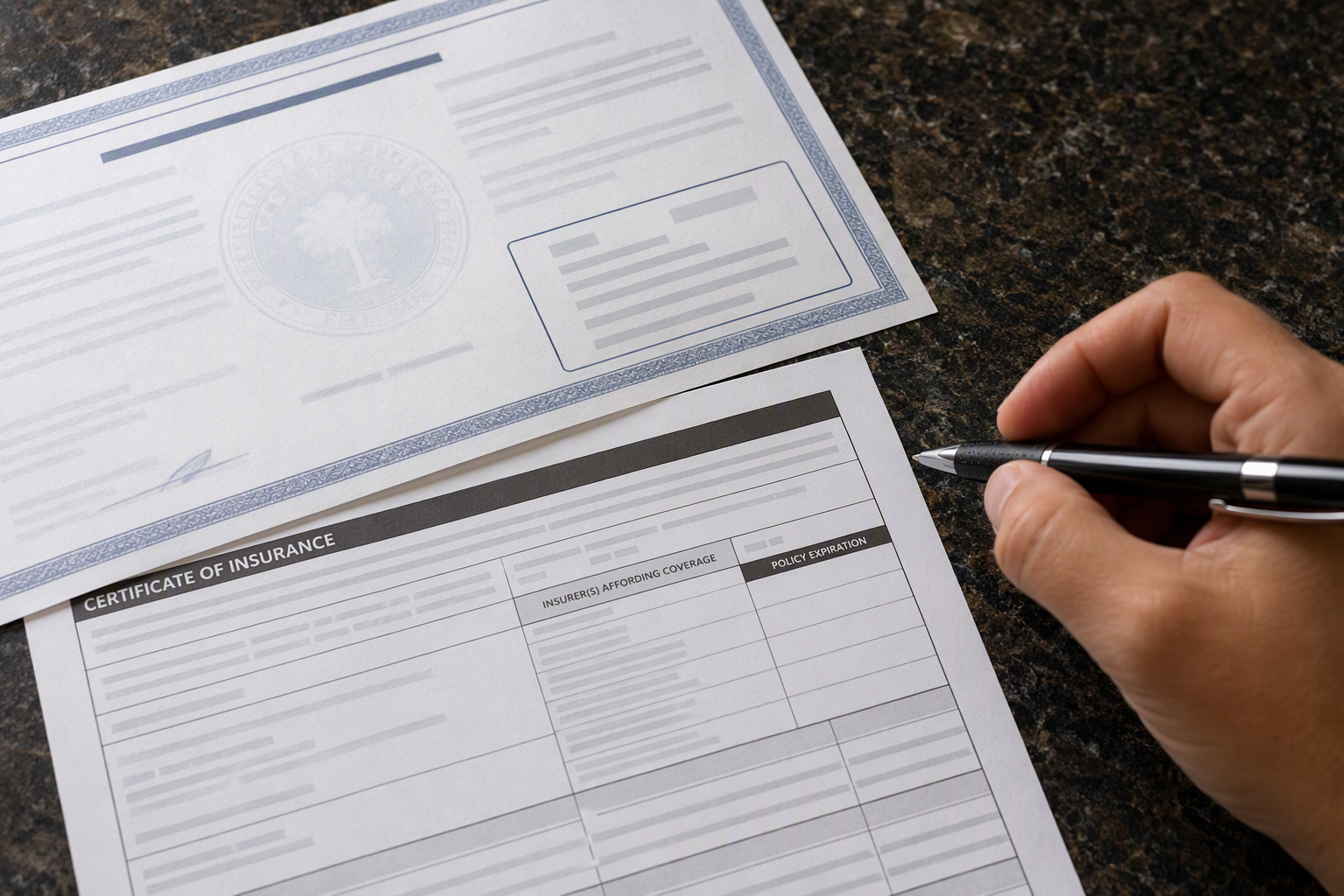
Yes — South Carolina requires elevator contractors to be licensed through the South Carolina Department of Labor, Licensing and Regulation (LLR), and any company working on elevators in the state must hold a current, valid contractor license.
Unlicensed work creates significant liability. If an injury occurs on equipment maintained by an unlicensed contractor, the building owner may bear full legal exposure. Always request a copy of the company’s LLR license number and verify it directly with the South Carolina LLR before execution of any agreement. Carolina Elevator Service operates as a licensed elevator contractor in South Carolina, meeting all state requirements for both maintenance and repair work in the Columbia area.
2. Does the company carry adequate liability insurance and workers’ compensation coverage?
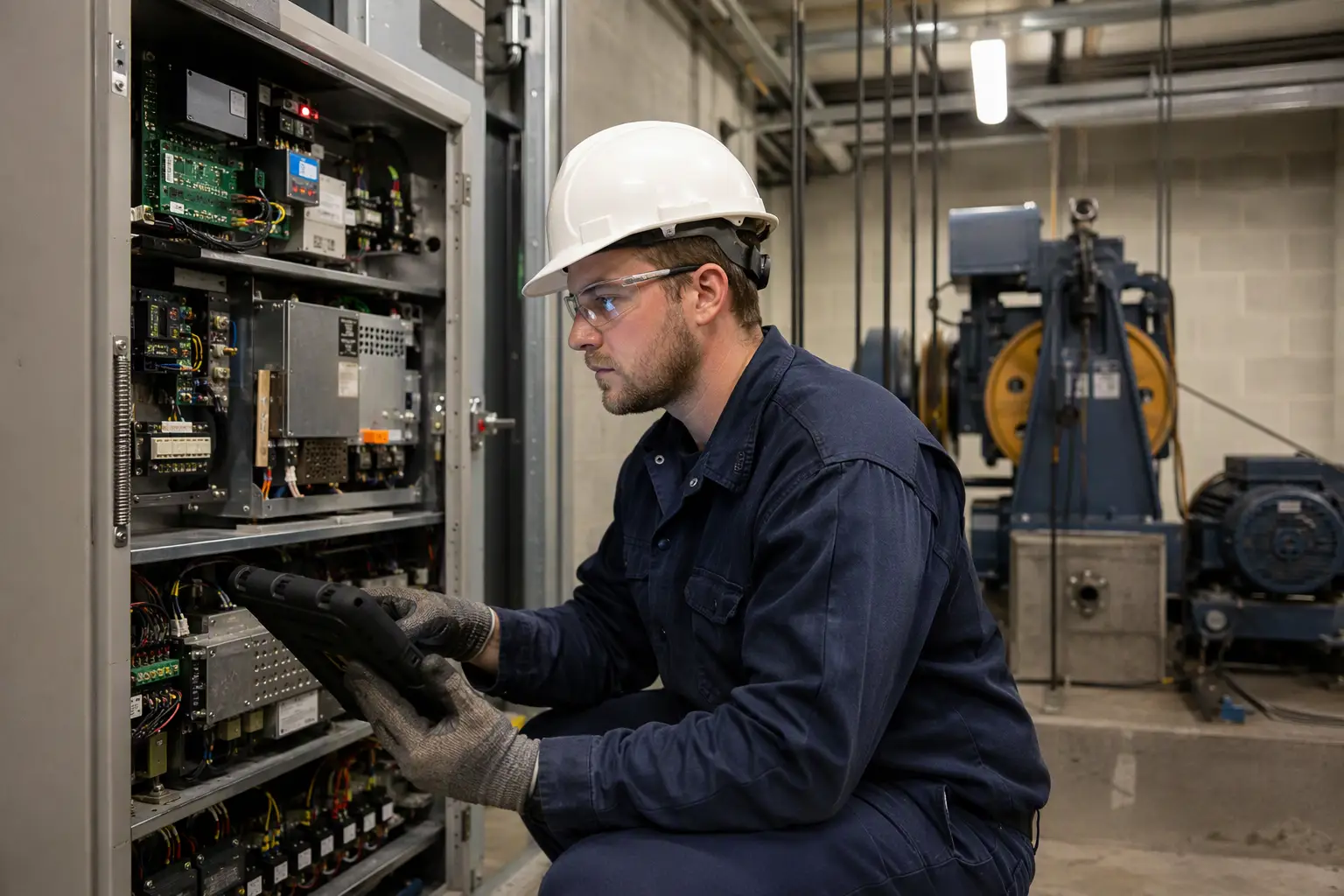
Every elevator service company should carry general liability insurance and workers’ compensation insurance before technicians set foot on a property.
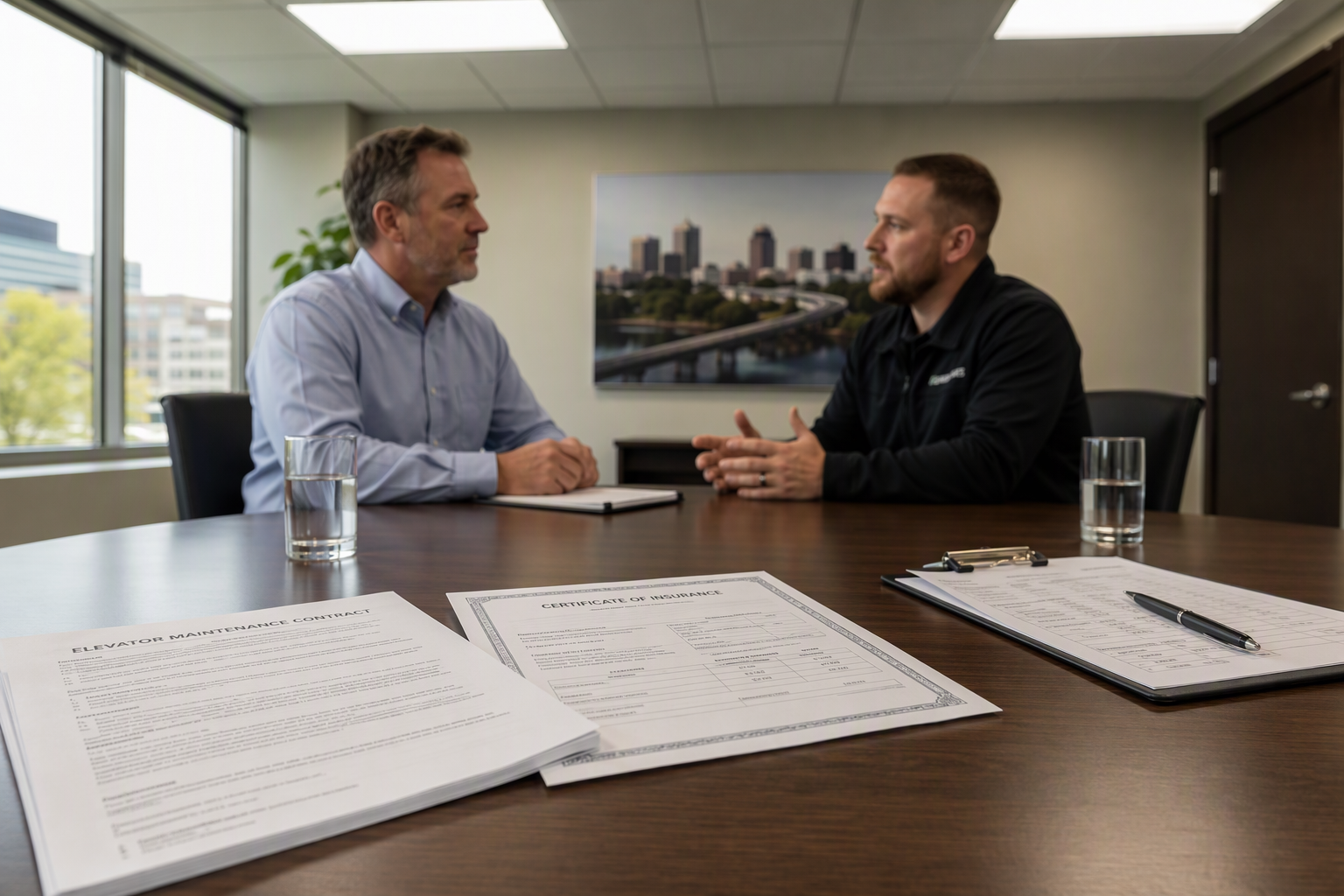
Ask for a Certificate of Insurance (COI) naming the building owner or property management company as an additional insured. Confirm that the coverage limits are sufficient for elevator work, which is classified as a high-risk trade. Workers’ compensation coverage protects building owners from claims if a technician is injured on-site. Never accept verbal assurances — request the COI in writing before work begins.
3. Which ASME elevator safety codes does the company work to?
Elevator maintenance and repair work in South Carolina must conform to the ASME A17.1 Safety Code for Elevators and Escalators for new and altered equipment and ASME A17.3 for existing installations.
ASME A17.1 establishes the baseline safety requirements for elevator design, construction, operation, inspection, testing, and maintenance across the United States and Canada. ASME A17.3 governs the safety of existing elevators already in service. A qualified elevator company should be able to explain which code edition applies to a specific installation, how their maintenance program aligns with those requirements, and which items in a maintenance control program (MCP) are code-mandated versus recommended best practice.
Ask specifically whether the company uses a written, documented maintenance control program as contemplated under ASME A17.1. A company that cannot answer this question in specific terms is a concern.
4. How does the company ensure ADA compliance for elevator installations and repairs?
All commercial and public-accommodation elevator work must comply with ADA Standards for Accessible Design, which govern cab dimensions, door timing, control height, and accessible features.
When repairs involve cab interiors, door operators, control panels, or floor-level accessibility, the work can trigger ADA compliance reviews. A knowledgeable elevator company will identify when proposed repair or modernization work intersects with ADA requirements and advise the building owner accordingly. This is especially important for properties subject to Title II (state and local government) or Title III (places of public accommodation) of the ADA. Failing to maintain ADA-compliant features during repair work can expose a property owner to federal complaints and civil litigation.
5. Who performs the inspections, and are they certified elevator inspectors?
Elevator inspections in South Carolina are performed by inspectors authorized through the state, and a reputable elevator company should be transparent about who conducts inspections and what credentials those inspectors hold.
It is important to understand the distinction between the elevator contractor who performs maintenance and the inspector who certifies the equipment. In South Carolina, periodic inspections are conducted by state-authorized inspectors. Ask whether the company has Qualified Elevator Inspectors (QEIs) on staff or works in coordination with authorized inspection entities. Also ask how the company prepares equipment for state inspections and what their track record is for passing inspections without major deficiencies.
6. What does the maintenance contract actually cover?
Maintenance contracts vary widely — some cover only routine lubrication and adjustment while others include parts, emergency callbacks, and modernization recommendations, so every line item must be clearly defined in writing.
Before signing, request a line-by-line breakdown of what is and is not included. Common contract structures include:
- Oil and grease (OG) contracts: Cover only lubrication and minor adjustments. Parts and labor for repairs are billed separately.
- Full-coverage contracts: Cover parts, labor, and callbacks within defined parameters.
- Partial coverage contracts: A hybrid that includes some parts categories but excludes others (e.g., cab interiors or hydraulic cylinders).
Ask specifically which parts categories are excluded, whether callback visits during or after business hours are included, and what the process is for scheduling non-emergency repairs discovered during routine maintenance visits.
7. How does the company handle emergency breakdowns and entrapments?
Emergency response capability is a non-negotiable requirement for any elevator company, because passenger entrapments are life-safety events that demand a prompt, qualified response.
Ask the company to describe their emergency protocol in writing. Key questions include: Is there a dedicated emergency phone line? Are technicians dispatched directly, or is the call routed through a call center? What is the procedure for communicating with trapped passengers until a technician arrives? The elevator company should also be able to confirm that their technicians are trained in entrapment rescue procedures consistent with ASME A17.1 requirements and applicable OSHA confined-space and lockout/tagout protocols.
8. What is the technician’s training and qualification standard?
Elevator technicians should be trained to a recognized industry standard, with ongoing education to keep pace with evolving equipment technology and updated code requirements.
Ask whether technicians have completed an apprenticeship program, hold certifications from recognized industry organizations, and receive regular continuing education. Also ask whether the company assigns dedicated technicians to specific accounts — familiarity with a building’s equipment history reduces diagnostic errors and improves maintenance quality. A company that cannot explain its technician qualification process should be viewed with caution, particularly for complex hydraulic or traction elevator systems common in Columbia’s commercial building stock.
9. Does the company have experience with your specific elevator type and manufacturer?
Elevator service requires manufacturer-specific knowledge, because hydraulic elevators, geared traction, gearless traction, and MRL (machine-room-less) systems each have distinct maintenance and diagnostic requirements.
Ask the company to list elevator types and brands they regularly service. Relevant questions include: Have their technicians completed manufacturer training for the brand installed in your building? Do they have access to manufacturer diagnostic tools and technical bulletins? This matters most for proprietary systems where software diagnostics require factory-trained access. A mismatch between technician expertise and equipment type is a leading cause of misdiagnosis and premature component replacement.
10. How does the company source replacement parts, and do they use OEM components?
Parts quality directly affects equipment longevity and safety, and building owners should ask whether the company uses original equipment manufacturer (OEM) parts or aftermarket alternatives.
OEM parts are engineered to the tolerances of the original equipment and typically carry manufacturer warranties. Aftermarket parts may be less expensive but can void equipment warranties or fail to meet the performance specifications required for safe operation. Ask the company to document parts sourcing practices in the maintenance contract and specify what happens when a part is on back-order. Parts availability delays are a common cause of extended equipment downtime, so ask about the company’s parts inventory and supplier relationships.
11. What is the company’s inspection and preventive maintenance schedule?
A documented, scheduled maintenance program is the foundation of elevator reliability and code compliance, and the company should be able to provide a written maintenance schedule aligned with ASME A17.1 requirements.
| Maintenance Task | Typical Frequency | Code Reference |
|---|---|---|
| Full preventive maintenance visit | Monthly (high-use) or quarterly (low-use) | ASME A17.1 MCP Requirements |
| Safety device testing (governors, safeties) | Per state inspection cycle | ASME A17.1 / SC LLR requirements |
| Hydraulic fluid inspection | Each maintenance visit | ASME A17.1 |
| Door operator adjustment and lubrication | Each maintenance visit | ASME A17.1 |
| State periodic inspection | Per SC LLR schedule | South Carolina LLR |
| Five-year hydraulic pressure test | Every 5 years | ASME A17.1 |
| Full load safety test (traction elevators) | Per code cycle | ASME A17.1 |
Ask the company to provide a written maintenance control program document specific to each elevator in the building. This document should identify every maintenance task, its required frequency, and the technician responsible for logging completion. Carolina Elevator Service provides clients with documented maintenance control programs that align with current ASME standards and South Carolina regulatory requirements.
12. How does the company document maintenance visits and repair work?
Proper documentation is legally and operationally essential — every maintenance visit, repair action, and parts replacement should be recorded in a permanent maintenance log that is accessible to the building owner.
Ask whether the company provides written service tickets after every visit, maintains a digital maintenance history accessible to the property owner, and keeps records sufficient to satisfy state inspection requirements. Under ASME A17.1, a maintenance control program must include a log of completed tasks. In the event of an incident or regulatory inquiry, incomplete records can expose a building owner to significant liability. Request sample service documentation before signing a contract.
13. What happens if the elevator fails a state inspection?
When an elevator fails a state inspection in South Carolina, the equipment must be taken out of service until deficiencies are corrected, and the building owner needs a clear plan from the service company for expedited remediation.
Ask the elevator company to walk through their deficiency remediation process step by step:
- Receive the written inspection report identifying specific deficiencies.
- Assess each deficiency and provide a written repair proposal with timeline and cost estimate.
- Obtain owner authorization and source required parts or materials.
- Complete all corrective repairs with qualified technicians.
- Document all work performed and replaced components.
- Coordinate re-inspection with the authorized inspector or South Carolina LLR.
- Confirm reinstatement of operating permit and return elevator to service.
Ask specifically how quickly the company can mobilize for post-inspection repairs and whether they have a track record of expedited remediation for buildings that cannot sustain extended downtime.
14. Can the company provide references from comparable properties in the Columbia, SC area?
Local references from similar property types — commercial office buildings, multi-family residential, healthcare facilities, or municipal buildings — are the most reliable indicator of service quality in the Columbia market.
Ask for at least three references from properties comparable to yours in size, use, and elevator type. Contact those references and ask specifically about inspection pass rates, response to emergency calls, documentation quality, and whether they would renew the contract. A company with a strong local presence in Columbia should have no difficulty providing verifiable references. Be cautious of companies that can only offer references from outside the South Carolina market.
15. What modernization or upgrade recommendations does the company make, and how do they prioritize them?
A trustworthy elevator company will distinguish clearly between safety-critical upgrades required for code compliance and optional enhancements that improve performance or energy efficiency.
Ask the company to provide a written condition assessment of the equipment, categorizing recommendations as: (1) code-required and mandatory, (2) safety-advisory and strongly recommended, or (3) elective upgrades that extend equipment life or improve passenger experience. Be wary of companies that present every recommendation as equally urgent — this is a common sales pressure tactic. Ask specifically which upgrades, if deferred, would result in a failed inspection or violation of ASME A17.3 existing-elevator requirements.
16. How does the company handle OSHA compliance for elevator maintenance work?
Elevator maintenance work involves confined spaces, electrical hazards, and fall risks, and all technicians must follow OSHA standards for lockout/tagout (LOTO), pit entry, and machine room safety.
Ask the company whether their technicians follow documented OSHA LOTO procedures before working on energized equipment, whether they have a written confined-space entry program for elevator pit work, and whether technicians use personal protective equipment (PPE) appropriate for elevator service environments. OSHA compliance is not only a worker safety matter — a technician injury on a building’s equipment during non-compliant work can expose the building owner to OSHA investigation and civil liability.
17. What are the contract terms, cancellation clauses, and renewal conditions?
Elevator maintenance contracts often contain automatic renewal clauses, long notice-period cancellation requirements, and liquidated damages provisions that can lock a building owner into an unfavorable relationship for years.
Before signing, have legal counsel review the contract for: automatic renewal windows (how many days’ notice is required to cancel before auto-renewal triggers), assignment clauses (can the contract be sold to another company without owner consent), performance standards and dispute resolution mechanisms, and what constitutes a material breach by either party. A reputable elevator company will present transparent contract terms and be willing to negotiate reasonable cancellation provisions. Carolina Elevator Service serves Columbia, SC property owners with straightforward contract terms designed to build long-term service relationships rather than trap clients through unfavorable exit clauses.
18. Does the company offer a written condition assessment before starting a new maintenance relationship?
A comprehensive written condition assessment of existing elevator equipment is a best-practice baseline that protects both the building owner and the incoming service provider from inheriting undisclosed liability.
Ask whether the company performs a pre-contract inspection and provides a written report before the maintenance agreement takes effect. This assessment should identify the current condition of all major components, any existing code deficiencies, items nearing end of useful service life, and any outstanding safety concerns. Without this baseline, disputes about responsibility for pre-existing conditions are common. The assessment also gives the building owner a realistic picture of future capital expenditure requirements.
19. How does the company stay current with code changes and emerging elevator technology?
Elevator codes are updated on a regular cycle, and the best elevator companies invest in ongoing code education so that their maintenance programs remain current with the latest ASME and South Carolina regulatory requirements.
As of 2026, elevator service companies should be conversant with current ASME A17.1 and A17.3 editions and aware of how South Carolina has adopted applicable code editions through its regulatory process. Ask whether the company’s service managers participate in industry association activities, whether technicians receive annual code-update training, and whether the company proactively communicates upcoming code requirements to clients so that building owners can budget accordingly. Technology developments — including remote monitoring systems, predictive maintenance platforms, and modernized control systems — are also areas where a forward-looking elevator company should be able to advise clients.
20. Why should I consider Carolina Elevator Service for elevator maintenance and repair in Columbia, SC?
Carolina Elevator Service is a certified elevator service company operating in the Columbia, SC market with a focus on code-compliant maintenance, transparent documentation, and responsive local service for commercial and residential properties.
Building owners and facility managers in Columbia can expect from Carolina Elevator Service: maintenance programs aligned with current ASME A17.1 Safety Code for Elevators and Escalators requirements, documented maintenance control programs for every account, full compliance with South Carolina LLR licensing requirements, and a service approach built on clear communication and written documentation. Carolina Elevator Service serves properties across the Columbia, SC metropolitan area — from commercial office and retail properties to multi-family residential buildings, healthcare facilities, and government installations.
Choosing a local, committed elevator partner rather than a national contractor managed from a remote call center means that building owners deal with technicians who know the local regulatory environment, understand the building stock of Midlands South Carolina, and are accountable to the community they serve.
Summary: Complete Checklist of Questions to Ask an Elevator Company
Use the following checklist when evaluating any elevator service provider in South Carolina:
- Are you licensed through the South Carolina LLR as an elevator contractor?
- Can you provide a current Certificate of Insurance naming our organization as additional insured?
- Which edition of ASME A17.1 and A17.3 does your maintenance program follow?
- How do you identify and address ADA compliance issues during repair work?
- Who performs state inspections, and what credentials do they hold?
- What exactly is included and excluded in the maintenance contract?
- What is your emergency response and entrapment rescue protocol?
- What is the training and qualification standard for your technicians?
- Do your technicians have experience with our specific elevator type and manufacturer?
- Do you use OEM parts, and how do you handle parts procurement?
- Can you provide a written maintenance control program and schedule?
- How is each maintenance visit and repair documented, and do we receive copies?
- What is your process if our elevator fails a state inspection?
- Can you provide three local references from comparable properties?
- How do you prioritize modernization recommendations?
- Do your technicians follow OSHA LOTO and confined-space procedures?
- What are the contract term, cancellation notice period, and renewal conditions?
- Do you perform a pre-contract condition assessment?
- How do you stay current with ASME code updates and emerging technology?
- What differentiates your service in the Columbia, SC market?
Get a Free Elevator Assessment from Carolina Elevator Service
Columbia, SC property owners and facility managers who want straightforward answers to every question on this list can start with a no-obligation elevator assessment from Carolina Elevator Service. A qualified technician will evaluate the current condition of the equipment, identify any outstanding code compliance concerns, and provide a clear, written summary — with no pressure and no hidden fees.
Contact Carolina Elevator Service for a free elevator assessment: 803-865-1400
Need elevator service you can rely on? Carolina Elevator Service is ready to help.