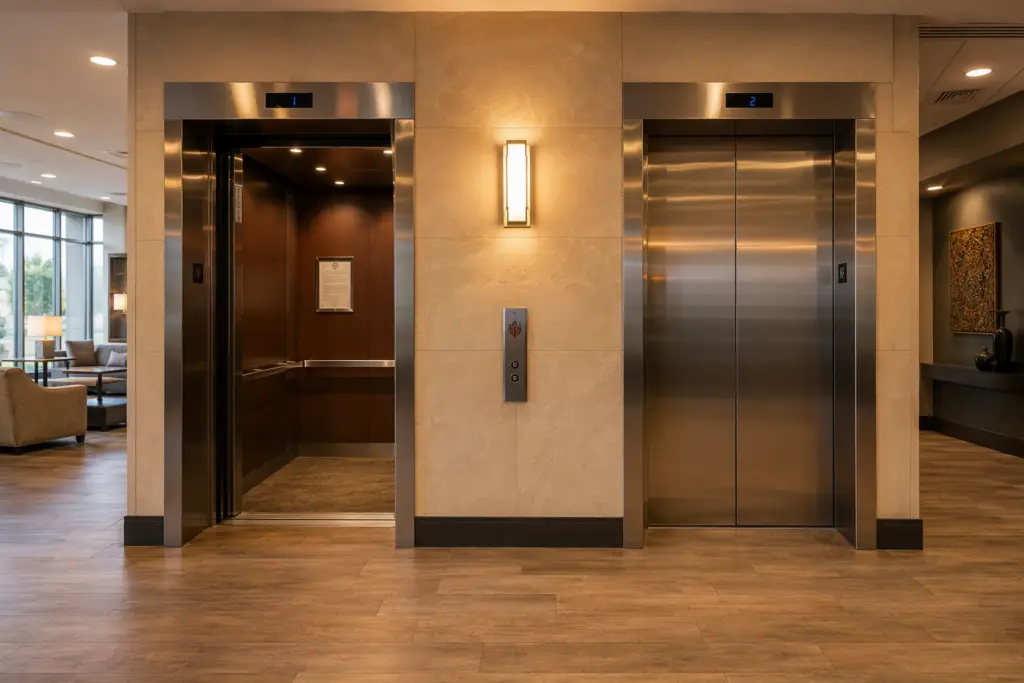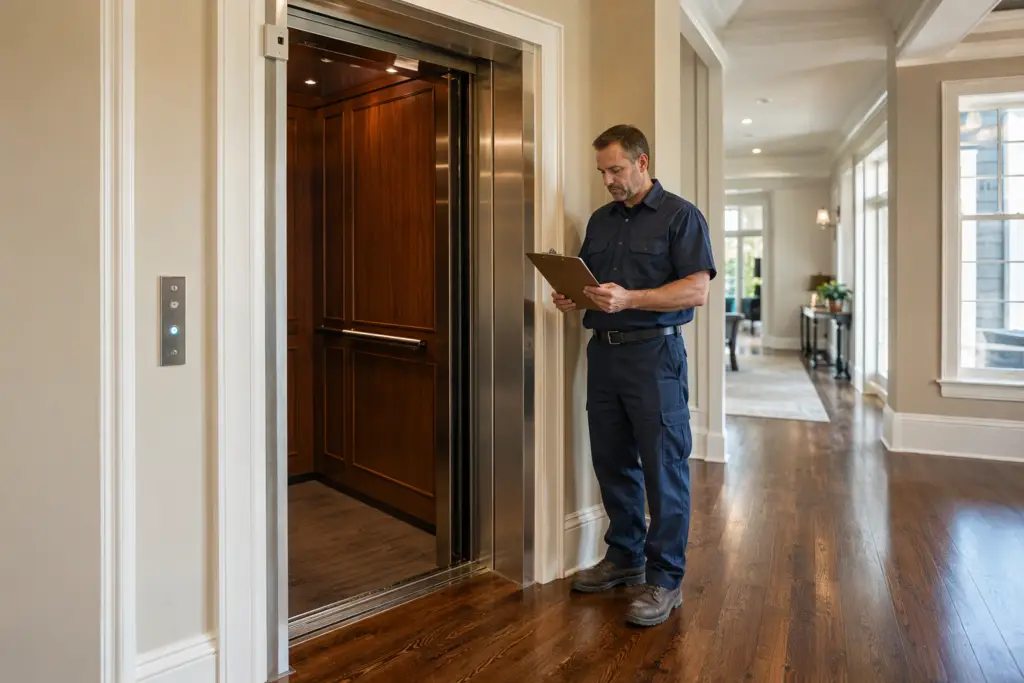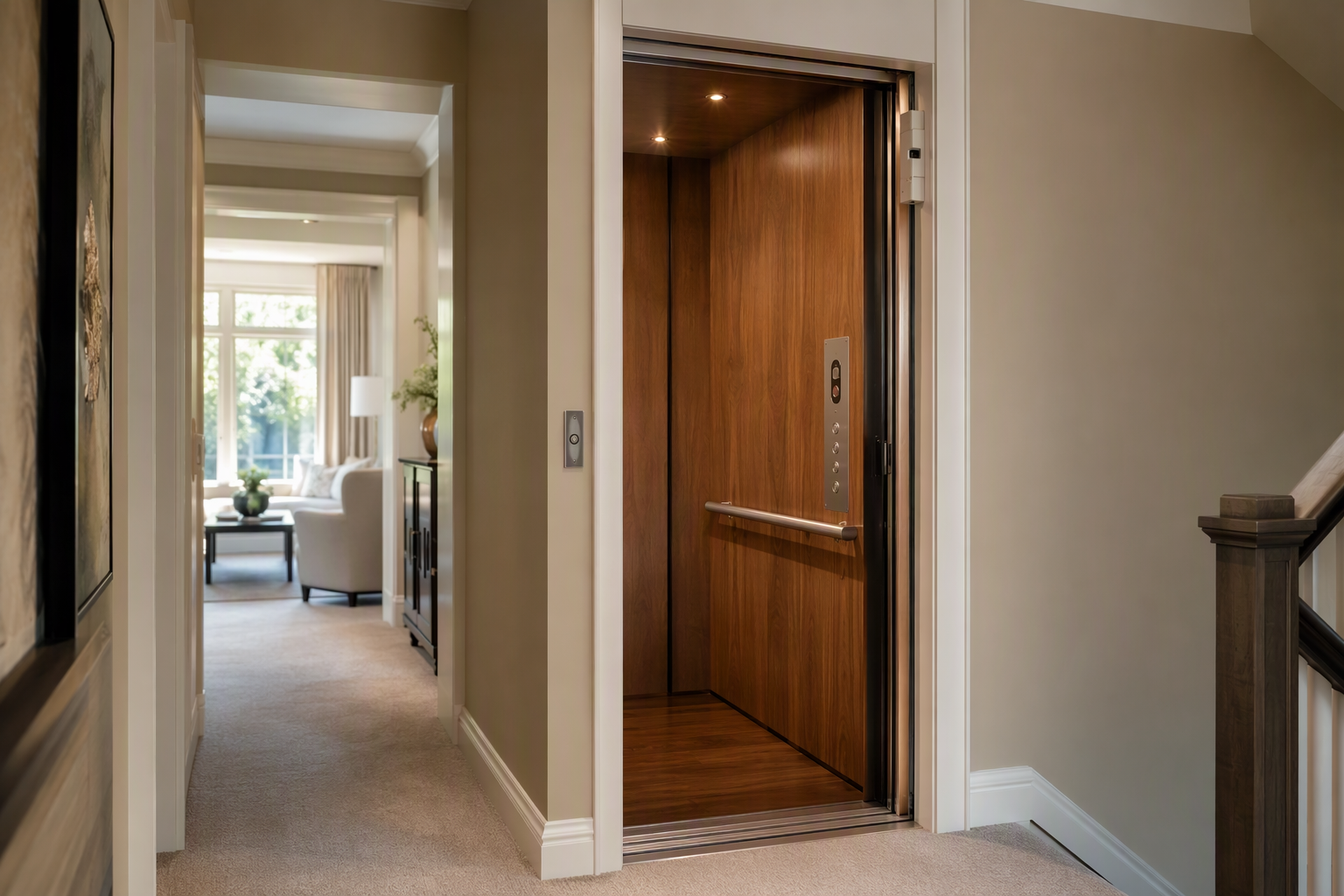
Yes. Elevator companies that hold appropriate state credentials service Inclinator residential elevators and stairlifts through scheduled maintenance programs. These programs typically cover lubrication, safety device testing, rope or cable inspection, drive-system adjustments, and parts replacement. Homeowners in Columbia, SC who own Inclinator equipment can engage a local certified elevator company rather than relying solely on the original manufacturer for ongoing service.
What Exactly Is an Inclinator Elevator?

Inclinator is a manufacturer that produces residential vertical platform lifts, home elevators, and stairlifts designed for private dwellings.
Inclinator Company of America has manufactured residential lifting equipment for decades. Their product line includes cable-drum home elevators, hydraulic home elevators, and inclined stairlifts. These units are installed in private homes to improve accessibility for residents who have mobility challenges or who simply prefer the convenience of a vertical lift between floors. Because Inclinator builds to residential rather than commercial specifications, the mechanical components — motors, cables, rollers, guide rails, and safety governors — still require the same disciplined maintenance schedule as any other lifting device to remain safe and reliable.
Inclinator units vary in drive type: older cable-drum models use a motor-driven drum to wind lifting cables, while more recent hydraulic models use a power unit and cylinder. Each drive type has its own lubrication requirements, wear points, and failure modes, which is why a knowledgeable elevator technician — rather than a general handyman — is the appropriate service provider.
Are Inclinator Home Elevators Covered by South Carolina Elevator Law?

In most cases, no — South Carolina’s elevator code explicitly exempts equipment installed in a single private dwelling from its statutory requirements.
Under S.C. Code Title 41, Chapter 16 (South Carolina Elevator Code) and S.C. Code of Regulations Chapter 71, Article 5 (Regulations 71-5000 through 71-5700), the South Carolina Department of Labor, Licensing and Regulation (LLR), Office of Elevators and Amusement Rides, has oversight of elevator facilities across the state. However, the South Carolina Elevator Code does not apply to equipment in a single private dwelling. This means a home elevator installed exclusively in an owner-occupied single-family residence generally falls outside mandatory state inspection and permitting requirements.
This exemption does not mean homeowners can ignore safety. It means that private-dwelling units are not legally required to obtain an operating certificate or submit to state inspection cycles the way commercial and multi-family elevators must. Best practice — and the recommendation of Carolina Elevator Service — is to voluntarily follow the maintenance intervals and safety standards established by ASME A17.1, the Safety Code for Elevators and Escalators, even when the law does not compel it.
If an Inclinator unit is installed in a multi-family building, a mixed-use structure, or any setting that is not a single private dwelling, then South Carolina’s full regulatory framework applies, including registration, annual inspection, and the requirement to display an operating certificate inside the car.
What Does a Residential Elevator Maintenance Program Include?
A comprehensive residential maintenance program for Inclinator equipment covers all mechanical, electrical, and safety systems on a scheduled basis to prevent failures before they occur.
Specific service tasks typically grouped into a residential maintenance program include:
- Drive system inspection: Checking motor brushes, contactors, and wiring on cable-drum units; inspecting the power unit, pump, valve, and cylinder seals on hydraulic units.
- Cable and sheave inspection: Examining lifting cables or chains for broken wires, kinks, and elongation; verifying proper seating on sheaves and drums.
- Lubrication: Applying manufacturer-specified lubricants to guide rails, rollers, sheave bearings, and drive components to reduce wear.
- Safety device testing: Actuating the speed governor and safeties (where present), testing the final limit switches, door interlocks, and emergency stop.
- Leveling adjustment: Verifying that the car lands within acceptable tolerances at each floor to prevent tripping hazards.
- Electrical checks: Testing the call station, lighting, alarm bell, and emergency power or battery backup systems.
- Structural inspection: Examining the hoistway, guide rail fasteners, car enclosure, and overhead structure for signs of corrosion, movement, or damage.
Carolina Elevator Service provides residential elevator maintenance in the Columbia, SC area and applies the same systematic approach to Inclinator units that it uses on commercial equipment — because the physics of a falling car do not change based on where the elevator is installed.
How Often Should an Inclinator Home Elevator Be Serviced?
Industry best practice, aligned with ASME A17.1 guidance for residential elevators, is at minimum an annual maintenance visit with interim lubrication and checks as the manufacturer specifies.
Frequency recommendations vary by use intensity and drive type. A home elevator used several times daily by family members ages with its components more quickly than one used occasionally. Hydraulic units should have their fluid and filter inspected at least annually. Cable-drum units should have cables inspected for wear on a similar schedule. Any unit showing unusual noise, vibration, or leveling drift should be serviced immediately rather than waiting for a scheduled interval.
Even though South Carolina law does not mandate annual inspections for single-dwelling home elevators, voluntary adherence to a yearly service schedule reflects the spirit of the safety requirements that apply to all other elevator types in the state.
What Is the Difference Between a Maintenance Contract and an On-Call Service Call?
A maintenance contract is a proactive, scheduled agreement to inspect and service the unit at defined intervals; an on-call service call is reactive and occurs only after something goes wrong.
Maintenance contracts generally provide lower per-visit costs, scheduled downtime that homeowners can plan around, and documentation of service history — which can matter when selling a home or demonstrating due diligence. On-call service is available when an unexpected breakdown occurs but typically costs more per visit and does not provide the systematic inspection that catches developing problems early. For homeowners who depend on the elevator for daily mobility, a lapse in service coverage can be a genuine safety and quality-of-life risk.
Can Any Elevator Company Service an Inclinator Unit, or Must the Owner Use an Authorized Dealer?
A qualified elevator company with technical knowledge of residential lift systems can service Inclinator equipment; the homeowner is not necessarily restricted to a single authorized dealer.
Inclinator units use standard elevator components — cables, sheaves, motors, hydraulic power units — that experienced elevator technicians are trained to service. Parts availability and manufacturer technical documentation may vary, so selecting a company familiar with residential elevator systems and capable of sourcing Inclinator-compatible components is important. Homeowners should verify that the service company carries appropriate insurance and that its personnel are qualified under industry standards. Carolina Elevator Service serves Columbia, SC homeowners with Inclinator and other residential elevator equipment and maintains familiarity with the mechanical systems found in these units.
What Safety Standards Apply to Inclinator Residential Elevators Even When State Law Does Not?
ASME A17.1, the Safety Code for Elevators and Escalators, provides the technical safety benchmarks that responsible owners and service companies apply to residential equipment voluntarily.
ASME A17.1 covers private-residence elevators and establishes requirements for safeties, buffers, hoistway enclosures, door and gate equipment, electrical systems, and more. South Carolina adopted ASME A17.1-2019/CSA B44:19 as its official code for regulated facilities. While the private-dwelling exemption removes the state enforcement mechanism for single-family home elevators, the technical requirements within A17.1 reflect engineering consensus on what makes an elevator safe. A service company that uses A17.1 as its service benchmark — regardless of legal obligation — is applying the most authoritative safety standard available in the industry.
For Inclinator units installed in accessible settings where the Americans with Disabilities Act (ADA) applies — for example, in a residential care facility or a common area of a multi-family building — ADA accessibility requirements for clear floor space, controls, and door timing also come into play and must be maintained through regular service.
What Are the Most Common Maintenance Issues Found on Inclinator Elevators?
The most frequently encountered issues on Inclinator residential elevators include worn or elongated lift cables, degraded door and gate interlocks, sluggish or failing drive motors, low hydraulic fluid levels, and corroded or seized guide rail components.
Cable wear is particularly important to monitor on older cable-drum Inclinator models. As cables stretch over time, the car may land out of level, creating a trip hazard. Hydraulic units can develop slow cylinder leaks that reduce travel speed and, left unaddressed, eventually prevent the car from reaching the top floor. Electrical contactors on motor controllers wear over many switch cycles and can cause intermittent failures. Guide rail lubrication prevents the roller guides from scoring the rail and causing noisy, jerky operation. All of these issues are detectable and correctable through routine maintenance before they escalate into safety events or costly repairs.
What Should a Homeowner Do if an Inclinator Elevator Stops Working?
If an Inclinator elevator stops working, the homeowner should follow this procedure to ensure safety before contacting a service provider:
- Do not force the doors open. If the car has stopped between floors, forcing the hoistway or car door open creates a fall risk. Wait for the car to be returned to a landing by qualified personnel.
- Use the emergency alarm. If a person is trapped inside, activate the in-car alarm bell or call button to alert others in the building.
- Shut off power at the disconnect switch. If the car is at a floor landing and the doors can be opened normally, a responsible adult may shut off the main disconnect switch (typically located in the machine room or adjacent to the unit) to prevent inadvertent movement during inspection.
- Document the symptoms. Note what the elevator was doing when it stopped — unusual noise, a smell, a specific floor where it stalled, error codes on the controller display — so the service technician has a starting point for diagnosis.
- Contact a qualified elevator service company. Call a company experienced with residential elevator systems. Do not attempt mechanical or electrical repairs without proper training and tools.
- Report injuries appropriately. If the malfunction results in an injury, seek medical attention immediately. For units in regulated (non-single-dwelling) settings in South Carolina, the law requires that accidents seriously injuring anyone other than an employee be reported to the state before the end of the next working day.
How Does Residential Elevator Maintenance Compare to Commercial Elevator Maintenance?
Residential elevator maintenance follows the same fundamental principles as commercial maintenance but differs in inspection frequency requirements, regulatory oversight, unit capacity, and typical usage intensity.
| Factor | Residential Inclinator Elevator (Single Private Dwelling) | Commercial Passenger Elevator (South Carolina) |
|---|---|---|
| SC State Inspection Required? | No — exempt under SC Elevator Code | Yes — at least annually before operating certificate renewal |
| Operating Certificate Required? | No — exempt for single private dwelling | Yes — must be displayed in car |
| Applicable Code (Voluntary / Mandatory) | ASME A17.1-2019 (voluntary best practice) | ASME A17.1-2019 (mandatory, SC adopted July 2021) |
| Typical Recommended Service Interval | Annual minimum; per manufacturer schedule | Annual minimum; per state inspection cycle |
| Drive Types Common | Cable-drum, hydraulic, inclined rail | Traction (MRL and geared), hydraulic |
| Capacity Range (Typical) | Lower — residential loads | Higher — commercial passenger loads |
| Maintenance Contract Availability | Yes — offered by qualified elevator companies | Yes — standard industry practice |
| State Construction Permit Required for New Install? | No — exempt for single private dwelling | Yes — before erection, construction, or alteration |
Does the South Carolina Code Apply if an Inclinator Is in a Rental Property or Multi-Family Building?
Yes — if the Inclinator unit is installed in a rental property, multi-family building, or any facility that is not a single private dwelling, South Carolina’s full elevator regulatory framework applies.
The exemption under the South Carolina Elevator Code is specific to equipment in a single private dwelling. A landlord who installs a residential-style elevator in a duplex, apartment building, or rental home for tenant use falls outside that exemption and must comply with registration, permitting, annual inspection, and operating certificate requirements administered by the South Carolina Department of Labor, Licensing and Regulation (LLR), Office of Elevators and Amusement Rides. In such settings, a special inspector conducting the required inspection may not be employed by or have a service or warranty contract with the entity that services the elevator — a conflict-of-interest rule that building owners must account for when selecting their service and inspection providers.
What Qualifications Should a Homeowner Look for in a Residential Elevator Service Company?
Homeowners should look for companies whose personnel are trained on the specific drive systems in their elevator, who carry adequate liability insurance, and who demonstrate familiarity with ASME A17.1 safety requirements for residential equipment.
For South Carolina commercial elevator work, the state requires that special inspectors meet the qualifications in the 2018 edition of QEI-1, the American National Standard for Qualification of Elevator Inspectors. While home elevators in single dwellings are not subject to state inspection, homeowners benefit from working with companies whose technicians understand the same technical standards that inform state inspection requirements. Asking a prospective service company how they approach cable wear limits, safety device testing, and hydraulic fluid maintenance is a straightforward way to gauge technical competence before signing any service agreement.
Can an Inclinator Stairlift Be Serviced Under the Same Maintenance Program as a Home Elevator?
Inclinator stairlifts can be included in a residential maintenance program, but they involve different mechanical systems than vertical home elevators and are typically treated as a separate service category.
Stairlifts use an inclined rail, a drive motor or rack-and-pinion mechanism, and a chair or platform that travels along the rail. Service tasks include rail lubrication, drive gear inspection, obstruction sensor testing, seatbelt or restraint checks, battery backup verification, and remote control calibration. Vertical home elevators involve hoistways, cables or hydraulics, and door interlocks that stairlifts do not. A service company experienced with both product lines can address the full scope of Inclinator residential equipment under a single maintenance relationship, simplifying scheduling and record-keeping for the homeowner.
What Happens if a Residential Elevator Is Neglected for Several Years?
A residential elevator that has gone without professional service for several years is likely to have accumulated multiple deferred maintenance issues simultaneously, increasing both the cost of restoration and the risk of a safety event during operation.
Cable-drum units may have cables that are well past their useful service life. Hydraulic units frequently develop hardened or cracked cylinder seals and contaminated fluid after years without a fluid exchange. Electrical components corrode, switch contacts pit, and wiring insulation can become brittle. Guide rails accumulate debris and develop dry spots that accelerate roller wear. Returning a long-neglected unit to safe service typically requires a comprehensive condition assessment, followed by prioritized repairs, before the unit is placed back into regular use. Carolina Elevator Service conducts residential elevator assessments in the Columbia, SC area for homeowners who are unsure of the current condition of their equipment.
How Should a Homeowner Document Residential Elevator Maintenance?
Homeowners should maintain a written service log that records the date of each service visit, the technician or company performing the work, tasks completed, parts replaced, and any conditions noted for future attention.
Good documentation serves multiple purposes. It creates a maintenance history that helps the next service technician diagnose recurring issues and identify trends — for example, a lubrication interval that is proving too long based on rail wear patterns. It also supports home resale by demonstrating to buyers that the elevator has been properly maintained. In the event of an incident, a documented service history shows that the owner exercised reasonable care. Even though South Carolina law does not require private-dwelling elevator records, maintaining them is consistent with the ownership responsibility that the South Carolina Elevator Code places on owners of regulated elevator facilities: to keep every elevator in safe operating condition and in line with applicable standards.
Are Hydraulic Fluid Leaks on Residential Inclinator Elevators a Safety or Environmental Concern?
Yes — hydraulic fluid leaks on residential elevators are both a safety concern (fire risk, slip hazard, loss of lift capacity) and a potential environmental concern depending on leak volume and location.
South Carolina’s elevator regulations address hydraulic cylinder integrity directly for regulated facilities: newly installed underground hydraulic elevator cylinders must be encased in plastic outer containment to limit electrolytic corrosion. This requirement reflects awareness of the environmental impact of fluid migration into soil. For above-ground residential hydraulic units, leaking fluid creates a slip hazard in the machine space, can saturate insulation, and — if it reaches the drive motor — creates a fire risk. Regular inspection of the cylinder, fittings, hoses, and power unit is the most effective way to identify and address leaks before they become serious. Any leak, however minor, warrants prompt attention from a qualified service technician.
What Role Does Emergency Power Play in Residential Inclinator Elevator Safety?
Emergency or battery backup power ensures that a home elevator can complete a descent to a floor landing during a power outage, preventing occupant entrapment.
South Carolina’s elevator code requires that passenger elevators in regulated facilities have standby power that runs emergency lighting and the alarm bell for at least four hours if normal power fails. While this mandatory requirement applies to regulated commercial equipment, the underlying safety principle is directly applicable to residential elevators: an occupant — particularly one with mobility impairment who depends on the elevator — should never be stranded mid-travel during a power interruption. Inclinator and similar residential elevator manufacturers offer battery lowering devices or automatic emergency descent systems that return the car to a floor landing on battery power. These systems should be tested during each maintenance visit to confirm battery health and proper descent function.
How Do Homeowners in Columbia, SC Find a Qualified Inclinator Elevator Service Provider?
Columbia, SC homeowners can locate qualified residential elevator service companies through the South Carolina Department of Labor, Licensing and Regulation, through industry associations, or through referrals from other homeowners or accessibility equipment suppliers in the area.
When evaluating providers, homeowners should confirm that the company has experience with residential elevator systems (not only commercial equipment), that its technicians understand cable-drum and hydraulic drive systems common in Inclinator products, and that the company carries general liability and workers’ compensation insurance. Carolina Elevator Service operates in the Columbia, SC market and provides residential elevator maintenance for homeowners seeking a locally based, knowledgeable service partner for their Inclinator or other home elevator equipment.
Is It Worth Having a Pre-Purchase Inspection Done on an Inclinator Elevator When Buying a Home?
Yes — a pre-purchase elevator inspection by a qualified elevator company is a practical investment that can reveal deferred maintenance, end-of-life components, or safety concerns before the home sale closes.
Standard home inspectors typically note the presence of a residential elevator and may flag obvious concerns, but they rarely have the technical training to assess cable condition, safety device function, or hydraulic system integrity with the specificity needed to estimate remaining service life or repair costs. An elevator company conducting a dedicated inspection can examine drive components, test interlocks and limits, measure cable wear, and review the unit’s service history if documentation is available. The findings allow buyers to negotiate repairs, escrow funds for known work, or factor maintenance costs into their overall assessment of the property. Carolina Elevator Service provides residential elevator assessments in the Columbia, SC area for prospective homebuyers and real estate professionals who need an informed evaluation of existing home elevator equipment.
What Is the Expected Service Life of an Inclinator Home Elevator?
The service life of an Inclinator home elevator depends heavily on maintenance quality, usage frequency, and drive type, but well-maintained residential elevators commonly provide many decades of service when components are replaced as they wear.
There is no universal code-defined retirement age for private-dwelling elevators. Rather than thinking in terms of a fixed lifespan, homeowners are better served by thinking in terms of component condition: cables that show broken wires or stretch beyond limits should be replaced; hydraulic cylinders that develop persistent leaks may need relining or replacement; motor contactors that show pitting and wear should be renewed. A systematic maintenance program identifies these component-level decisions before they become emergencies. The overall structure — hoistway, guide rails, car frame — often outlasts multiple sets of wear components when properly maintained from installation forward.
Contact Carolina Elevator Service for a free elevator assessment at 803-865-1400.
Need elevator service you can rely on? Carolina Elevator Service is ready to help.