When South Carolina’s elevator regulatory authority determines that required services have not been performed on a vertical transportation unit, it has the legal power to order that elevator shut down without notice. The consequences extend well beyond a simple paperwork problem: the elevator becomes legally inoperable, the building owner assumes direct liability for any continued use, and restoring service requires navigating a formal compliance pathway under S.C. Code Title 41, Chapter 16. Understanding exactly what triggers this action — and how to avoid it — is essential for every property owner, facility manager, and building operator in Columbia, SC.
What legal authority does South Carolina have to issue a cease and desist on an elevator?
South Carolina’s authority to shut down a non-compliant elevator comes directly from statute and is administered by the South Carolina Department of Labor, Licensing and Regulation (LLR), Office of Elevators and Amusement Rides.
Under S.C. Code Title 41, Chapter 16, no elevator facility may be operated in South Carolina without both a valid certificate of registration and a current operating certificate issued by the state. When those documents lapse — typically because required inspections or services have not been performed — the LLR has statutory grounds to order the elevator removed from service. The cease and desist mechanism exists specifically to protect the public from equipment that has not been verified as safe by a qualified state or special inspector. The LLR’s authority is broad: local ordinances that conflict with the South Carolina Elevator Code or its regulations are void, meaning no municipality can override a state shutdown order.
What specifically triggers a cease and desist order related to elevator services?
A cease and desist order is typically triggered when an elevator is operated without a current operating certificate, which itself results from required inspections or maintenance services not being completed on schedule.
Under South Carolina regulations (S.C. Code of Regulations Chapter 71, Article 5, Regulations 71-5000 through 71-5700), elevators must be inspected at installation, registration, alteration or repair, and at least once every year before the operating certificate is renewed. If that annual inspection does not take place — whether because a service provider was never retained, appointments were missed, or deficiencies were found and not corrected — the operating certificate cannot be renewed. Operating an elevator without a valid certificate exposes the owner to a formal enforcement action. Additional triggers can include failure to correct deficiencies identified in a prior inspection, operating equipment altered without a state construction permit, or failing to report a serious accident to the LLR before the end of the next working day.
What does a cease and desist order actually require the building owner to do?
A cease and desist order requires the building owner to immediately stop all use of the elevator and take affirmative steps to prevent passenger access until compliance is restored and a new operating certificate is issued.
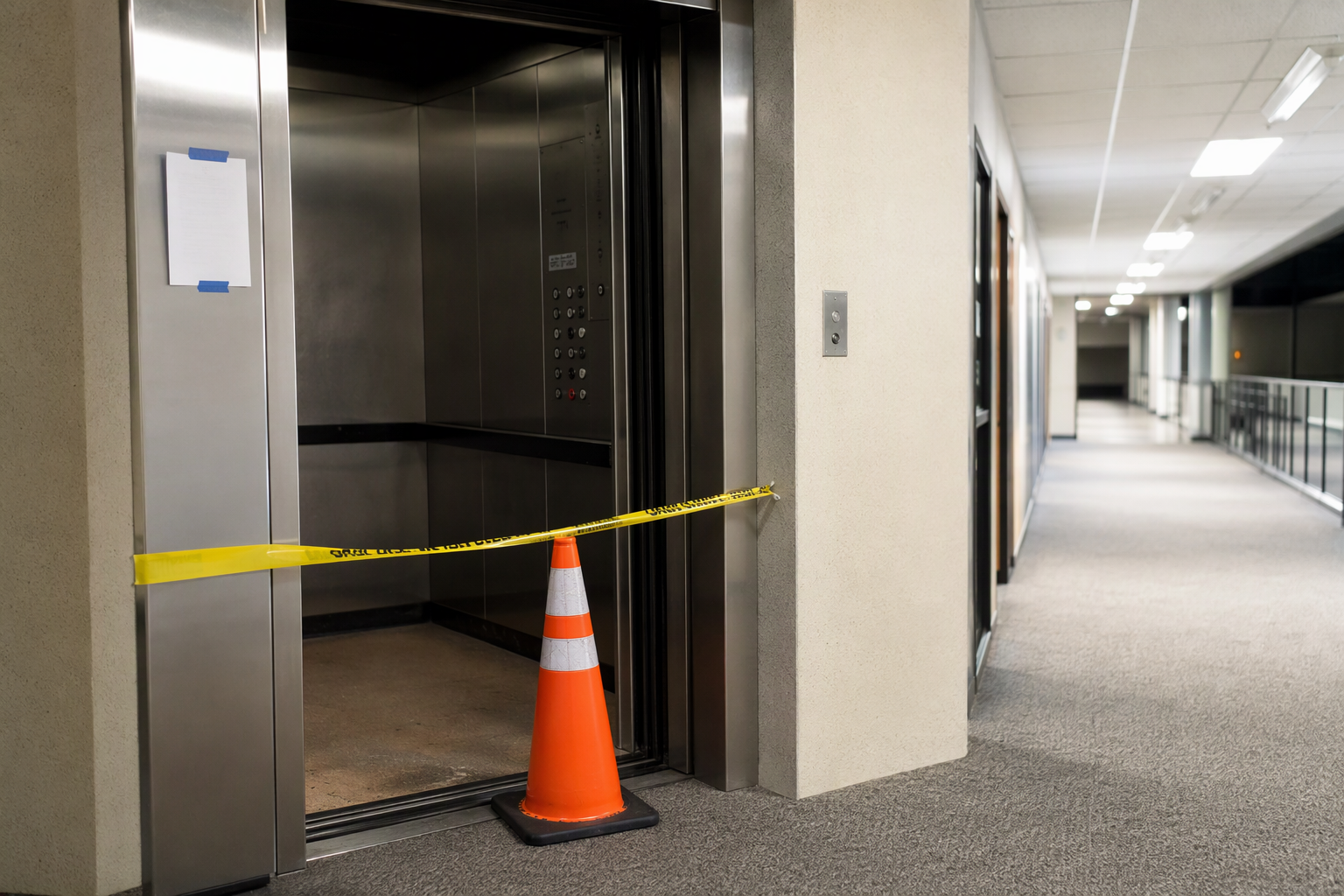
In practical terms, this means physically restricting access to the elevator cab and all landing doors, posting clear notices, and beginning the compliance restoration process without delay. The owner bears the burden of demonstrating that whatever deficiency prompted the order — whether a missed inspection, an uncorrected mechanical issue, or the absence of a valid certificate — has been fully remediated. Operating the elevator after receiving a cease and desist order compounds the legal exposure significantly, as it constitutes a knowing violation of the South Carolina Elevator Code.
What are the step-by-step actions a building owner should take after receiving a cease and desist?
Restoring elevator service after a state cease and desist order requires a structured, documented compliance process that addresses both the immediate shutdown requirements and the underlying inspection deficit.
- Secure the elevator immediately. Lock all landing doors, disable the cab from normal operation, and post visible out-of-service notices on every floor. Do not permit any use — even by maintenance staff — until the LLR authorizes resumption.
- Read the order carefully. Identify the specific deficiencies or violations cited by the South Carolina Department of Labor, Licensing and Regulation, Office of Elevators and Amusement Rides. Each item must be addressed individually.
- Retain a qualified elevator service company. Contact a service provider capable of performing the corrective work and scheduling the required inspection. Carolina Elevator Service works with property owners in Columbia, SC to assess current elevator condition and coordinate the path back to compliance.
- Obtain any required permits. If the corrective work involves an alteration or repair that requires a state construction permit under S.C. Code Title 41, Chapter 16, that permit must be obtained before work begins.
- Schedule a state or special inspector. Under South Carolina law, required inspections may only be made by state inspectors or by licensed special inspectors who meet the qualifications in the 2018 edition of QEI-1 (American National Standard for Qualification of Elevator Inspectors). Note that a special inspector may not inspect an elevator on which the inspector or the inspector’s employer holds a current service or warranty contract.
- Complete all corrective work. Ensure every deficiency identified in the cease and desist order and any subsequent inspection report is fully resolved before requesting the inspection sign-off.
- Request reinspection and operating certificate renewal. Once the inspector confirms compliance, work with the LLR to renew the operating certificate. The renewed certificate, or a copy, must be displayed conspicuously inside the elevator car before service resumes.
- Document everything. Retain all permits, inspection reports, corrective work orders, and correspondence with the LLR. This documentation is critical if liability questions arise later.
How long does it take to restore service after a cease and desist order?
Restoration timelines vary depending on the nature and extent of the deficiencies identified, but every day the elevator remains out of service represents real operational and financial impact for the building.
Simple cases — such as an elevator that is mechanically sound but whose operating certificate lapsed due to a missed annual inspection — can potentially be resolved relatively quickly once an inspection is scheduled and completed successfully. More complex situations involving mechanical deficiencies, required alterations, or permit requirements will take longer, as corrective work must be completed before an inspection can confirm compliance. Building owners in Columbia, SC who keep a proactive maintenance and inspection schedule are far less likely to face this scenario, since annual inspections under South Carolina’s requirements can identify and address issues before they escalate to enforcement action.
What are the financial and liability consequences of operating an elevator under a cease and desist order?
Continuing to operate an elevator after the LLR issues a cease and desist order creates compounding legal, financial, and liability exposure that far exceeds the cost of corrective maintenance and inspection.
Beyond statutory penalties for violating the South Carolina Elevator Code, operating a non-compliant elevator after a formal shutdown order creates direct civil liability if any person is injured during that period. Insurance carriers routinely deny or contest claims arising from elevator incidents on equipment known to be operating in violation of state law. ADA compliance obligations under Title II or Title III of the Americans with Disabilities Act add another layer: a building required to provide accessible vertical transportation that falls out of service without an accessible alternative may face a separate federal complaint. The combined exposure — state penalties, civil liability, ADA risk, and insurance complications — makes immediate compliance the only financially rational response.
Does the cease and desist apply to all elevator types or only certain equipment?
The South Carolina Elevator Code’s enforcement authority applies to essentially all elevator facilities covered by the statute, though specific inspection intervals and requirements vary by equipment type.
Under South Carolina’s regulations, standard passenger and freight elevators require annual inspections before operating certificate renewal. Handicap lifts are inspected every five years; manlifts, television tower elevators, and special purpose elevators every seven years; dumbwaiters are inspected when installed or altered. Equipment in a single private dwelling is specifically exempt from the South Carolina Elevator Code. All covered equipment, regardless of inspection interval, must maintain a current certificate of registration and operating certificate — and all are subject to enforcement action if those documents lapse or if the equipment is found to be operating unsafely.
What inspection intervals apply to different elevator types in South Carolina?
South Carolina’s inspection schedule is set by regulation and directly determines when operating certificates must be renewed; missing these intervals is the most common path to enforcement action.
| Equipment Type | South Carolina Inspection Interval | Operating Certificate Required? | Applicable Standard |
|---|---|---|---|
| Passenger and freight elevators | At least once per year (before certificate renewal) | Yes | ASME A17.1-2019/CSA B44:19 |
| Handicap lifts | Every five years | Yes | ASME A17.1-2019/CSA B44:19 |
| Manlifts | Every seven years | Yes | ASME A17.1-2019/CSA B44:19 |
| Television tower elevators | Every seven years | Yes | ASME A17.1-2019/CSA B44:19 |
| Special purpose elevators | Every seven years | Yes | ASME A17.1-2019/CSA B44:19 |
| Dumbwaiters | At installation and after alteration | Yes | ASME A17.1-2019/CSA B44:19 |
| Equipment in single private dwellings | Exempt from state code | Not applicable | Not applicable |
Who is legally responsible for ensuring elevator services are performed — the owner or the tenant?
Under South Carolina law, the owner of an elevator facility bears the legal obligation to keep every elevator in safe operating condition and in compliance with state regulations.
This is an important distinction for commercial landlords, property managers, and tenants in Columbia, SC. While lease agreements may allocate maintenance responsibilities contractually between parties, the statutory obligation under S.C. Code Title 41, Chapter 16 runs to the owner. The LLR will direct enforcement action — including a cease and desist — to the owner of record. Tenants or property management companies that neglect elevator services based on a belief that another party “handles it” do not eliminate the owner’s regulatory exposure. Building owners should ensure that any property management agreement explicitly assigns elevator maintenance and inspection coordination responsibilities, and that those responsibilities are actively verified rather than assumed.
What role does the ASME A17.1 safety code play in a South Carolina cease and desist scenario?
ASME A17.1 is the technical foundation for South Carolina’s elevator safety requirements, meaning any deficiency that triggers enforcement action will ultimately be measured against its provisions.
South Carolina has adopted the ASME A17.1/CSA B44, 2019 edition (ASME A17.1-2019/CSA B44:19) without amendment, effective as noticed in the S.C. State Register on July 23, 2021. New elevator facilities must comply with the edition in effect when the construction permit was issued. Elevator facilities that were in operation before July 1, 1986 must comply with the 1986 edition of ANSI A17.3, the safety code for existing elevators and escalators. When an inspector identifies a deficiency that cannot be corrected to allow certification, that finding is grounded in ASME A17.1’s specific technical requirements — which is why corrective work must be performed by personnel who understand those standards in detail.
Can a building use a special inspector rather than a state inspector to get back into compliance?
Yes — South Carolina law allows inspections required for operating certificate renewal to be performed by a licensed special inspector, whose report may be accepted in place of a state inspection, subject to strict independence requirements.
Special inspectors in South Carolina must be licensed and must demonstrate qualifications meeting the 2018 edition of QEI-1, the American National Standard for Qualification of Elevator Inspectors. However, the law contains a critical conflict-of-interest restriction: a special inspector may not inspect an elevator on which the inspector or the inspector’s employer has a current service or warranty contract. This means a building owner seeking to use a special inspector for a reinspection after a cease and desist order must ensure that the inspector has no current service relationship with that specific elevator. This distinction matters when selecting a service provider and an inspection provider — they must be independent of each other under South Carolina’s rules.
What happens if an elevator accident occurs while the elevator is operating under a cease and desist order?
Operating an elevator after receiving a cease and desist order and then experiencing an accident creates the most severe liability scenario a building owner can face, combining regulatory penalties with direct civil and potentially criminal exposure.
South Carolina law already requires that any accident seriously injuring a person other than an employee be reported to the state before the end of the next working day. When that accident occurs on an elevator that was under a state shutdown order, the owner’s knowing disregard of the enforcement action becomes a central fact in any subsequent proceeding — regulatory, civil, or otherwise. Insurance coverage is at serious risk of being voided or contested. The ADA and OSHA may each have independent jurisdiction depending on the nature of the facility and the circumstances of the injury. This compounding exposure is precisely why no building owner should permit any use of a shut-down elevator, even brief or limited use, until the LLR formally authorizes resumption of service.
What OSHA requirements intersect with a South Carolina elevator cease and desist?
While OSHA’s jurisdiction covers worker safety rather than the public elevator certification process, elevator-related workplace hazards can trigger parallel federal enforcement that compounds a state cease and desist scenario.
Under OSHA standards, employers have a general duty to provide workplaces free from recognized hazards. If employees are required to use an elevator that the LLR has ordered shut down, or if elevator maintenance workers are exposed to hazards during corrective work, OSHA may have independent grounds for investigation and citation. OSHA’s elevator-related standards address issues such as construction hoists, material lifts, and workplace access, and can apply simultaneously with South Carolina’s regulatory action. Building owners and facility managers should ensure that corrective work following a cease and desist is performed with full attention to worker safety requirements, not only the state inspection checklist.
How does ADA compliance factor into an elevator that is shut down by cease and desist order?
When an elevator that provides required accessible vertical transportation is taken out of service under a cease and desist order, the building owner may simultaneously face ADA obligations that require providing an equivalent accessible alternative.
Under Title II and Title III of the Americans with Disabilities Act, covered entities must ensure that programs, services, and facilities remain accessible to individuals with disabilities. When an elevator is the primary or required accessible means of vertical access in a multi-story building, its removal from service — even for a lawful reason such as state enforcement compliance — does not suspend the ADA obligation. Building owners should consult with legal counsel about whether a temporary accessible alternative is required during the shutdown period and document all steps taken to minimize the impact on persons with disabilities. The intersection of state elevator law enforcement and federal accessibility law creates a dual compliance burden that must be managed simultaneously.
What preventive maintenance practices help building owners in Columbia, SC avoid a cease and desist order?
Consistent, documented preventive maintenance and proactive scheduling of required inspections are the most reliable way to avoid the conditions that lead to state enforcement action.
The LLR’s enforcement pathway typically begins with an expired or non-renewable operating certificate — which itself results from an inspection that did not occur or one that identified deficiencies that were not corrected. Building owners who maintain a documented maintenance schedule, retain a service provider capable of identifying and correcting issues before inspection, and calendar their annual inspection dates well in advance are far less likely to reach the enforcement threshold. Carolina Elevator Service supports property owners and facility managers in Columbia, SC by providing elevator assessments that identify compliance gaps before they become enforcement events. Additional preventive steps include verifying that the operating certificate displayed inside the elevator car is current, confirming that any alterations or repairs are preceded by the required state construction permit, and ensuring standby power systems meet South Carolina’s requirement for at least four hours of emergency lighting and alarm bell operation if normal power fails.
What records should building owners maintain to demonstrate compliance and defend against enforcement?
Thorough documentation is both a practical compliance tool and a legal defense: records demonstrating that required services were performed on schedule can establish an owner’s good faith in any enforcement proceeding.
At a minimum, building owners should retain current and historical operating certificates, all state and special inspector reports, construction permits for any alterations, corrective work orders with completion dates, and correspondence with the LLR. The operating certificate, or a copy, must be displayed conspicuously inside each elevator car under South Carolina law — meaning the absence of a posted certificate is itself visible evidence of a potential violation during any state inspection. Maintenance logs should identify what was checked, what was found, and what was corrected, with dates and the identity of the service provider. These records should be retained beyond the current certificate period, as past compliance history can be relevant in any future enforcement or liability proceeding.
How does South Carolina handle elevators installed before the current code was adopted?
South Carolina’s regulations establish different technical benchmarks for older equipment, but all covered elevator facilities — regardless of age — remain subject to the registration, certification, and inspection requirements that can lead to cease and desist enforcement.
Elevator facilities in operation before July 1, 1986 must comply with the 1986 edition of ANSI A17.3, the safety code for existing elevators and escalators, while new installations must comply with the ASME A17.1-2019/CSA B44:19 edition in effect when the construction permit was issued. Age does not exempt an elevator from the annual inspection requirement or the need for a valid operating certificate. Older equipment may face additional complexity during corrective work if deficiencies are identified, since upgrades may need to meet current standards depending on the nature and scope of the work. Building owners with legacy equipment in Columbia, SC should ensure their service provider is familiar with both the applicable legacy standard and current South Carolina requirements.
What specific technical requirements in South Carolina could cause an elevator to fail inspection and trigger enforcement?
Several South Carolina-specific technical requirements go beyond the base ASME A17.1 standard and can be the basis for inspection failures that lead to certificate non-renewal and potential enforcement action.
Among the requirements specific to South Carolina: passenger elevators must have standby power capable of running emergency lighting and the alarm bell for at least four hours if normal power fails. Newly installed underground hydraulic elevator cylinders must be encased in plastic outer containment to limit electrolytic corrosion. Firefighters’ service on new installations must use the five-pin S.C. #1000 key. Any alteration or repair requires a state construction permit before work begins — work performed without a permit can itself be a basis for enforcement action, independent of whether the work was performed correctly. Carolina Elevator Service is familiar with these South Carolina-specific requirements and helps clients in the Columbia area ensure that maintenance and repair work addresses them directly.
Can a building owner appeal or challenge a cease and desist order issued by the LLR?
South Carolina’s administrative process provides mechanisms for challenging regulatory enforcement actions, but pursuing an appeal does not suspend the obligation to comply with a cease and desist order while the challenge is pending.
Building owners who believe a cease and desist order was issued in error or is factually inaccurate should consult legal counsel experienced in South Carolina administrative law promptly. The practical reality is that the fastest path to restoring elevator service is typically demonstrating compliance — completing the required inspection, correcting deficiencies, and obtaining a renewed operating certificate — rather than pursuing a lengthy administrative appeal. While the appeal process exists as a legal right, every day spent in litigation rather than achieving compliance extends the period during which the elevator cannot legally operate and the building owner faces liability exposure for inaccessible vertical transportation.
How should property managers in Columbia, SC vet an elevator service provider to avoid compliance gaps?
Selecting an elevator service provider with demonstrated familiarity with South Carolina’s specific regulatory requirements is essential to avoiding the compliance gaps that lead to enforcement action.
Property managers should confirm that any prospective service provider understands the South Carolina LLR’s inspection and certification requirements, is familiar with the ASME A17.1-2019/CSA B44:19 as adopted by South Carolina, and can coordinate with qualified state or special inspectors who meet QEI-1 qualifications. Critically, property managers must understand the independence requirement: the inspector cannot be affiliated with the service provider for the same elevator. A service provider that proactively tracks certificate renewal dates, identifies deficiencies before inspection, and maintains documentation of all work performed gives the building owner the best defense against an enforcement action. Carolina Elevator Service focuses exclusively on the South Carolina market, including Columbia, and structures its service approach around the state’s specific regulatory framework rather than a generic national checklist.
Contact Carolina Elevator Service for a free elevator assessment at 803-865-1400.
Need elevator service you can rely on? Carolina Elevator Service is ready to help.